Romans 6:12-18 ><)))*> ><)))*> ><)))*> Luke 12:39-48
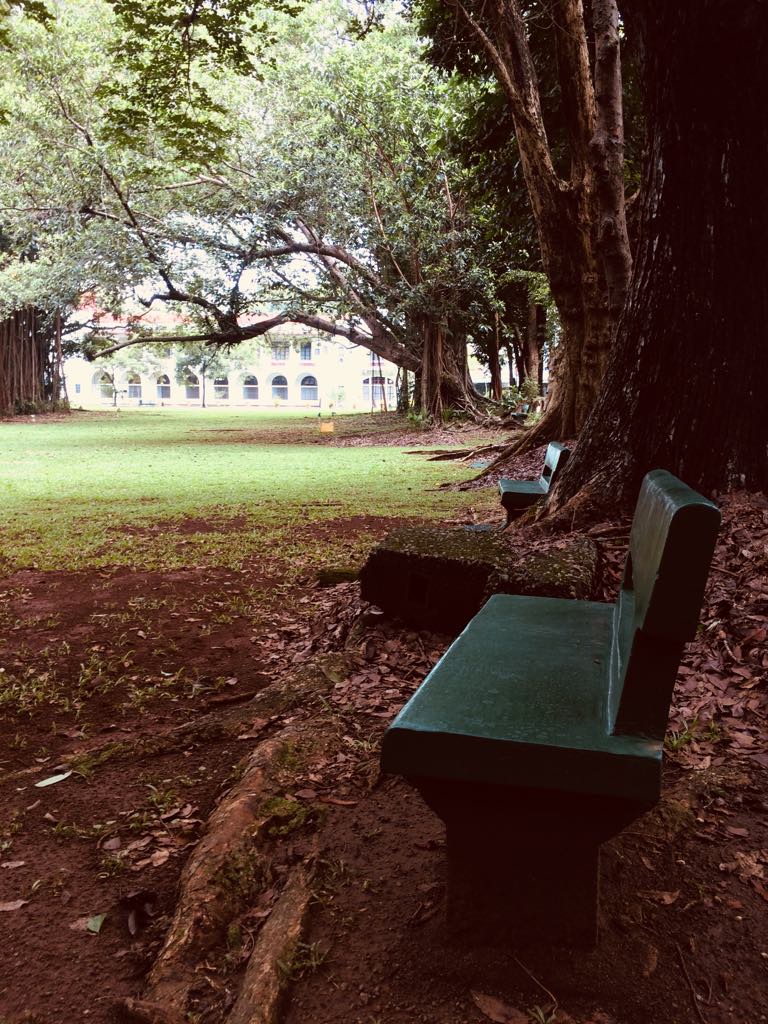
Sacred Heart Novitiate in Novaliches, QC, July 2017.
God our Father, All Saints’ Day and All Souls’ Day are still a week from now but today’s gospel reminds us that death is so certain to come one day to each one of us.
Nobody is exempted.
And the sooner we come to accept this fact and reality, the better for us.
Then Peter said, “Lord, is this parable meant for us or for everyone?” And the Lord replied, “Who, then, is the faithful and prudent steward whom the master will put in charge of his servants to distribute the food allowance at the proper time? Blessed is that servant whom his master on arrival finds doing so.”
Luke 12:41-43
Too often, we are like St. Peter, feeling so secured with our association with you, that we are always exempted from others.
Today you are reminding us that death will certainly come to each one of us, your stewards here on earth.
Remind us that the greatest gift you have entrusted with us is this gift of self, this gift of life.
Give us the grace to use our very selves, our whole body, for your greater glory as St. Paul told the Romans in our first reading.
It is in coming to terms with death when we begin to come to terms with life because that is when we start living authentically and readily for the great inevitability.
Not in fear but in great honor and privilege in serving you well, our Lord.
Whatever we do with our life shall be our gift to you. Amen.
God our Father, so often we profess our faith in you.
But so often, it is not authentic faith at all because it is more of manipulating you for we can actually see all possibilities.
Like that someone in the crowd who said to Jesus:
“Teacher, tell my brother to share the inheritance with me.” Jesus replied to him, “Friend, who appointed me as your judge and arbitrator?” Then he said to the crowd, “Take care to guard against all greed, for though one may be rich, one’s life does not consist of possessions.”
Luke 12:13-15
Forgive us Lord in believing more in our selves than in you, in believing our selves that we can use you for our selfish ends even if it something rightly ours.
Give us an authentic faith like that one Abraham had when he believed in you, O God, that you would still fulfill your promise to make him the father of all nations despite his advanced age as well as Sarah’s condition.
As explained by St. Paul in today’s first reading, teach us to have the same faith of Abraham who showed a kind of resurrection faith – of faith that God could bring forth life from the barren or “dead” womb of Sarah.
A “faith that justifies” like that of Abraham is a faith that saves because more than fulfilling his promise, Abraham believed that God can bring back to life anyone already dead like the womb of wife Sarah who was already old and barren.
Let us grow in having an authentic faith like Abraham who entrusted his total self to you, Lord, even if human reason reason tells us there is no hope at all. Amen.
Kindly say a prayer for the recovery of our brother priest, Fr. Federico dela Cruz, who had brain surgery last night due to a head injury he sustained in an accident Saturday night. Thank yo.
The Lord Is My Chef Sunday Recipe Week XXVIII-C, 13 October 2019
2 Kings 5:14-17 ><}}}*> 2 Timothy 2:8-13 ><}}}*> Luke 17:11-19
Photo by Mr. Jim Marpa, September 2019.
This Sunday readings tell us about the skin, the healing of people afflicted with the dreaded “Hansen’s disease” or leprosy. Since ancient time, it has always been seen with deeper implications than mere wounds on the skin that scars not only the leper but also the community. At its worst, it is regarded as a divine punishment that lepers have to be separated from others to live in designated areas for their treatment.
Skin plays a major role in our social status and mobility. Being the largest organ of the human body, the skin is always the first to be seen and noticed that whatever its condition would always have a big impact on the person, for better or for worst.
This is specially true for us Filipinos who are so concerned with our skin color that we still regard being white or maputi is maganda (beautiful) and having dark skin or maitim is pangit (ugly). No wonder everybody is going crazy to get whiter skin with all those soaps and creams and medicines advertised on billboards everywhere!
In a very funny twist unknown to most Filipinos who idolise white skin, many of our popular devotions in the Catholic faith actually have dark skin like Quiapo’s Black Nazarene and Our Lady of Antipolo?!
But, that’s another story of how skin-deep we can be…..
Going back to our reflection of today’s readings, Jesus is inviting us to go deeper than the skin to realize the richer meaning of having faith in him.
As Jesus continued his journey to Jerusalem, he traveled through Samaria and Galilee. As he was entering a village, ten lepers met him. They stood at a distance from him and raised their voice, saying, “Jesus, Master! Have pity on us!” And when he saw them, he said, “Go show yourselves to the priests.” As they were going they were cleansed. And one of them, realizing he had been healed, returned, glorifying God in a loud voice; and he fell at the feet of Jesus and thanked him. He was a Samaritan.
Luke 17:11-16
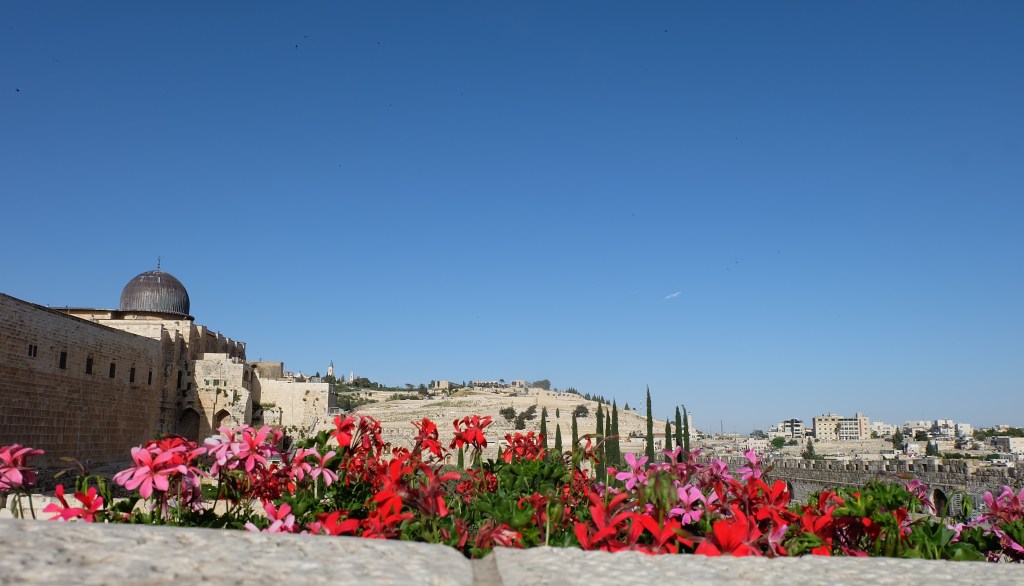
View from the walled city of ancient Jerusalem, May 2019.
Since June 30 of this year, the 13th Sunday of Ordinary Time, we have been following Jesus when “he resolutely determined to journey to Jerusalem” (Lk.9:51). More than a destination to reach, Christ’s journey to Jerusalem is about directions in life because it is spiritual and theological in nature than spatial or geographical.
It is the same truth every pilgrim to the Holy Land realizes too!
And now that Jesus is nearing Jerusalem to fulfill his mission, his teachings are getting clearer and closer to home, indicating also our own “passing over” or pasch with him with the many verbs and movements found in our gospel scene today.
Let’s try reflecting on them one by one. Please bear with me…
“As Jesus continued his journey to Jerusalem” …. Jesus never stops in his journey to Jerusalem to suffer with us, to cry with us, to die with us. He is committed in being one with us in our many struggles and battles in this life until we make it with him to heaven.
“he travelled through Samaria and Galilee.” This is beautiful. Samaria and Galilee are the regions where the poor and marginalized lived, where sinners abound. But, that is where Jesus would always come. When we are in our darkest moments in life due to sickness, failures and disappointments, especially sin – that is when Jesus comes closest to us! In the first reading, we have heard how God’s Prophet Elisha told the Syrian Army General Naaman to bath in the Jordan River to be healed of his leprosy even if he were a pagan and an enemy of Israel! God loves us all.
“As he was entering a village, ten lepers met him.” Keep in mind that Jesus came for the lost like us. Be open and ready for him for he is always passing by. Jesus surely comes to those who patiently wait for him.
“They stood at a distance from him, and raised their voice, saying, ‘Jesus, Master! Have pity on us!’ and when he saw them, he said, ‘Go show yourselves to the priests.’ As they were going they were cleansed.” This episode of the healing of ten lepers can only be found in St. Luke’s gospel filled with many meaningful expressions. First is how “the lepers stood at a distance from Jesus.” This is our usual stance with the Lord when we are full of sin, so ashamed to look at him. But, it does not really matter with the Lord who looks more into is our hearts full of contrition than into our ego full of pride as we shall hear three weeks from now in the parable of the Pharisee and tax collector (Lk. 18:9-14).
The lepers cried to him, “Jesus, Master! Have pity on us!” and when Jesus saw them, he told them to see the priests and they were cleansed. This is an extraordinary profession of faith in Christ by the ten lepers who were crying out not only for pity but also mercy. There are only three instances in the gospels when Jesus is addressed in his name, once in Matthew and twice in Luke. This is the first and the second is when Dimas the thief called on him saying, “Jesus, remember me when you come into your kingdom.” To say his name “Jesus” in itself is a prayer, an admission of guilt and sin. That is why, as the ten lepers went their way to the priests, they were “cleansed” like Dimas on the cross was instantly promised with paradise.
“And one of them, realizing he had been healed, returned, glorifying God in a loud voice; and he fell at the feet of Jesus and thanked him. He was a Samaritan.”
Here we find every encounter with Jesus in prayer and the sacraments as well as in various events in our life is a passage to salvation and new life. See the transition from being cleansed into being healed: that is something deeper than the skin, so to speak. The Samaritan was not merely cleansed of his skin blemishes but most of all, his soul and inner being that Jesus later told him to “Stand up and go; your faith has saved you.”
Sometimes in life, we stop at being cleansed by the Lord; after obtaining our prayers and wishes, we never go back to him until we face another problem again. Are we willing to keep on going back to Jesus to kneel before him and to thank him?
Last Sunday we prayed to Jesus to increase our faith and today like the ten lepers from a distance, we cry out to him as our Master to have pity on us. We always have that gift of faith in us but we have to deepen and cultivate it daily in our prayer life and most especially in the Sunday Eucharist, the highest expression of giving thanks to God.
Let us live in our faith and trust in God’s gift freely given to everyone regardless of who we are. Let us rely in the words of St. Paul that
“if we have died with him we shall also live with him; if we persevere we shall also reign with him. But if we deny him he will deny us. If we are unfaithful he remains faithful, for he cannot deny himself.”
The Lord Is My Chef Breakfast Recipe for the Soul, Tuesday, Easter VII, 04 June 2019
Acts 20:17-27 >< )))*> >< )))*> >< )))*> John 17:1-11
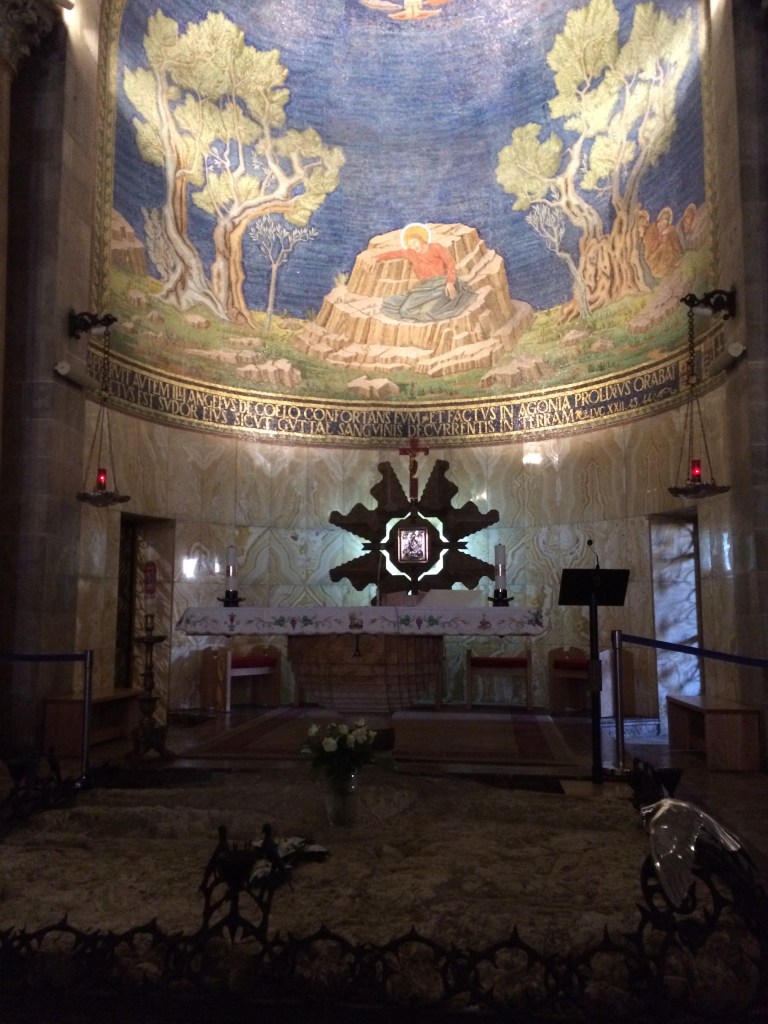
Altar of the Church of All Nations beside the Garden of Gethsemane in the Holy Land. Photo by author, April 2017.
I am hesitant in greeting you a good morning, Lord Jesus Christ. How I wish I could have even a fifth of your courage in facing death. All throughout your life here on earth, you faced death squarely. You were never caught by surprise.
Jesus raised his eyes to heaven and said, “Father, the hour has come.”
John 17:1
In the first reading, St. Paul also spoke about his coming death when he summoned the leaders of the church in Ephesus to a meeting in Miletus where he told them that after that meeting, they would never see his face again.
Every day, Lord, we face death every time we make choices and decisions. But rarely are we aware about death with the capital “D” except when we are in extreme danger or when diagnosed with the big “C”.
Last night as I prayed, I got focused about facing death. I am afraid, Lord even though I know that when it comes, I will not feel anything. The pain would be with those I would leave behind, with those who love me and care for me. Yet, I am still afraid.
And that is when you consoled me, making me realize that what is most terrifying with death is when we fail to live authentically. When we waste every opportunity to live fully because coming to terms with death is coming to terms with life too!
That is the reason why you – and the saints – were never afraid with death. That is part of the joy of Easter, of living authentically.
Help us, O Lord, to live truthfully, and fully in your love and mercy so that when our time comes, we have no regrets leaving this life on earth because while still here, we are already one with you in the Father (Jn.17:3).
We pray also for those who are terminally ill, undergoing surgery and other medical procedures today, for those languishing in jail especially those who are innocent, for those barely surviving the many trials of every day living trying to make ends meet. Comfort them, Lord Jesus with your healing presence. Amen.
A sculpture of Jesus’ Agony at the Garden below a window of the Church of All Nations beside the Garden of Gethsemane. Photo by author, April 2017.
Did our prayer help you?
Share us your thoughts and prayers too.
Follow our blog for your daily recipe for the soul.
God bless!
fr nick
The Chapel of the Ascension believed to be the site where Jesus stood before ascending into heaven while his disciples looked at. Photo by author, 04 May 2019.
Outside the old city of Jerusalem on the Mount of Olives is the Chapel of the Ascension believed to be the site of Jesus Christ’s Ascension into heaven. Though the octagon-shaped structure is massive and very high, it is quite small inside with just one door for entrance and exit. Immediately upon entering that door on the floor is a framed slab of stone called the “Ascension Rock” venerated by pilgrims because that is where Jesus stood before going up to heaven.
The Ascension Rock. Photo by author, April 2017.
But personally, in the two occasions I have been there in 2017 and last month, my focus have always been more on the four windows of the chapel’s dome.
The rays of light coming through them have always evoked in me the beauty of Christ’s Ascension with a feeling that is so uplifting. The morning rays of the sun gently filling the room with light warms your heart as if angels are keeping you company like what we heard from the first reading during the Ascension of Jesus.
A window at the dome of the Chapel of the Ascension. Photo by author, April 2017.
As I prayed this week on the meaning of the Solemnity of the Ascension by recalling my two pilgrimages to the Holy Land in the light of our readings today, it is only now have I realized that the key to this feast is not found in looking up to the skies or looking down on where Jesus stood before going up to heaven.
It is in looking more into our hearts, looking deep inside us can we truly find the meaning of the Ascension of the Lord.
This feast is an invitation to get inside our hearts, not just into our minds and imagination to appreciate the words of Jesus Christ these past two Sundays about his “going and coming in a little while” (Jn.13:31, 33;14:25;16:16,20).
Remember how Jesus these past two weeks kept on speaking about his leaving and his coming at the same time? Of how we reflected last Sunday that in life, we do not really leave but simply come into new level of existence and new level of relating with God and with others?
Then he led them out as far as Bethany, raised his hands, and blessed them. As he blessed them he parted from them and was taken up to heaven. They did him homage and then returned to Jerusalem with great joy, and they were continually in the temple praising God.
Luke 24:50-53
Normally, it is sadness that we feel most in every leaving and departures: when kids leave home to pursue college somewhere, when a father or a mother leaves abroad to work over a long period of time, or a beloved dies. Though the cliche may be right sometimes that “parting is such a sweet, sweet sorrow”, the fact remains there is always sadness whenever we leave or somebody leaves us.
That is why St. Luke’s account of the Ascension is strange when he tells us that Christ’s disciples “then returned to Jerusalem with great joy” after the Ascension. St. Luke does not give any hint or a tinge of sadness among the disciples when Jesus left them to sit at the right hand of God almighty Father in heaven. And, the Holy Spirit has not come down yet. Where did the disciples get this great joy after Jesus had left?
Detail of a 15th century Greek Orthodox icon of the Ascension of Christ with Mary so calm while the apostles very animated, eager to proclaim the gospel. From Google.
We do not have the details at how this great shift happened that the disciples were filled with great joy after Ascension but, the Scriptures and the stories of the saints as well as those of some true heroes provide us with some answers and reasons.
According to St. Luke as well as the other evangelists, Jesus came to see his disciples for many days (40 according to Luke) after Easter. The Lord taught them with some more lessons preparing them for his coming Ascension. Most of all, Jesus made his disciples experienced his new mode of presence in his glorious body. He showed them his wounds and dined with them so often to convince them that he had really risen.
In all instances of his appearances, there was always joy among the disciples. Slowly, the disciples’ joy in knowing Jesus is risen deepened into great joy at the Ascension when this truth sank deeper into their hearts too that they have finally and truly accepted Jesus is alive!
When a truth or a reality stays only in our minds, that is always open to doubts. But, the moment that truth or reality we know is brought down to our hearts, that is only when we truly accept it as really true. And that is when we are filled with great joy because we are already convinced without any doubts of the truth or reality we have received.
Saints and heroes alike find great joy in their sufferings and death because of their convictions in their hearts that what they knew in their minds are very true. They lead “authentic” lives because what they knew in their minds was what they felt in their hearts that they eventually say and do. It is only in authentic living can we find great joy in living, no matter how painful or difficult it may be.
15th century Greek Orthodox icon of the Ascension. From Google.
And that is the great joy in the Ascension of Jesus Christ: the disciples, like us, start living authentically because we are deeply convinced that the Lord had not left us but had in fact launched a new level of nearness with us. His Ascension is the finality of the redemption he had won for us coming right into our hearts when we realize that Jesus did not simply die and rose again for a nameless mass of people. He did everything personally for each one of us.
This is what social media can never give us. Despite its great popularity, social media have left many of us still sad and even sick with various forms of mental illnesses. Everything that happens in the Net often remains up in our heads, rarely sinking into our hearts that still keep us apart despite our connections.
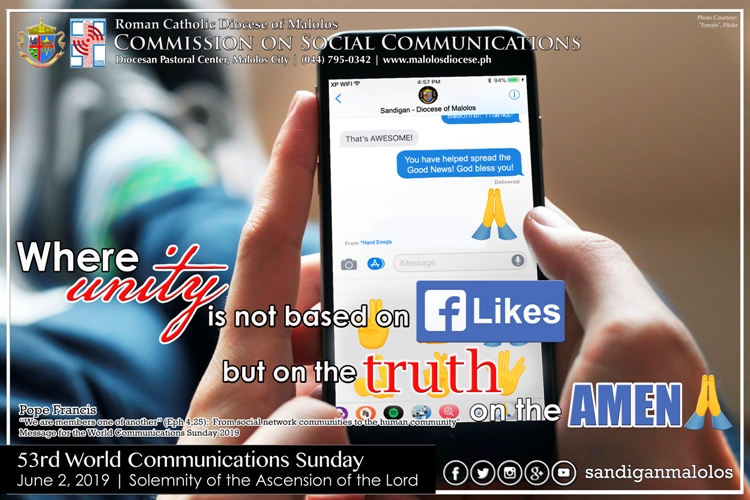
In his message for the 53rd World Communications Sunday we also celebrate today, Pope Francis invites us to connect deeper into the human community and not just in social network communities. The Holy Father stresses that interconnection must go down into personal encounters in the flesh, not just in virtual reality, calling for a shift from “likes” to “amen”.
Poster by Kendrick Ivan Panganiban.
How ironic that all these modern means of communications were invented to bring us all closer together but it seems the opposite is happening. We are growing apart and have become more impersonal than ever! We are all guilty of so often clicking the “like” button without having read the complete post or seen the photos of our relatives and friends. We rarely take time to “process” what we read and see on Facebook by people we call “friends” who often number to thousands. What an inauthentic way of living!
The Ascension of the Lord is a call to authentic living as it launched a new level of nearness of God with us and us with him and with one another. Unlike in the Old Testament as the author of the Letter to the Hebrews explained, Jesus did not enter a sanctuary made of human hands, referring to the old Temple worship that was never complete due to human imperfections. When Jesus came and went through his pasch, he brought God closest to us. We can rise up or ascend to his new level of relationship, new level of existence by rising up also from our infirmities and limitations in him who dwells in our hearts. A joyful month of June to you! Amen.







 lordmychef.com