Lord My Chef Daily Recipe for the Soul, 26 August 2025
Tuesday in the Twenty-first Week of Ordinary Time, Year I
1 Thessalonians 2:1-8     <*{{{{><  +  ><}}}}*>     Matthew 23:23-26
Thang you very much,
dear Jesus for the gift of
St. Paul your Apostle:
yesterday we heard how
he encouraged the church
at Thessalonica,
of how impressed he was
with their deep conviction
of faith;
today he described his
approach to starting the
church at Thessalonica:
so candidly speaking
how he did it while still
remaining tender and gentle
to them,
so sure he had taken
the right course of action.
You yourselves know, brothers and sisters, that our reception among you was not without effect. Rather, after we had suffered and been insolently treated, as you know, in Philippi, we drew courage through our God to speak to you the Gospel of God with much struggle. Our exhortation was not from delusion or impure motives, or did it work through deception. But as we were judged worthy by God to be entrusted with the Gospel, that is how we speak, not as trying to please men, but rather God, who judges our hearts (1Thessalonians 2:1-4).
As I pray,
Lord Jesus on these
words of St. Paul,
I cannot stop wondering
our many excuses
and "side trips" today
as your apostles;
how did St. Paul unwind
or recreate in his time
compared to our many
forms of rest and recreation;
so many of us cannot move on
with life and ministry
from whatever experiences
we have had in our previous
assignments unlike St. Paul
who simply kept the lessons
learned from his past experiences
at Philippi; most of all,
I could feel the intense love
of St. Paul to you, Lord Jesus
and his ministry with his
deep personal relationship
in you in prayers
so unlike us today
with so many excuses
in not praying at all.
What I love most
is St. Paul's
tenderness and gentleness
to his church
with his tenacious
hold on you Jesus.
although we were able to impose our weight as Apostles of Christ. Rather, we were gentle among you, as a nursling mother cares for her children. With such affection for you, we were determined to share with you not only the Gospel of God, but our very selves as well, as dearly beloved had you become to us (1Thessalonians 2:7-8).
Dearest Jesus,
may your word
be always alive and
active in me
flowing in my tender
and gentle service to your flock
so unlike the Pharisees you
have condemned again in
today's gospel
for being blind guides
of the people.
Amen.

Fr. Nicanor F. Lalog II
Our Lady of Fatima University
Valenzuela City
(lordmychef@gmail.com)
The Lord Is My Chef Daily Recipe for the Soul by Fr. Nicanor F. Lalog II
Friday, Feast of the Visitation of the Blessed Virgin Mary, 31 May 2024
Romans 12:9-16     ><]]]]'> + >>]]]]'> + >>>]]]]'>     Luke 1:39-56
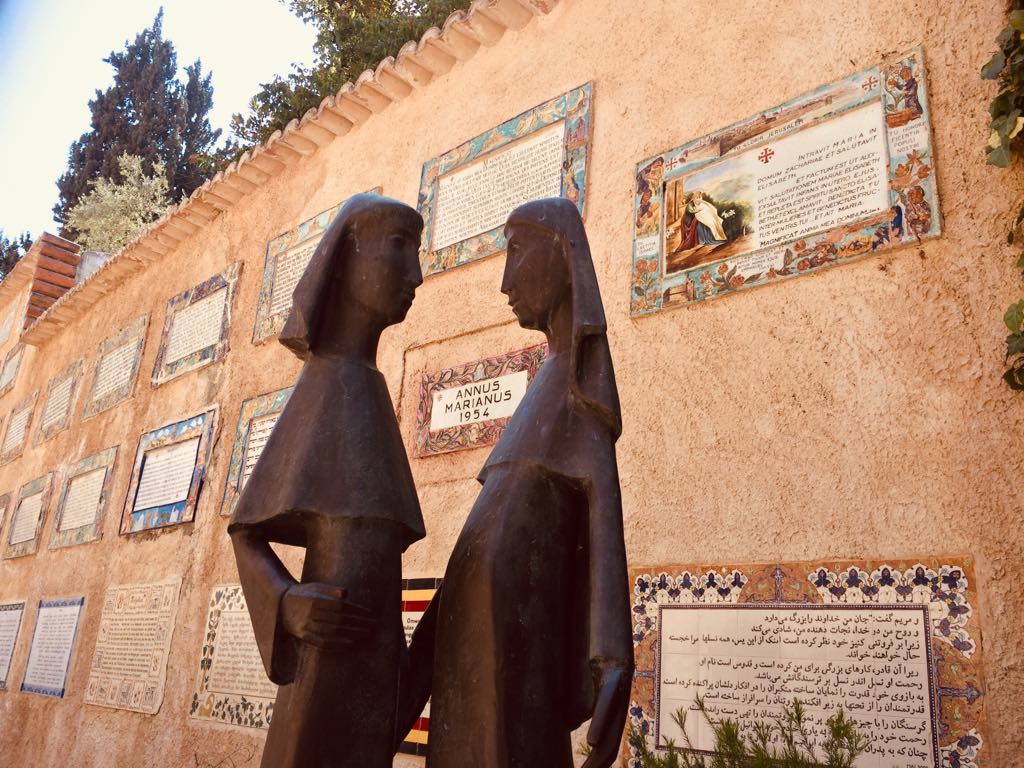
Photo by author, statues of Mary and Elizabeth at the Church of the Visitation in ein-Karem, the Holy Land, May 2017.
What a lovely way to end the month with this feast of the Blessed Virgin Mary’s Visitation of her cousin Elizabeth after starting off May on its very first day with another feast, St. Joseph the Worker that remind us of God’s coming to us in Jesus Christ.
Visit and visitation may seem to be one and the same, sharing the common Latin root word of the verb vide, videre “to see” from which came the word video.
But, a visit is more casual and informal without intimacy at all. We say it so well in Filipino, napadaan lang or just passing by which is more concerned with the place or location and site, not the person there. Napadaan lang ako kaya dinalaw na rin kita (I was just passing by and decided to see you). There was really no intention in seeing the other person there.
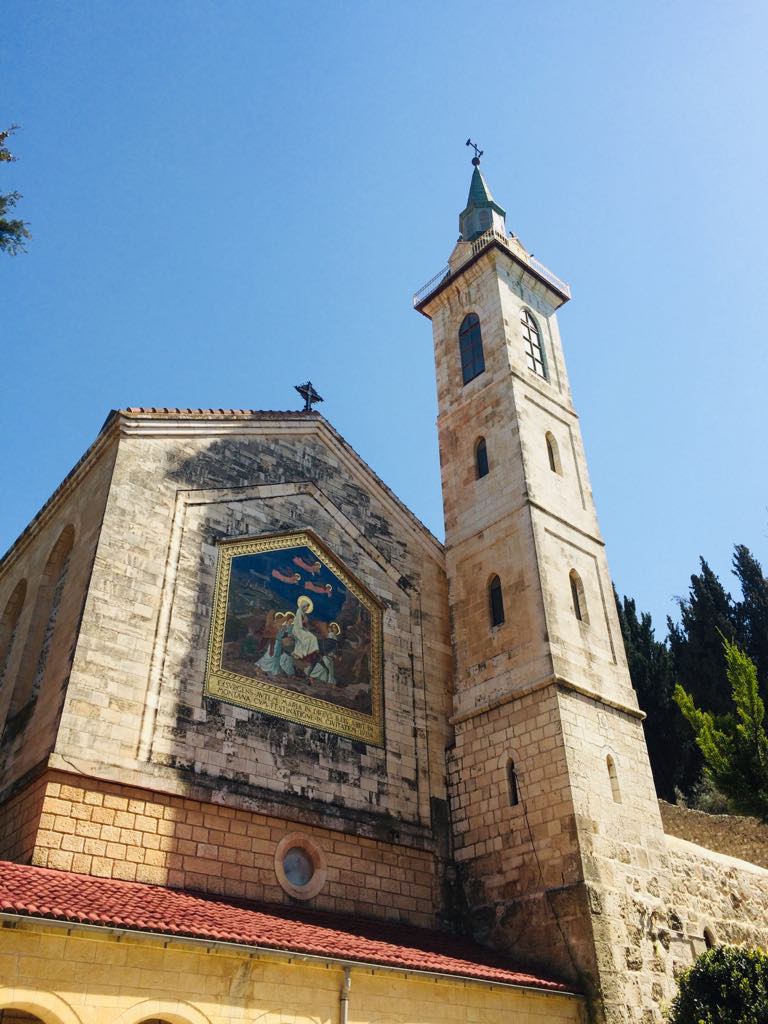
Photo by author, Church of the Visitation, Ein-Karem, Holy land, May 2017.
Visitation is more intentional. Mr. Webster described it as a more formal visit commonly used in church language like when bishop and priests come to see their parishioners. This explains why we refer to a chapel as a visita which is actually a small church in remote places that missionaries used to visit for the sacraments. Likewise, visitas became venues too for catechism classes and other religious even social gatherings in places far from the town itself where the parish is usually situated too.
Thus, visitation connotes a deeper meaning because there is an expression or implication at least of care and concern among the people, a kind of love shared by the visitor like Mary to the one visited, Elizabeth.
Visitation is more of entering into someone’s life and personhood as reported by Luke in Mary’s visitation of Elizabeth when “Mary entered the house of Zechariah and greeted Elizabeth” (Lk.1:40). There was a communion and sharing of their common experience of being blessed with the presence of God in their wombs.
Visitation is a sharing, a oneness in the joys and pains of those dear to us. The word becomes more meaningful when we examine its Filipino equivalent pagdalaw from the root word dala or something you bring like food or any gift when visiting relatives and friends. What you bring or dala is called pasalubong from the root salubong that literally means “meeting” or “encounter”. When the visitor and ones visited meet, they salubong.
Here it becomes more colorful and meaningful because more than the gifts we bring or dala in our visitations, we bring our very selves as a gift of presence. In every visitation, it is our very selves we gift, we share with those we visit, offering them our time and talent, joys and sadness and ears and heart to listen to their stories and absorb their woes and whatever they may have to unload upon us.
Photo by author, 2019.
That was what Mary did exactly in her visitation of Elizabeth with an extra gift, the most precious pasalubong to share with everyone, Jesus Christ in her womb, right in her very self and body!
We too are invited every day to be like Mary, a bringer or taga-dala of Jesus Christ to everyone we meet, the best pasalubong we can share with everyone. If we can only be like Mary in our dealings with others, trying to make every encounter a visitation that is a willful bringing and sharing of Christ with others, then we also bring with us God’s tenderness and mercy for this dark world that admires toughness and roughness.
How sad are those news of daily road rages happening almost everywhere, many times resulting in the loss of lives like the recent fatal shooting of a family driver in Makati.
Through the Blessed Mother’s humility and obedience before God, Christ came into the world to make us experience the Father’s tenderness in the many healings and miracles He performed. This tenderness of God in Jesus we saw too in Mary His Mother in the Visitation: Mary visited Elizabeth because she knew and felt her many wounds who for a long time bore no child, living in “disgrace before others” as she had claimed (Lk.1:25). A tender person like Jesus and Mary is one who comes to comfort and heal the wounds of those hurt in life, trying to lullaby the restless and sleepless, never adding insult to injuries.
Photo by author, Sacred Heart Novitiate, Novaliches, QC, 20 March 2024.
One last thing about the Visitation of Mary to her cousin Elizabeth. One of the best things we can experience from visitations and visits of family and friends like during wakes and funerals is that quality of sweetness.
Sweetness always goes with tenderness. It is the essence of God who is love. Anyone who loves is always sweet that always comes naturally from within, bringing out good vibes. It is never artificial like Splenda, always flowing freely and naturally that leaves a good taste and feeling to anyone.
In the Hail Holy Queen, Mary is portrayed as “O clement, O sweet Virgin Mary” to show her sweetness as a Mother. Recently I have seen some posts making a meme (?) of the Hail Holy Queen’s part that says “to you do we cry poor banished children of Eve”. I have not really dealt it with much attention because too often, there are a lot of generation gaps in many posts in social media; I really cannot relate much to the young perhaps due to my age. I just hope that post on the Hail Holy Queen is not derogatory. Back to our reflection…
Tenderness and sweetness are the most God-like qualities we all have but have unconsciously buried deep in our innermost selves, refusing them to surface because of our refusal to love for fears of getting hurt and left behind or lost. When Mary heard Elizabeth’s pregnancy, she simply followed her human and motherly instincts that in fact so Godly that she went in haste to hill country of Judah. How lovely!
Tomorrow it is already June, reminding us all we are halfway through the year. And it would be surprisingly quick that soon, it is already Christmas again! This feast of the Visitation reminds us of Mary’s great role in making Christmas a reality when God almighty became human, little and vulnerable like us to experience His sweetness and tenderness in Jesus Christ. Through Mary.
Let us pray:
God our loving Father,
thank for coming to us,
for staying with us,
not just visiting us;
help us imitate Your Son
Jesus Christ's Mother,
the Blessed Virgin Mary
whose "love is so sincere",
loving one another like Elizabeth
with "mutual affection,
showing honor,
fervent in spirit,
serving the Lord;
help us imitate Mary
to always rejoice in hope,
endure afflictions and
most of all, persevere in prayer"
(cf. Romans 12:9-12)
so we may always bring
Jesus Christ with everyone
we meet.
Amen.
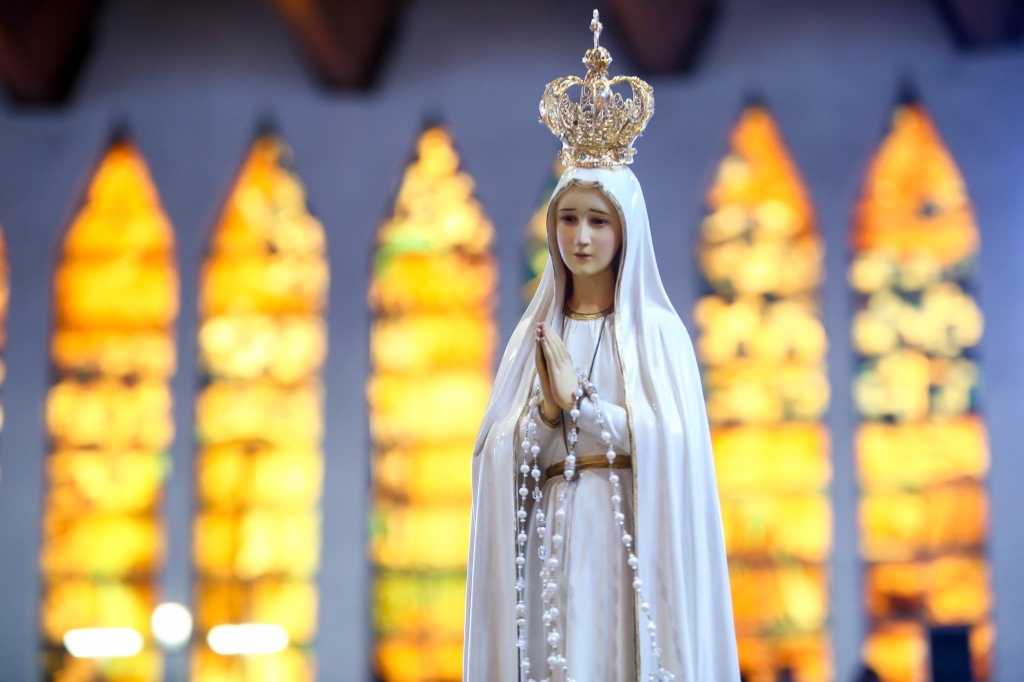
From cbcpnews.net, 13 May 2022, at the Parish of the National Shrine of Our Lady of Fatima, Valenzuela City.
Homily by Fr. Nicanor F. Lalog II, 07 July 2022
Capping and Pinning Ceremony of Nursing Students
Our Lady of Fatima University, Valenzuela City
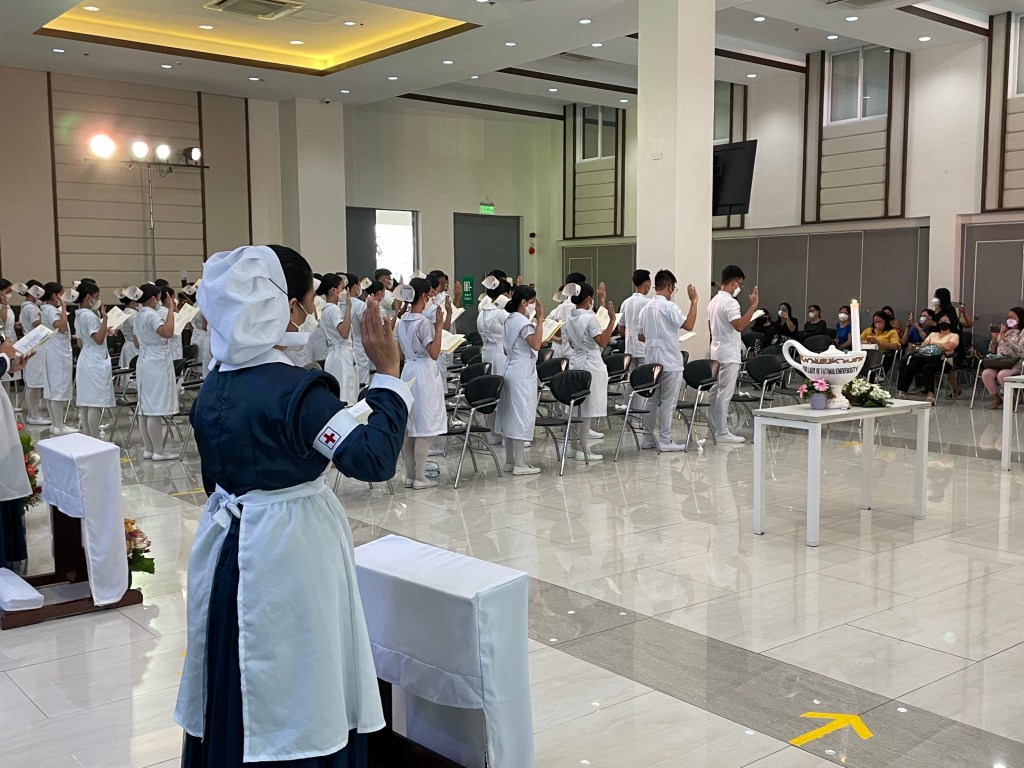
Photo by author, Nursing students taking their oath at their capping and pinning ceremony at the RISE Tower of the Our Lady of Fatima University in Valenzuela City, 25 June 2022.
If there is one thing that the world needs so badly now in these days of the pandemic is what we call “tender loving care” or TLC. And that is why nurses are so in demand everywhere in the world today, especially those imbued with TLC.
I had the opportunities of exercising my ministry briefly in the States and Canada in the early 2000 during my vacations there. One of the things I always heard from white people I have met in hospitals and retirement homes as well as those in parishes was the statement that “my nurse is a Filipino” or that their caregiver is from the Philippines. And they say it with pride and conviction! Fact is, I never heard people there even our own kababayan speaking so proud of us Filipino priests! Laging binibida sa akin noon yung nurse na Pinoy!
Why? Kasi mabubuti daw ang mga nurse na Filipino. And most likely, mabubyuti din!
Photo from Facebook of a nurse going to work amid the typhoon, November 2020.
“Mabuti” means good and kind, like God. And that trait is something so natural for us Filipinos because of our religiosity and high regard for good education which I can safely claim with pride you can find here at Our Lady of Fatima University. Thank you for choosing us for your education and formation as future nurses of then world.
Next to Veritas (Truth) in our University motto is Misericordia or mercy in English. In the bible we find the mercy of God is part of his quality of being tender and caring, the two qualities of nurses I wish to reflect today for you to be TLC like God, that is, with “tender loving care”.
Misericordia literally means “to move the heart” or “to stir the heart” wherein one’s heart is moved into action, into doing something to alleviate other’s sufferings. More than the feeling of pity, there were the hands doing something to help those sufferings.
Mercy implies an involvement of the person to another going through pains and sufferings like a father or a mother as the prophet Hosea described God so like our daddy in the truest sense in the first reading, full of tenderness and care for Israel representing us today; and despite our sinfulness and ingratitude to him, God spares us of his wrath.
Thus says the Lord: when Israel was a child I loved him, out of Egypt I called my son. Yet it was I who taught Ephraim to walk, who took them in my arms; I drew him with human cords, with bands of love; I fostered them like one who raises an infant to his cheeks; yet though I stooped to feed my child, they did not know that I was their healer. My heart is overwhelmed; my pity stirred. I will not give vent to my blazing anger, I will not destroy Ephraim again. For I am God not man, the Holy One present among you; I will not let the flames consume you.
Hosea 11:1, 3-4, 8-9
Hindi ba ganun din ang nurse, tatay na nanay like God?
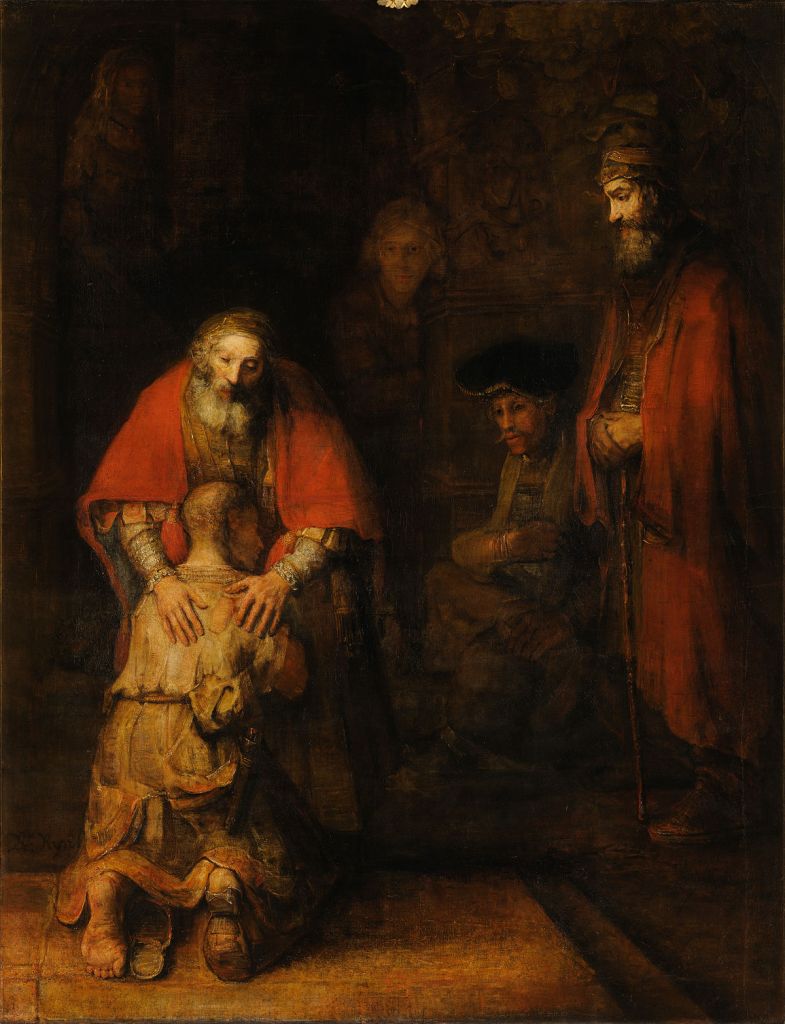
In his book on Rembrandt’s painting of the return of the prodigal son in Luke’s gospel, the late Fr. Henri Nouwen noted how the father’s two hands are of a father and a mother. The father’s hand looked firm evoking senses of being supportive, empowering, and encouraging while the mother’s hand looked soft that is consoling, caressing and comforting.
From en.wikipedia.org.
Tenderness is being like God, of having both the hand of a father and of a mother with a big heart able to accommodate those suffering because you know and realize the gravity of what they are going through. You forego plans of getting even, of vengeance, of punishing because a tender person is one who tries not to add more insult to one’s injuries or rub salt onto one’s wounds so to speak.
A tender person is one who tries to soothe and calm a hurting person, trying to heal his/her wounds like God often portrayed in many instances in the bible in lovingly dealing with sinners filled with mercy. Like God, a person filled with tenderness is one who comes to comfort and heal the sick and those taking on a lot of beatings in life.
When Jesus Christ came, he personified this tenderness of God like when he is moved with pity and compassion for the sick, the widows, the women and the children and the voiceless in the society. Tenderness is coming to heal the wounds of those wounded and hurt, trying to “lullaby” the restless and sleepless.
That was the tenderness exemplified by your role model, Florence of Nightingale in all her life that is why she is always portrayed holding a lamp bringing light into the world plunged to the darkness of war and sickness that continues to these days.
Later, you will be lighting your candles from those giant lamps while your professors along with the Dean put on your cap and pin to signify your going to hospital duties as part of your formation as future nurses. Totohanin ninyo na!
You are already a nurse once you receive that cap and pin.
Take care of that light that you are supposed to illumine the world. Most of all, take care of that light that also signifies every patient you shall be taking care of. Do not let the flame of life be extinguished.
Care, on the other hand, means to have compassion, from the Latin words cum patior, to suffer with. To care is to be human because care is recognizing the other person is my brother or sister, a human who is weak and vulnerable just like me.
When Jesus told his Apostles in our gospel today to “cure the sick, raise the dead, cleanse lepers, and drive our demons” (Mt.10:8), it is not literal at all. Remember before that he instructed the Twelve to proclaim “the kingdom of heaven is at hand” which means the most important is for others to realize and experience they are not alone, they have God with them amid all their miseries and sickness. And surely, amidst all of these is the certainty of death. Very often, as you would experience later, we cannot heal and cure all the sick.
What matters most is that they are cared for with all the tenderness so that even in their final moments, they feel they are not alone. That is why, nursing is more than a profession but also a vocation. A call from God to be like him, tender and caring to others, especially the sick and the dying. May God bless you more, our dear Nursing students along with all the nurses of the world. Amen.
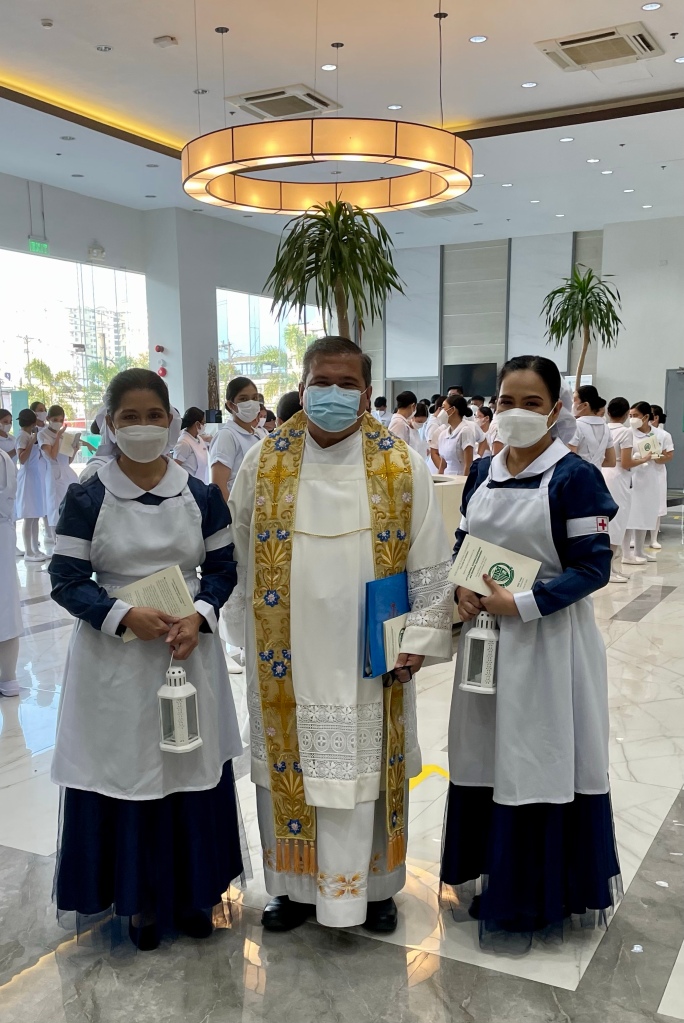
Photo by author, Nursing students taking their oath at their capping and pinning ceremony at the RISE Tower of the Our Lady of Fatima University in Valenzuela City, 25 June 2022.






 lordmychef.com