The Lord Is My Chef Breakfast Recipe for the Soul by Fr. Nicanor F. Lalog II
Friday, Week XXV, Year I in Ordinary Time, 24 September 2021
Haggai 1:15-2:1-9   ><]]]]'> + ><]]]]*> + ><]]]]'>   Luke 9:18-22
Good Friday 2020 in my former parish.
I could feel and hear you, Lord
speaking to me, asking me like Haggai:
"Who is left among you that saw
this house in its former glory?
And how do you see it now?
Does it not seem nothing
in your eyes?" (Haggai 2:3)
When I remember the images
of the first few months of pandemic
last year that fell on the Holy Week
and Easter Season, I felt like Haggai
and the returning exiles to Jerusalem
seeing their temple in ruins, still under
construction;  how I long, O Lord, to those
glory days when we celebrate and adore
you in our beautiful church!
But now, with the pandemic's second
year, our churches remain half empty.
How long shall we wait, Lord,
for COVID-19 to end so we can
go back to our church to celebrate
your presence, your love, your
salvation in Jesus Christ?
Strengthen us, dear God;
deepen our faith in you,
awaken our hope in you;
let us take courage like your
priests and returning exiles
to Jerusalem to await your promise
to "shake the heavens and the earth,
the sea and the dry land...
to shake all nations" (Haggai 2:6-7)
when you bring back the glory days
of worshipping you again in your
temple.
Most of all, open our minds
and our hearts to be shaken
inside for us to realize and
wholly embrace the Passion,
Death, and Resurrection of
Jesus your Christ (Luke 9:22), dear Father:
he is our glorious temple,
more magnificent than any church
or edifice when found in the hearts
of your people who abide in you,
who rely only on you.  Amen.
The Lord Is My Chef Sunday Recipe for the Soul by Fr. Nicanor F. Lalog II
Sunday XXV-B in Ordinary Time, 19 September 2021
Wisdom 2:12, 17-20 ><]]]]'>James 3:16-4:3 ><]]]]'> Mark 9:30-37
Photo by author, Church of Dominus Flevit overlooking Jerusalem, 2017.
From the pagan capital of Caesarea Philippi where he revealed himself as the Christ or Messiah, Jesus turned back to travel south towards Jerusalem to fulfill his mission. He did not want people to know about his journey as he was intensively teaching the Twelve with important lessons before his approaching pasch.
For the second time, he mentioned to the Twelve of his coming Passion, Death and Resurrection but they did not understand it again; but, instead of asking Jesus for explanations, they argued among themselves who was the greatest, presumably thinking who would get the best post once Jesus becomes “king”.
Jesus and his disciples left from there and began a journey through Galilee, but he did not wish anyone to know about it. He was teaching his disciples and telling them, “The Son of Man is to be handed over to men and they will kill him, and three days after his death he will rise.” But they did not understand the saying, and they were afraid to question him. They came to Capernaum and, once inside the house, he began to ask them, “What were you arguing about on the way?” But they remained silent. They had been discussing among themselves on the way who was the greatest.
Mark 9:30-34
The pandemic as a prolonged sabbath
This whole pandemic period may be considered a prolonged sabbath for everyone when we, along with nature in some instances are asked to take a rest, be silent and still. And return to God. That is the beautiful imagery of Mark telling us last week how from Caesarea Philippi in the north Jesus and the Twelve took a U-turn to go back south towards Jerusalem, hidden and silent.
It is along this way that Jesus is inviting us also to spend these quarantine periods to rediscover him and his teachings. Primary of these lessons from him is the paradox of the Cross, of Christ’s glory in his crucifixion and death that has always been a great stumbling block for many of us throughout the ages.
Photo by Ezra Acayan/Getty Images, Baclaran Church, February 2020.
Any disciple of Jesus can easily identify with the Twelve, of not understanding why Jesus had to suffer and die first in order to rise again on the third day. And like the Twelve, we have learned our lessons so well at Caesarea Philippi not to question it or be clarified lest we too are rebuked by the Lord like Peter!
There are times we cry out or complain to God when we are going through sufferings and trials why we have to get sick, why we have to lose a loved one, why we have to fail, why we have to suffer so much when we have tried our very best to be good and honest, sharing our time, talent, treasures and very selves in loving service to others?
But, let’s accept that it is often a sense of entitlement on our part, of trying to manipulate God when we surreptitiously tell him as if he does not know what we are really thinking and feeling that we are following Jesus to avoid pains and sufferings, or at least to have lighter cross because we believe we are good and better than others, therefore, we deserve better treatment.
And this is also the reason why like the Twelve “along the way”, we argue a lot on who is the greatest because it is better to think of the coming glory than contemplate every Good Friday we go through as Christ’s disciples. Sad to say, there are times we “compete” with one another for having the most pain gone through.
It can happen that whenever we are passing through some difficulties in life that we really do not see Christ at all but our selves alone because we are more focused on the rewards and gains we may have for the efforts, not really sacrifices.
See how Jesus asked them, “What were you arguing about on the way?”; recall how he declared during the Last Supper in John’s gospel, “I am the way and the truth and the life” (Jn.4:16). How come we do not see him along the way?
How could we have missed that while we are on the way (of the cross), our thoughts are focused on the coming glory than on Jesus himself in every undertaking? This is the problem with “health and wealth” kind of preaching and ministry when Jesus is more seen as giver and dispenser of material blessings than Lord and Savior. It is a clear case of what Jesus told Peter last week, “you are thinking not as God does, but as human beings do” (Mk.8:33).
"...in this paradox of the cross lies another paradox,
that of human living wherein the more we try to live uprightly,
striving to be good and loving,
the more we are attacked and confused by the devil...
Holiness always engenders hatred
 among men and women filled with evil
as we have been witnessing in the news lately."
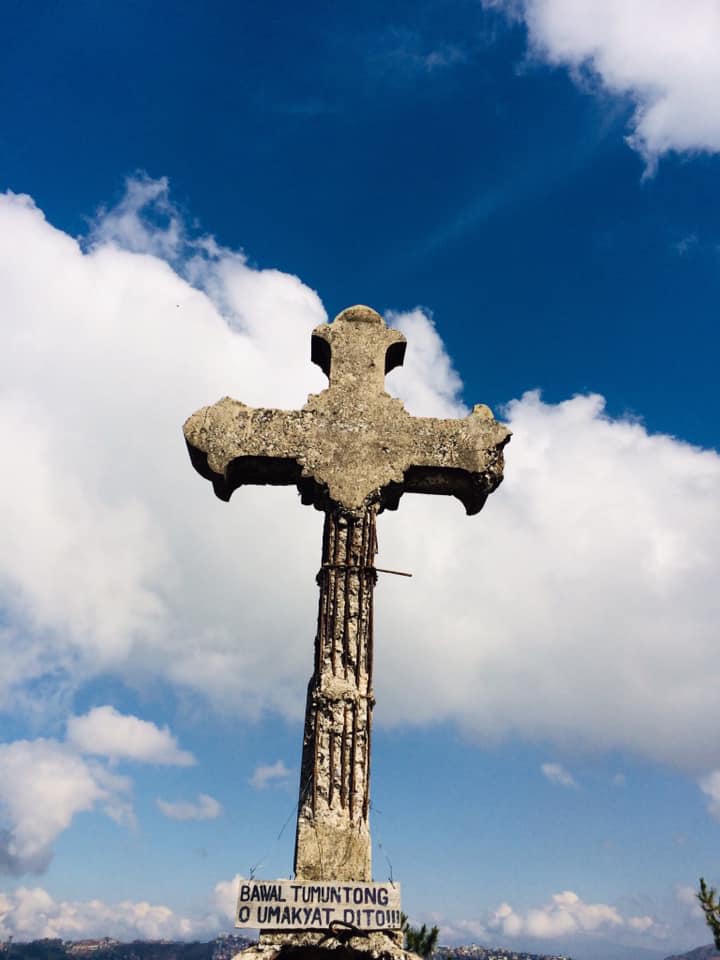
Photo by author, Dominican Hills, Baguio City, January 2019.
And no wonder, in this paradox of the cross lies another paradox, that of human living wherein the more we try to live uprightly, striving to be good and loving, the more we are attacked and confused by the devil through others as we have observed last week.
Holiness always engenders hatred among men and women filled with evil as we have been witnessing lately in the news. This had been foretold long ago by the author of the Book of Wisdom we have heard in the first reading:
The wicked say: Let us beset the just one, because he is obnoxious to us; he sets himself against our doings, reproaches us for transgressions of the law and charges us with violations of our training. Let us condemn him to a shameful death; for according to his own words, God will take care of him.
Wisdom 2:12, 20
Since the fall of Adam and Eve, see how man had always put God on trial like a criminal, being accused with all the miseries and sufferings on earth that reached its lowest point when Jesus was hanging on the cross with his enemies mockingly telling him, “If you are really the Son of God, come down and we will believe… He had saved others, now let him save himself!”.
The core of the paradox of the Cross
At the core of this paradox of the Cross is Jesus Christ’s central teaching of being like a child which he had first expressed clearly in his Incarnation and Birth by the Blessed Virgin Mary – the almighty God being born an infant, so small and so weak just like everyone of us! In coming to us a child and later dying on the cross, Jesus showed us that true greatness is in becoming small to become a part of the larger whole.
Then he sat down, called the Twelve, and said to them, “If anyone wishes to be first, he shall be the last of all and the servant of all.” Taking a child he placed it in their midst, and putting his arms around it, he said to them, “Whoever receives one child such as this in my name, receives me; and whoever receives me, receives not me but the One who sent me.”
Mark 9:35-37
To be a child means to owe one’s existence to another which we never outgrow even in our adult life. It is an attitude of being open to every possibility in life, an attitude of trusting others, of having clean mind and clean heart.
The world of men, of macho men we love to relish with delight in the secular and even religious world in all of its trappings of fads and fashion and “hard talks”, of external showmanships that we try so hard to project cannot hide the hypocrisies within, of keeping grips and control on everyone and everything like the disciples of Jesus.
The tragedy of that scene of the Twelve arguing who among them is the greatest to get the best position when Jesus comes to power continues to happen in our time with some people actually living in darkness are the ones who pretend to be seeing the light that in the process are misleading people towards darkness and destruction! Even in the church when we keep on referring to ourselves as “servants” of the poor when our lifestyles as priests and bishops, nuns and religious are that of the rich and famous!
The key to greatness is to be like a child – be simple, be trusting because children lack jealousy and selfish ambitions which according to James in the second reading are signs of the presence of “disorder and every foul practice” (Jas.3:16).
Photo by Mr. Jim Marpa, 2018.
This Sunday, Jesus is inviting us to examine ourselves truly why are we following him?
What have become of us in serving him – argumentative and divisive or welcoming of others especially the weak and marginalized?
Does my way of life speak of who I am as a disciple of Jesus, like a child, open to God and to others?



 lordmychef.com