
Lord My Chef Sunday Recipe for Soul by Fr. Nicanor F. Lalog II
Thirtieth Sunday in Ordinary Time, Cycle A, 25 October 2026
Exodus 22:20-26  ><}}}}*>  1 Thessalonians 1:5-10  ><}}}}*>  Matthew 22:34-40

A few months before the death of Pope Francis last year, a controversy arose among some people regarding St. Augustine’s teaching “Love and do what you like” when they overstretched its meaning as if one can do anything that may hurt others in the process.
St. Augustine never meant we can do whatever we like; most of all, the learned Saint had extensively taught on the need to distinguish “love” from a disordered one. When he said “Love and do what you like”, St. Augustine meant the kind of love that Jesus had taught his disciples at the Last Supper, love that is willing to offer one’s life for another. It is a love rooted in God that enables one to see more completely one’s self and others so that when we love, everything changes in our being so that our every doing is because of love and out of love. When we truly love, the sky is the limit in every good deed we can do for God through others.
This we find in today’s gospel when Jesus answers another test from his enemies at the temple area.
When the Pharisees heard that Jesus had silenced the Sadducees, they gathered together, and one of them, a scholar of the law, tested him by asking, “Teacher, which commandment in the law is the greatest?” He said to him, “You shall love the Lord, your God, with all your heart, with all your soul, and with all your mind. This is the greatest and the first commandment. The second is like it: You shall love your neighbor as yourself. The whole law and the prophets depend on these two commandments” (Matthew 22:34-40).

Unlike last Sunday’s encounter with the disciples of the Pharisees and Herodians, today’s testing of Jesus is “mild”, seemingly honest because many Jews were confused at that time with the so many laws they have to observe.
From the Ten Commandments given by God to Moses at Mount Sinai, they have dissected these into more than 600 precepts that they wondered if there was any single law which touched the core of people’s relationship with God. Perhaps that is where the malice in this test lies: the Pharisees wanted to know if there would be a simpler approach by Jesus that they felt impossible especially with their very legalistic frame of minds.
But Jesus surprised them anew in the way he addressed the question by first citing the Book of Deuteronomy when he answered, “You shall love the Lord, your God, with all your heart, with all your soul, and with all your mind. This is the greatest and the first commandment.” They knew it very well by heart but what was new and probably troubling for them was when Jesus followed up with “The second is like it: You shall love your neighbor as yourself.”
First of all, the scholar of the law was asking Jesus to pick the one most important of all commandments at the core of their relationship with God and with their life in general. They were hoping for a simplistic approach, a sort of panacea and shortcut. Instead of reducing the hundreds of laws into just one, Jesus gave them two commandments that are actually one and inseparable: love of God and love of others. They are like the cheeks of the human face best expressed in Filipino: Ang pag-ibig ay katulad ng isang mukha na mayroong dalawang pisngi; walang tao na iisa ang pisngi. Isang mukha, dalawang pisngi palagi.
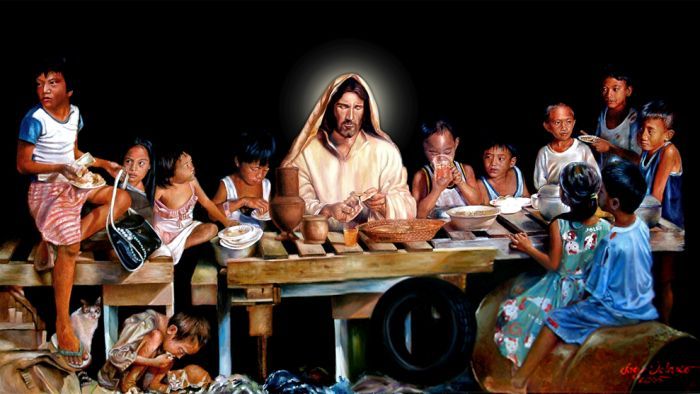
Most troubling for the enemies of Jesus was actually this other “face” of love of God: for them, the term neighbor was limited only to their fellow Jews which Jesus addressed in his parable of the good Samaritan found only in Luke’s gospel. In linking love of God with love of neighbor, Jesus reminded his enemies and listeners including us today of what the whole bible has been saying that religious observance is not enough like fasting, alms-giving and other ritual observances in the temple or synagogue, or church, and home.
One cannot love God without loving one’s brothers and sisters at the same time. No one can just love for God’s sake, to please God or observe his commandments. One must go further than the letters of the laws because one one seeks, finds and loves God in others. In the following chapter after this episode we find Jesus identifying himself with the poor, the hungry and thirsty, the naked, the sick and prisoners and aliens so that whatever we do unto them, we do unto him too (Mt.25:31-46)!
Hence, we have our first reading from Exodus God telling Moses to remind the people to be kind to strangers and foreigners for they were aliens too in Egypt before; that they should never oppress nor molest the poor and widows nor charge interests in loans, warning them of how he would listen to the cries of the oppressed.
More than teaching us the most important commandment of all, Jesus is inviting us to a new approach to life and to our relationships with God and with others in love. He is not disregarding the laws and commandments because their absence means presence of evil and sin as we have seen recently in France. Clearly, the looters and vandals in the many rallies there are those who believe they can do whatever they like without any sense of what is right and wrong.

This is what St. Paul is reminding the Thessalonians and us today in the second reading: Christianity is really difficult to understand and appreciate by people then and now without love at all except perhaps the disordered love St. Augustine had explained about 1300 years ago.
In answering the scholar of the law, Jesus revealed the truth of this immense love of God already present in us which enables us to see even beyond persons and things. When he said that the greatest and first commandment is to love God with all of our heart, and mind, and soul or total self and that the second is to love others as you love yourself, Jesus is revealing to us one of the most profound truths we fail to recognize and even reject so often.
Our love for God and for others unfold first in us, in our love for our self. We cannot love God unless we love and accept who we are – whatever is good and bad in us. Many times, some of us hate ourselves that we change even our gender, manipulate our appearances, fantasize on so many what ifs and wishful thinkings. The key to loving God totally is to first love our very self; Jesus became human like us to show us that is good to be human. It is only when we have come to embrace and accept wholly our gift of self can we give ourselves to God totally and to others. What I am to myself becomes what I am to others and vice versa. And together we all go to God as he comes to us—in love especially in the midst of all these shadows and darkness of things happening in our country and around the world. May we lead others to God by finding them first in us. Amen. Have a blessed week ahead.

