Christmas: A Decision To Choose Jesus, Our Highest Good

belen
The Lord Is My Chef Christmas Recipe 2018
            My dearest readers,

            A blessed Christmas to you all!  Thank you very much in joining me in this journey with our Lord Jesus Christ.  Thank you very much for following and “liking” my blogs.  It is my hope that somehow you have seen a glimpse of God’s majesty and kindness in my reflections.  On this joyous day of Christmas, join me in simply praying to our Lord Jesus born on this day.  Join me in reflecting some important things I have learned about Christmas.

            These past nine days in our reflections, I have tried asking Jesus about any message for me and for you, my readers and my parishioners.  As His birthday approached, I told Him some thoughts within me about Christmas although I am very sure those were not really mine but His also.  That is prayer:  conversing with God who has always been speaking to us.  We simply respond to Him.  And here is our prayer this Christmas…

            A blessed happy birthday to you, Lord Jesus Christ!  Thank you for the gift of the Holy Spirit in enabling me to start this prayer like Zechariah, giving praise and glory to you for “coming to us to save us and set us free” (Lk.1:68).  As I prayed over the gospels for the three Masses of your birthday, there were some things that came to my mind that I wish to offer to you.  Most likely, these must have actually come also from you.

             First lesson I have realized this Christmas: there is always somebody trying to be a king or an emperor among us, even within us.  There is always somebody wishing to unseat you, even claiming to be the Messiah or the Christ.  That has always been the setting of your coming, Lord:  “In those days a decree went out from Caesar Augustus that the whole world should be enrolled.  This was the first enrollment, when Quirinius was governor of Syria.  So all went to be enrolled, each to his own town” (Lk.2:1-3).  Among those who followed that order were your parents who were poor with no choice but obey the Roman emperor who believed in himself to be a god, the savior of the world.  Until now, Lord, there are people who act like emperors by coming out with all kinds of plans and dreams of grandeur, lording it over their people with many programs that benefit the poor and the needy but in reality are just feeding on their bloated egos and twisted minds.  They are everywhere, not only in government but sadly even in the church when some priests and volunteers destroy the unity of the parish or the clergy with their liturgies and plans so everyone would come for you Jesus but actually for them.  More sadly are these people found also in many families like the perfect father who feels he had never made any mistake in life or the manipulative mother who is convinced she knows everything; the monster brother or sister who always feels as sacrificing the most when in fact the one grabbing everything even the slightest attention.  They are the “pa-bida” always feeling as the “vida” when in fact are the “contravida”, sowing divisions and animosities everywhere.

             Give us the grace of humility, to always recognize you as the great and almighty God who chose to be born like a child to show us that the greatest power in the universe lies in being small like a child and not in being big.  Remind us always that each of us is an inn keeper who must always make room for you in our hearts.  Remind us always that we are your own, that you always come to us but sadly, many of us refuse to accept you as your beloved disciple John said, “He came to what was his own , but his own people did not accept him” (Jn.1:11).  St. Luke noted that it was the first enrollment when you were born 2000 years ago, meaning, there were still others that subsequently followed that until now continues to this day with the many people claiming to be you the Messiah, acting like emperors.  As we celebrate your birth today, keep us grateful to your coming and most of all for staying with us since then, give us the grace of Joseph and Mary to brave the long and dark journey to bring you forth in this world, truly the Son of God, the Savior of the world.

             Second lesson you have taught me this Christmas Lord Jesus is the opposite of the first: there would always be those taken for granted, those ignored and rejected who are like the stone rejected by the builders who become the cornerstone of the building as you used to say in your preaching.  Of course that is clearly you, Lord Jesus!  But we thank you for making us share in your greatness.  How brilliant is the wit and humor of St. Luke who said that all went to be enrolled only to reveal later in his narration that not entirely everyone.  There were those unmindful of the census going on since the officials also did not care at all about them too like the shepherds who were among the poorest of the poor of that time.  And the funny twist is that they got the best seats on your birth!  Now there were shepherds in that region living in the fields and keeping the night watch over their flock.  The angel of the Lord appeared to them and the glory of the Lord shone around them, and they were struck with great fear.  The angel said to them, “Do not be afraid; for behold, I proclaim to you good news of great joy that will be for all the people.  For today in the city of David a savior has been born for you who is Messiah and Lord.”  And suddenly, there was a multitude of the heavenly host with the angel, praising God and saying, “Glory to God in the highest and on earth peace to those on whom his favor rests” (Lk.2:8-11,13-14).

             What a beautiful story, Lord!  Your birth echoes the song of your Mother Mary, her Magnificat where she proclaimed “He has shown the strength of his arm, and has scattered the proud in their conceit.  He has cast down the mighty from their thrones and has lifted up the lowly.  He has filled the hungry with good things and the rich he has sent away empty” (Lk.1:51-53).  Many people still don’t get it, Lord.  First with you:  in crucifying you on the Cross, you have changed entirely the course of human history.  You who have been so ridiculed and put to shame with all the false accusations until now is the only person with the most influence in the world.  The Church you have established has also gone through so many destabilization plots within and outside but still here, despite our many sins and weaknesses, and yes, amid our hypocrisies.  And many of us today celebrating your birthday have just gone through so much beatings this year but now thankful before you because you have never forsaken us.  And those fake gods and emperors?  Trying to amuse themselves with more lies as they suffer being totally alone and empty within.

             Lord Jesus Christ, it has been raining since two days ago and more rains are expected this week.  Some, including me, feel your birthday today seems sad and gloomy.  But as I prayed over the stories of St. Luke about the harsh conditions when you were born, I have learned that is what Christmas Day is for – a beacon of light to guide us in the many mountains and valleys, cliffs and ravines we travel in this journey of life.  There would always be people who would make life difficult for us, conditions everywhere that are unfavorable to us but on this day of your birth, you are asking us to stand by you, to make that conscious decision to trust you that good things and better days are ahead of us.  Christmas is about making that conscious decision to always have you, Lord Jesus Christ as our highest good in life.  As our patron saint said, “From your fullness O Lord, we have all received , grace in place of grace” (Jn.1:16).   AMEN. Fr. Nicanor F. Lalog II, Parokya ng San Juan Apostol at Ebanghelista, Gov. F. Halili Ave., Bagbaguin, Sta. Maria, Bulacan.

Photos from Google.

humbleheart

Advent is God Leading Us to New Directions in Life

48396795_474653906393673_4933836951066247168_n
The Lord Is My Chef Simbang Gabi Recipe-9
24 December 2018
2 Samuel 7:1-5, 8-12, 14, 16///Luke 1:67-79

            Finally!  It is the word of the day.

            Finally we have completed the nine-day novena of Christmas but that is not the true joy of our annual Simbang Gabi tradition.  What is most essential is in these nine days of rising early for the novena, we have rediscovered Jesus Christ in ourselves and among others while at the same time recommitted ourselves to Him again as our only fulfillment in life.  I hope that in the past nine days we have rediscovered and even brought back somehow to our lives our sense of the sacred that is now fast fading out in our very consumerist society.  Through the many religious symbolisms found in our liturgies and readings these Advent season, it is hoped that we have rediscovered God – as well as our sense of the sacred – who is the most meaningful and essential in life.  

            Finally today also, we find the only male character in St. Luke’s story of the coming of Christmas regaining his stature after being on the distaff side, Zechariah.  After disbelieving the good news of (finally) having a son through the angel Gabriel’s annunciation at the Temple when he was forced into silence by becoming mute and deaf, Zechariah was finally able to speak again after declaring his son shall be named John.  And his very first words after being silent for nine months were praises to God the Almighty like Mary during the Visitation.  Called theBenedictus, Zechariah affirmed and confirmed in himself first the reality and truth of God being present in our lives amid the many twists and turns in life, narrating His reality and fidelity to His promises from the time of the Patriarchs and the Prophets of Israel down to the birth of John who would prepare the Christ.  In effect, Zechariah had finally come into a full circle in singing the Benedictus:  like his wife Elizabeth and son still in her womb John, St. Luke tells us how Zechariah was also filled with the Holy Spirit at that instance on the naming of John when he prophesied, “Blessed be the Lord, the God of Israel” (Lk.1:68).

          Zechariah shows today the fruits of his “forced silence” that had deepened his priesthood that is very evident in the opening line of Benedictus, giving glory to God for His fidelity and mighty acts to save Israel.  It is very similar with some of the popular parts of the psalms that every Jew prays.  There are three important reasons that Zechariah tells us why God is blessed:  “for he has come to his people and set them free,  he has raised up for us a mighty Savior, born of the house of his servant David” (Lk.1:68-69).  What is amazing in the Benedictus is that the verbs are in the past tense, of the works of God being done in the past like visiting His people, setting them free or redeeming them by sending Jesus Christ.  Like the Magnificat, it is a looking back and a looking forward to more great things God has in store for us.  Zechariah is reminding how God has never stopped working wonders for us, speaking and acting through prophets so many years ago even before the coming of Christ who is the fulfillment of all His promises.

           We have mentioned how we priests and other religious and consecrated persons sing the Magnificat every evening; the Benedictus, on the other hand, is sung every morning prayers called lauds.  As we face a new day, like Zechariah at the birth of his son John, we look back and remember so that in the process we renew our faith and trust in God who never stops in working for our good.  We praise God and put our trust and confidence in Him for every new day, hoping He would continue to visit us, redeem us, and raise us up from the many challenges we are going to face. But most of all, we are reminded too by Zechariah at this time, on the eve of Christmas, to ponder in our hearts where the Lord is leading us to?  Zechariah had seen the hand of God in Israel’s history, in his own life, and could see it also present in the coming life of his son John.  It is very clear that God is our leader in life, the invisible hand who directs us.  When we come to think of it, Zechariah’s forced silence was a way for him to rediscover again his sense of God and his sense of the sacred.  So many times for us, including us priests that although we keep our prayers and devotions, they are devoid of God.  One of the things this generation is fast losing is that sense of the sacred when everything is not taken for granted and trivialized.  How I hate before the Metro Film Festival during Christmas when we as the only Christian nation in this part of the world celebrates the merriest and longest Christmas are feasting on movies about evil and horror movies.  At least these past few years, there have been marked improvements in our film industry with great movies coming out.  Last year I was able to see the adaptation of Nick Joaquin’s “Portrait of the Filipino as Artist” that was magnificent in its interpretation of the play.
 
          On these remaining hours of the day before Christmas, imitate Zechariah to get some silent moments with our self and with God to reflect on where is the Lord leading us to this Christmas?  What direction in life is He asking us to follow?  In the first reading we have heard God asking David to stop his plans of building a temple for Him.  There was nothing wrong with building a temple but it was not the plan of God for David but for his son Solomon.  The same thing with us:  no matter how good our plans are for God and for others, it is the direction God has for us?  We can never prepare the way of the Lord unless we first sub it to His plan and follow His directions.  A blessed Christmas to you! AMEN. Fr. Nicanor F. Lalog II, Parokya ng San Juan Apostol at Ebanghelista, Gov. F. Halili Ave., Bagbaguin, Sta. Maria, Bulacan.
*Photo by author, altar linen of our Parish Church.  May we follow God’s directions for our lives.

Advent is Looking Back – and Forward – to God’s Goodness

48393157_735339493505987_5673987050278223872_n (1)
The Lord Is My Chef Simbang Gabi Recipe-7
22 December 2018
1Samuel 1:24-28///Luke 1:46-56

          Mary’s prominence lies not only in giving birth to Jesus Christ but more of her being His perfect disciple, the first Christian, the first receiver and doer of the Word who became flesh in her womb.  After sharing Christ with Elizabeth in the Visitation, Mary now sings the Magnificat like the song of Hannah in the first reading when she was gifted by God with the child Samuel despite her barrenness.  It is very amazing that the Blessed Virgin Mary is the only person who has appeared most – five times – as a cover of the TIME Magazine.  Likewise, her Magnificat is said to be the only poem that has been set to music more than any other in the whole history.  Almost every great musician has worked on Mary’s canticle like Bach, Mozart, Vivaldi and Rachmaninoff while for over a thousand years it had been sung or recited in the evening in monasteries around the world following St. Benedict’s rule in the sixth century. The Magnificat is a song of praise and thanksgiving to God, Mary’s own experience of God not only in her own life but also in her cousin Elizabeth who was barren and old yet conceived a child to become the Lord’s precursor, John the Baptizer.  At the Visitation, Elizabeth praised Mary but when it was Mary’s turn to speak, she praised God instead of Elizabeth contrary to common gesture of returning her favour because it was very clear with her that every gift is from God, and the greatest gift we can all have from God is His Son Jesus Christ whose birthday we celebrate on Tuesday.

            What is so remarkable with the Magnificat is its Advent flavor:  it is not only a praise and thanksgiving to God for all the wondrous things He had done to Mary and to us all but also a song of looking forward to more blessings to come from Him!  That is what Advent is all about, a looking back to the first Christmas and a joyful waiting for the Second Coming of Jesus Christ!  This is very evident in her opening lines, “My soul proclaims the greatness of the Lord; my spirit rejoices in God my savior.  For he has looked upon his lowly servant.  From this day all generations will call me blessed:  the Almighty has done great things for me, and holy is his Name” (Lk.1:46-49).  It is definitely a fruit of her prayer or gestational silence we mentioned the other day like what Elizabeth did.  Mary took into her inmost being the message of the angel to rejoice as a highly favored one of God, acknowledging the work of grace in her despite her stature in life.  Again we find here some strong Jewish flavors of which Mary must be aware of like the expression “the Almighty has done great things for me” which has strong roots in the Old Testament experience of the Israelites and their prophets when God saved them from Egypt and so many trials.  Think of the great things God has done to you also and rejoice!  Look back to the past 12 months and here we are, still together although some badly beaten with some even bruised in life but like Mary and Elizabeth meeting together, there are so many reasons for us to celebrate and thank the Almighty for the great things He had done to us.  And the most wonderful blessing next to God is the gift of family and friends around us, like the two cousins, a beautiful imagery of two pregnant women rejoicing together, celebrating life as they looked back in their personal lives and in their nation’s history the many good things God had done to them since the time of Abraham.

           The Magnificat shows us too that most of the things Mary mentioned have not happened yet:  “He has mercy on those who fear him in every generation.  He has shown the strength of his arm, and has scattered the proud in their conceit.  He has cast down the mighty from their thrones and has lifted up the lowly.  He has filled the hungry with good things and the rich he has sent away empty.  He has come to the help of servant Israel for he has remembered his promise of mercy, the promise he made to our fathers, to Abraham and his children forever” (Lk.1:50-57).  These are a mixture of images from the Old Testament about the things God had done to Israel and to the two cousins but at the same time mention other things that would happen only upon the completion of Christ’s mission.  This is to show us that Mary’s Magnificat is also about the perfect presence of God in Jesus Christ in our lives who is the “same yesterday, today and forever” (Heb. 13:8).

             Last year I was privileged to join my former colleagues at GMA-7 News as their chaplain on a pilgrimage to the Holy Land – all for free with everything in first class!  On our flight back to Manila, we met some OFW’s and one of them was so ecstatic in meeting Ms. Jessica Soho, making a commotion like crazy at the Ben Gurion Airport which is noted for its strict security measures.  A female security officer caught our attention and held us for a while as she checked our papers and passports.  Making things worse, the crazy OFW kept telling the officer to let us go because Ms. Jessica is a celebrity in our country.  That got the Israeli’s blood boiled and turned her attention to me, the only man in our group, asking me to go with her to their office.  That was when the three women of GMA News stood for me – our SVP Ms. Marissa Flores, Ms. Jessica Soho, and newly retired VP Ms. Kelly Vergel de Dios – telling the airport official that I am their friend, a friend for over 30 years, explaining how I used to work with them until I resigned and became a priest.  I felt my world stopping momentarily like in a dream sequence:  everything happened so fast!  There was the possible delay and a lot of interviews but I also felt God’s strong arm holding me, also tenderly caressing me with His mercy when I heard the three veterans of news defending me.  It was the final blessing I got from God during that pilgrimage when the three women of GMA-7 News were like Mary and Elizabeth reminding me how God had worked in our lives all these years.  It was like a Magnificat moment for me that until now I can recall the sweet smile that incident had left me.  Try praying the Magnificatstarting tonight as you thank God for the many wondrous things He had done to you despite the many trials you have also gone.  Thank God for the faithful and wonderful friends who have visited you to see His plans for you and most of all, be open for more blessings to come from Him this Christmas.  Let us pray for the many great women who have changed our lives, the Marys and Elizabeths who visited us and brought us closer to Jesus Christ.  AMEN. Fr.NicanorF.LalogII,Parokya ng San Juan Apostol at Ebanghelista, Gov. F. Halili Ave., Bagbaguin, Sta. Maria, Bulacan

*Photos by the author:  above are the bronze statues of Mary and Elizabeth at the Church of the Visitation; below, our group photo during our Holy Land Pilgrimage last April 2017.

48398771_2164177240301796_9078224252741615616_n

Christ Comes in Silence

MaiAthens
The Lord Is My Chef Simbang Gabi Recipe-4
19 December 2018
Judges 13:2-7, 24-25///Luke 1:5-25

            Going to funeral wakes can sometimes be humorous especially when people ask me all kinds of questions that sometimes I wonder if I look like the Google page.  One of the FAQ’s I always get is what is the most difficult part in the life of us priests?  Many would always burst into laughter when I tell them that it is when our back gets itchy and we have no one to scratch it, telling them about the saying “ang hapdi matitiis pero ang kati ay hindi” (pains are bearable but not itch).  This is very true that is why I keep three back scratchers made of wooden carved arm with a hand from Baguio in my room, one in the TV area, the second at my study desk and another at my bedside.  But lately I have found another big problem of living alone as a priest when I never knew I had no voice until I celebrate the Mass in the morning!  And how would I know that I do not have voice when I have nobody to talk to in my room or rectory when I wake up early morning except God who is always in silence?  Sometimes it could be embarrassing and even funny but overall, it is no big deal with me.  In fact, being silently alone in my parish is the most wonderful blessing I cherish so much in my priesthood.

            But going back to our voice, it is one of our most valued possessions as priests or even of anyone.  No wonder, the word “voice” itself connotes power in our language usage for to lose one’s voice is also to lose power and ability to lead.  Without the voice, anyone’s ability to communicate is drastically impaired as you could no longer communicate effectively to express your thoughts and your feelings, you could no longer give advice and counsel to others on many things or teach anyone.  In short, to lose one’s voice means never to be heard again.  Today in our gospel we heard the first story by Luke about Christmas, the annunciation of the birth of John the Baptizer to his father Zechariah while he was serving as a priest at the Jerusalem Temple during its most important feast.  An angel appeared to him to announce how God have heard his prayer and of his wife Elizabeth for a child but instead of being filled with joy with the good news from heaven, Zechariah doubted God.

            Then Zechariah said to the angel, “How shall I know this?  For I am an old man, and my wife is advanced in years.”  And the angel said to him in reply, “I am Gabriel, who stands before God.  I was sent to speak to you and to announce to you this good news.  But now you will be speechless and unable to talk until the day these things take place, because you did not believe my words, which will be fulfilled at their proper time.” (Lk.1:18-20)

            One of the rare commodities in the world today is perhaps silence.  Everybody is talking, even cars and elevators and other machines.  When we examine the bible and even our lives, we see that every communication by God is always preceded by silence.  Before God created everything, Genesis tells us that there was silence first.  The beloved disciple John opens his gospel by saying “In the beginning was the word” to show everything with God was in silence.  Jesus Himself was born in the silence of the night at Bethlehem while the gospel accounts tell us nothing much about His childhood except when He was lost and found three days later at the Temple of Jerusalem.  After that finding at the Temple, what we have are the hidden years of Christ when nothing is heard about Him or from Him for 30 years.  And during His brief ministry of about three years, Jesus used to withdraw to the mountains or wilderness to pray in silence.  Such is the importance of silence not only for our spiritual growth and maturity in Christ but according to experts, also for our total well being as persons.

           In starting his Christmas story with Zechariah being forced by the angel to go into silence, Luke is teaching us the essential value of silence in preparing for Christmas.  Luke described Zechariah and his wife Elizabeth coming from families of priests who must be used to speaking, to giving talks, explaining things to many people.  It seems that with his advanced age, Zechariah must be of a significant stature among his peers.  But now, he had been forced into silence by God so that he may have more time to examine things going on inside and in his life, more time for reflection and even for renewal.  His wife Elizabeth appears to be more properly disposed in receiving the good news about the birth of John with her attitude of silence when she went into seclusion for five months saying, “So has the Lord done for me at a time when he has seen fit to take away my disgrace before others” (Lk.1:24-25).  Similarly like her in the Old Testament was the wife of Manoah who remained silent when a man of God told her she would bear a son to be called Samson, “I did not ask him where he came from” (Jgs.3: 6).

             Advent is the presence of God but sometimes when we are overburdened with so many things like anxieties and problems in life, frustrations and disappointments, sickness and death in the family, we become unaware of His divine presence even if we continue to pray and do our religious duties and devotions.  Too often we lack the conscious awareness of God in our lives that we take Him for granted, considering Him more as a given than a presence and a reality.  Like Zechariah who happens to be a priest who must be more attuned and rooted in God, we hardly notice His coming or even doubt Him and His powers.  God is never put off by our questions but what “irritates” Him is when we question Him, when we doubt Him, when we ask about His character.  That is a lack of faith in Him, a lack of trust, and lack of personal relationship and constant dialogue with Him like what St. Joseph had in our reflections yesterday.  Remember, St. Joseph is the most silent person in the Bible.

          Like the stories of pregnancies we have been hearing these past days, Advent is a call for us to moments of “gestational silence” that is deeper than losing one’s voice or being quiet.  Gestational silence, or pregnant silence if you wish which is what gestation is all about, is withdrawing into ourselves not to escape but to finally face and listen more intently to the rumblings and sounds within us and around us, to listen more intently to God who is our only true voice in life.  Like Zechariah in the gospel today, we could be so tired already of doing everything, banging our heads on the wall to solve everything, to answer everything.  Let us force ourselves in these remaining days before Christmas to go into gestational silence to open ourselves to God speaking to us anew with His other other possibilities and new perspectives for us.  After all, it is only God who is our only true voice in this life in Christ. AMEN. Fr.NicanorF.LalogII,Parokya ng San Juan Apostol at Ebanghelista, .Gov. F. Halili Ave., Bagbaguin, Sta. Maria, Bulacan.

*Photo by Dra. Mai B. Dela Pena, sunset in Athens, Greece, 2016.  Used with permission.

Holiness and Sinfulness

stjosephchurch
The Lord Is My Chef Simbang Gabi Recipe-3
18 December 2018
Jeremiah 23:5-8///Matthew 1:18-25

             One of my unforgettable experiences in my parish is when a husband and wife quarreled during the baptism of their child.  When I asked the father the name to be given to their son right before baptism, he gave another name and instantly, his wife hit him with her elbow and snapped, “who’s that baby again!?”

             In the rites of baptism, it is the father who is asked by the minister on the name to be given to the child.  It is the father who gives the name because he is the origin of life, the giver of life; hence, every child uses the father’s family name to show his paternity.  This is in essence the reason God asked Joseph “to be not afraid to take Mary as his wife” so he would be the legal father of Jesus Christ.  Though it is very clear in the account of Matthew yesterday and today that Jesus is truly the Son of God and not of any human, the evangelist shows us how through Joseph, Jesus belongs by law – legally – to the house of David as fulfillment of God’s promise.  At the same time, in giving name to Jesus, Joseph proves more than ever his holiness which is the meaning of his description as a “righteous” or “just” man.  This is how the birth of Jesus Christ came about.  When his mother Mary was betrothed to Joseph, but before they lived together, she was found with child through the Holy Spirit.  Joseph her husband, since he was a righteous man, yet unwilling to expose her to shame, decided to divorce her quietly (Mt.1:18-19).

             Holiness for the Jews or being righteous and just is primarily obedience to the Laws of God handed down through Moses.  However, during the time of Christ this perception became so limited to mere obedience to the letters of the law that even Jesus later on would try to correct.  His legal father, St. Joseph, in fact would exactly do that when he showed that holiness is a constant dialogue with God when one is nourished by His words like a tree planted near the streams of water, bearing fruits of love for God and for others.  This imagery is found in the Book of Psalms that says men who are just and righteous are those who “delight in the law of the Lord, like a tree planted near streams of water, that yields its fruit in season; its leaves never wither; whatever they do prospers” (Ps.1:2-3).  When St. Joseph decided to quietly divorce Mary after learning about her pregnancy, it was the height of his love for her as he was very willing to walk away and let her marry whoever fathered that child in her womb than subject her to public shame and humiliation as their laws prescribed.  In that aspect alone, we find St. Joseph very holy indeed!  But it did not stop there:  after being informed by the angel in a dream of the divine nature of Mary’s pregnancy, St. Joseph proved anew his holiness with his deep love for God by eventually taking Mary as his wife that paved the way for the first Christmas we now celebrate.  St. Joseph’s holiness shone brightly in this aspect when his love for Mary was never diminished but even deepened when his love for God moved him to take “his wife home.”  Here are the fine prints of St. Joseph’s holiness that in his love for God, he had to take Mary as his wife and in doing that, he eventually brought forth in a sense the birth of Jesus Christ.  Every time we love God, it always leads us to love others too.  It is when we live in love that Jesus Christ truly comes into our lives and Christmas happens always.

             But there is something bigger and better, lovelier and holier to unfold in St. Joseph’s role as legal father of Jesus Christ.  Notice how Matthew repeated the verb “to name” twice:  “She will bear a son and you are to name him Jesus, because he will save his people from their sins (Mt.1:21)” and “When Joseph awoke, he did as the angel had commanded him and took his wife into his home.  He had no relations with her until she bore a son, and named him Jesus (Mt.1:24-25).”   Giving of names in general connotes authority.  In Genesis, God gave man the authority to give names to the animals He had created.  Parents give names to their children as a sign of their authority.  Bullies in classrooms and anywhere always try to assert their authority by giving funny names to their victims while lovers always have unique names given to their beloved as terms of endearment.  In this respect, St. Joseph did not merely give up that authority of giving name but must have also realized within him the awesome reality of things about to unfold in the birth of Mary’s child who “will save his people from their sins” (Mt.1:21).

             Three weeks ago I read in the news how a popular American airlines apologized to a mother when their ground crew at the boarding gate laughed and insulted her daughter named “Abcde” which is pronounced as Ab-city.  I have baptized a baby in my parish with a similar name, “Wxyz”.  The parents never complained or filed charges against me when I questioned them for their choice of name for their son, warning them of negative repercussions in the future.  Giving of names is a very serious duty among the Jews (and it should be for everyone!) because a name always indicates the person’s mission.  In giving the child of Mary the name “Jesus” that means “God is my salvation”, St. Joseph must have realized not only the mission of Christ but most of all fully accepted it as one that the world needs so badly.  Recall that during the ministry of Jesus, religious leaders of His time always questioned His forgiving of sins because only God can forgive sins.  Problem with them like the Pharisees and the scribes, they have refused to recognize Jesus as the Christ, the Son of God sent to forgive sins.  Right from the start during his dream, St. Joseph was already aware of the mission of Jesus Christ which is to forgive sins.  And his obedience to the instruction of giving the name “Jesus” is indicative of his holiness because the first step to being holy is to admit our sinfulness, our need for forgiveness by God.  This is the problem of the world today, the lack of sense of sinfulness among most of us even among us priests as shown by the sex scandals.  The mark of true holiness is the humility to admit and accept one’s sinfulness and need for forgiveness.  When Pope Francis was interviewed for the first time for a magazine, he was asked how he would describe himself and his quick answer was, “I am a sinner.”
       Sin is a turning away from God, the absence and failure to love.  It is the opposite of holiness which is being filled with God.  Unless we realize that our sinfulness is the first and most important thing needed to be fixed within us, we will never move forward, we will never grow, and we will never experience Christ’s coming.  This is the very reason Christ was born, to forgive our sins so that we may return and go back to God who is our fundamental relationship in life.  No healing, no life in general will ever come and prosper when this relationship with God is out of order because of sins.  St. Joseph is a righteous or just man, a holy man, because in recognizing the need for the forgiveness of our sins, he cooperated with God in His plans by naming the child of Mary as “Jesus” and that is why we now celebrate Christmas.  God bless you!  AMEN. Fr.NicanorF.LalogII,Parokya ng San Juan Apostol at Ebanghelista, .Gov. F. Halili Ave., Bagbaguin, Sta. Maria, Bulacan.
*Photo by author, Church of St. Joseph at Nazareth, the Holy Land, April 2017.

Our Origin and Mission in Jesus Christ

48184542_1236165199867720_9017446140471148544_n
The Lord Is My Chef Simbang Gabi Recipe-2
17 December 2018
Genesis 49:2, 8-10///Matthew 1:1-17

            Surely today after our Simbang Gabi, all attention would be on the Miss Universe Beauty Pageant with everybody rooting for our bet, memorizing the names and answers of almost every candidate from all over the world.  I have never seen any episode of Miss Universe or any beauty pageant in my entire life but from what I have read and heard, our intense interests with beauty contests is our way of coping with the harsh realities in our nation of crooks and corrupt officials that we try to identify with the beautiful and glamorous.  As you examine every candidate later on TV, try remembering our reflection on this second Simbang Gabi which is also about names and origins and mission.

            Today we begin the second phase of Advent when our liturgy shifts its focus to the first coming of Jesus more than 2000 years ago in Bethlehem.  The Church’s official countdown for Christmas Day actually starts today December 17 until the 24th when all our readings look back to the events leading to Christ’s birth.  Every year on this date we hear the beginning of the gospel of Matthew about the genealogy of Jesus Christ where we are presented with names of our Lord’s ancestors that mostly sound funny and even weird.  Yesterday we have reflected that the joy of Advent and Christmas is the Person of Jesus Christ found among every person.  Today, we deepen this reflection on the Person of Jesus Christ through His genealogy that reveals to us His origin and mission which we also share with Him.

            It is interesting to recall that when Jesus faced Pilate during His trial, the Roman governor asked Him “Where are you from?” (cf. Jn.18:38).  It was also the same question that all four evangelists tried to answer later in writing their respective gospel account of the Christ.  For Matthew and John, it is the most essential question needed to be answered right away that they both opened their gospel accounts by presenting the origins of Jesus Christ.  We shall reflect on John’s version about the origins of Jesus on Christmas; today we focus on Matthew’s genealogy which is very Jewish in flavor and context considering his own background and audience made up largely of Jewish converts to Christianity.  Right away, Matthew traced the genealogy of Jesus to the two prominent figures of Israel by solemnly declaring at the beginning of his gospel, “The book of the genealogy of Jesus Christ, the son of David, the son of Abraham” (Mt.1:1).

           For Matthew, the story of the promise of God begins with Abraham who was called to journey from his homeland to the Promised Land.  More than a journey into another land, it was also a journey into the future by Abraham when all nations who would come from him shall come together to be blessed by the Lord.  Every Jew is aware of this promise by God to Abraham and Matthew is now reminding them how everything was fulfilled in the birth of Jesus as the Christ.  Pope Emeritus Benedict XVI explains in “Jesus of Nazareth, the Infancy Narratives”that “From the beginning of the genealogy, then, the focus is already on the end of the Gospel, when the risen Lord says to his disciples:  ‘Make disciples of all nations’ (Mt.28:19).  In the particular history revealed by the genealogy, this movement toward the whole is present from the beginning; the universality of Jesus’ mission is already contained within his origin” (page 5).

            Next to Abraham, Matthew structured much of the history of his genealogy around the figure of David, the greatest king of Israel to whom the promise of eternal kingdom had been given by God.  Fully aware of the significance of symbolisms in number among his people, Matthew structured the genealogy of Jesus into three sets of fourteen generations considering that the Hebrew letters of the name David add up to fourteen also:  “Thus the total number of generations from Abraham to David is fourteen generations; from David to the Babylonian exile, fourteen generations; from the Babylonian exile to the Christ, fourteen generations” (Mt.1:17).  Again, we listen to Pope Emeritus Benedict XVI,“this threefold division by Matthew shows that the genealogy of Jesus is in fact the Gospel of Christ the King wherein we can find the whole history looking onto Him whose throne is to endure forever (ibid., page 6).”   Here we find anew the fulfillment in Jesus of God’s promise to Abraham and to David.

            The third and surprising element in Matthew’s genealogy of Jesus is the inclusion of five women that is very novel at that time considering it was a male dominated world.  See that Matthew traced more of the male line of the Lord’s genealogy; he must be up to something in mentioning the five women as roots also of Jesus: Tamar, Rahab, Ruth, Bathsheeba the wife of Uriah, and then Mary His mother.  The first four women were considered sinners and right away we can see how Matthew had indicated in the genealogy the mission of Jesus as Savior of the world when He took upon Himself the sins of the four women including those of the world.  It was not chauvinism on the part of Matthew but simply employing a technique prevalent at that time; but, here he also presents to us another reality of aside from being sinners, all four women before Mary were also foreigners or gentiles who were looked down upon by the Jews at that time.  Through them, Christ’s mission to the Gentiles is also made manifest in His genealogy, proof that indeed the genealogy of Jesus is the whole Gospel in itself!

           But the biggest surprise of Matthew after putting four sinful, gentile women in the genealogy of Jesus is his manner of ending it with another woman though this time a Jewish one, Mary.  Note like in a song all throughout the genealogy, we find the pattern of father and son like in “Abraham was the father of Jacob” to indicate human paternity among the ancestors of Jesus.  Note how Matthew would devise a twist near the end by telling us “Jacob (was) the father of Joseph, the husband of Mary.  Of her was born Jesus who is called the Christ” (Mt.1:16).  The evangelist is very clear here with the Divine origin of Jesus Christ who did not come from Joseph or any human father.  Right after the genealogy, Matthew would narrate the circumstances surrounding the birth of Jesus Christ, stressing the fact that He was conceived in the womb of Mary by the Holy Spirit.  Very clear Matthew has no plans of minimizing the role of Joseph in Christ’s birth; on the contrary, the evangelist extolled Joseph’s role at the genealogy and following story of the Nativity that as the legal father of Jesus, Joseph makes Jesus legally from the Davidic line of succession as fulfillment of the promise to David by God.  Such is the mystery of the person of Jesus Christ that although His origins can be traced to humans, beginning with Abraham and David, He also came from above with God truly His Father which we profess in faith that He is true God and true Man.  In Jesus Christ through Mary, “human existence starts afresh so that we can now claim that our true genealogy is in our faith in Jesus who gives us our origin and mission from God (ibid.).”

           One of my spiritual fathers who has a tremendous impact in my life was the late American Jesuit Fr. Arthur Shea.  He was my spiritual director during our Ignatian 30-day retreat in Cebu more than 20 years ago.  His favorite expression was “man is a mystery.”  Indeed, every person is a mystery for we never know exactly everything about him or her, someone we must always respect because no matter what, he or she is a child of God above us.  The genealogy of Jesus Christ challenges us today to rise and hold on to that honor of being a beloved child of God that despite our sinful past, many weaknesses and failures, we can always start afresh like Mary putting an end to the cycle of sins and evil.  The genealogy of Jesus Christ reminds us that life is more about direction than destination.  Like Abraham, we are all wayfarers treading the path of Jesus who is the way, the truth and life with no clear indications of places to go except of directions to the future to be like Him.  Like David, God would always find a way to change our courses in life so we can follow His direction despite our grave sins.  Let us pray with Mary that we may let God set the direction of our lives so that we may bring Christ back into this world that has veered away from Him.AMEN.Fr.NicanorF.LalogII,Parokya ng San Juan Apostol at Ebanghelista, .Gov. F. Halili Ave., Bagbaguin, Sta. Maria, Bulacan.

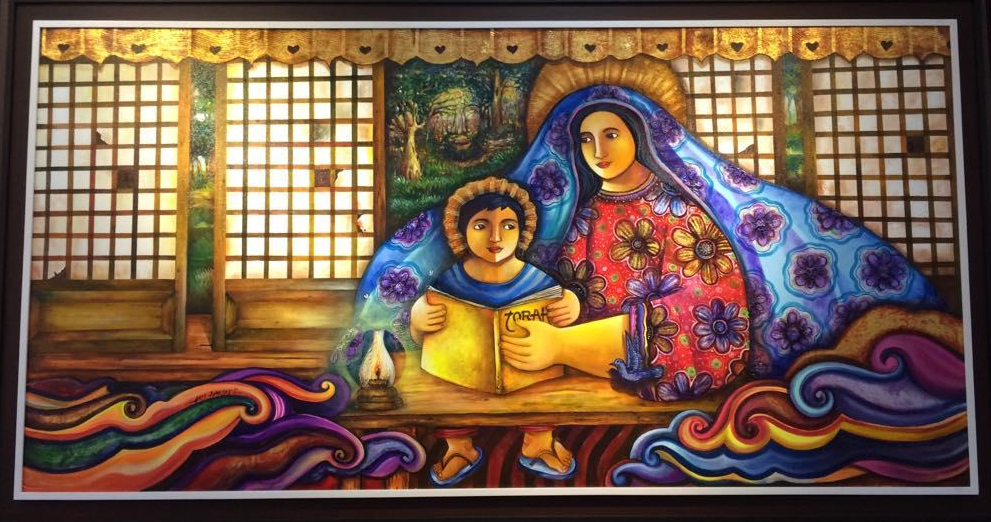
*Photo is another painting on acrylic (48×96) by Bulakenyo artist Aris Bagtas called “Luklukan ng Karunungan” (Seat of Wisdom) displayed at the second floor of the Library of the Immaculate Conception Major Seminary at Guiguinto, Bulacan.  A lively and beautiful rendition by Aris of Mary teaching her Son Jesus Christ while at the background is Joseph looking at them.  Used with permission.

Advent Is Creating A Room for God In My Life

37196152_10156528615579704_3429030339266215936_o (1)
The Lord Is My Chef Sunday Recipe
Advent-2, Year C, 09 December 2018
Baruch 5:1-9//Philippians 1;4-6, 8-11//Luke 3:1-6

            I must confess that I am also guilty of getting into the so-called “Christmas rush” that is totally empty of Jesus Christ.  No, I am not a “shopaholic” but this early I am already so stressed out with my toxic schedules of activities for the coming Christmas.  And that is when God in His amazing ways intervened by totally cutting me off from the “loop” to redirect me to the spirit of Advent that calls us to create a room for Christ’s coming.  It started two weeks ago when our internet connection became erratic which we thought was just normal in our country so notorious for its dismal internet services.  But when I could no longer connect with the internet for my work last Tuesday and Wednesday for my talks, classes and blogs, we called a technician to fix the bugs, only to be told that the problem is my nine year-old Sony Vaio that needs to be upgraded or totally replaced.  My first reaction was to replace the technician but it was the first time I really felt to be out of the web that can be alienating and even debilitating.  That was when I realized to pray more, to fast from social media and modern communications, hoping to find Jesus Christ anew in my additional periods of prayer and silence.  It was also at that time when my Ninong and Ninang came from the US to celebrate their golden wedding anniversary at the church where they got married with me as the priest-presider.  After the reception, they asked me to go with them to their hotel where they surprised me with a Christmas gift, a new laptop computer!  See how God works in amazing ways if we give Him a room in our lives; my plan was to get a new computer next year but here is God sending me one from heaven right on my lap in the most perfect time.

             “In the fifteenth year of the reign of Tiberius Caesar, when pontius Pilate was governor of Judea, and Herod was tetrarch of Galilee, and his brother Philip tetrarch of the region of Ituraea and Trachonitis, and Lysania was tetrarch of Abilene, during the high priesthood of Annas and Caiaphas, the word of God came to John son of Zechariah in the desert.  John went throughout the whole region of the Jordan, proclaiming a baptism of repentance for the forgiveness of sins (Lk.3:1-3).”

                 Every time, every moment is a perfect time for God to come but, do we have a room for Him in our lives?  Luke presents us today the setting of the first coming of Jesus Christ more than 2000 years ago.  Times may have changed but the situation and feelings remain the same to this day when God comes to us right in the midst of our present situation, whether in our personal lives or in our political world or religious set up.  There is always that voice in the wilderness calling us to repent and prepare His way, His coming.  In the first Sunday of Advent last week, we reflected how this season of preparation is the presence of God which we can truly experience when we dare to open ourselves to Him in prayer and silence.  On this Second Sunday of Advent, our readings deepen this reflection of finding the presence of God by having a room or space for Him in our hearts and in our lives.

               According to the late American Neal A. Maxwell who was an Elder of the Church of Jesus Christ of the Latter-Day Saints, “Each of us is an innkeeper who decides if there is room for Jesus.”  What a beautiful insight that is very true!  We need to create a space and room in ourselves – more than just merely opening – to welcome Jesus Christ’s intense presence in our lives these days!  With all hyperrevolution now happening in our midst due to modern means of  communications that have greatly affected our lives, the more we need to experience Christ’s intense presence so that we are not only informed and formed but most of all transformed like during the time of John the Baptizer.  Every year, the second and third Sundays of Advent are always about the preaching of John the Baptist which is essentially about the coming of Jesus Christ.

                  The key here is the intense presence of Jesus Christ not only in us but also in the world.  The detailed reportorial by Luke of the setting of Christ’s coming over 2000 years ago suggests the integration of salvation history with secular history of all peoples.  Christ has come and Christ will come again though Christ had never left us but remains with us in the present.  We have just celebrated the Solemnity of the Immaculate Conception that reminds us of God’s presence amid man’s absence.  We become absent to God when we sin like Adam who hid from God after eating the forbidden fruit.  We fail to meet and experience God in His power and grace when we are absent to Him as we prefer to spend more time with things of the world than of heaven.  We become absent from God when we refuse to abandon our sinful ways or when we have stopped to hope for any change and salvation coming from God with whom nothing is impossible.  This Sunday, let us intensify the presence of God by creating a room, creating a space in our hearts and in our lives where Jesus may dwell and reign to direct our lives like John the Baptizer who went to desert to fast and create a space in himself and in his life for Christ.  It is impossible to meet God when we are so filled with things of the world and of ourselves.  God has many plans for us in Jesus that He sent Him to us but He cannot do anything if we do not let Him into our lives.  St. Paul tells us in the second reading that he is “confident” or sure that God will fulfill his promise that every man and woman shall see “the salvation of God” (Lk. 3:6).  Let us continue to dare on this second Sunday of Advent to open ourselves to God by creating a room for Him in our hearts and in our lives and allow Him to take possession of us like what Baruch prophesied in the first reading when Jerusalem would eventually be liberated from its conquerors.  Look back to your past and see how the Lord has done great things for you; trust Him, hope in Him always for He has come, He shall come and He is come. AMEN.  Fr.Nicanor F. Lalog II, Parokya ng San Juan Apostol at Ebanghelista, .Gov. F. Halili Ave., Bagbaguin, Sta. Maria, Bulacan

*Photo by Jim Marpa, St. James the Greater Parish, Solsona, Ilocos Norte, 17 July 2018.  Used with permission.

LMC

What’s on your mind, Who’s in your heart?

PhilipStPaulResize
The Lord Is My Chef Sunday Recipe, 25 November 2018
Solemnity of Our Lord Jesus Christ, King of the Universe
Daniel 7:13-14///Revelation 1:5-8///John 18:33-37
 
            The trial of Jesus before Pontius Pilate occupies a very important role in the fourth gospel.  Unlike the other three evangelists, John mentioned only in passing that Jesus was brought to the high priest Caiaphas (Jn.18:24) after being examined by his father-in-law Annas while Simon Peter was outside denying the Lord thrice (Jn.18:12-23).  In narrating to us this trial of Jesus before Pilate, we see the spirituality and artistry of the beloved disciple who began his gospel account by solemnly declaring the eternal divinity of the Lord, “In the beginning was the Word, and the Word was with God, and the Word was God” (Jn.1:1).  Building up the climax of his gospel, John placed Jesus for the first time – in fact the only time – face to face with the world’s representative of political power.  And this shows us the meaning and essence of what we are celebrating today with Jesus Christ our Lord as King of the Universe, that His kingdom is “in this world but not of this world.”
 
            Pilate said to Jesus, “Are you the king of the Jews?”  Jesus answered, “Do you say this on your own or have others told you about me?”  Pilate answered, “I am not a Jew, am I?  Your own nation and the chief priests handed you over to me.  What have you done?” (Jn.18:33-35)

             Every morning when we open our Facebook, this scene seems to be happening again in a similar manner when Mark Zuckerberg’s creation asks us“What’s on your mind?”  Facebook and social media are gifts from God, a tremendous blessing for mankind where people meet to forge new friendships and renew old ones.  However, its overuse and abuse have led to many occasions of sins and evil.  In asking Pilate “Do you say this on your own or have others told you about me”, Jesus was not merely asking him what was on his mind but more of who was in his heart.  And we all perfectly know what happened next:  despite pleadings even by his own wife when he himself knew deep inside him the truth, Pilate washed his hands and went on with what was on his mind to sentence Jesus to death even if he knew deep in his heart He was totally innocent and in fact a very good man.

                The question “what’s on your mind” is so enticing for us to just open up without really thinking hard with what we say that may hurt others or have long lasting negative effects not only on other persons but especially to us.  It is a question with so many other implications that do not really seek to address anything substantial but only to affirm our own selves that in this world, at this very moment, “I am the king or the queen” and I can do everything!  We say whatever is on our minds to lord it over other people, sometimes literally throwing our weight around on others that in the process, we destroy our relationships.  Worst of all, when we keep on letting out what is on our minds without checking its veracity, we actually reveal our stupidity than sanity.  If we have to ask any question, we have to be ready to know its answer.  That is why, when we ask Jesus a question, we must inquire things of the above than things of this world for we might not like His answer that eventually would forcibly bring out from our hearts the right answer like what happened with Pilate later.  When Pilate asked Jesus “are you the king of the Jews”, he was not really ready to know yet the answer because deep in his heart he felt and knew the people behind the plot to kill Jesus.  Pilate was not ready to confront them because he also knew the Jewish leaders were very much aware of his corrupt practices.  How sad that so often we ask not to know the answers but simply to affirm our convictions especially if we know they are not sound at all.  When we ask more of this world, of things verifiable by facts and things that can be seen and tested, then we are not yet ready for the truth.

                Jesus answered, “My kingdom does not belong to this world.  If my kingdom did belong to this world, my attendants would be fighting to keep me from being handed over to the Jews.  But as it is, my kingdom is not here.”  So Pilate said to him, “Then you are a king.”  Jesus answered, “You say I am a king.  For this I was born and for this I came into the world, to testify to the truth.  Everyone who belongs to the truth listens to my voice.” (Jn. 18:36-37)

            Jesus Christ is king but His kingdom does not belong to this world.  It is in the world but not of the world.  His kingdom transcends beyond this world but right here in us.  Jesus Christ is king when in our hearts He reigns supreme, when we see Him among others as our brothers and sisters in Him.  More than our thoughts and ideas, more than our feelings and assumptions are persons to be loved and respected.  This is the reason why the question is not“what’s on your mind” but “who’s in your heart” which asks the more crucial question, “is Jesus our king?”  
             To recognize Jesus our King is to follow Him by taking up our cross because His kingdom is based not on force or power but on love expressed in humility, kindness, patience, and mercy that are often seen as weakness in the world.  Yes, one may say His kingship is out of this world but that is exactly what the world needs these days!  Remember His lessons to us His disciples these past weeks when He sent us with “no food, no sack, no money in our belts” (Mk.6:8),  that we must be like little children for “whoever does not accept the kingdom of God like a child will not enter it” (Mk.10:15), insisting that whoever wants to be great in His kingdom must be the slave of all like Him who came “not to be served but to serve and to give his life as ransom for many” (Mk.10:44-45).

             The Solemnity of Christ the King reminds us at the closing of our liturgical calendar as we prepare for Advent next week of that main truth that we as a Church must continue to be an image of this kingdom.  And what is the truth?  In the bible, truth is a road or a path one can follow with complete trust to have life found in God’s law.  Truth is something that must be done as in the expression “to walk in truth” (Ps. 119:105) by conforming our lives to the word of God.  See again the spirituality and artistry of the beloved disciple, of how he alone recorded the Lord’s declaration “I am the way, the truth, and the life” (Jn.14:6).  Here we find the totality of Christ the King who is the Truth because He is the way and the life.  Let us recognize today with thanksgiving to God Christ’s coming to us as our Alpha and Omega, our beginning and end.  May His kingdom come as we heed His call every day, especially in the Holy Mass as “the time of fulfillment… Repent, and believe in the gospel” (Mk.1:14-15).  Jesus my King, stay in my heart, reign in my life always!  AMEN. Fr. Nicanor F. Lalog II, Parokya ni San Juan Apostol at Ebanghelista, Gov. F. Halili Ave., Bagbaguin, Sta. Maria, Bulacan 3022.  Email:  lordmychef@gmail.com   

*Photo by my former student Arch. Philip Santiago, Basilica of St. Paul Outside-the-Walls in Rome, October 2018.

LMC

Asking Jesus

45333784_1945748215727504_3541947692357779456_nThe Lord Is My Chef Sunday Recipe, Week XXXI-B, 04 November 2018
Deuteronomy 6:2-6///Hebrews 7:23-28///Mark 12:28-34 
                          

            We have seen these past two weeks Jesus in His journey back to Jerusalem asking us – through James and John, and the blind Bartimaeus – the quintessential question, “What do you want me to do for you?”  But this Sunday, we find a reversal of roles when, One of the scribes came to Jesus and asked him, “Which is the first of all the commandments?” (Mk.12:28)

             What question would you ask Jesus if given that chance?

             Jesus had finally reached Jerusalem, frequenting the Temple area which He had cleansed upon His arrival on Palm Sunday.  Mark tells us the building up of antagonism against Him by His enemies asking Him with many questions.  First were the chief priests, scribes and elders who asked about His authority in cleansing the Temple and then the Pharisees who teamed up with the Herodians to ensnare Him with the question about the paying of taxes to the emperor.  Last to test Jesus were the Sadducees who asked about the resurrection by presenting to Him the case of a woman who had married seven brothers after dying one after the other.  Mark tells us how Jesus satisfactorily answered all their questions that people were so amazed with Him.  It was at this time when a scribe who had heard them disputing and saw how well Jesus had answered them came forward with the question we also ask up to this time, “Which is the first of all the commandments?”

             Like that man who asked Jesus what must he do to inherit eternal life (Mk.10:17), we can also identify with this scribe whose question is without guile.  Like him, we find ourselves in many occasions asking the same question due to confusions from the so many things to be followed and fulfilled to be a good person and enter heaven.  We know deep in our hearts like him how humans have stretched God’s commandments that have now exceeded more than ten that many could not even recite in order.  Like this scribe, we have seen how faith and religion have ceased to be a way of life but more of casuistry, of obeying and keeping rules that made God look like a cop watching over us, ready to apprehend us for any violations instead of being a loving Father living with us.  Like that scribe, deep in us is a longing for something higher, of something really akin with God than with our present situation when everything seems to be relative and on ground level.

             We are known by the questions we ask, not by the answers we give that are often wrong or far from truth and reality.  Asking the right question leads us to the right answer and solution to our problems.  Even if we cannot find any ready answer to our questions but for as long as we are asking the right ones, we find clues for their answers as we move on with our lives.  Here in our gospel today we find how our questions reveal who we really are, indicating our focus and distractions in life.  In preparation for His coming pasch in Jerusalem, Jesus would reveal to us today and next Sunday the more essential things with God regarding our obedience to His laws and our attitude on giving.  So, let us reflect on the reply of Jesus to the question of the scribe which is based on the “Shema Israel” prayer that every pious Jew must know by heart:  “The first is this:  ‘Hear O Israel!  The Lord our God is Lord alone!  You shall love the Lord your God with all your heart, with all your soul, with all your soul, and with all your strength.’  The second is this:  ‘You shall love your neighbor as yourself.’  There is no other commandment greater than these.” (Mk.12:29-31) 

           Shema Israel is a verbatim quote from Deuteronomy 6:4-5.  It is a prayer that evolved from the Jews’ experience and reflection of the Ten Commandments as a love involving their relationship with God and with others.  More than a list of laws to be followed, the Decalogue became the sign of God’s covenant with Israel, a relationship to be kept with God at its center whose face is found among everyone as brothers and sisters.  Hence, when the scribe asked Jesus which is the first of all the commandments, it was a desire to find God Himself.  And when Jesus saw how the scribe had understood His answer, He told him “You are not far from the kingdom of God.” (Mk.12:34) 

           Observe that child-like attitude of the scribe with his question.  He was looking up to Jesus, looking for God in Him.  When we ask Jesus any question, that is the only attitude required of us.  Recall the different questions asked to Jesus in the daily readings last month like those concerning inheritance or how many would be saved (Lk.12:13, 23), or if His teachings are meant for us or for everyone (Lk.12:41).  See how Jesus ignored the questions because they were the least of His concerns.  Instead, He proceeded with His teachings to emphasize the importance of storing riches in heaven, passing through the narrow gate and being a wise and faithful steward.  When a teacher of the law asked Jesus who is my neighbor, the Lord replied with the parable of the Good Samaritan so that he would realize in himself that we are all neighbors who must show love and concern for one another.  When Pilate asked Jesus during His trial, the Lord clarified his questions so as to remind him that He is more than of this world.  And speaking of the fourth gospel, it is only John who had recorded Jesus repeatedly saying His being lifted up in glory, that is, His crucifixion when He would draw everyone to Himself (Jn.12: 32).  Here we find my dear readers how that every time we ask Jesus a question, the answer would always be found on His Cross because we can only look upward to Christ crucified.  It is only on the Cross can we be led to higher things like God Himself!  Ask Jesus any question like:

        Do you love me, Lord?
        Why all the sufferings in the world?
        Where are we going?

          Try asking Jesus like a child, like that scribe and most likely, when we see His pains and sufferings on His outstretched arms and folded legs, head crowned with thorns with expressive eyes and lips filled with love, we find His answers on the Cross.  This is why Jesus is “able to save e to save those who approach God through Him (Heb.7:24-26)” because He is our High Priest who literally hanged high up on the Cross for us.  May you be blessed to find God in your questions to Jesus!  AMEN. Fr. Nicanor F. Lalog II, Parokya ni San Juan Apostol at Ebanghelista, Gov. F. Halili Ave., Bagbaguin, Sta. Maria, Bulacan 3022.  Email: lordmychef@gmail.com

*Photo by Richard Val Candelaria.  Used with permission.

“Guantanamera” Recorded by Pete Seeger (1963)

popefranciscuba
LordMyChefSundayMusic//Week XXIX-B//21October2018
Jesus is a Radical

            This song is my earliest lesson on the universality of music:  I was in elementary when I first heard it played by my elders totally ignorant of its lyrics and meaning except that the melody is so lovely, so moving.  The music had stayed on with me since then and how glad to finally have it as our Sunday Music after mentioning Che Guevarra in my homily (https://lordmychef.wordpress.com/2018/10/20/jesus-is-a-radical/).

            “Guantanamera” as a song was first recorded and popularized in 1929 by Cuban singer Joseito Fernandez.  Its lyrics were based on the poem by Cuban poet Jose Marti that eventually became a patriotic song in Cuba.  In 1963, the late American folk singer and social activist Pete Seeger recorded it during the Cuban Missile Crisis, eventually becoming a staple in the protest and peace movements of that time into the early ‘70’s.  The song speaks well about the radical kind of love and service Jesus asks us in today’s gospel.  It is actually the heartaches of a “truthful man” in Guantanamo, Cuba who was deeply hurt at how powerful and rich countries have destroyed his lovely native land.  But despite these, he still offered peace and goodwill, a “white rose”.

And for the cruel one who would tear out
This heart with which I live.
I cultivate neither thistles nor nettles
I cultivate a white rose.
Guantanamera, guajira guantanamera
I know about a fatal evil
Among the unspeakable shames:
The enslavement of human beings
Is the great shame of the world!
Guantanamera, guajira guantanamera
With the poor people of this earth,
I want to share my lot.
With the poor people of this earth,
I want to share my lot.
The little streams of the mountains
Please me more than the sea.
Guantanamera, guajira guantanamera
*Photo from Google, Pope Francis celebrating Mass in Havana during his pastoral visit there in 2015.