Advent Is Creating A Room for God In My Life

37196152_10156528615579704_3429030339266215936_o (1)
The Lord Is My Chef Sunday Recipe
Advent-2, Year C, 09 December 2018
Baruch 5:1-9//Philippians 1;4-6, 8-11//Luke 3:1-6

            I must confess that I am also guilty of getting into the so-called “Christmas rush” that is totally empty of Jesus Christ.  No, I am not a “shopaholic” but this early I am already so stressed out with my toxic schedules of activities for the coming Christmas.  And that is when God in His amazing ways intervened by totally cutting me off from the “loop” to redirect me to the spirit of Advent that calls us to create a room for Christ’s coming.  It started two weeks ago when our internet connection became erratic which we thought was just normal in our country so notorious for its dismal internet services.  But when I could no longer connect with the internet for my work last Tuesday and Wednesday for my talks, classes and blogs, we called a technician to fix the bugs, only to be told that the problem is my nine year-old Sony Vaio that needs to be upgraded or totally replaced.  My first reaction was to replace the technician but it was the first time I really felt to be out of the web that can be alienating and even debilitating.  That was when I realized to pray more, to fast from social media and modern communications, hoping to find Jesus Christ anew in my additional periods of prayer and silence.  It was also at that time when my Ninong and Ninang came from the US to celebrate their golden wedding anniversary at the church where they got married with me as the priest-presider.  After the reception, they asked me to go with them to their hotel where they surprised me with a Christmas gift, a new laptop computer!  See how God works in amazing ways if we give Him a room in our lives; my plan was to get a new computer next year but here is God sending me one from heaven right on my lap in the most perfect time.

             “In the fifteenth year of the reign of Tiberius Caesar, when pontius Pilate was governor of Judea, and Herod was tetrarch of Galilee, and his brother Philip tetrarch of the region of Ituraea and Trachonitis, and Lysania was tetrarch of Abilene, during the high priesthood of Annas and Caiaphas, the word of God came to John son of Zechariah in the desert.  John went throughout the whole region of the Jordan, proclaiming a baptism of repentance for the forgiveness of sins (Lk.3:1-3).”

                 Every time, every moment is a perfect time for God to come but, do we have a room for Him in our lives?  Luke presents us today the setting of the first coming of Jesus Christ more than 2000 years ago.  Times may have changed but the situation and feelings remain the same to this day when God comes to us right in the midst of our present situation, whether in our personal lives or in our political world or religious set up.  There is always that voice in the wilderness calling us to repent and prepare His way, His coming.  In the first Sunday of Advent last week, we reflected how this season of preparation is the presence of God which we can truly experience when we dare to open ourselves to Him in prayer and silence.  On this Second Sunday of Advent, our readings deepen this reflection of finding the presence of God by having a room or space for Him in our hearts and in our lives.

               According to the late American Neal A. Maxwell who was an Elder of the Church of Jesus Christ of the Latter-Day Saints, “Each of us is an innkeeper who decides if there is room for Jesus.”  What a beautiful insight that is very true!  We need to create a space and room in ourselves – more than just merely opening – to welcome Jesus Christ’s intense presence in our lives these days!  With all hyperrevolution now happening in our midst due to modern means of  communications that have greatly affected our lives, the more we need to experience Christ’s intense presence so that we are not only informed and formed but most of all transformed like during the time of John the Baptizer.  Every year, the second and third Sundays of Advent are always about the preaching of John the Baptist which is essentially about the coming of Jesus Christ.

                  The key here is the intense presence of Jesus Christ not only in us but also in the world.  The detailed reportorial by Luke of the setting of Christ’s coming over 2000 years ago suggests the integration of salvation history with secular history of all peoples.  Christ has come and Christ will come again though Christ had never left us but remains with us in the present.  We have just celebrated the Solemnity of the Immaculate Conception that reminds us of God’s presence amid man’s absence.  We become absent to God when we sin like Adam who hid from God after eating the forbidden fruit.  We fail to meet and experience God in His power and grace when we are absent to Him as we prefer to spend more time with things of the world than of heaven.  We become absent from God when we refuse to abandon our sinful ways or when we have stopped to hope for any change and salvation coming from God with whom nothing is impossible.  This Sunday, let us intensify the presence of God by creating a room, creating a space in our hearts and in our lives where Jesus may dwell and reign to direct our lives like John the Baptizer who went to desert to fast and create a space in himself and in his life for Christ.  It is impossible to meet God when we are so filled with things of the world and of ourselves.  God has many plans for us in Jesus that He sent Him to us but He cannot do anything if we do not let Him into our lives.  St. Paul tells us in the second reading that he is “confident” or sure that God will fulfill his promise that every man and woman shall see “the salvation of God” (Lk. 3:6).  Let us continue to dare on this second Sunday of Advent to open ourselves to God by creating a room for Him in our hearts and in our lives and allow Him to take possession of us like what Baruch prophesied in the first reading when Jerusalem would eventually be liberated from its conquerors.  Look back to your past and see how the Lord has done great things for you; trust Him, hope in Him always for He has come, He shall come and He is come. AMEN.  Fr.Nicanor F. Lalog II, Parokya ng San Juan Apostol at Ebanghelista, .Gov. F. Halili Ave., Bagbaguin, Sta. Maria, Bulacan

*Photo by Jim Marpa, St. James the Greater Parish, Solsona, Ilocos Norte, 17 July 2018.  Used with permission.

LMC

What’s on your mind, Who’s in your heart?

PhilipStPaulResize
The Lord Is My Chef Sunday Recipe, 25 November 2018
Solemnity of Our Lord Jesus Christ, King of the Universe
Daniel 7:13-14///Revelation 1:5-8///John 18:33-37
 
            The trial of Jesus before Pontius Pilate occupies a very important role in the fourth gospel.  Unlike the other three evangelists, John mentioned only in passing that Jesus was brought to the high priest Caiaphas (Jn.18:24) after being examined by his father-in-law Annas while Simon Peter was outside denying the Lord thrice (Jn.18:12-23).  In narrating to us this trial of Jesus before Pilate, we see the spirituality and artistry of the beloved disciple who began his gospel account by solemnly declaring the eternal divinity of the Lord, “In the beginning was the Word, and the Word was with God, and the Word was God” (Jn.1:1).  Building up the climax of his gospel, John placed Jesus for the first time – in fact the only time – face to face with the world’s representative of political power.  And this shows us the meaning and essence of what we are celebrating today with Jesus Christ our Lord as King of the Universe, that His kingdom is “in this world but not of this world.”
 
            Pilate said to Jesus, “Are you the king of the Jews?”  Jesus answered, “Do you say this on your own or have others told you about me?”  Pilate answered, “I am not a Jew, am I?  Your own nation and the chief priests handed you over to me.  What have you done?” (Jn.18:33-35)

             Every morning when we open our Facebook, this scene seems to be happening again in a similar manner when Mark Zuckerberg’s creation asks us“What’s on your mind?”  Facebook and social media are gifts from God, a tremendous blessing for mankind where people meet to forge new friendships and renew old ones.  However, its overuse and abuse have led to many occasions of sins and evil.  In asking Pilate “Do you say this on your own or have others told you about me”, Jesus was not merely asking him what was on his mind but more of who was in his heart.  And we all perfectly know what happened next:  despite pleadings even by his own wife when he himself knew deep inside him the truth, Pilate washed his hands and went on with what was on his mind to sentence Jesus to death even if he knew deep in his heart He was totally innocent and in fact a very good man.

                The question “what’s on your mind” is so enticing for us to just open up without really thinking hard with what we say that may hurt others or have long lasting negative effects not only on other persons but especially to us.  It is a question with so many other implications that do not really seek to address anything substantial but only to affirm our own selves that in this world, at this very moment, “I am the king or the queen” and I can do everything!  We say whatever is on our minds to lord it over other people, sometimes literally throwing our weight around on others that in the process, we destroy our relationships.  Worst of all, when we keep on letting out what is on our minds without checking its veracity, we actually reveal our stupidity than sanity.  If we have to ask any question, we have to be ready to know its answer.  That is why, when we ask Jesus a question, we must inquire things of the above than things of this world for we might not like His answer that eventually would forcibly bring out from our hearts the right answer like what happened with Pilate later.  When Pilate asked Jesus “are you the king of the Jews”, he was not really ready to know yet the answer because deep in his heart he felt and knew the people behind the plot to kill Jesus.  Pilate was not ready to confront them because he also knew the Jewish leaders were very much aware of his corrupt practices.  How sad that so often we ask not to know the answers but simply to affirm our convictions especially if we know they are not sound at all.  When we ask more of this world, of things verifiable by facts and things that can be seen and tested, then we are not yet ready for the truth.

                Jesus answered, “My kingdom does not belong to this world.  If my kingdom did belong to this world, my attendants would be fighting to keep me from being handed over to the Jews.  But as it is, my kingdom is not here.”  So Pilate said to him, “Then you are a king.”  Jesus answered, “You say I am a king.  For this I was born and for this I came into the world, to testify to the truth.  Everyone who belongs to the truth listens to my voice.” (Jn. 18:36-37)

            Jesus Christ is king but His kingdom does not belong to this world.  It is in the world but not of the world.  His kingdom transcends beyond this world but right here in us.  Jesus Christ is king when in our hearts He reigns supreme, when we see Him among others as our brothers and sisters in Him.  More than our thoughts and ideas, more than our feelings and assumptions are persons to be loved and respected.  This is the reason why the question is not“what’s on your mind” but “who’s in your heart” which asks the more crucial question, “is Jesus our king?”  
             To recognize Jesus our King is to follow Him by taking up our cross because His kingdom is based not on force or power but on love expressed in humility, kindness, patience, and mercy that are often seen as weakness in the world.  Yes, one may say His kingship is out of this world but that is exactly what the world needs these days!  Remember His lessons to us His disciples these past weeks when He sent us with “no food, no sack, no money in our belts” (Mk.6:8),  that we must be like little children for “whoever does not accept the kingdom of God like a child will not enter it” (Mk.10:15), insisting that whoever wants to be great in His kingdom must be the slave of all like Him who came “not to be served but to serve and to give his life as ransom for many” (Mk.10:44-45).

             The Solemnity of Christ the King reminds us at the closing of our liturgical calendar as we prepare for Advent next week of that main truth that we as a Church must continue to be an image of this kingdom.  And what is the truth?  In the bible, truth is a road or a path one can follow with complete trust to have life found in God’s law.  Truth is something that must be done as in the expression “to walk in truth” (Ps. 119:105) by conforming our lives to the word of God.  See again the spirituality and artistry of the beloved disciple, of how he alone recorded the Lord’s declaration “I am the way, the truth, and the life” (Jn.14:6).  Here we find the totality of Christ the King who is the Truth because He is the way and the life.  Let us recognize today with thanksgiving to God Christ’s coming to us as our Alpha and Omega, our beginning and end.  May His kingdom come as we heed His call every day, especially in the Holy Mass as “the time of fulfillment… Repent, and believe in the gospel” (Mk.1:14-15).  Jesus my King, stay in my heart, reign in my life always!  AMEN. Fr. Nicanor F. Lalog II, Parokya ni San Juan Apostol at Ebanghelista, Gov. F. Halili Ave., Bagbaguin, Sta. Maria, Bulacan 3022.  Email:  lordmychef@gmail.com   

*Photo by my former student Arch. Philip Santiago, Basilica of St. Paul Outside-the-Walls in Rome, October 2018.

LMC

Asking Jesus

45333784_1945748215727504_3541947692357779456_nThe Lord Is My Chef Sunday Recipe, Week XXXI-B, 04 November 2018
Deuteronomy 6:2-6///Hebrews 7:23-28///Mark 12:28-34 
                          

            We have seen these past two weeks Jesus in His journey back to Jerusalem asking us – through James and John, and the blind Bartimaeus – the quintessential question, “What do you want me to do for you?”  But this Sunday, we find a reversal of roles when, One of the scribes came to Jesus and asked him, “Which is the first of all the commandments?” (Mk.12:28)

             What question would you ask Jesus if given that chance?

             Jesus had finally reached Jerusalem, frequenting the Temple area which He had cleansed upon His arrival on Palm Sunday.  Mark tells us the building up of antagonism against Him by His enemies asking Him with many questions.  First were the chief priests, scribes and elders who asked about His authority in cleansing the Temple and then the Pharisees who teamed up with the Herodians to ensnare Him with the question about the paying of taxes to the emperor.  Last to test Jesus were the Sadducees who asked about the resurrection by presenting to Him the case of a woman who had married seven brothers after dying one after the other.  Mark tells us how Jesus satisfactorily answered all their questions that people were so amazed with Him.  It was at this time when a scribe who had heard them disputing and saw how well Jesus had answered them came forward with the question we also ask up to this time, “Which is the first of all the commandments?”

             Like that man who asked Jesus what must he do to inherit eternal life (Mk.10:17), we can also identify with this scribe whose question is without guile.  Like him, we find ourselves in many occasions asking the same question due to confusions from the so many things to be followed and fulfilled to be a good person and enter heaven.  We know deep in our hearts like him how humans have stretched God’s commandments that have now exceeded more than ten that many could not even recite in order.  Like this scribe, we have seen how faith and religion have ceased to be a way of life but more of casuistry, of obeying and keeping rules that made God look like a cop watching over us, ready to apprehend us for any violations instead of being a loving Father living with us.  Like that scribe, deep in us is a longing for something higher, of something really akin with God than with our present situation when everything seems to be relative and on ground level.

             We are known by the questions we ask, not by the answers we give that are often wrong or far from truth and reality.  Asking the right question leads us to the right answer and solution to our problems.  Even if we cannot find any ready answer to our questions but for as long as we are asking the right ones, we find clues for their answers as we move on with our lives.  Here in our gospel today we find how our questions reveal who we really are, indicating our focus and distractions in life.  In preparation for His coming pasch in Jerusalem, Jesus would reveal to us today and next Sunday the more essential things with God regarding our obedience to His laws and our attitude on giving.  So, let us reflect on the reply of Jesus to the question of the scribe which is based on the “Shema Israel” prayer that every pious Jew must know by heart:  “The first is this:  ‘Hear O Israel!  The Lord our God is Lord alone!  You shall love the Lord your God with all your heart, with all your soul, with all your soul, and with all your strength.’  The second is this:  ‘You shall love your neighbor as yourself.’  There is no other commandment greater than these.” (Mk.12:29-31) 

           Shema Israel is a verbatim quote from Deuteronomy 6:4-5.  It is a prayer that evolved from the Jews’ experience and reflection of the Ten Commandments as a love involving their relationship with God and with others.  More than a list of laws to be followed, the Decalogue became the sign of God’s covenant with Israel, a relationship to be kept with God at its center whose face is found among everyone as brothers and sisters.  Hence, when the scribe asked Jesus which is the first of all the commandments, it was a desire to find God Himself.  And when Jesus saw how the scribe had understood His answer, He told him “You are not far from the kingdom of God.” (Mk.12:34) 

           Observe that child-like attitude of the scribe with his question.  He was looking up to Jesus, looking for God in Him.  When we ask Jesus any question, that is the only attitude required of us.  Recall the different questions asked to Jesus in the daily readings last month like those concerning inheritance or how many would be saved (Lk.12:13, 23), or if His teachings are meant for us or for everyone (Lk.12:41).  See how Jesus ignored the questions because they were the least of His concerns.  Instead, He proceeded with His teachings to emphasize the importance of storing riches in heaven, passing through the narrow gate and being a wise and faithful steward.  When a teacher of the law asked Jesus who is my neighbor, the Lord replied with the parable of the Good Samaritan so that he would realize in himself that we are all neighbors who must show love and concern for one another.  When Pilate asked Jesus during His trial, the Lord clarified his questions so as to remind him that He is more than of this world.  And speaking of the fourth gospel, it is only John who had recorded Jesus repeatedly saying His being lifted up in glory, that is, His crucifixion when He would draw everyone to Himself (Jn.12: 32).  Here we find my dear readers how that every time we ask Jesus a question, the answer would always be found on His Cross because we can only look upward to Christ crucified.  It is only on the Cross can we be led to higher things like God Himself!  Ask Jesus any question like:

        Do you love me, Lord?
        Why all the sufferings in the world?
        Where are we going?

          Try asking Jesus like a child, like that scribe and most likely, when we see His pains and sufferings on His outstretched arms and folded legs, head crowned with thorns with expressive eyes and lips filled with love, we find His answers on the Cross.  This is why Jesus is “able to save e to save those who approach God through Him (Heb.7:24-26)” because He is our High Priest who literally hanged high up on the Cross for us.  May you be blessed to find God in your questions to Jesus!  AMEN. Fr. Nicanor F. Lalog II, Parokya ni San Juan Apostol at Ebanghelista, Gov. F. Halili Ave., Bagbaguin, Sta. Maria, Bulacan 3022.  Email: lordmychef@gmail.com

*Photo by Richard Val Candelaria.  Used with permission.

“Guantanamera” Recorded by Pete Seeger (1963)

popefranciscuba
LordMyChefSundayMusic//Week XXIX-B//21October2018
Jesus is a Radical

            This song is my earliest lesson on the universality of music:  I was in elementary when I first heard it played by my elders totally ignorant of its lyrics and meaning except that the melody is so lovely, so moving.  The music had stayed on with me since then and how glad to finally have it as our Sunday Music after mentioning Che Guevarra in my homily (https://lordmychef.wordpress.com/2018/10/20/jesus-is-a-radical/).

            “Guantanamera” as a song was first recorded and popularized in 1929 by Cuban singer Joseito Fernandez.  Its lyrics were based on the poem by Cuban poet Jose Marti that eventually became a patriotic song in Cuba.  In 1963, the late American folk singer and social activist Pete Seeger recorded it during the Cuban Missile Crisis, eventually becoming a staple in the protest and peace movements of that time into the early ‘70’s.  The song speaks well about the radical kind of love and service Jesus asks us in today’s gospel.  It is actually the heartaches of a “truthful man” in Guantanamo, Cuba who was deeply hurt at how powerful and rich countries have destroyed his lovely native land.  But despite these, he still offered peace and goodwill, a “white rose”.

And for the cruel one who would tear out
This heart with which I live.
I cultivate neither thistles nor nettles
I cultivate a white rose.
Guantanamera, guajira guantanamera
I know about a fatal evil
Among the unspeakable shames:
The enslavement of human beings
Is the great shame of the world!
Guantanamera, guajira guantanamera
With the poor people of this earth,
I want to share my lot.
With the poor people of this earth,
I want to share my lot.
The little streams of the mountains
Please me more than the sea.
Guantanamera, guajira guantanamera
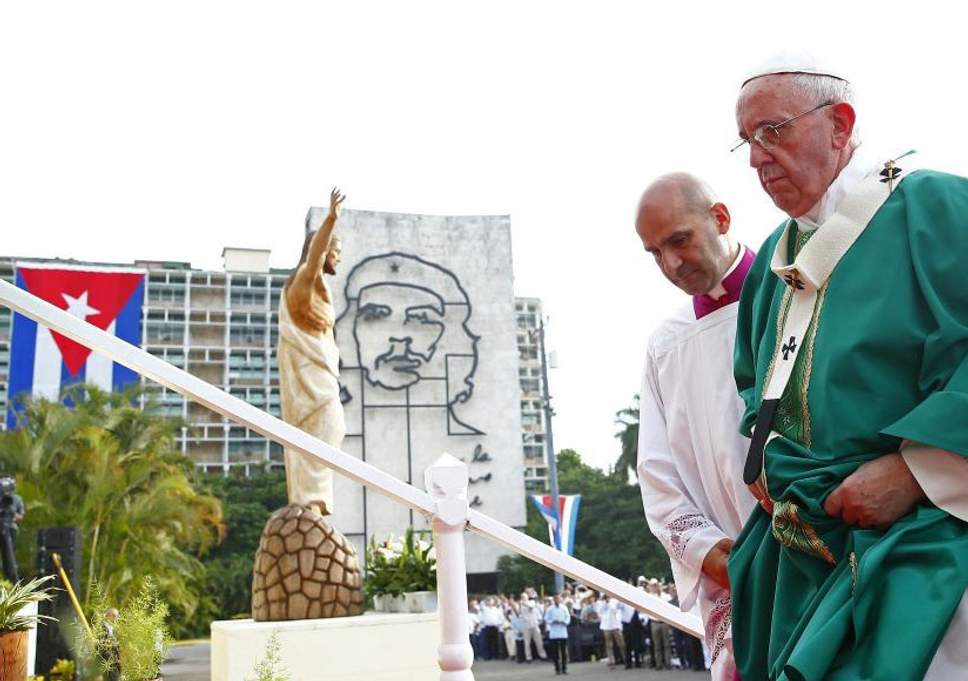
*Photo from Google, Pope Francis celebrating Mass in Havana during his pastoral visit there in 2015.

Jesus is a Radical

44157335_373059289901700_9121462066467569664_n
The Lord Is My Chef Sunday Recipe, Week XXIX-B, 21October 2018
Isaiah 53:10-11///Hebrews 4:14-16///Mark 10:35-45

             Twenty years ago, a popular brand of clothing came with shirts printed with the iconic face of Che Guevarra.  It was the most “in” or most cool to wear among teenagers though many of them knew nothing who Che Guevarra is.  In a newspaper interview, the marketing manager of the clothing company explained the image of the Cuban rebel leader perfectly fit their fashion sense that is supposed to be “revolutionary”.  It may sound funny and superficial but that is how we often see a rebel who is both a radical and a subversive trying to destabilize the status quo, even out to destroy everything to start a new beginning in government and society.

             But that is not the essence of the word radical which came from the Latin word “radix” that means “roots”.  To be radical means to go back to the roots of a belief or a system like in government and in religion.  So often, as the radical strives to go back to the roots of a belief or system, he is also labeled as subversive because of the need to overturn or remove false images and ideas to bring out the original sense.  Last Sunday during canonization of new saints led by Pope Paul VI and Salvadoran Archbishop Oscar Romero, Pope Francis said Jesus is a radical when He told a man to sell his possessions, give to the poor its proceeds and to come follow Him.  It was a very radical step because that is the very root of eternal life which is to leave everything behind for God.  And in that sense, indeed, Jesus is a radical and a subversive too.

             Jesus summoned them and said to them, “You know that those who are recognized as rulers over the Gentiles lord it over them, and their great ones make their authority over them felt.  But it shall not be so among you.  Rather, whoever wishes to be great among you will be the slave of all.  For the Son of Man did not come to be served but to serve and to give his life as a ransom for many.” (Mk.10:43-45)

             Keep in mind that Jesus is now approaching Jerusalem and had predicted for the final third time to the Twelve His coming Passion, Death, and Resurrection.  And He is intensifying too His teachings to His disciples and to us in these remaining six Sundays before we usher in Advent Season for Christmas next month.  In no uncertain terms, He clarifies today the true meaning of discipleship when the brothers James and John requested Him that they be seated beside Him when He reigns in glory.  The two brothers have not fully grasped the full meaning of the pasch of the Lord.  They have blindly followed Him because they knew He would triumph in the end and would want to ensure that they would not miss every bit of His victory.

             The same thing is true with us when sometimes we are like James and John, willing to suffer and bear all hardships in exchange of something so precious, of something that would greatly benefit us after all the sacrifices.  As we would say in Filipino, “hindi na bale, basta…” wherein there is always the overarching sense of rewards in every suffering.  No wonder, many politicians are willing to forego of any little sanity and dignity left in them, sacrifice everything and everyone including family and honor just to be elected into office because of the rewards.  The late Jesuit Fr. Thomas Green used to call this in his books as “humility with a hook” when people would “humbly” bear everything in exchange of a great personal favor.  In that case, there is no real suffering nor service or love at all!

             Jesus is asking us today to be radical in our being Christian, for us to go back to the very root of His mission, that is, save the world by dying on the cross.  And that means we cannot be His disciples and have access to salvation without sharing in His death in order to have a part in His resurrection.  This is the radical idea too of Isaiah’s oracle in the first reading when God said how through the suffering of His servant – the coming Christ – “shall justify many, and their guilt he shall bear.” (Is. 53:11)  Jesus on the cross is the supreme manifestation of the Father’s love for us all and the ultimate reason for all our hopes in life.  Therefore, like Christ, it is into the Father’s hands that we must entrust the future without expecting anything in return!  And this we can achieve if we go back again to our roots, to being like a child confidently trusting our parents that everything would be perfectly well in life.  Like a child, we must learn to believe and to love simply without thinking of how things would eventually turn out.  Like a child, let us simply love and just do it for love.  Period.

             To radically follow Jesus means we also have to subvert, that is, overturn all our ideas about Him and one another.  When Jesus spoke of His “baptism” and “cup of drink” to James and John, He was asking them and us today to cast away and forget all our human standards and conventions of discipleship as if we are entitled to anything at all.  That God blesses only people with comfortable and affluent life, that God loves only those who are good… these are not true!  If wealth and health are the true measures of the goodness of God, then He is not good at all because there are more people suffering financially, emotionally, physically and spiritually.  In fact, in my own experience and among many people, I would dare and radically claim that when we go through many sufferings, it means God trusts us so much that we can handle and bear such trials in life like His Son Jesus Christ on the Cross.  Rejoice when you are going through difficulties because God loves you and believes in you!  Remember that our relationship with Jesus and with one another is always based on a life of service, of servanthood wherein we try our best to make the world more humane as possible, enabling the kingdom of God to come.  It is so unlike the world where relationships are based on power and domination that many of our politicians have turned politics into a family business by creating political dynasties that ironically isolate them from others and from God.

              It is always difficult to live radically as a disciple of Christ but let us be consoled by the words of the author of the Letter to the Hebrews who said we have in Jesus a high priest who “has similarly been tested in every way” (Heb.14:15) like us so that when discipleship becomes so difficult for us, “let us confidently approach the throne of grace to receive mercy and to find grace for timely help.” (Heb.4:16)  This Sunday, let us not be afraid to go back to our roots in God through Jesus Christ who abandoned everything into the Father’s hands to be a servant of everyone.  Let us be radical in our love and service for one another.  A blessed Sunday to everyone!  AMEN. Fr. Nicanor F. Lalog II, Parokya ni San Juan Apostol at Ebanghelista, Gov. F. Halili Ave., Bagbaguin, Sta. Maria, Bulacan 3022.  Email:  lordmychef@gmail.com

*Photo by my former student at ICSB-Malolos, Arch. Philip Santiago at the Basilica della Santissima Trinita, Fatima, Portugal, October 2018.  Used with permission.

We Are Evangelists of the Lord

St.Luke
The Lord Is My Chef Breakfast Recipe-Prayer
Thursday//18October2018//Feast of St. Luke, Evangelist
2Timothy 4:10-17///Luke 10:1-9

             Today we thank you O Lord for opening our eyes through St. Luke in showing to us that what we need most in this world are people who would reveal to us and enable us to experience the mystery of your coming and presence among us.  You never told us to pray for more machines or technology, more gadgets or more money for the abundant harvest.  What we need are people – laborers – or evangelists who would write with their lives your gospel of love, your gospel of life like St. Luke.

             “The harvest is abundant but the laborers are few; so ask the master of the harvest to send out laborers for his harvest.” (Lk.10:2)

             Of your four evangelists, only St. Luke made known to us how he had “decided, after investigating everything accurately anew, to write it down in an orderly sequence” (Lk.1:3) everything about you and your teachings, O Lord.  With his life and writings, we were able to have a glimpse of the mysteries of your life especially stories of your Annunciation and Birth up to your presentation at the Temple that have endeared the Christmas season to us.

             It was St. Luke who always told us the many instances you have prayed to stress the need for an intimacy with God always in this life.  He was the only one who told us the beautiful Emmaus story that has been a constant reminder of Easter burning always within our hearts.  And it was also St. Luke who remarkably showed us how Mary has always been your model disciple until the Pentecost.

             Give us, Lord Jesus, the same grace as a laborer and an evangelist which is the ability to see and communicate God working in our lives daily in the power of the Holy Spirit.  AMEN. Fr. Nicanor F. Lalog II, Parokya ng San Juan Apostol at Ebanghelista, Gov. F. Halili Ave., Bagbaguin, Sta. Maria, Bulacan 3022. E-mail to lordmychef@gmail.com.

*Photo from Google: “Saint Luke Drawing the Virgin” by Flemish painter Roger van der Weyden (1400-1464).  It is one of the most important paintings from Europe in the United States now kept on display at the Museum of Fine Arts in Boston.  It is a very lovely and very interesting painting too!

“These Eyes” by The Guess Who (1969)

grayscale photo of jesus christ
Photo by Alem Sánchez on Pexels.com
LordMyChefSundayMusic//Week XXVIII-B//14October2018
Something’s Gotta Give

            Mark tells us something so beautiful about the scene in today’s gospel when a man approached Jesus to ask him what he must do to inherit eternal life.  After being told to obey the commandments, the man told Jesus he had kept all these since his youth.  Then, Mark tells us how Jesus looked at him, loved him and said to him, “You are lacking in one thing.  Go, sell what you have, and give to the poor and you will have treasure in heaven, then come follow me.”  At that statement his face fell, and he went away sad, for he had many possessions. (Mk.10:21-22)

            So many times in our lives it also happens that Jesus along with our loved ones would always look at us with eyes full of love, telling us to do something but we refuse due to our foolish pride.  So many times when Jesus and our loved ones give us the look of love, our faces also fall like that man in the gospel and we go away sad because we could not let go of things and people we feel more valuable than them.  And for those occasions when we could not look straight into the eyes of Jesus and our loved ones filled with love, here is our LordMyChef Sunday Music from The Guess Who’s classic “These Eyes” released in 1969.  The music and the lyrics, especially the vocals all make this so evocative that if I would make a movie about Jesus Christ, this song would definitely be a part of the soundtrack.  Happy listening and a blessed Sunday!

These eyes, cry every night for you
These arms, long to hold you again
The hurtings on me, yeah
I will never be free, no, my baby, no no
You gave a promise to me, yeah
And you broke it, and you broke it, oh no
These eyes watched you bring my world to an end
This heart could not accept and pretend
The hurtings on me, yeah
I will never be free, no, no, no
You took the vow with me, yeah
And you spoke it, and you spoke it, babe……..

Something’s Gotta Give

autumnkid
The Lord Is My Chef Sunday Recipe, Week XXVIII-B, 14October2018
Wisdom 7:7-11///Hebrews 4:12-13///Mark 10:17-30

            As Jesus was setting out on a journey, a man ran up, knelt down before him, and asked him, “Good teacher, what must I do to inherit eternal life?” (Mk.10:17)

            Each one of us can readily identify with this man because we all carry in our hearts the same question he had asked Jesus.  As we have reflected last Sunday, it is one of the FAQ’s of all time to Jesus next to the Pharisees’ “is it lawful for a husband to divorce his wife?”(Mk. 10: 2)  In our reflection last week, we also said how Jesus answered both questions by bringing us back to God who is our ultimate source and end in life.  Last Sunday, Jesus explained how God planned our relationships “in the beginning” when He created man and woman while today He tells us what to do to inherit eternal life.  So, what is to go back to God?

           First, going back to God to inherit eternal life is reading and studying the Sacred Scriptures prayerfully.  We always meet God in His words found in the Bible.  In enumerating to the man some of the commandments, Jesus reminds us to always consult and fulfill the Laws handed down by Moses in the Old Testament.  Moreover, the second reading today assures us that “the word of God is living and effective, sharper than any two-edged sword, penetrating even between soul and spirit, joints and marrow, and able to discern reflections and thoughts of the heart.  No creature is concealed from him, but everything is naked and exposed to the eyes of him to whom we must render an account.” (Heb.4:12-13)   His words are living because God is living for He Himself is life, personally speaking to us in the Sacred Scriptures!

            Second, going back to God to inherit eternal life is acting on His words by forgetting one’s self in Christ, taking our cross to follow Him.  It is not enough to desire God, to read and listen to His words.  Remember how Herod also loved to listen to the words by John the Baptist and later of Jesus Christ but never had the courage heed them.  We need to have courage to go back to God because He would always direct us to places and instances we never imagined as Jesus told Peter before His ascension at Tiberias.  See how Mark presented to us today the progression of the teaching of Jesus to that man.  Before replying to his question, Jesus chided him, “Why do you call me good?  No one is good but God alone.” (Mk.10:18)  Christ must have seen something deeper with this man that right away He directed him to God through His Laws as the answer to his question.  The man was sincere with his question, unlike the Pharisees last Sunday who asked only to “test” Jesus.  The Lord must have seen him as a possible disciple being a “just man of Israel” who was molded by observance to the Laws, truly searching and waiting for the Messiah and day of salvation.  Then, in a dramatic fashion as recorded by Mark, the Lord challenged him to leave everything behind for God:  Jesus, looking at him, loved him and said to him, “You are lacking in one thing.  Go, sell what you have, and give to the poor and you will have treasure in heaven; then come follow me.” (Mk.10:21)

            Oh how we are very much like that man again, when our faces would fall as we walk away sad from the loving face of Jesus because we could not give up so many possessions we value more than God!  Going back to God means “something’s gotta give” – are we willing to let go of ourselves and of our possessions to inherit eternal life?  In 2003, Jack Nicholson and Dianne Keaton starred in a movie called “Something’s Gotta Give” that is about giving up one’s self, offering some sacrifices to experience real love, real peace and real joy.  All the more are these true if we want to inherit eternal life when we choose God more than anything!  This was the reflection of the author of the Book of Wisdom in the first reading:  he had realized while in a progressive and affluent society of the Greek world at that time that everything in life fades and passes away except Wisdom which is the personification of God:  “Yet all good things together came to me in her company, and countless riches at her hands.” (Wis.7:11)

            Last Tuesday, there were two massive gatherings of people in the country:  one at the Manila Cathedral where the relic of the incorrupt heart of St. Padre Pio was venerated and the other were at the various lotto outlets scattered throughout our archipelago.  The sights have reminded me of Charles Dickens’ A Tale of Two Cities that perfectly describe them:  “It was the best of times, the worst of times, it was the age of wisdom, the age of foolishness, it was the epoch of belief, it was the epoch of incredulity… we had everything before us, we had nothing before us, we were all going direct to Heaven, we were all going direct the other way.”  What I just want to share here is the contrast of the scenes:  the people more concerned with life here on earth, of instantly becoming rich by hitting the one billion peso prize despite the odds of one in 40 million and those wishing for miracles who braved the sun and the rains for six hours just to get near the relic of the incorrupt heart of St. Pedro Pio.  There is nothing really wrong with betting in lotto and in venerating a relic; problem is when people see them as an end in itself, giving rise to “gambling mentality” and “spiritualization”.  The former is the attitude of some people wishing to get rich without working hard while the latter is a simplistic view on leap of faith.  Something’s gotta give if we want to be rich and be blessed!  But if we are wise, we would rather be working to inherit eternal life because it is something Christ has assured us already when He offered Himself on the Cross.“All things are possible for God” in the sense that He does everything to get us back with Him in heaven that is for everyone unlike winning the lotto that is so exclusive to just one or two winners.  How unwise that many of us would rather still do whatever is needed to win that elusive jackpot than have that assured salvation in Christ!

           When we come to consider everything, we realize that what we must really do to inherit eternal life is to be like children.  Twice in these past four weeks that Jesus had taught the need to be like children.  When we examine His life and teachings from His birth to His death and resurrection, everything in Jesus was being like a child, of abandoning His self completely to the Father like a child because “the kingdom of God belongs to children… whoever does not accept the kingdom of God like a child will not enter it.” (Mk.10:14-15)  Children teach us many lessons about giving up everything for the most valuable thing they can have.  This is the attitude Christ demands from us if we wish to join Him in His journey back to Jerusalem, back to God.  AMEN. Fr. Nicanor F. Lalog II, Parokya ni San Juan Apostol at Ebanghelista, Gov. F. Halili Ave., Bagbaguin, Sta. Maria, Bulacan 3022.  Email:  lordmychef@gmail.com

Photo from Google.


“Get Back” by The Beatles (1969)

Beatles-White-Album-Portraits
LordMyChefSundayMusic//Week XXVII-B//07October2018
Get Back to Whom We All Belong, God

            As I have told you in my earlier blog of how I have lately been feeling nostalgic of so many things with an urge to get back to the past, to the people and places and other fond memories including music (https://lordmychef.wordpress.com/2018/10/06/get-back-to-whom-we-all-belong-god/).  Maybe that is the usual route we take in this journey in life when we get back to everything and everyone in our lives so that we could get back inside our hearts to finally get back to God in the end.  It is not being morbid but simply being true.  Anyone who had lived half a century probably realize this too when we suddenly feel missing so many things in life as we have been so focused with our many pursuits in life.  And that is when we begin to slow down, to feel everything in life, rediscovering the beauty of prayer, silence, and stillness.  When we get back to our inner self, we also get back to God and that is when we get back right on track with life again.  Sometimes the key is to stop thinking so much and to start feeling more to understand more (https://lordmychef.wordpress.com/2018/10/05/knowing-too-much-understanding-too-little/).

             Next to God and prayer, music has always been my most faithful companion in life.  It just happens during and after meditations, a song or a tune would suddenly pop inside my mind and would keep playing in there for a few days that I have often incorporated them in my homilies and reflections.  Just like our LordMyChefSundayMusic today which I have chosen to be the title of my Sunday homily.  From the Beatles’ 1969 hit “Get Back” that became the closing track of their 1970 album Let It Be before they split, let’s rock n’ roll!  Amen!!!

Jojo was a man who thought he was a loner
But he knew it wouldn’t last
Jojo left his home in Tucson, Arizona
For some California grass

Get back, get back
Get back to where you once belonged
Get back, get back
Get back to where you once belonged
Get back Jojo, go home

Get back, get back
Back to where you once belonged
Get back, get back
Back to where you once belonged
Get back Jo

Sweet Loretta Martin thought she was a woman
But she was another man
All the girls around her say she’s got it coming
But she gets it while she can

Get back, get back
Get back to where you once belonged
Get back, get back
Get back to where you once belonged
Get back Loretta, go home

Get back, get back
Get back to where you once belonged
Get back, get back
Get back to where you once belonged

Get back, get back
Get back to where you once belonged
Get back, get back, get back

Get Back To Whom We All Belong, God

DSCF0895
The Lord Is My Chef Sunday Recipe, Week XXVII-B, 07 October 2018
Genesis 2:18-24///Hebrews 2:9-11///Mark 10:2-14

             Lately I have been having some strange feelings that I think probably comes with age as well as with the reality of my mortality.  Don’t get me wrong.  It is not about being morbid or depressed or whatever.  It is just a kind of feeling wishing every day is a “throwback Thursday” when I want to listen to old songs, see old friends and visit old places I have been to.  It is like singing the Beatles’ “Get Back” over and over again because that is the actual direction we all take eventually in life:  we get back to ourselves, back to our roots, back to everything and everyone, and most of all, back to God.

             Jesus Himself in our gospel these past weeks has been going to the same direction.  From Caesarea Philippi, He took a U-turn to go back to Jerusalem to fulfill His mission which is to get back the people to God.  After identifying Himself as the Messiah, Jesus held special lessons about discipleship with the Twelve until they reached Capernaum the other Sunday where they stayed in a “house”.  Today and next Sunday, Mark tells us how Jesus entertained some questions from the crowd that are very relevant even to our own time, divorce and how to gain eternal life.  In both instances, Jesus would bring us all back to God the Father for the answers.

             The Pharisees approached Jesus and asked, “Is it lawful for a husband to divorce his wife?”  They were testing him.  He said to them in reply, “What did Moses command you?”  They replied, Moses permitted a husband to write a bill of divorce and dismiss her.”  But Jesus told them, “Because of the hardness of your hearts he wrote you this commandment.  But from the beginning of creation, God made them male and female.  For this reason a man shall leave his father and mother and be joined to his wife, and the two shall become one flesh.  So they are no longer two but one flesh.  Therefore what God has joined together, no human being must separate.” (Mk.10:2-9)

             There we have it from the Lord Himself, loud and clear.  Jesus wants us to go back to the very roots and cause of our relationships, God.  More than the fidelity of husband and wife to each other, our gospel is reminding us to always see God as the foundation of the ties that bind us together as persons and communities.  More than the law and human situation, Jesus went back farther to God as the ultimate root and origin of everything in this life in explaining divorce to the Pharisees.  This explains why our first reading is taken from Genesis where it is shown how the sages of Old Testament reflected on the realities of life:  that everything happened because God the Creator willed it so “in the beginning.”  We came into being because of God, “male and female he created them.”  Most of all, it is very clear that it is not man who caused God to create woman for she has always been a part of His plan because “it is not good for man to be alone.  I will make a suitable partner for him.” (Gen. 2:18)  It is also God who is the reason why we get attracted and desire to enter into communion with others most especially in getting married.  Our relationships in general and marriage in particular are a part of the grand design of God; we come together because of God.  And we can only recover our original unity in God through man and woman, “that is why a man leaves his father and mother and clings to his wife, and the two of them become one flesh.” (Gen.2:24)  Human relationships must be governed by God and not by humans.  We also find in these short passages the beautiful vision of marriage and sexuality that drives man and woman toward union, not the impulse of a carnal and uncontrollable blind instinct.

            So many things happen that mar and destroy our relationships.  People change, even those in our family, in our circle of friends, and most especially with spouses.  Without being simplistic about it, Jesus tells us that one reason for this is “the hardness of our hearts” when we are filled with ego, when we refuse to love.  That imagery by the Lord of hardened hearts is timely as we venerate tomorrow the relic of the incorrupt heart of St. Padre Pio at UST.  I am not surprised that St. Padre Pio’s heart has remained incorrupt with the holiness he had shown especially with the sick and the sinners that his heart must be so filled with love of God.  A heart without love is a dead heart, a heart of stone that is hard and selfish.  And this is why I am not also surprised at all when arrogant creatures like politicians caught on camera shamelessly demeaning people later complained of chest pains after going viral in social media.  They are like the Pharisees with hardened hearts.

 A good friend recently wrote in his blog a beautiful reflection about the South African term “Ubuntu” that is very appropriate for us today as we experience divisions due to politics (https://relativejoyforyou.wordpress.com/2018/10/05/ubuntu/).  Ubuntu is the belief that we are defined by our compassion and kindness towards others.  According to my friend, there can be many other ways of defining or describing “Ubuntu” which I believe also rests on God being the very root and foundation of our relationships.  I recalled his blog as I prayed on our gospel this Sunday, especially that part when “in the house the disciples questioned Jesus about this.” (Mk.10:10)  I wish to direct your attention more to that going back in the house where they were staying which is for me an imagery of Jesus bringing back the Twelve into the very heart of God to explain the evils men do to destroy our wonderful ties and relationships.  And for the second time in three weeks, Jesus again would call children to tell the Twelve that “the kingdom of God belongs to such as these.  Amen, I say to you, whoever does not accept the kingdom of God like a child will not enter it.” (Mk.10:14-15)

                 Ubuntu is also a call to go back to our being children.  Two Sundays ago we reflected that the way we relate with children and women reflects our true relationship with God.  After explaining the nature of our relationships being rooted in God, Jesus “inside the house” again showed that the children embody the reality of our communion because only they can show true kindness and compassion, love and trust with one another.  Children have that unique gift of being “aware” of our single origin and unity in God.  By embracing children, Jesus is again inviting us to go back to the pristine image of holiness, of oneness with God and with others when we regard everyone as “brothers and sisters” in Christ. (Heb.2:11)  AMEN. Fr. Nicanor F. Lalog II, Parokya ni San Juan Apostol at Ebanghelista, Gov. F. Halili Ave., Bagbaguin, Sta. Maria, Bulacan 3022

Photo by Fr. Nick f. Lalog II, Wailing Wall of Jerusalem, April 2017.