Lent is greeting, announcing Christ

40 Shades of Lent by Fr. Nicanor F. Lalog II
Wednesday, Solemnity of the Annunciation of the Lord, 25 March 2026
Isaiah 7:10-14, 8:10 +++ Hebrews 10:4-10 +++ Luke 1:26-38
“Cestello Annunciation” by Botticelli painted in 1490; from en.wikipedia.org.

A friend informed me last Monday of the death of a former classmate in elementary named Nilo; his brother Mar had sent me a message asking me if I could possibly celebrate Mass at his wake: “A long time ago we met in a Mass in our Barrio chapel when you approached us and greeted ‘kumusta, Nilo, classmate!’ And I never forgot that smile on his face after you acknowledged him. Nilo was so happy with your coming to him… we will greatly appreciate if you can celebrate Mass for him in his wake.”

I was so touched with the message and despite my toxic schedule this week, I promised to come today to offer a Mass for Nilo.

That’s why while praying over today’s Solemnity of the Annunciation, I realized how in every greeting we also bring Jesus Christ, of how we make him present in others too.

In the sixth month, the angel Gabriel was sent from God to a town of Galilee called Nazareth, to a virgin betrothed to a man named Joseph, of the house of David, and the virgin’s name was Mary. And coming of her, he said, “Hail, full of grace! Then Lord is with you.” (Luke 1:26-28)

Photo by Ar. Philip Santiago, Annunciation Basilica in Nazareth, October 2025.

The Solemnity of the Annunciation of the Lord often falls in Lent, adding more meaning in our inner journey into our hearts to meet Christ in this blessed season.

Notice how in our Sunday and daily readings we find God greeting us, inviting us to come to him to set things right in our lives (Is.1:18). Here is a God so loving, pointing out our sins but never judging us but actually believing in us that we could change and be converted to become better persons.

The past three weeks have been so tiring but fulfilling for me as a university chaplain giving recollection and hearing confession later in our various university campuses. First thing I tell every penitent is how God is so happy with us when we come to the sacrament of reconciliation because he has long been waiting for us. God rejoices because we finally welcome him in our lives!

Though it could be painful and shameful to confess our many sins, it is actually the sign of grace working in us too because the moment we change our sinful ways, then we grow! When we see our sins, our weaknesses and limitations as humans yet still forge on in life to become better persons, to achieve greater things for others, that is God working in us.

That is why Luke tells us today how the angel greeted Mary during the annunciation using the Greek words “kaire” which is to rejoice and “charis” or “karis” for grace:  “Hail (or rejoice), full of grace!  The Lord is with you” (Lk.1:28). 

This is actually unusual because Jews greet each other with “shalom” for peace; why did Luke use kaire?

Because wherever and whenever there is grace, surely there is rejoicing like in those beautiful gospel stories we have heard the past three Sundays this Lent: the Samaritan woman, the healing of the man born blind, and the raising to life of Lazarus who had been dead for four days. In all these instances, it was Jesus Christ who came on his own to bring grace to everyone that everybody rejoiced.

Photo by Ar. Philip Santiago, Annunciation Basilica in Nazareth, October 2025.

Lent is the time to get real, to stop pretending. It is the time for us to finally admit our own limitations and weaknesses in order to create a space in our hearts and in our lives to let God fill us, to let God possess us. That is the purpose of the lenten practice of fasting.

Mary became the Mother of Jesus Christ not because of any special qualities in herself but simply because God is so good, so loving. Despite her fears and questions, she welcomed the angel Gabriel by saying “yes” to God’s plan of giving birth to the Messiah and Savior of mankind.

Can we be like Mary who said yes and allowed God’s power to “hover over us” to renew our lives in welcoming Jesus Christ? 

This was the problem of Isaiah with King Ahaz in the first reading who pretended to refusing God in asking for signs of his presence when actually he had already entered into alliances with other pagan kings in the region as the Babylonians were closing in them; he had doubted God already. Hence, Isaiah’s prophecy to insist that God is our protector: “Listen, O house of David! Is it not enough for you to weary men, must you also weary my God? Therefore the Lord himself will give you this sign: the virgin shall be with child, and bear a son, and shall name him Emmanuel: God is with us” (Is.7:13-14; 8:10).

Photo by cottonbro studio on Pexels.com

How sad that in this modern time when we rely more with our science and technology, we have not only shut out God from our lives but we have even refused to welcome him in his coming to us, asking us to open ourselves anew to him and his powers and plans. We have not only become impersonal but worst, we seem to have chosen death more than life, darkness than light. Just check on the news going on everywhere and we see how heartless we have become.

The late American spiritual writer and monk Thomas Merton rightly said, “We live in a time of no room, which is the time of the end.  The time when everyone is obsessed with lack of time, lack of space, with saving time, conquering space… The primordial blessing, ‘increase and multiply’ has suddenly become a hemorrhage of terror… In the time of the end there is no longer room for the desire to go on living.  Why?  Because they are part of a proliferation of life that is not fully alive, it is programmed for death” (Raids on the Unspeakable, pp. 70-72).

What a tragedy in our modern time when we are supposed to be more intelligent with so many inventions, more affluent with so many money, more real with everything being shown in social media, the more we are empty and lost. Our communications are all mass mediated, no more person to person that is warm, so filled with life that is vibrant and dynamic giving us so much reasons to believe, to love, to hope in life and the future.

The Solemnity of the Lord reminds us today of God’s coming among us like one of us in everything except sin. In Christ’s coming through the Blessed Virgin Mary, we are reminded how each one of us is a sign of God’s presence and coming. Every time we greet one another, every time we reach out to others in love and kindness, every time we are one with others especially the marginalized and neglected, we do the will of God (second reading) and become an Emmanuel, a God-is-with-us. Amen.

Photo by author, Sacred Heart Novitiate, Novaliches, QC, 20 March 2026.

The problem with our greetings

The Lord Is My Chef Daily Recipe for the Soul by Fr. Nicanor F. Lalog II
Monday, Solemnity of the Assumption of the Blessed Virgin Mary, 15 August 2022
Revelation 11:19, 12:1-6, 10 ><}}}*> 1 Corinthians 15:20-27 ><}}}*> Luke 1:39-56
Photo by author, view of sunrise from Our Lady of Fatima University in Antipolo City, 14 August 2022.

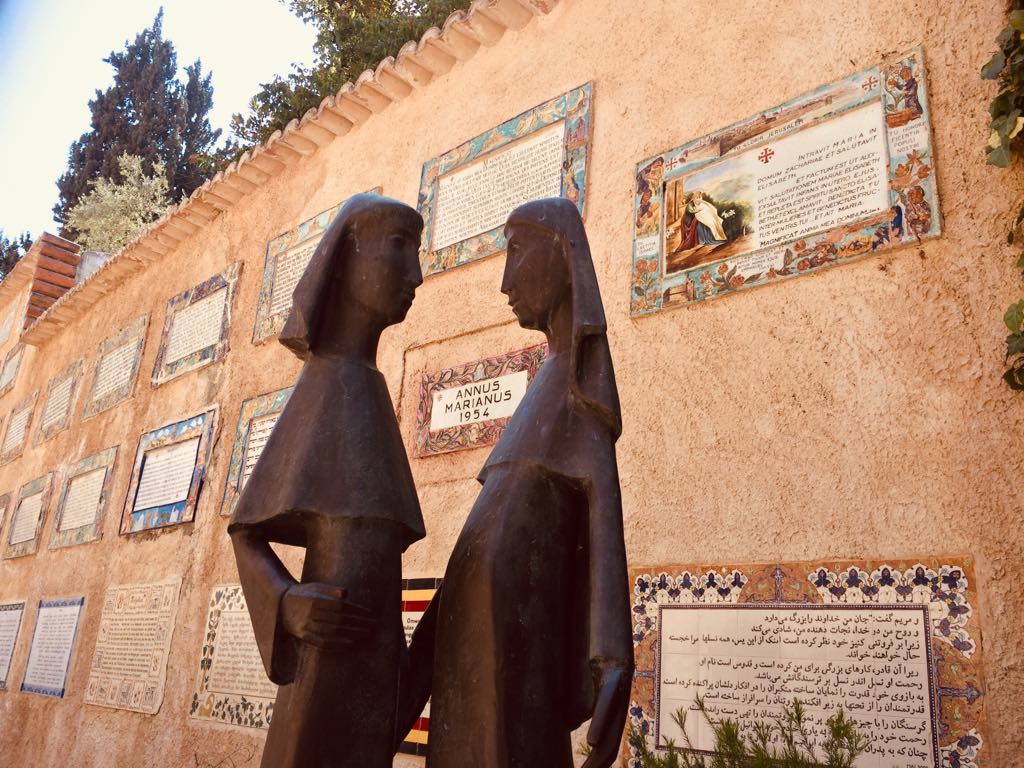
It is very rare to find in the Bible a story of two women together, conversing, blessing each other. And that rarity happens in our gospel scene today of the Visitation of Mary to her cousin Elizabeth in a town in Judah as we celebrate the Solemnity of the Assumption of Mary.

What kind of greeting did Mary say that when Elizabeth heard her, the child in her womb leaped in joy, filling her with the Holy Spirit to call Mary blessed? This could have not been any ordinary greeting to elicit such a response from Elizabeth, for her to be filled by the Holy Spirit!

Luke does not tell us how Mary greeted Elizabeth who was six months pregnant at that time with John the Baptist, the forerunner of Jesus who was also in the womb of Mary at that time. Most likely, she must have said something too close or similar with Gabriel’s greeting to her during the Annunciation, “Hail favored one! The Lord is with you” (Lk.1:28).


As we await of that future glory, 
part of the basis for our assumption
 into heaven like Mary someday depends 
 in the way we greet others because 
that is an indication of our generosity 
and selflessness to a great extent.

Perhaps some of you are wondering why the Church is using this story of the Visitation on this Solemnity of the Assumption of the Blessed Virgin Mary. One reason is of course, there is no written account of the Assumption of Mary into heaven.

However, the Visitation story which includes Mary’s Canticle of the Magnificat that she sang as a response to Elizabeth’s praises reflects the meaning of the Assumption: it is a celebration of the great things that God has done for Mary and for us including which he would also do in the future like our “assumption” into heaven like we profess every Sunday in the Apostles’ Creed, “the resurrection of body and life everlasting.”

“The Assumption of the Virgin” by Italian Renaissance painter Titian completed in 1518 for the main altar of Frari church in Venice. Photo from en.wikipedia.org.

Mary became the first human to experience fully the salvation by her Son Jesus Christ, from her Immaculate Conception which speaks of our lost glory from the beginning, and unto her Assumption which promises us of the future glory we shall have in heaven.

As we await of that future glory, part of the basis for our assumption into heaven like Mary someday depends in the way we greet others because that is an indication of our generosity and selflessness to a great extent.

When Elizabeth heard Mary’s greeting, the infant leaped in her womb, and Elizabeth, filled with the Holy Spirit, cried out in a loud voice and said, “Blessed are you among women, and blessed is the fruit of your womb. Blessed are you who believed that what was spoken to you by the Lord would be fulfilled.”

Luke 1:41-42, 45

To greet is to recognize God working in us, among us.  
It is thinking more of the other person and God than one's self.

Have you noticed these past several years of a silly and inane trend especially in many churches of commentators greeting the congregation with “Magandang umaga po sa ating lahat” or “Good morning to us all”?

What kind of a greeting is that?

To greet somebody is to share something with others. In the Visitation, Mary shared Jesus Christ who was in her womb to Elizabeth that even John in her womb felt him, leaping for joy.

To greet means to extend goodwill to someone, to desire blessings and good things to others.

That was the reason Mary went to visit Elizabeth; she was thinking more of her cousin who was old and barren yet pregnant for six months by the grace of God. Mary visited Elizabeth to affirm the goodness and kindness of God, to recognize that God’s plans for Elizabeth and her baby in her womb have direct correlations with God’s plans for her and her baby in the womb, Jesus.

To greet is to recognize God working in us, among us. It is thinking more of the other person and God than one’s self.

Now, how did it happen that we Filipinos have retrogressed especially in our religious gatherings as well as civic activities when those holding the mic would always say, “Magandang gabi sa ating lahat… Pagpalain tayong lahat ng Diyos” (Good evening to us all or May we all be blessed)?

Photo by author, Church of the Visitation, Ein-Karem, Holy Land, May 2017.

Keep in mind the greeter is sharing what he/she has like a “good morning” or a “blessed day”. Then why is it there are so many among us especially commentators who include their very selves when greeting the congregation, saying “good morning to us all” and other inanities?

To greet others where the greeter includes self in the greeting is like giving a sandwich or coffee to everyone yet takes a bite first or sips too! It is very much the same as replying “me too” when someone tells you “I love you”.

If you include yourself in a greeting, it is not a greeting at all but an insult, a clear sign of callous ego and selfishness to the highest degree that one cannot wait for others to be greeted back.

See the humility and wisdom of Mary: after she had greeted Elizabeth who praised her in return by calling her “blessed” – the first to call her as one – Mary praised God. Not Elizabeth.

When we greet anybody with good morning or good evening or whatever, we do not include ourselves in the greeting because the very fact we are greeting others means we have a lot of good and blessings in us. Like Mary and Elizabeth, we feel so blessed by God that we share Jesus freely to others. Like Mary, we believe and trust that God will never forsake us, will never forget us.

If we can’t even greet somebody so well and so freely, how can we be truly Christian like Mary?

Photo by author in Nazareth, Israel, May 2019.

The Solemnity of the Assumption reminds us today of that great and powerful greeting by Mary to her cousin Elizabeth that led to an encounter and revelation to happen between two women, one old and barren to bear a child with the other too young and unmarried virgin yet both bore children in their wombs by the grace of God.

And it was not just an encounter between the two mothers-to-be but also between their two infants still in their wombs!

In their greetings, God’s mighty deeds became evident, truly present and felt through their mutual exchange of believing, of saying “yes” to Jesus.

The blessedness of this celebration today is found in God’s mighty deeds now resounding in the eternal greeting Mary gives her Son Jesus in heaven.

Photo by author, sunset with the Makati skyline from Antipolo City, 13 August 2022.

Do we hear Mary’s greetings in our own greetings to one another?

Do our greetings elicit responses from others?

Do our greetings lead others to leap for joy?

Or, do our greetings annoy them because we do not greet them at all, we refuse to share Jesus because we have become too conceited?

How can we be assumed into heaven body and soul if we are so filled with our very selves, when we can’t even freely and truly give away greetings to others?

Then, it must be a case of too much presumptions, of assuming everything for us. Amen.

Have a blessed week ahead everyone!