Living As God’s Children

49234257_542308659606249_5909495384316575744_n
The Lord Is My Chef Sunday Recipe, 20 January 2019
Feast of the Sto. Nino, Week II, Year C
Isaiah 9:1-6///Ephesians 1:3-6, 15-18///Luke 2:41-52

            Sometimes when we look at our religious celebrations we get the impression that we as a people seem to be very ritualistic and even fanatics.  But, on deeper examinations, we find in these feasts the expressions of our deep faith nurtured through our history and culture as a nation by God’s invisible hand.  A perfect example is today’s Feast of the Sto. Nino celebrated every third Sunday of January that is proper only to our country in recognition of the important role played by the image of the Child Jesus in our Christianization almost 500 years ago.  All the readings and prayers of today’s Mass are taken from Christmas Season even if we are already in the Second Sunday of Ordinary Time because the Sto. Nino is an extension of Christmas.  Recall also that two weeks ago right after the Epiphany of the Lord we have celebrated the Traslacion in Quiapo featuring the adult Jesus Christ carrying the Cross more known as the Black Nazarene.  They are the two most popular Christ devotions in our country that every region and province, town and barrio up to the smallest sitio has its own version of celebrating Traslacion and/or Sto. Nino.  In both devotions we find the finest examples of our vibrant faith in Jesus Christ who became like us in everything except sin in order to save us, heal us, and bring us closer with one another as one big family with God as our Father.  And in both devotions too, Christ calls us to continue living into our adulthood as God’s little children like Him the Sto. Nino and the Black Nazarene.

            After three days of searching, Mary and Joseph found the 12 year-old child Jesus at the Temple and he said to them, “Why were you looking for me?  Did you not know that I must be in my Father’s house?”  But they did not understand what he said to them.  He went down with them and came to Nazareth, and was obedient to them; and his mother kept all these things in her heart.  And Jesus advanced in wisdom and age and favor before God and man (Lk. 2:51-52). 

           From His childhood into His adulthood, Jesus remained a child of His heavenly Father and of His parents Mary and Joseph.  In this scene on His finding at the temple, we again see the centrality of Christ’s teaching of remaining like a child in order to belong to the kingdom of heaven.  And it was not only Him who showed it in this short account by St. Luke but also Mary and Joseph who “both did not understand” what Jesus had told them but still took care of Him very well as “He advanced in wisdom and age and favor before God and man.”  Here we find the importance of love in remaining children of God as shown by the deep love among the members of the Holy Family that is rooted in the Father’s love.  Notice how in this age of so much advancement in technologies that we have become more technical than personal, love has also suffered so greatly.  It is not only abused and misused but most of all, misunderstood.  Love has become a commodity that people think could be had simply and instantly like anything in a store or a vending machine, forgetting that love is more than a feeling but a decision we must keep.  Most of all, love is a choice we make by choosing what is most painful and most difficult because true love is found only on the Cross of Christ.

            This is what I am telling you at the beginning, the seemingly funny or weird flow of our celebrations after Christmas:  Traslacion and then Sto. Nino that are both anchored on love of God that did not merely happen in Christ’s birth and coming but most of all in His suffering and death on the Cross.  Love is often symbolized by the heart but its total meaning can only be found in the great sign of the Cross where we can find the perfect expression of Christian “childlikeness” and Christian maturity.  Recall how Jesus on the Cross remained a child of the Father to whom He entrusted His total self while at the same time remained faithful to His mission, resolutely going to Jerusalem to face His fate as a matured adult.  That is love when we can be tender and docile to our beloved and at the same time stand our ground to keep our promise, no matter what or how painful it could be.  It is a love until the end that is always willing to share and give, never thinking of anything in return.

              To be able to love like a child and remain loving as a matured adult like Jesus Christ, we need to always live in the present moment.  God revealed Himself to Moses as “I AM WHO AM” while in the gospels particularly in John’s, we find Jesus always declaring the great “I AM” as the Resurrection and life, the way, the truth and the life, as well as the good shepherd and the true vine.  God is love because He is always in the here and now, the present, not in the past and not in the future.  See how a child always has a time to take time as it comes, one day at a time, so calmly without advance planning and thinking or greedy hoarding of time.  Unlike us adults, we need planners and schedules to follow, finding or making time like a sausage to be sliced into portions to be eaten at a desired time.  Kids always live in the fullness of time like a cup of milk or water that has everything that for them, any time is a time to sleep, a time to eat, a time to play.  And that is why they love all the time!  We adults are so pressured and stressed that even in loving others and especially God, we always bargain with time as if it can be done.  We love to postpone time because we are not yet ready, even refusing to move on as we dwell with our painful past.  Remember the warning of Jesus that nobody knows the time when He shall come that we must always be on guard and ready for that time by always loving God and others all the time.  Recall our quotation last week that says, “For people who rush, time is fast; for people who wait, time is slow; but, for people who love, time is not.”  A child of God lives in the present because he knows, like Jesus Christ, every moment is the fullness of time we must receive with gratitude because in every present moment we have everything.  This is totally different from the young people’s concept of “YOLO” that is actually about living in the future now being advanced without realizing the beautiful present moment.

             To be a child of God like the Senor Sto. Nino is to walk in the “great light” of Christ, our “Wonder-counselor, God-hero, Father-forever, and Prince of Peace” (Is.9:1,5) who calls us to love every moment of our lives by living in the present.  May Jesus “enlighten the eyes of our hearts that we may know what is the hope that belongs to his call, what are the riches of glory in his inheritance among the holy ones” (Eph.1:18).  AMEN.  Fr. Nicanor F. Lalog II, Parokya ng San Juan Apostol at Ebanghelista, Gov. F. Halili Ave., Bagbaguin, Sta. Maria, Bulacan.

*Photo is a painting of Sto. Nino devotees by Bulakenyo artist Aris Bagtas.  Used with permission.
This 2019, Handle Life with Prayer

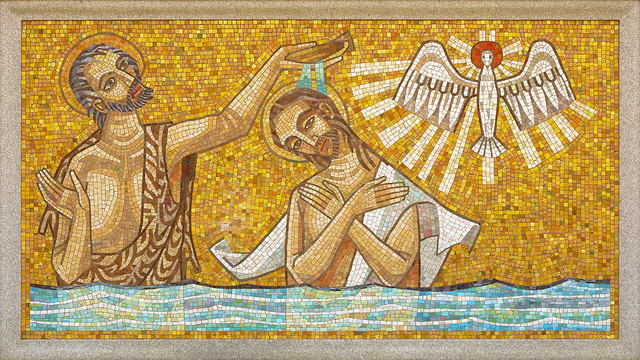
baptismjesus
The Lord Is My Chef Sunday Recipe
Feast of the Baptism of the Lord, 13 January 2019
Isaiah 40:1-5, 9-10///Titus 2:11-14; 3:4-7///Luke 3:15-16, 21-22

            Today is the last Sunday of the Christmas season that closes with the Feast of the Baptism of the Lord.  But that does not mean we stop celebrating the coming of Jesus Christ.  In fact, this feast of His baptism reminds us of the great importance of praying daily to celebrate His coming the whole year through.

            The people were filled with expectation… After all the people had been baptized and Jesus had also been baptized and was praying, heaven was opened and the Holy Spirit descended upon him in bodily form like a dove.  And a voice came from heaven, “You are my beloved Son; with you I am well pleased” (Lk.3:15, 21-22).

            One thing we shall notice this year when St. Luke guides us in our gospel every Sunday is how he always presents Jesus Christ at prayer like here at His baptism.  Only St. Luke records this detail that Jesus was praying after His baptism when the “heaven was opened.”  That is the meaning of Christmas, the opening of heaven for us through Christ’s coming after it was closed when Adam and Eve were banished following their Fall.  See how St. Luke situated the Lord’s baptism like his Christmas story to show us that Jesus lived at a specific time and period in history, that He had really come!  “In the fifteenth year of the reign of Tiberius Caesar, when Pontius Pilate was governor of Judea, and Herod was tetrarch of Galilee, and his brother Philip tetrarch of the region of Iturea and Trachonitis, and Lysanias was tetrarch of Abilene, during the high priesthood of Annas and Caiaphas” (Lk.3:1-2).

            The same is very true today in our own time.  In this specific period when everything seems to be so dark and in disarray, when we are filled with expectation after a long period when God had seemed forgotten us, suddenly there comes a voice in the wilderness, not in the desert of Jordan but right here inside our hearts of new hope, new beginnings this 2019!  Jesus had opened heaven with His coming to us more than 2000 years ago and He continues to call us to come to Him, to be one with Him and be in Him.  He is here inside our hearts inviting us to open up with Him, to converse with Him, to speak to Him and to hear Him in the context of prayer.  This feast of the Baptism of the Lord reminds us of that invitation from God for us to open up to Him too because He is now more accessible to us than ever in Christ.  In becoming human like us in everything except in sin, Jesus brought God nearer to us that we can converse with Him to air our concerns and innermost feelings to Him.  Most of all, experience in prayer God’s great love for us when we listen to His voice and heed His calls to discover far more great things in this life than we have ever imagined!  Why waste this great grace in Him?

               Second reason why we need to handle life with prayer is because it purifies us, cleanses us like the waters of the river.  Jesus need not be baptized because He has no sins; but, He chose to be baptized by John to show His solidarity with us sinners.  This is the main point of the prophecy by Isaiah in the first reading as well as the letter of St. Paul to Titus:  Jesus is the mercy of the Father to us sinners who had come to expiate our sins by taking upon Himself – the sinless one – our sins.  It is very sad that fewer people are now praying in the real sense because many of us have lost that sense of sinfulness.  Everything has become relative especially morality as if everything is now acceptable and therefore, nothing is sinful.  When people refuse to see and accept their sinfulness, when they feel being sinless, then they start acting like God, even claiming to be the Messiah and stop praying altogether.  We pray because we are sinful, because we have failed in doing what is right and what is good.  We pray to be cleansed of our sinfulness so we can be with Jesus to follow and imitate Him.  Real prayer happens when we admit before God our sins to be purified in Him.

                   Most of all, we have to pray always because life is difficult.  After the scene of the baptism of Jesus at Jordan, the next chapter tells us about His temptation by the devil in the wilderness.  After the long Christmas vacation, almost everybody had gone back to “reality of life”, of work and studies, of constant struggles and sufferings as well as sacrifices.  Jesus came to the world to help us in this life, calling us to come to Him for His yoke is easy and His burden is light.  That is the beautiful symbolism of Jesus plunging into Jordan.  For the Jewish thought, bodies of water like the sea, the lake and the river are symbols of the nether world, of the powers of darkness and evil.  When Jesus plunged into Jordan River and when He walked on water, they both mean the power of Jesus over darkness and sins.  That is why we pray to be purified, to be cleansed from our sins.  Now, flowing river is symbolic of life in the Old Testament as attested by the Nile in Egypt, the Tigris-Euphrates in Babylonia, and the Jordan in Israel.  There is always the danger of losing one’s life in the river especially when it is swollen but at the same time, there is also the abundance of life from its waters that nourish plants and teem with marine life.  Jesus choosing to be baptized at Jordan River tells us His coming to us in our lives marked with many dangers as well as with opportunities.  In fact, right in His baptism at Jordan, Jesus was already giving us a hint at the inauguration of His ministry about His coming Passion, Death and Resurrection symbolized by the river.  We all know this too for sure that great opportunities await us this 2019 but we all know we can attain these all if we are willing to take the plunge and meet head on the many challenges that would entail sacrifices and pains on our part.  Life is very much like a river and the good news is Jesus is here with us to help us and assure us of being fruitful if we can open to God in prayer.

            Every morning when we wake up, the heavens open with the Father telling us that due to the oneness of Christ with us, we too are His beloved children with whom He is well pleased.  Noteworthy in this part how St. Luke inserted after Christ’s baptism his version of the genealogy of Jesus, starting it backwards to end up with Adam, “the son of God” (Lk.3:38).  Aside from showing us the humanity of Jesus, St. Luke fittingly closed his baptism account of reminding us how in the Lord we have become God’s children too.  And that is enough reason for us to always pray not only because God converses with us and we need to be purified of our sins but most of all because we are the children of the Father in Christ Jesus.  With that in our minds and in our hearts, 2019 looks so promising indeed!  AMEN.  Fr. Nicanor F. Lalog II, Parokya ng San Juan Apostol at Ebanghelista, Gov. F. Halili Ave., Bagbaguin, Sta. Maria, Bulacan.

*Photos from Google.

fultonsheen

Epiphany: New Beginnings in Christ

wise-men-still-seek-him-1-728
The Lord Is My Chef Sunday Recipe
Solemnity of the Epiphany of the Lord, 06 January 2019
Isaiah 60:1-6///Ephesians 3:2-3, 5-6///Matthew 2:1-12

            Metro Manila’s main thoroughfare is called EDSA for Epifanio delos Santos Avenue.  Its namesake is a famous scholar from the province of Rizal whose name means “manifestation” or “appearance” from the Greek epiphanes.  EDSA today may be considered as the epiphany of everything that is wrong in the country, from government inefficiency to people lacking in discipline and patriotism.  Mention the word EDSA and you feel sad and gloomy all of a sudden. On the other hand, the Epiphany we celebrate today brings joy and jubilation because it is the manifestation of the universal kingdom of Jesus Christ to the pagans symbolized by the magi from the East.  After the octave of Christmas, it is celebrated within this joyous season to remind us that while deep within each one of us is a natural search or inclination for God, it is actually God who looks for us and eventually finds us.  Though it is God who appears to us or “epiphanies” to us, we have to be like the magi who must look and find Him as well as lead others to Him too!

            When Jesus was born in Bethlehem of Judea, in the days of King Herod, behold, magi from the east arrived in Jerusalem, saying, “Where is the newborn king of the Jews?  We saw his star at its rising and have come to do him homage.” (Mt. 2:1-2)

            It takes a wise person to search for Jesus – and a wiser person to lead others to Him!  How sad that so many people today feel so lost and could not find the right directions to Jesus because as we have reflected last Christmas, there are so many of us who pretend to be the Christ.  When somebody comes to us, seeking comfort or counsel or simply company, do they find the newborn King in us?  When people come to our homes, do they experience Jesus in our family?  When people come to pray and celebrate the sacraments in our parish or chapel, do they find Christ present there among the people and the place itself?  How sad that so many churches are desecrated in the name of finding Christ among the people that we have allowed everything and everyone to disregard their sanctity with so much pomp and pageantry that tend to manifest more the pride and ego, or insecurities of those in charge of these sacred places.  People continue to search for that Bethlehem where they could find rest and comfort, solace and consolation in the newborn king Jesus Christ. The Epiphany of the Lord reminds us that Christ came to the world to be the fulfillment of everyone and He had become human like us in everything except sin so we can find Him easily.  There are many symbolisms that may be gleaned from these wise men representing us today.

            They are sometimes called as kings as attested from our first reading, “Rise up in splendor!  Your light has come, the glory of the Lord shines upon you… Nations shall walk by your light; kings by your shining radiance.  Caravans of camels shall fill you, dromedaries from Midian and Ephah; all from Sheba shall come bearing gold and frankincense, and proclaiming the praises of the Lord” (Is.60:1, 4, 6).  From this part of Isaiah’s prophecy we also got that picture of the three wise men travelling as kings from the farthest parts of the world of that time riding on camels to show that even the most powerful men of the world recognize Jesus as the King of Kings.  In our responsorial psalm today, we heard ancient places that extend from the extreme west like Tarshish which is in Tartessos, Spain up to the isles off the coast of Africa and the Middle East which is part of Asia to represent rulers of the world who would come to worship Christ.  Notice how these places mentioned in Isaiah and Psalms refer to the three continents known during that time, namely, Africa, Asia, and Europe symbolizing the whole world coming to Christ.  Some Church Fathers even preached that the three kings symbolize the three stages of our life where Christ leads and guides us:  youth, maturity and old age.  In whatever state or stage of life we are, true wisdom and peace can only be found in Christ Jesus regardless of our differences.

            But above all of these we find that with the wise men coming from the East where the sun rises is that they show us the Epiphany as a new beginning in our lives.  The magi represent our inner journey in life to find and follow Jesus Christ.  Last year, I have dwelt a lot in that realization that life is more of a directional than a destination.  What matters most in life is that we keep on following Jesus Christ our light, our star.  That is direction, where He is leading us.  It never stops.  We just keep on following Him until we reach our final destination in heaven for we are all “coheirs, members of the same body, and copartners in the promise in Christ Jesus through the gospel” (Eph. 3:6).  This direction we have to follow in life never stops for the discovery of God is not the end but the beginning of a journey.  And in this journey in Jesus Christ, we do not simply go as followers but are expected to eventually become believers too.  Matthew noted at the end of the gospel today how the magi“departed for their country by another way” (Mt. 2: 12), meaning they have become believers eventually of Christ.  Their lives have changed and must have never been the same as before after finding Jesus because they have believed.  That is their big advantage and difference with Herod and the experts of Jerusalem who knew everything about the Messiah being born in Bethlehem but refused to believe Him.  This is the danger with us today:  many Christians today are mere followers but not wise enough to be believers of Christ.

            Like those young people aspiring to follow their stars at GMA-7’s talent search program “StarStruck”, we also need to dream, believe,and survive.  We all dream to be fulfilled in life.  And every lofty dream is always from above, from God as Matthew told us this Christmas the dreams of Joseph and now the dream of the magi.  It is said that those who dream with their eyes wide open are the real dreamers, the trailblazers who change the world.  That is because they did not only believe in their dreams and with themselves but most of all, they believed in God.  On this Solemnity of the Epiphany of the Lord, He is inviting us to dream and believe so that we may live fully in Him.  Every day is a new beginning to search and follow and believe Jesus Christ our light.  Today we are given with over 350 days to begin anew in Jesus.  Be wise.  Search Him.  Follow Him.  Believe Him.  Happy Epiphany of the Lord! AMEN. Fr. Nicanor F. Lalog II, Parokya ng San Juan Apostol at Ebanghelista, Gov. F. Halili Ave., Bagbaguin, Sta. Maria, Bulacan

*Photos from Google.

starstruck

Meeting Jesus in 2019 with Mary

49114007_268477453833709_8702178554349092864_n
The Lord Is My Chef New Year Recipe
Solemnity of Mary, Mother of God, 01 January 2019
Numbers 6:22-27///Galatians 4:4-7///Luke 2:16-21

            One of my favorite sayings came from the waiting the room of our former family dentist Dr. Eddie Calalec of Meycauyan, Bulacan that says, “Time is fast for those who rush; Time is slow for those who wait; but, Time is NOT for those who love.”  We all complain of time being so fast.  Everybody is always in a hurry.  According to an elderly man I have talked to a couple of years ago, time moves so fast these days because people are always busy.  He explained that before, time was so slow because after farming earlier that day, they just waited for sunset and for time of harvest.  Life was so laid back at that time that truly time was so slow.  But life is not about time being fast or slow but of love.  The Church rightly celebrates today not the New Year which is time; remember that we celebrated the new year in the Church calendar last first Sunday of Advent.  Today we are celebrating the Solemnity of Mary, Mother of God to celebrate her great love for Jesus that we hope to emulate this 2019.

             Mary embodies the whole meaning of that saying “TIME is not for those who love” as she presents to us not only the first but the perfect disciple of Jesus who loves Him so much.  St. Paul beautifully expressed in the second reading when time is not because of love which is “the fullness of time” (Gal.4:4).  When we love, there is fullness of time as if everything is suspended in animation, everything is frozen.  Every man who had courted any woman knows this very well of how time freezes when conversing with a beloved, not realizing the passing of time.  Old couples experience the same thing and so are good friends who could “waste” time together doing nothing, saying nothing to one another that after a few hours are all surprised at how long we have been together.  Time and space cease to bound people who truly love.  And that is why“if you want to be eternal, then, love” like God.

             People who love are always in haste not to do things or accomplish tasks but to be with their loved ones.  Luke tells us how “The shepherds went in haste to Bethlehem and found Mary and Joseph, and the infant lying in the manger” (Lk.2:16) after a heavenly host of angels proclaimed to them the good news of the birth of Jesus Christ.  We also heard from Luke during our Simbang Gabi after the annunciation of the birth of Jesus when “Mary set out and travelled to the hill country in haste to a town of Judah” (Lk.1: 39).  This is the kind of haste – to come quickly to meet God, to be with a beloved, dear one – that is slowly fading away among us in this crazy world always on a mad race.  Everybody is rushing, running around, multitasking to accomplish so much that deplete us of energy even of time to be with our loved ones.  Many parents are guilty of this who turn nights into days making money to send their kids into expensive schools because of love; yet, when you ask them to attend a school meeting, to get the card of their children, they send the grandparents or nannies because they are busy at work.  More so with God as seen in the steady decrease of Mass attendance with people coming in late and then rushing to leave for meals and other things.  And admittedly, this is partly because so many priests are also in a rush to celebrate more masses and sacraments sadly for the wrong reasons and most of all, many of us could not share Jesus in homilies because we could not even come to Him for prayers.  It is simply a case of lack of any concern for God despite professions of faith or belief in Him.  Would we be like the shepherds if a host of angels appear tonight or today to tell us where Jesus Christ is?  Would we go in haste to find God, to meet God?  Would we be in haste to be with our loved ones, really?

         In this age of instant connections and social media via modern communications, actual meetings and coming together person to person have been replaced by mediated interactions.  We hardly experience anyone’s presence anymore that relationships have become superficial without any depths and meaning at all.  There is always the TV and the gadgets to entertain everyone, forgetting the tremendous blessing of everyone’s presence.  In the first reading we heard how God instructed Moses and Aaron to bless the people whenever they gather because every human presence is a blessing, a gift or a present.  And the highest blessing we can all have is the presence of God among us in Christ Jesus!  Mary as the Mother of Jesus is teaching us today that God is always present within us and with one another.  Let us not waste our time rushing for so many things that we only realize the giftedness of everyone most especially of our very selves when we are already old or sick.  Mary as the Mother of God and our Mother too shows us the need to always be in haste to meet Jesus right here inside us for He is here to stay with us, to be with us for the next 365 days of 2019, come rain or shine, no matter what.  AMENFr. Nicanor F. Lalog II, Parokya ng San Juan Apostol at Ebanghelista, Gov. F. Halili Ave., Bagbaguin, Sta. Maria, Bulacan.

Photo of another painting by Bulakenyo visual artist Aris Bagtas depicting Mary with the child Jesus in lively colors, going out perhaps to meet the rainy new year.  Used with permission.

On Becoming Children of God

JimMarpa9m
The Lord Is My Chef Sunday Recipe
Feast of the Holy Family, 30 December 2018
1 Samuel 1:20-22, 24-28///1 John 3:1-2, 21-24///Luke 2:41-52

         Christmas reminds us that Jesus Christ comes through our family in the same manner He came through the husband and wife of Joseph and Mary.  It is right and fitting that within the octave or eight days of Christmas we also celebrate this Sunday the Feast of the Holy Family.  In this world of broken families, by choice or by circumstances, the gospel reminds us that a family is always made up of a father, mother and child:  When his parents saw him, they were astonished, and his mother said to him, “Son, why have you done this to us?  Your father and I have been looking for you with great anxiety” (Lk.2:48).  But more than our human families, Christmas reminds us most of all of our being a family of God with Him as our Father:  And he said to them, “Why were you looking for me?  Did you not know that I must be in my Father’s house?”  But they did not understand what he said to them.  He went down with them and came to Nazareth, and was obedient to them; and his mother kept all these things in her heart.  And Jesus advanced in wisdom and age and favor before God and man (Lk.2:49-52).

         The good news is that we all remain God’s children no matter how old we may be like Nat King Cole singing “to kids from one to ninety-two” which the beloved disciple reminds us in the second reading,  “Beloved:  See what love the Father has bestowed on us that we may be called the children of God.  Yes so we are.  The reason the world does not know us is that it did not know him” (1Jn.3:1).  It is becoming disheartening when people claim that Christmas is for kids because of the superficial things about the season like happiness over gifts.  We seem to have forgotten that Christmas came because of adults like Joseph and Mary, Zechariah and Elizabeth who remained children of God in being obedient to His holy will which is at the very core of experiencing Christ’s coming not only on Christmas Day when we remain like children. This Sunday we are invited to join Mary and Joseph in searching for the child Jesus whom we have often lost in our busy schedules, responsibilities and careers so we may also rediscover in the process our being children of the Father in heaven.

         See the beauty of the response of Jesus to His parents upon finding Him at the temple, “Why were you looking for me?  Did you not know that I must be in my Father’s house?” (Lk.2: 49).  Though Jesus Christ is truly human like us in everything except sin, growing up and maturing in all aspects, His divine Sonship has always been clear with Him even as a 12 year-old child.  His intimacy with the Father was never lost in His becoming human.  His being the Son of the Father in heaven is the very core of His mission that we always hear Him telling us in His preaching about His being one with the Father and most of all, of the need for us to become children to be included in His kingdom.  This He reveals to us in three ways through this only episode about His childhood as recorded by St. Luke.  First is His complete freedom as a person.

         Jesus has always been free from so many conventions and rules even laws that limit humans from being totally free for God as Father.  Remember how Joseph His legal father also showed that true holiness is abiding in the Laws of Moses based on love that he decided to leave Mary in silence after learning of her pregnancy.  But after hearing the angel’s explanation in a dream, Joseph freely decided on himself based on his love for God, for Mary and for Jesus to take her as his wife.  How funny that when we were growing up we kept on demanding for freedom from our parents thinking that being free is being able to do whatever pleases us.  Then we realize that true freedom is choosing what is good, what is true.  That true freedom leads us to be more loving and faithful.  Too often it seems that as the world gives so much emphasis on freedom, the fact remains that the more we try to be free, the more we become unfree, finding ourselves imprisoned and caught up in too much binds and traps that most of us would always go somewhere to be alone, to have “me time” because we are not free deep within as we have forgotten our basic identity as beloved children of God the Father.  Jesus was so free that He stayed behind at the Temple because deep within Him he was at home at His Father’s house.  And deep within Him He spoke freely of His Father that amazed the experts with Him at the Temple because they were constricted with many concepts and thoughts about God when Jesus was so free to share the love He has inside.

          And here lies the beauty of true freedom that leads to amazement and wonder, to being surprised by something bigger, greater, and so beautiful.  Poets claim that children are the closest to God and the spiritual realms because they always have the sense of wonder and awe.  Even Mary and Joseph must have been amazed at the response of the child Jesus, reminding them of the announcements made to them by the angel before His coming.  In this age of Netflix and daily video streaming of everything, we are being robbed of the simple and deep joy of being surprised unlike when we were younger that we have to wait for the next series of the Knight Rider or Dallas or ChiPS.  With these modern technologies, the more we have become not free at all as we just follow the flow of networks, tech giants, advertisers and markets.  We have been imprisoned by economics and profits along with gimmicks that we miss life in the process.  The finding of Jesus at the Temple reminds us that our God is a God of surprises, that when we are truly free for the Father in heaven, there is always awe and amazement with life.  We live and do not rush, enjoying time and every present moment in life, unafraid of what would happen next.  Then, we become grateful or thankful for everything we have, material and spiritual.

         Every Sunday as children of God we gather in the Holy Mass we call Eucharist, the Greek word for thanksgiving.  In the first reading we have heard Hannah offering her son Samuel to the temple as her thanksgiving for the gift of a child after God answered her prayers.  The gospels teem with so many occasions when Jesus would pray often to praise and thank God His Father, even in public.  His life is a thanksgiving in itself that He gave it entirely to the Father for us.  Though I am not a beauty pageant expert, I feel that Ms. Catriona Gray’s winning the Miss Universe title was largely because of her childlike traits of being free, amazing, and thankful.  Only a child-like attitude like hers can see the silver linings amid the children growing at the slums of Tondo and still be grateful.  It is exactly what Jesus had said that“unless you become like children, you shall never inherit the kingdom of heaven”  that she was eventually crowned as Miss Universe!

          To be a child is to owe one’s existence from another, from God and from parents and elders.  When we teach our children to always sayplease and thank you including po and opo, we are actually reminding them of that deep reality within each of us that we are here on earth because we were given as a gift.  We are not really teaching them something new but more of awakening in them something inherent that our existence is not of our own, our “I” or self not of our own making that we have to be thankful always to God and with our parents and with others.  This is something we adults always forget or even discard and abandon especially when we fill to have achieved so much in life.  We all remain children in our whole lives because are always in need of one another especially when we get older and eventually lose our memories and abilities to do things that rightly so, we get into a second childhood.  On this Feast of the Holy Family, let us be thankful for the gift of one another, especially of our family.  How lovely were those Christmas greetings on Facebook – “from our family to yours” – if each one remains a child of God, freely loving and surprising everyone of the reality of the God among us Jesus Christ, the Emmanuel. AMEN. Fr. Nicanor F. Lalog II, Parokya ng San Juan Apostol at Ebanghelista, Gov. F. Halili Ave., Bagbaguin, Sta. Maria, Bulacan

*Photo above by Jim Marpa.  Used with permission.  Below from Google.

findingjesus

Christmas: A Decision To Choose Jesus, Our Highest Good

belen
The Lord Is My Chef Christmas Recipe 2018
            My dearest readers,

            A blessed Christmas to you all!  Thank you very much in joining me in this journey with our Lord Jesus Christ.  Thank you very much for following and “liking” my blogs.  It is my hope that somehow you have seen a glimpse of God’s majesty and kindness in my reflections.  On this joyous day of Christmas, join me in simply praying to our Lord Jesus born on this day.  Join me in reflecting some important things I have learned about Christmas.

            These past nine days in our reflections, I have tried asking Jesus about any message for me and for you, my readers and my parishioners.  As His birthday approached, I told Him some thoughts within me about Christmas although I am very sure those were not really mine but His also.  That is prayer:  conversing with God who has always been speaking to us.  We simply respond to Him.  And here is our prayer this Christmas…

            A blessed happy birthday to you, Lord Jesus Christ!  Thank you for the gift of the Holy Spirit in enabling me to start this prayer like Zechariah, giving praise and glory to you for “coming to us to save us and set us free” (Lk.1:68).  As I prayed over the gospels for the three Masses of your birthday, there were some things that came to my mind that I wish to offer to you.  Most likely, these must have actually come also from you.

             First lesson I have realized this Christmas: there is always somebody trying to be a king or an emperor among us, even within us.  There is always somebody wishing to unseat you, even claiming to be the Messiah or the Christ.  That has always been the setting of your coming, Lord:  “In those days a decree went out from Caesar Augustus that the whole world should be enrolled.  This was the first enrollment, when Quirinius was governor of Syria.  So all went to be enrolled, each to his own town” (Lk.2:1-3).  Among those who followed that order were your parents who were poor with no choice but obey the Roman emperor who believed in himself to be a god, the savior of the world.  Until now, Lord, there are people who act like emperors by coming out with all kinds of plans and dreams of grandeur, lording it over their people with many programs that benefit the poor and the needy but in reality are just feeding on their bloated egos and twisted minds.  They are everywhere, not only in government but sadly even in the church when some priests and volunteers destroy the unity of the parish or the clergy with their liturgies and plans so everyone would come for you Jesus but actually for them.  More sadly are these people found also in many families like the perfect father who feels he had never made any mistake in life or the manipulative mother who is convinced she knows everything; the monster brother or sister who always feels as sacrificing the most when in fact the one grabbing everything even the slightest attention.  They are the “pa-bida” always feeling as the “vida” when in fact are the “contravida”, sowing divisions and animosities everywhere.

             Give us the grace of humility, to always recognize you as the great and almighty God who chose to be born like a child to show us that the greatest power in the universe lies in being small like a child and not in being big.  Remind us always that each of us is an inn keeper who must always make room for you in our hearts.  Remind us always that we are your own, that you always come to us but sadly, many of us refuse to accept you as your beloved disciple John said, “He came to what was his own , but his own people did not accept him” (Jn.1:11).  St. Luke noted that it was the first enrollment when you were born 2000 years ago, meaning, there were still others that subsequently followed that until now continues to this day with the many people claiming to be you the Messiah, acting like emperors.  As we celebrate your birth today, keep us grateful to your coming and most of all for staying with us since then, give us the grace of Joseph and Mary to brave the long and dark journey to bring you forth in this world, truly the Son of God, the Savior of the world.

             Second lesson you have taught me this Christmas Lord Jesus is the opposite of the first: there would always be those taken for granted, those ignored and rejected who are like the stone rejected by the builders who become the cornerstone of the building as you used to say in your preaching.  Of course that is clearly you, Lord Jesus!  But we thank you for making us share in your greatness.  How brilliant is the wit and humor of St. Luke who said that all went to be enrolled only to reveal later in his narration that not entirely everyone.  There were those unmindful of the census going on since the officials also did not care at all about them too like the shepherds who were among the poorest of the poor of that time.  And the funny twist is that they got the best seats on your birth!  Now there were shepherds in that region living in the fields and keeping the night watch over their flock.  The angel of the Lord appeared to them and the glory of the Lord shone around them, and they were struck with great fear.  The angel said to them, “Do not be afraid; for behold, I proclaim to you good news of great joy that will be for all the people.  For today in the city of David a savior has been born for you who is Messiah and Lord.”  And suddenly, there was a multitude of the heavenly host with the angel, praising God and saying, “Glory to God in the highest and on earth peace to those on whom his favor rests” (Lk.2:8-11,13-14).

             What a beautiful story, Lord!  Your birth echoes the song of your Mother Mary, her Magnificat where she proclaimed “He has shown the strength of his arm, and has scattered the proud in their conceit.  He has cast down the mighty from their thrones and has lifted up the lowly.  He has filled the hungry with good things and the rich he has sent away empty” (Lk.1:51-53).  Many people still don’t get it, Lord.  First with you:  in crucifying you on the Cross, you have changed entirely the course of human history.  You who have been so ridiculed and put to shame with all the false accusations until now is the only person with the most influence in the world.  The Church you have established has also gone through so many destabilization plots within and outside but still here, despite our many sins and weaknesses, and yes, amid our hypocrisies.  And many of us today celebrating your birthday have just gone through so much beatings this year but now thankful before you because you have never forsaken us.  And those fake gods and emperors?  Trying to amuse themselves with more lies as they suffer being totally alone and empty within.

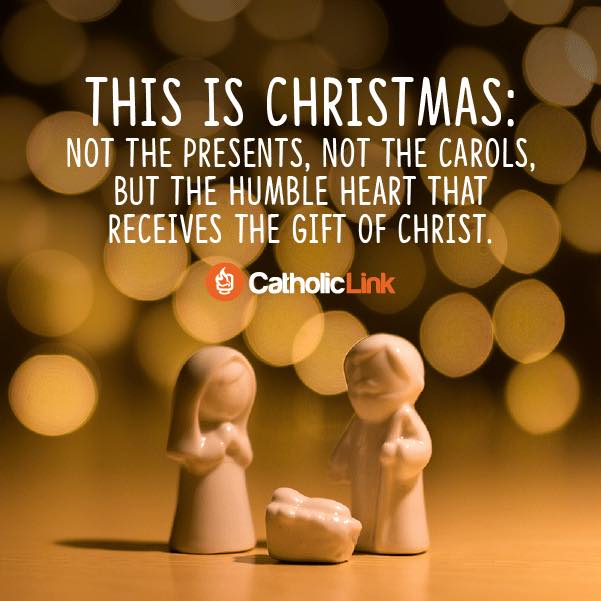
             Lord Jesus Christ, it has been raining since two days ago and more rains are expected this week.  Some, including me, feel your birthday today seems sad and gloomy.  But as I prayed over the stories of St. Luke about the harsh conditions when you were born, I have learned that is what Christmas Day is for – a beacon of light to guide us in the many mountains and valleys, cliffs and ravines we travel in this journey of life.  There would always be people who would make life difficult for us, conditions everywhere that are unfavorable to us but on this day of your birth, you are asking us to stand by you, to make that conscious decision to trust you that good things and better days are ahead of us.  Christmas is about making that conscious decision to always have you, Lord Jesus Christ as our highest good in life.  As our patron saint said, “From your fullness O Lord, we have all received , grace in place of grace” (Jn.1:16).   AMEN. Fr. Nicanor F. Lalog II, Parokya ng San Juan Apostol at Ebanghelista, Gov. F. Halili Ave., Bagbaguin, Sta. Maria, Bulacan.

Photos from Google.

humbleheart

Advent is God Leading Us to New Directions in Life

48396795_474653906393673_4933836951066247168_n
The Lord Is My Chef Simbang Gabi Recipe-9
24 December 2018
2 Samuel 7:1-5, 8-12, 14, 16///Luke 1:67-79

            Finally!  It is the word of the day.

            Finally we have completed the nine-day novena of Christmas but that is not the true joy of our annual Simbang Gabi tradition.  What is most essential is in these nine days of rising early for the novena, we have rediscovered Jesus Christ in ourselves and among others while at the same time recommitted ourselves to Him again as our only fulfillment in life.  I hope that in the past nine days we have rediscovered and even brought back somehow to our lives our sense of the sacred that is now fast fading out in our very consumerist society.  Through the many religious symbolisms found in our liturgies and readings these Advent season, it is hoped that we have rediscovered God – as well as our sense of the sacred – who is the most meaningful and essential in life.  

            Finally today also, we find the only male character in St. Luke’s story of the coming of Christmas regaining his stature after being on the distaff side, Zechariah.  After disbelieving the good news of (finally) having a son through the angel Gabriel’s annunciation at the Temple when he was forced into silence by becoming mute and deaf, Zechariah was finally able to speak again after declaring his son shall be named John.  And his very first words after being silent for nine months were praises to God the Almighty like Mary during the Visitation.  Called theBenedictus, Zechariah affirmed and confirmed in himself first the reality and truth of God being present in our lives amid the many twists and turns in life, narrating His reality and fidelity to His promises from the time of the Patriarchs and the Prophets of Israel down to the birth of John who would prepare the Christ.  In effect, Zechariah had finally come into a full circle in singing the Benedictus:  like his wife Elizabeth and son still in her womb John, St. Luke tells us how Zechariah was also filled with the Holy Spirit at that instance on the naming of John when he prophesied, “Blessed be the Lord, the God of Israel” (Lk.1:68).

          Zechariah shows today the fruits of his “forced silence” that had deepened his priesthood that is very evident in the opening line of Benedictus, giving glory to God for His fidelity and mighty acts to save Israel.  It is very similar with some of the popular parts of the psalms that every Jew prays.  There are three important reasons that Zechariah tells us why God is blessed:  “for he has come to his people and set them free,  he has raised up for us a mighty Savior, born of the house of his servant David” (Lk.1:68-69).  What is amazing in the Benedictus is that the verbs are in the past tense, of the works of God being done in the past like visiting His people, setting them free or redeeming them by sending Jesus Christ.  Like the Magnificat, it is a looking back and a looking forward to more great things God has in store for us.  Zechariah is reminding how God has never stopped working wonders for us, speaking and acting through prophets so many years ago even before the coming of Christ who is the fulfillment of all His promises.

           We have mentioned how we priests and other religious and consecrated persons sing the Magnificat every evening; the Benedictus, on the other hand, is sung every morning prayers called lauds.  As we face a new day, like Zechariah at the birth of his son John, we look back and remember so that in the process we renew our faith and trust in God who never stops in working for our good.  We praise God and put our trust and confidence in Him for every new day, hoping He would continue to visit us, redeem us, and raise us up from the many challenges we are going to face. But most of all, we are reminded too by Zechariah at this time, on the eve of Christmas, to ponder in our hearts where the Lord is leading us to?  Zechariah had seen the hand of God in Israel’s history, in his own life, and could see it also present in the coming life of his son John.  It is very clear that God is our leader in life, the invisible hand who directs us.  When we come to think of it, Zechariah’s forced silence was a way for him to rediscover again his sense of God and his sense of the sacred.  So many times for us, including us priests that although we keep our prayers and devotions, they are devoid of God.  One of the things this generation is fast losing is that sense of the sacred when everything is not taken for granted and trivialized.  How I hate before the Metro Film Festival during Christmas when we as the only Christian nation in this part of the world celebrates the merriest and longest Christmas are feasting on movies about evil and horror movies.  At least these past few years, there have been marked improvements in our film industry with great movies coming out.  Last year I was able to see the adaptation of Nick Joaquin’s “Portrait of the Filipino as Artist” that was magnificent in its interpretation of the play.
 
          On these remaining hours of the day before Christmas, imitate Zechariah to get some silent moments with our self and with God to reflect on where is the Lord leading us to this Christmas?  What direction in life is He asking us to follow?  In the first reading we have heard God asking David to stop his plans of building a temple for Him.  There was nothing wrong with building a temple but it was not the plan of God for David but for his son Solomon.  The same thing with us:  no matter how good our plans are for God and for others, it is the direction God has for us?  We can never prepare the way of the Lord unless we first sub it to His plan and follow His directions.  A blessed Christmas to you! AMEN. Fr. Nicanor F. Lalog II, Parokya ng San Juan Apostol at Ebanghelista, Gov. F. Halili Ave., Bagbaguin, Sta. Maria, Bulacan.
*Photo by author, altar linen of our Parish Church.  May we follow God’s directions for our lives.

Advent is God’s Tenderness and Sweetness

49116908_550946642036661_8965409051152220160_n
The Lord Is My Chef Simbang Gabi Recipe-8
Fourth Sunday of Advent, 23 December 2018
Micah 5:1-4///Hebrews 10:5-10///Luke 1:39-45

            Christmas is a story of love, about the meeting of lovers with God as the Great Lover who gave us His only Son because of His immense love for us.  Unfortunately, this love of Christmas is often presented in the cheesy songs as romantic love like in “Pasko na Sinta Ko”and “Last Christmas”.  The word “lovers” may be too serious as a term for us to relate this with today’s gospel the Visitation of Mary to her cousin Elizabeth; but, the truth is, both women were so in love with God who clearly loved them so much with children in their womb bound to change the course of human history forever.  They in turn, were also filled with love for each other as expression of their love for God.  And when there is love, there is always tenderness and sweetness that all happen in the context of a visitation that we first try to reflect upon.

             Visit and visitation may seem to be one and the same in the sense that both have a common Latin root word, the verb to see, “vidi, videre” from which came the word video.  But, a visit is more casual and informal without intimacy because it is just “a passing by” or merely to see.  It is more concerned with the place or the location and site and not the person to be visited.   We say it clearly in Filipino as in “napadaan lang” when it just so happened you were passing by a place and even without any intentions, you tried seeing someone there.  On the other hand, visitation is more commonly used in church language like when a bishop or priests come to see the parishioners in remote places.  This is the reason a chapel is more known as a visita in our country because that is where priests visit and check on the well-being of people living in areas very far from the parish usually at the town proper.  Aside from being the venue for the celebration of Masses, the visita serves as classroom for catechism classes and other religious even social gatherings in a particular place.  Thus, visitation connotes a deeper sense in meaning because there is an expression care and concern among people, a kind of love shared by the visitator/visitor and the one visited like Mary and Elizabeth.  Visitation is more of entering into someone’s life or personhood as reported by St. Luke on Mary’s visitation to Elizabeth where Mary “entered the house of Zechariah and greeted Elizabeth” (Lk.1:40),  implying communion or the sharing of a common experience.  In this case, the two women shared the great experience of being blessed with the presence of God in their wombs!

          Visitation, therefore, is a sharing or oneness in the joys and pains of those dear to us.  The word becomes more meaningful when we try to examine its Filipino equivalent which is “pagdalaw” from the root word “dala” that can be something you bring or a verb to bring.  When we come for a visitation, we dala or bring something like food or any gift.  But most of all we bring our very selves like a gift of presence wherein we share our total selves with our time and talents, joys and sadness, and everything to those being visited.  And that is what Mary did exactly in her visitation of Elizabeth where she brought with her the Lord Jesus Christ in her womb, becoming the first monstrance of the Lord as well as His first tabernacle.  We are invited to become like Mary in the visitation of others to bring Christmas and Jesus Himself to others by allowing our very body to be the “bringer” or “taga-dala” of Christ.  The Lord Himself is the highest good we can bring as pasalubong in ever visitation we make.  And if we can only be like Mary in our visitations and dealings with one another sharing Jesus Christ, then we also bring with us God’s tenderness and sweetness to others.  In a world that admires toughness and roughness, qualities like tenderness and sweetness are so rare to find these days.  How sad, even tragic is the viral video of bullying at the Junior High School of the Ateneo last week that has spawned other forms of bullying with everybody lynching on the bully, making all kinds of jokes out of the incident while forgetting the bigger bullies we have in the halls of power these days.  See that the two most popular presidents ever elected won the hearts of many voters because of their macho image of astig or sanggano, relishing their pugnacious character and behavior with matching cuss words and street talk, exactly the bullies we often condemn?!

             Back to our topic…tenderness and sweetness in Filipino are often translated in just one word which is “malambing” from “lambing” that has no direct English translation except that it connotes a loving affection; but, both terms are more than just affections but stirrings from the heart that move us into action.  Tenderness is very much like gentleness; the former is more focused while the latter is very general attitude.  Tenderness is more than being soft and gentle but an awareness of the other person’s weaknesses, needs and vulnerabilities.  A tender person is one who tries not to add more insult to one’s injuries or rub salt onto one’s wounds so to speak.  A tender person is one who tries to soothe and calm a hurting person, trying to heal his/her wounds like God often portrayed in many instances in the bible in lovingly dealing with sinners filled with mercy.  Like God, a person filled with tenderness is one who comes to comfort and heal the sick and those taking on a lot of beatings in life.  When Jesus Christ came, He also personified this tenderness of God like when He is moved with pity and compassion for the sick, the widows, the women and the children and the voiceless in the society.  Tenderness is coming to heal the wounds of those wounded and hurt, trying to “lullaby” the restless and sleepless.  Mary visited Elizabeth because she also knew the many wounds of her cousin who for a long time bore no child, living in “disgrace before others” as she had claimed (Lk.1:25).

            Sweetness always goes with tenderness.  It is the essence of God who is love.  Anyone who loves is always sweet that always comes naturally from within, bringing out good vibes.  It is never artificial like Splenda, always flowing freely and naturally that leaves a good taste and feeling to anyone.  In the Hail Holy Queen, Mary is portrayed as “O clement, O sweet Virgin Mary” to show her sweetness as a mother.  According to the late Fr. Henri Nouwen in his book “The Return of the Prodigal Son”, we are all invited to be like God in having both the qualities of a father and mother in Him.  Basing his reflections on the painting by Rembrandt of the said parable, God has a father’s hand that is supportive, empowering and encouraging and a mother’s hand that is consoling, caressing, and comforting.  There are no pretensions and pompousness in being sweet, never needs much effort to exert in showing it for it comes out naturally and instantly.

            Tenderness and sweetness are the most God-like qualities we all have but have buried deep into our innermost selves, refusing them to come out because of our refusal to love for fears of getting hurt and left behind or, even lost.  When Mary heard about Elizabeth’s condition, she simply followed her human and motherly instincts that are in fact so Godly – she went in haste to visit her.  Tenderness and sweetness are the twin gifts of Christmas to humanity when God almighty became little and vulnerable like us so we can be great and powerful like Him in being able to love.  Let me end this long reflection with a quotation from the classic novel “The Plague” by Albert Camus:  “A loveless world is a dead world, and always there comes an hour when one is weary of prisons, of one’s work, and of devotion to duty, and all one craves for is a loved face, the warmth and wonder of a loving heart.”  Let that love in you come out this Christmas and hereafter, simply be human like the child Jesus and be surprised at its tremendous power to change the world like God Almighty.  AMEN. Fr. Nicanor F. Lalog II, Parokya ng San Juan Apostol at Ebanghelista, Gov. F. Halili Ave., Bagbaguin, Sta. Maria, Bulacan.

*Photo by the author, our Nativity scene at the side of the church with the manger still empty.  Be the Child Jesus Christ, be tender and sweet to someone going through hard times in life, to someone suffering in silence.  Let them feel Christ, let them be touched by God with your concrete love of tenderness and sweetness.

Advent is Looking Back – and Forward – to God’s Goodness

48393157_735339493505987_5673987050278223872_n (1)
The Lord Is My Chef Simbang Gabi Recipe-7
22 December 2018
1Samuel 1:24-28///Luke 1:46-56

          Mary’s prominence lies not only in giving birth to Jesus Christ but more of her being His perfect disciple, the first Christian, the first receiver and doer of the Word who became flesh in her womb.  After sharing Christ with Elizabeth in the Visitation, Mary now sings the Magnificat like the song of Hannah in the first reading when she was gifted by God with the child Samuel despite her barrenness.  It is very amazing that the Blessed Virgin Mary is the only person who has appeared most – five times – as a cover of the TIME Magazine.  Likewise, her Magnificat is said to be the only poem that has been set to music more than any other in the whole history.  Almost every great musician has worked on Mary’s canticle like Bach, Mozart, Vivaldi and Rachmaninoff while for over a thousand years it had been sung or recited in the evening in monasteries around the world following St. Benedict’s rule in the sixth century. The Magnificat is a song of praise and thanksgiving to God, Mary’s own experience of God not only in her own life but also in her cousin Elizabeth who was barren and old yet conceived a child to become the Lord’s precursor, John the Baptizer.  At the Visitation, Elizabeth praised Mary but when it was Mary’s turn to speak, she praised God instead of Elizabeth contrary to common gesture of returning her favour because it was very clear with her that every gift is from God, and the greatest gift we can all have from God is His Son Jesus Christ whose birthday we celebrate on Tuesday.

            What is so remarkable with the Magnificat is its Advent flavor:  it is not only a praise and thanksgiving to God for all the wondrous things He had done to Mary and to us all but also a song of looking forward to more blessings to come from Him!  That is what Advent is all about, a looking back to the first Christmas and a joyful waiting for the Second Coming of Jesus Christ!  This is very evident in her opening lines, “My soul proclaims the greatness of the Lord; my spirit rejoices in God my savior.  For he has looked upon his lowly servant.  From this day all generations will call me blessed:  the Almighty has done great things for me, and holy is his Name” (Lk.1:46-49).  It is definitely a fruit of her prayer or gestational silence we mentioned the other day like what Elizabeth did.  Mary took into her inmost being the message of the angel to rejoice as a highly favored one of God, acknowledging the work of grace in her despite her stature in life.  Again we find here some strong Jewish flavors of which Mary must be aware of like the expression “the Almighty has done great things for me” which has strong roots in the Old Testament experience of the Israelites and their prophets when God saved them from Egypt and so many trials.  Think of the great things God has done to you also and rejoice!  Look back to the past 12 months and here we are, still together although some badly beaten with some even bruised in life but like Mary and Elizabeth meeting together, there are so many reasons for us to celebrate and thank the Almighty for the great things He had done to us.  And the most wonderful blessing next to God is the gift of family and friends around us, like the two cousins, a beautiful imagery of two pregnant women rejoicing together, celebrating life as they looked back in their personal lives and in their nation’s history the many good things God had done to them since the time of Abraham.

           The Magnificat shows us too that most of the things Mary mentioned have not happened yet:  “He has mercy on those who fear him in every generation.  He has shown the strength of his arm, and has scattered the proud in their conceit.  He has cast down the mighty from their thrones and has lifted up the lowly.  He has filled the hungry with good things and the rich he has sent away empty.  He has come to the help of servant Israel for he has remembered his promise of mercy, the promise he made to our fathers, to Abraham and his children forever” (Lk.1:50-57).  These are a mixture of images from the Old Testament about the things God had done to Israel and to the two cousins but at the same time mention other things that would happen only upon the completion of Christ’s mission.  This is to show us that Mary’s Magnificat is also about the perfect presence of God in Jesus Christ in our lives who is the “same yesterday, today and forever” (Heb. 13:8).

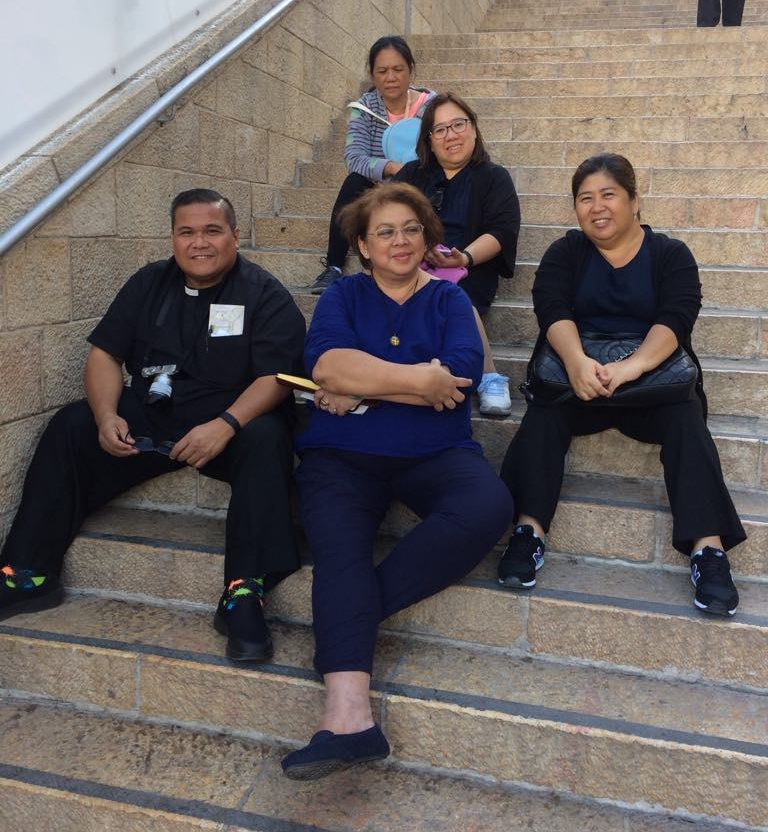
             Last year I was privileged to join my former colleagues at GMA-7 News as their chaplain on a pilgrimage to the Holy Land – all for free with everything in first class!  On our flight back to Manila, we met some OFW’s and one of them was so ecstatic in meeting Ms. Jessica Soho, making a commotion like crazy at the Ben Gurion Airport which is noted for its strict security measures.  A female security officer caught our attention and held us for a while as she checked our papers and passports.  Making things worse, the crazy OFW kept telling the officer to let us go because Ms. Jessica is a celebrity in our country.  That got the Israeli’s blood boiled and turned her attention to me, the only man in our group, asking me to go with her to their office.  That was when the three women of GMA News stood for me – our SVP Ms. Marissa Flores, Ms. Jessica Soho, and newly retired VP Ms. Kelly Vergel de Dios – telling the airport official that I am their friend, a friend for over 30 years, explaining how I used to work with them until I resigned and became a priest.  I felt my world stopping momentarily like in a dream sequence:  everything happened so fast!  There was the possible delay and a lot of interviews but I also felt God’s strong arm holding me, also tenderly caressing me with His mercy when I heard the three veterans of news defending me.  It was the final blessing I got from God during that pilgrimage when the three women of GMA-7 News were like Mary and Elizabeth reminding me how God had worked in our lives all these years.  It was like a Magnificat moment for me that until now I can recall the sweet smile that incident had left me.  Try praying the Magnificatstarting tonight as you thank God for the many wondrous things He had done to you despite the many trials you have also gone.  Thank God for the faithful and wonderful friends who have visited you to see His plans for you and most of all, be open for more blessings to come from Him this Christmas.  Let us pray for the many great women who have changed our lives, the Marys and Elizabeths who visited us and brought us closer to Jesus Christ.  AMEN. Fr.NicanorF.LalogII,Parokya ng San Juan Apostol at Ebanghelista, Gov. F. Halili Ave., Bagbaguin, Sta. Maria, Bulacan

*Photos by the author:  above are the bronze statues of Mary and Elizabeth at the Church of the Visitation; below, our group photo during our Holy Land Pilgrimage last April 2017.

48398771_2164177240301796_9078224252741615616_n

Mary Is the True Miss Universe

SnGiovanniRotondo
The Lord Is My Chef Simbang Gabi Recipe-5
20 December 2018
Isaiah 7:10-14///Luke 1:26-38

            Allow me to join the jubilation over our very own Ms. Catriona Gray’s winning of the Miss Universe 2018 title last Monday in Thailand.  As usual, I did not see it but cannot resist checking the news as everybody talked about her beauty and grace, and most especially her intelligence.  Though I have not seen the other candidates and their performances, I am very convinced she rightly deserves the title especially with her answer to the final question given her.  One quality I like most with Ms. Gray is her being filled with enthusiasm that was very evident with the way she projected herself, exuding with good vibes and life.  Enthusiasm is from two Greek words “en theos” that mean to be filled with God – like the Blessed Virgin Mary who is “full of grace and the Lord is with her” (Lk.1:28).

            On this fifth day of our Simbang Gabi we hear the second story by St. Luke of how the first Christmas happened.  He tells us how six months after announcing to Zechariah the coming of their son John, the angel Gabriel went to Nazareth to announce the good news of the birth of our Savior Jesus Christ to the Blessed Virgin Mary who was betrothed to St. Joseph.  Unlike Zechariah who doubted the angel’s message, Mary was more open with her response by asking how it would all take place.  And the angel said to her in reply, “The Holy Spirit will come upon you, and the power of the Most High will overshadow you.  Therefore the child to be born will be called holy, the Son of God” (Lk.1:35).

            Last Monday we have reflected how St. Matthew ended his story of the genealogy of Jesus Christ with Mary to show her as the new beginning of everything in the world.  Through Mary’s giving birth to Jesus, we now share with Him one common origin in faith who is God as our Father so that despite our many sins and failures, we are given with a fresh start, new opportunities in life daily.  St. Luke bolsters this today with his account of the annunciation of the birth of Jesus to Mary.  As a Jew, Mary must be totally aware of the words of the angel about herself being “overshadowed by the Most High” like in the Old Testament stories of God’s presence in the cloud during their journey in the wilderness after their exodus from Egypt.  Even Moses could not enter the tent when “the cloud covered it and the glory of the Lord filled the tabernacle” (Ex.40:34-38).  To be filled and overshadowed by the presence of God is to be to be possessed by God and eventually to be transformed by God.  Remember how in the movie “The Ten Commandments” when the face of Moses was transformed after meeting God.  The three synoptic gospels record a similar incident of God’s presence in a cloud hovering with Jesus during His transfiguration at Mount Tabor witnessed by Peter, James and John.  The two great prophets of Israel were there, Elijah and Moses conversing with Jesus when a cloud overshadowed them with a voice declaring “this is my beloved Son, listen to Him.”

          Matthew, Mark and Luke tell us how the apostles were all terrified at the sight of the Transfiguration.  And we can also surmise how terrifying it must be to experience God’s presence, to be filled with God.  But that is how grace works!  After seeing our own limitations and yet we are still able to forge on, to achieve greater things, it is God working in us.  This is the reason that St. Luke tells us how the angel greeted Mary during the annunciation using the Greek words “kaire” which is to rejoice and “charis” or “karis” for grace:  “Hail (or rejoice), full of grace!  The Lord is with you” (Lk.1:28).  Wherever and whenever there is grace, surely there is rejoicing. We rejoice in the winning of Ms. Catriona Gray as Miss Universe because it is indeed a grace she had received as an individual and for us as a nation plagued with so much sufferings and miseries.  The late American spiritual writer and monk Thomas Merton rightly said, “We live in a time of no room, which is the time of the end.  The time when everyone is obsessed with lack of time, lack of space, with saving time, conquering space… The primordial blessing, ‘increase and multiply’ has suddenly become a hemorrhage of terror… In the time of the end there is no longer room for the desire to go on living.  Why?  Because they are part of a proliferation of life that is not fully alive, it is programmed for death” (Raids on the Unspeakable, pp. 70-72).

         Advent is the time to get real, to stop pretending.  Advent is the time for us to finally admit our own limitations, to create a space in our hearts and in our lives to let God fill us, to let God possess us.  Like Mary, can we allow God’s power to hover over us and do the same to renew our lives in welcoming Jesus Christ?  Like the question posed to Ms. Gray, think of the many instances in your life where you have learned your most important lessons in life and most surely like her, these were also the moments we have faced or seen many hardships and sufferings yet, instead of being down, they have inspired us, they have transformed us into better persons.  It is here where I admired most Ms. Gray when she said how the slums of Tondo made her look among the poor children for beauty, to see the silver linings, and still be grateful.  What a beautiful soul indeed – something like our Blessed Virgin Mary who told the angel, “Behold I am the handmaid of the Lord.  May it be done to me according to your word.”  Let us now open our hearts to God so the Holy Spirit may hover us, fill us with Jesus Christ.  AMEN.  Fr.NicanorF.LalogII,Parokya ng San Juan Apostol at Ebanghelista, .Gov. F. Halili Ave., Bagbaguin, Sta. Maria, Bulacan

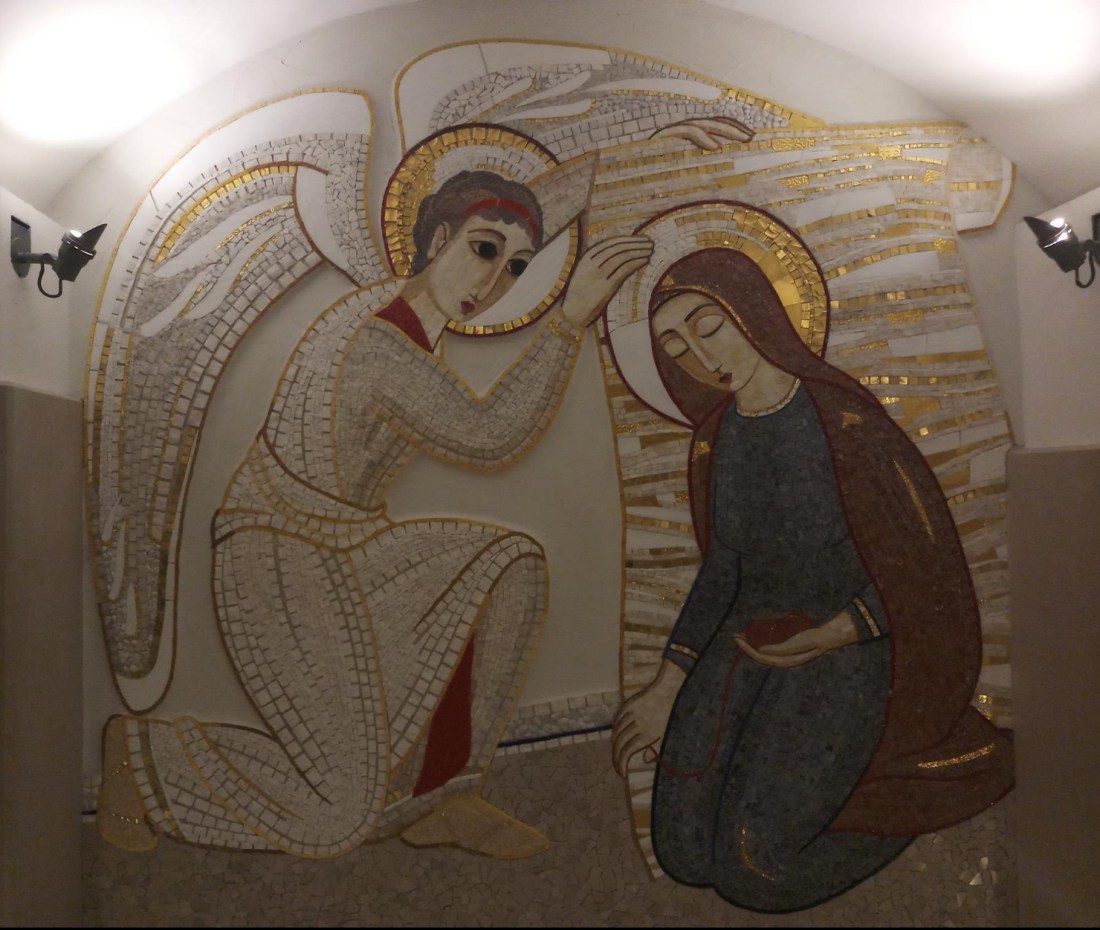
*Photo by my former student at ICSB, Arch. Philip Santiago, mosaic of the Annunciation to Mary at the San Giovanni Rotondo Church, Italy, October 2018.  Used with permission.