Holiness and Sinfulness

stjosephchurch
The Lord Is My Chef Simbang Gabi Recipe-3
18 December 2018
Jeremiah 23:5-8///Matthew 1:18-25

             One of my unforgettable experiences in my parish is when a husband and wife quarreled during the baptism of their child.  When I asked the father the name to be given to their son right before baptism, he gave another name and instantly, his wife hit him with her elbow and snapped, “who’s that baby again!?”

             In the rites of baptism, it is the father who is asked by the minister on the name to be given to the child.  It is the father who gives the name because he is the origin of life, the giver of life; hence, every child uses the father’s family name to show his paternity.  This is in essence the reason God asked Joseph “to be not afraid to take Mary as his wife” so he would be the legal father of Jesus Christ.  Though it is very clear in the account of Matthew yesterday and today that Jesus is truly the Son of God and not of any human, the evangelist shows us how through Joseph, Jesus belongs by law – legally – to the house of David as fulfillment of God’s promise.  At the same time, in giving name to Jesus, Joseph proves more than ever his holiness which is the meaning of his description as a “righteous” or “just” man.  This is how the birth of Jesus Christ came about.  When his mother Mary was betrothed to Joseph, but before they lived together, she was found with child through the Holy Spirit.  Joseph her husband, since he was a righteous man, yet unwilling to expose her to shame, decided to divorce her quietly (Mt.1:18-19).

             Holiness for the Jews or being righteous and just is primarily obedience to the Laws of God handed down through Moses.  However, during the time of Christ this perception became so limited to mere obedience to the letters of the law that even Jesus later on would try to correct.  His legal father, St. Joseph, in fact would exactly do that when he showed that holiness is a constant dialogue with God when one is nourished by His words like a tree planted near the streams of water, bearing fruits of love for God and for others.  This imagery is found in the Book of Psalms that says men who are just and righteous are those who “delight in the law of the Lord, like a tree planted near streams of water, that yields its fruit in season; its leaves never wither; whatever they do prospers” (Ps.1:2-3).  When St. Joseph decided to quietly divorce Mary after learning about her pregnancy, it was the height of his love for her as he was very willing to walk away and let her marry whoever fathered that child in her womb than subject her to public shame and humiliation as their laws prescribed.  In that aspect alone, we find St. Joseph very holy indeed!  But it did not stop there:  after being informed by the angel in a dream of the divine nature of Mary’s pregnancy, St. Joseph proved anew his holiness with his deep love for God by eventually taking Mary as his wife that paved the way for the first Christmas we now celebrate.  St. Joseph’s holiness shone brightly in this aspect when his love for Mary was never diminished but even deepened when his love for God moved him to take “his wife home.”  Here are the fine prints of St. Joseph’s holiness that in his love for God, he had to take Mary as his wife and in doing that, he eventually brought forth in a sense the birth of Jesus Christ.  Every time we love God, it always leads us to love others too.  It is when we live in love that Jesus Christ truly comes into our lives and Christmas happens always.

             But there is something bigger and better, lovelier and holier to unfold in St. Joseph’s role as legal father of Jesus Christ.  Notice how Matthew repeated the verb “to name” twice:  “She will bear a son and you are to name him Jesus, because he will save his people from their sins (Mt.1:21)” and “When Joseph awoke, he did as the angel had commanded him and took his wife into his home.  He had no relations with her until she bore a son, and named him Jesus (Mt.1:24-25).”   Giving of names in general connotes authority.  In Genesis, God gave man the authority to give names to the animals He had created.  Parents give names to their children as a sign of their authority.  Bullies in classrooms and anywhere always try to assert their authority by giving funny names to their victims while lovers always have unique names given to their beloved as terms of endearment.  In this respect, St. Joseph did not merely give up that authority of giving name but must have also realized within him the awesome reality of things about to unfold in the birth of Mary’s child who “will save his people from their sins” (Mt.1:21).

             Three weeks ago I read in the news how a popular American airlines apologized to a mother when their ground crew at the boarding gate laughed and insulted her daughter named “Abcde” which is pronounced as Ab-city.  I have baptized a baby in my parish with a similar name, “Wxyz”.  The parents never complained or filed charges against me when I questioned them for their choice of name for their son, warning them of negative repercussions in the future.  Giving of names is a very serious duty among the Jews (and it should be for everyone!) because a name always indicates the person’s mission.  In giving the child of Mary the name “Jesus” that means “God is my salvation”, St. Joseph must have realized not only the mission of Christ but most of all fully accepted it as one that the world needs so badly.  Recall that during the ministry of Jesus, religious leaders of His time always questioned His forgiving of sins because only God can forgive sins.  Problem with them like the Pharisees and the scribes, they have refused to recognize Jesus as the Christ, the Son of God sent to forgive sins.  Right from the start during his dream, St. Joseph was already aware of the mission of Jesus Christ which is to forgive sins.  And his obedience to the instruction of giving the name “Jesus” is indicative of his holiness because the first step to being holy is to admit our sinfulness, our need for forgiveness by God.  This is the problem of the world today, the lack of sense of sinfulness among most of us even among us priests as shown by the sex scandals.  The mark of true holiness is the humility to admit and accept one’s sinfulness and need for forgiveness.  When Pope Francis was interviewed for the first time for a magazine, he was asked how he would describe himself and his quick answer was, “I am a sinner.”
       Sin is a turning away from God, the absence and failure to love.  It is the opposite of holiness which is being filled with God.  Unless we realize that our sinfulness is the first and most important thing needed to be fixed within us, we will never move forward, we will never grow, and we will never experience Christ’s coming.  This is the very reason Christ was born, to forgive our sins so that we may return and go back to God who is our fundamental relationship in life.  No healing, no life in general will ever come and prosper when this relationship with God is out of order because of sins.  St. Joseph is a righteous or just man, a holy man, because in recognizing the need for the forgiveness of our sins, he cooperated with God in His plans by naming the child of Mary as “Jesus” and that is why we now celebrate Christmas.  God bless you!  AMEN. Fr.NicanorF.LalogII,Parokya ng San Juan Apostol at Ebanghelista, .Gov. F. Halili Ave., Bagbaguin, Sta. Maria, Bulacan.
*Photo by author, Church of St. Joseph at Nazareth, the Holy Land, April 2017.

Advent Is the Presence of God

4XmasJohnhay17M
The Lord Is My Chef Sunday Recipe
Advent Week I, Year C, 02 December 2018
Jeremiah 33:14-16//1Thessalonians 3:12-4:2//Luke 21:25-28, 34-36

             Happy New Year everyone!  Today we start our new liturgical calendar in the Church with the first of the four Sundays of Advent symbolized by the Advent wreath that would be blessed and lighted after the homily by the priest.  Flowers are minimized at the altar and violet or deep blue is the motif while the Gloria is not sung except during the Simbang Gabi in joyful anticipation of Christmas.  The word Advent is from the Latin adventus that referred to the coming or arrival of the Roman emperor known as Caesar.  At the height of the Roman Empire (the Pax Romana), the emperor used to visit the different provinces under his rule and there would always be elaborate preparations because he was also considered as god by the Romans.  With the fall of Rome, the Church eventually adopted that practice to prepare for the birth of the King of kings.  And rightly so if we recall what Jesus told Pilate last Sunday at the Solemnity of Christ the King, “You say I am a king.  For this I was born and for this I came into the world, to testify to the truth.  Everyone who belongs to the truth listens to my voice.” (Jn.18:37)

             When we look at our liturgical calendar, we celebrate every day in the whole year the Kingship of Jesus Christ who is the presence of God among us.  Though Advent has two aspects, beginning today until December 16 when our sights are focused on the Second Coming of Christ and from December 17 to 24 when we focus on His first coming more than 2000 years ago, we celebrate every day in our lives the presence of Jesus in us and among us.  St. Bernard of Clairvaux beautifully said that between these two comings of Christ is His third coming in every present time.  And that is what Advent is all about:  the presence of God.  Christmas is more than a date to be remembered but the Person of Jesus Christ.  We can never experience His coming at the end of time nor His first Christmas if we do not dare to open ourselves to God, to His presence in every here and now.

             “But when these signs begin to happen, stand erect and raise your heads because your redemption is at hand.  Beware that your hearts do not become drowsy from carousing and drunkenness and anxieties of daily life, and that they catch you by surprise like a trap.  For that day will assault everyone who lives on the face of the earth.  Be vigilant at all times and pray that you have the strength to escape the tribulations that are imminent and to stand before the Son of Man.” (Lk.21:28, 34-36)

             Like during the Sunday before Christ the King, our gospel for the first Sunday of Advent invites us to focus on the “end time” or eschaton, the days of fulfillment of God’s promise when Christ comes again which nobody knows when except the Father.  Unlike in the movies and the other doomsday scenarios portrayed by some, the end of time should never be taken literally because it is a kind of writing called apocalyptic.  Such portrayals should never be imagined as they merely try to evoke the very difficult trials and tribulations peoples would experience and have experienced in different periods of time that continue to this day.  Are we not all still groaning in pain as St. Paul described from all the sufferings and hardships we go through today?  But here lies the good news of Advent:  it is during our moments of trials and sufferings when Jesus Christ comes!  The more persecutions, the more hardships we go through, the more we need to pray hardest, to be vigilant, to stand erect and raise our heads because it is during those trying times when Jesus Christ comes, and in fact when He is with us.

             The key word here is presence from which came also the word present which is the synonym for the word gift.  We need to always dare to open ourselves to God in the most unexpected moments of our lives because that is when we truly feel Him present in us and among us.  It is in our daring to be open to God’s presence when we can truly experience the giftedness of each day and each moment of life.  Too often, we remember God most when we are too far from Him due to our sinfulness.  That is when we look inside, examine our hearts, and turn back to Him, searching for His presence.  It is a proof that we can only find meaning in our lives in Jesus Christ and that is why He came.  On the other hand, we also feel God’s presence most when we are so blessed.  But these are two extremes that do not happen every day.  That is why we have to be “daring” or adventurous in being open to God especially during ordinary days.  The ordinary days are in fact the trying times for us all to be faithful to God, to feel His presence.  Too often, we get so used with our lives that we become oblivious to the presence of God.  Even in the midst of problems, disappointments and frustrations we just don’t mind them at all, expecting things would get better soon.  And God?   We just presume He is in charge but we do not really feel Him.  God has become a mere given in life that we pray, do our devotions and other spiritual activities just to fulfill them or get them done.  They have become empty because we have closed our hearts and selves to God’s many and amazing ways of coming to our lives, that He is always present in the simplest and most ordinary moments of life.

           This is the challenge of Advent:  that we always dare to open ourselves to God’s presence through prayers and silence.  Jeremiah said it well in the first reading, “The days are coming, says the Lord, when I will fulfill the promise I made to the house of Israel and Judah.  In those days, in that time…” (Jer. 33:14,15)    God is faithful to His promise and always comes to us, always with us.  We need to be daring to open ourselves to His presence to meet Him in our prayers and in silence.  To be daring in opening ourselves to God’s presence means being still with Him, “wasting” time with Him by daring to set aside too much social media and gadgets that waste our time and distract us of the more important things in life.  On this first week of Advent, let us be daring in opening ourselves to God by doing something different, by being good and better Christians as St. Paul asked us in the second reading.  If we fail to experience God during this Advent season, we would never experience Him in Christ coming on Christmas or any time.  Be daring and be filled with God this week!  AMEN.  Fr. NicanorF. Lalog II, Parokya Ng San Juan Apostol At Ebanghelista, Gov. F. Halili Ave., Bagbaguin, Sta. Maria, Bulacan

*Photo by the author, Manor House, Camp John Hay, December 2017.

LMC

Ano Nga Ba ang Inaabangan sa Pasko?

Lawiswis ng Salita ni P. Nicanor F. Lalog II, Ika-20 ng Nobyembre 2018
IMG_2434
 
Minsa’y nagmisa ako sa aming mababang paaralan
At sa aking panimula aking nausisa mga bata
Kung ilang araw na nga lang ba ang Pasko?
Nag-uunahan, nakangiti na tila baga bumabati
At kasali sa laban o bawi, buong galak nilang sinabi
“41 days before Christmas!”
Ako’y nagulat, kanila pala’ng inaabangan
Araw ng Pasko kaya’t bilang nila kung ilang araw na lang
Habang ako nama’y nagulantang sa gayong katotohanan.
Bakit nga ba tayo sabik sa araw ng Pasko?
Ano nga ba ating inaabangan
Palagi tayong mayroong countdown?
Kung ang Pasko ay isang petsa nga lang,
Bakit hindi na lang tayo magbilangan
Bagong Taon pa lamang?
Madalas sa ating karanasan
Tayo ma’y natitigilan kinagabihan ng Pasko
Lalo na’t nagkaubusan ng pagkai’t mga pamaskong pinaghandaan.
Ito nga lang ba ang dahilan at kahulugan ng Kapaskuhan?
Lahat ng kaabalahanan at kapaguran sa paghihintay
Di malaman kung napasaan?
Kung ating pagninilayan diwa ng Pasko
Araw-araw itong maipagdiriwang kung sa puso natin sumisilang
Itong si Hesus at hindi sa sabsaban.
Higit sa petsa ng Kanyang kapanganakan
Ang Pasko ay isang kaganapan nang makialam
Sa ating kaguluhan ang Diyos na walang hanggan;
Kanyang pinunan, ating kakulangan
Binigyang saysay buhay nating walang kabuluhan
Upang tayong sinilang sa kasalanan, magkaroon ng kabanalan.
Mamuhay tayo’ng lagi sa Kanyang kapanatilihan
Upang ngayon pa lamang ay maranasan hatid Niyang kagalakan
Kesa ito’y abangan at malibang sa pagbibilang ng petsa at buwan.
BelenJohnHay2
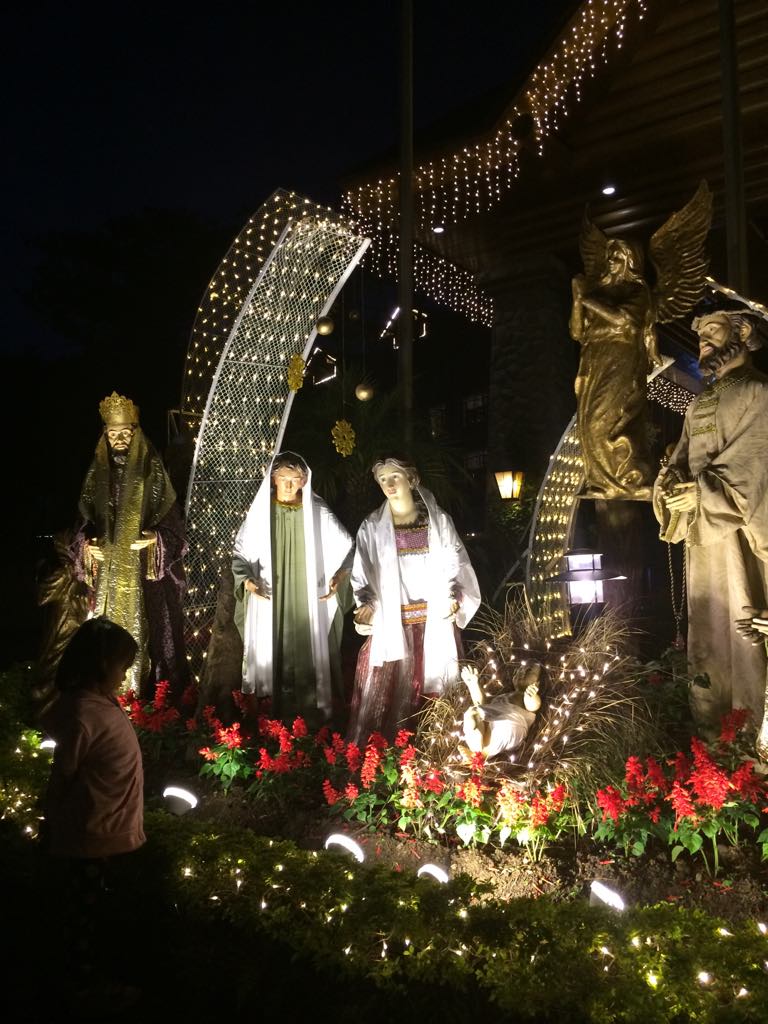
Larawan ay kuha ng may-akda, Belen ng Manor House sa Camp John Hay, Baguio, Nobyembre 2017.