
Advent is God’s Tenderness and Sweetness

49116908_550946642036661_8965409051152220160_n
The Lord Is My Chef Simbang Gabi Recipe-8
Fourth Sunday of Advent, 23 December 2018
Micah 5:1-4///Hebrews 10:5-10///Luke 1:39-45

            Christmas is a story of love, about the meeting of lovers with God as the Great Lover who gave us His only Son because of His immense love for us.  Unfortunately, this love of Christmas is often presented in the cheesy songs as romantic love like in “Pasko na Sinta Ko”and “Last Christmas”.  The word “lovers” may be too serious as a term for us to relate this with today’s gospel the Visitation of Mary to her cousin Elizabeth; but, the truth is, both women were so in love with God who clearly loved them so much with children in their womb bound to change the course of human history forever.  They in turn, were also filled with love for each other as expression of their love for God.  And when there is love, there is always tenderness and sweetness that all happen in the context of a visitation that we first try to reflect upon.

             Visit and visitation may seem to be one and the same in the sense that both have a common Latin root word, the verb to see, “vidi, videre” from which came the word video.  But, a visit is more casual and informal without intimacy because it is just “a passing by” or merely to see.  It is more concerned with the place or the location and site and not the person to be visited.   We say it clearly in Filipino as in “napadaan lang” when it just so happened you were passing by a place and even without any intentions, you tried seeing someone there.  On the other hand, visitation is more commonly used in church language like when a bishop or priests come to see the parishioners in remote places.  This is the reason a chapel is more known as a visita in our country because that is where priests visit and check on the well-being of people living in areas very far from the parish usually at the town proper.  Aside from being the venue for the celebration of Masses, the visita serves as classroom for catechism classes and other religious even social gatherings in a particular place.  Thus, visitation connotes a deeper sense in meaning because there is an expression care and concern among people, a kind of love shared by the visitator/visitor and the one visited like Mary and Elizabeth.  Visitation is more of entering into someone’s life or personhood as reported by St. Luke on Mary’s visitation to Elizabeth where Mary “entered the house of Zechariah and greeted Elizabeth” (Lk.1:40),  implying communion or the sharing of a common experience.  In this case, the two women shared the great experience of being blessed with the presence of God in their wombs!

          Visitation, therefore, is a sharing or oneness in the joys and pains of those dear to us.  The word becomes more meaningful when we try to examine its Filipino equivalent which is “pagdalaw” from the root word “dala” that can be something you bring or a verb to bring.  When we come for a visitation, we dala or bring something like food or any gift.  But most of all we bring our very selves like a gift of presence wherein we share our total selves with our time and talents, joys and sadness, and everything to those being visited.  And that is what Mary did exactly in her visitation of Elizabeth where she brought with her the Lord Jesus Christ in her womb, becoming the first monstrance of the Lord as well as His first tabernacle.  We are invited to become like Mary in the visitation of others to bring Christmas and Jesus Himself to others by allowing our very body to be the “bringer” or “taga-dala” of Christ.  The Lord Himself is the highest good we can bring as pasalubong in ever visitation we make.  And if we can only be like Mary in our visitations and dealings with one another sharing Jesus Christ, then we also bring with us God’s tenderness and sweetness to others.  In a world that admires toughness and roughness, qualities like tenderness and sweetness are so rare to find these days.  How sad, even tragic is the viral video of bullying at the Junior High School of the Ateneo last week that has spawned other forms of bullying with everybody lynching on the bully, making all kinds of jokes out of the incident while forgetting the bigger bullies we have in the halls of power these days.  See that the two most popular presidents ever elected won the hearts of many voters because of their macho image of astig or sanggano, relishing their pugnacious character and behavior with matching cuss words and street talk, exactly the bullies we often condemn?!

             Back to our topic…tenderness and sweetness in Filipino are often translated in just one word which is “malambing” from “lambing” that has no direct English translation except that it connotes a loving affection; but, both terms are more than just affections but stirrings from the heart that move us into action.  Tenderness is very much like gentleness; the former is more focused while the latter is very general attitude.  Tenderness is more than being soft and gentle but an awareness of the other person’s weaknesses, needs and vulnerabilities.  A tender person is one who tries not to add more insult to one’s injuries or rub salt onto one’s wounds so to speak.  A tender person is one who tries to soothe and calm a hurting person, trying to heal his/her wounds like God often portrayed in many instances in the bible in lovingly dealing with sinners filled with mercy.  Like God, a person filled with tenderness is one who comes to comfort and heal the sick and those taking on a lot of beatings in life.  When Jesus Christ came, He also personified this tenderness of God like when He is moved with pity and compassion for the sick, the widows, the women and the children and the voiceless in the society.  Tenderness is coming to heal the wounds of those wounded and hurt, trying to “lullaby” the restless and sleepless.  Mary visited Elizabeth because she also knew the many wounds of her cousin who for a long time bore no child, living in “disgrace before others” as she had claimed (Lk.1:25).

            Sweetness always goes with tenderness.  It is the essence of God who is love.  Anyone who loves is always sweet that always comes naturally from within, bringing out good vibes.  It is never artificial like Splenda, always flowing freely and naturally that leaves a good taste and feeling to anyone.  In the Hail Holy Queen, Mary is portrayed as “O clement, O sweet Virgin Mary” to show her sweetness as a mother.  According to the late Fr. Henri Nouwen in his book “The Return of the Prodigal Son”, we are all invited to be like God in having both the qualities of a father and mother in Him.  Basing his reflections on the painting by Rembrandt of the said parable, God has a father’s hand that is supportive, empowering and encouraging and a mother’s hand that is consoling, caressing, and comforting.  There are no pretensions and pompousness in being sweet, never needs much effort to exert in showing it for it comes out naturally and instantly.

            Tenderness and sweetness are the most God-like qualities we all have but have buried deep into our innermost selves, refusing them to come out because of our refusal to love for fears of getting hurt and left behind or, even lost.  When Mary heard about Elizabeth’s condition, she simply followed her human and motherly instincts that are in fact so Godly – she went in haste to visit her.  Tenderness and sweetness are the twin gifts of Christmas to humanity when God almighty became little and vulnerable like us so we can be great and powerful like Him in being able to love.  Let me end this long reflection with a quotation from the classic novel “The Plague” by Albert Camus:  “A loveless world is a dead world, and always there comes an hour when one is weary of prisons, of one’s work, and of devotion to duty, and all one craves for is a loved face, the warmth and wonder of a loving heart.”  Let that love in you come out this Christmas and hereafter, simply be human like the child Jesus and be surprised at its tremendous power to change the world like God Almighty.  AMEN. Fr. Nicanor F. Lalog II, Parokya ng San Juan Apostol at Ebanghelista, Gov. F. Halili Ave., Bagbaguin, Sta. Maria, Bulacan.

*Photo by the author, our Nativity scene at the side of the church with the manger still empty.  Be the Child Jesus Christ, be tender and sweet to someone going through hard times in life, to someone suffering in silence.  Let them feel Christ, let them be touched by God with your concrete love of tenderness and sweetness.
Advent Is The Joy of Persons

48363133_2022338281220522_1767266466916204544_n
The Lord Is My Chef Simbang Gabi Recipe-1
Advent-3, Year C, 16 December 2018
Zephaniah 3:14-18//Philippians 4:4-7//Luke 3:10-18

          Christmas is undeniably the most joyous season of the whole year.  And we all know the reason because it is the birth and coming of our Savior Jesus Christ.  Unfortunately in practice, we always forget Jesus Christ and we get focused on the gifts and decorations that delight our senses but leave us empty within.  When we forget Jesus Christ as the reason of the season, then we altogether forget the persons around us, forgetting that the greatest gift we can always receive is the gift of our personhood, the gift of another person we journey in life.  One rejoices because of a person.  Only persons can bring joy and only persons can rejoice.

          You must have seen the Christmas short film of Ayala Malls’ “Wishing Tree” where a Lola and her apo celebrate the Simbang Gabi at Greenbelt.  After Mass, the apo would hang his Christmas wish on the “wishing tree” aided by the security guard.  The Lola eventually had Alzheimer’s, had to stay home while her apo went alone to Simbang Gabi.  As usual, the apo who had grown up into a young man went to hang his Christmas wish but this time, instead of asking for toys, he simply wrote “Make Lola happy again.”  The security guard saw his wish and had a brilliant idea of gathering from the mall’s CCTV records the joyful memories of the Lola and her apo at Greenbelt through the years.  On Christmas Eve, the apo went to kiss and greet his sick Lola in her room where he found a Christmas card from Ayala malls.  Inside was a USB with footages of their happy days together at Greenbelt that lit up Lola’s face with joy as if she had suddenly recovered her memories that she rested her head on her apo’s arm.  How amazing that despite her dementia, Lola rejoiced again when she saw the gift of person in her apo, their gift of selves to each other that tells us only persons can bring joy to another person, not money or things or gadgets.

         This third Sunday of Advent which we also call “Gaudete Sunday” or “Rejoice Sunday”, we level up our rejoicing because our joy is not only coming from another person but from the Second Person of the Holy Trinity, the Son of God Jesus Christ!  Such was also the joy of Mary in singing her Magnificat upon experiencing the very person of  God in herself and in Elizabeth, “My soul magnifies the Lord” (Lk.1:46).  Every joy is magnified because of the person of Jesus Christ who revealed to us that our God is not merely an entity but a Person who relates with us and wants that relationship deepened as a true Father to us.  Last week, we reflected how we must create a room or a space within us to let Christ come to us and possess us.  Today, our readings remind us how God shows us Himself and His plans for us through other persons in Christ Jesus.  See how the people were filled with joy upon listening to the preaching by John the Baptizer in the wilderness of Jordan.  Everybody, including sinners like tax collectors and soldiers were asking him “what should we do?” because they felt the joy within of Christ’s coming.  And the good news is that through John, the people of that time including us today found that God is not really asking so much from us:  we simply have to live simple lives of sharing whatever we have, being fair and just with one another.

         To everyone in the crowd, John said, “Whoever has two cloaks should share with the person who has none.  And whoever has food should do likewise.  Tax collectors should stop collecting more than what is prescribed while soldier should stop the practice of extortion, do not falsely accuse anyone, and be satisfied with their wages.” (Lk.3:11, 13, 14)

          Let us rejoice because God is not asking great things from us to experience His coming in Jesus!  We do not have to withdraw to the mountains and wilderness to find Jesus Christ.  All He wants is our complete person with concrete acts of love and charity, mercy and kindness with every person around us who is our brother and sister in Him.  All God wants is our complete person wherein we are faithful and true to Him through others in whatever state of life we are into.  See how all the readings proclaimed during this Season of Advent teach us to realize that God has truly come among us in the person of Jesus Christ so that we can experience Him in our very personhood and among other persons, both in good times and in bad times, in joys and in tears.  Together we all celebrate life’s ups and downs with God Himself in Jesus through the persons who heed His call to love and to serve.  In becoming human like us, God the Son came to proclaim that the Kingdom of God is within us and that the Holy Spirit has been sent to support our relationships with other persons.  It is always a struggle to be a good person most especially among relatives and friends who are supposed to be the first to love and understand us but turn out to do the opposite.  So often, we forget the other person due to many fears within us like being unloved or rejected, going hungry or thirsty, of losing and getting lost.  The prophet Zephaniah tells us in the first reading to cast away all fears and be not discouraged by failures and hurts in life; rejoice because you are so loved by the Lord!  “The Lord, your God, is in your midst, a mighty savior; he will rejoice over you with gladness, and renew you in his love, he will sing joyfully because of you, as one sings at festival” (Zeph. 3:17).  St. Paul reiterates this call for rejoicing, telling us “Your kindness should be known to all.  The Lord is near.  Have no anxiety at all, but in everything, by prayer and petition, with thanksgiving, make your requests known to God.  Then the peace of God that surpasses all understanding will guard your hearts and minds in Christ Jesus” (Phil.4:5-7). 

         How sad, and how can we rejoice this Advent and Christmas in our country where Christmas is said to be the merriest and the longest when the president and his men especially in the police force rejoice in the death of drug dependents and criminals?  We condemn every act of violence especially to innocent victims but executing their perpetrators, eliminating addicts and criminals will never solve the problem.  How can we rejoice when very clearly justice favors the rich and powerful who can all go free or even be exempted from being arrested simply because of age?  How can we rejoice when telling lies and peddling fake news are the norms of the administration, maligning people and institutions?  The most tragic part of this attitudes of killing, telling lies and injustice in courts is the atmosphere they create among people to lose respect for another person, to fail to see the value of every person rooted in God.  Anyone who rejoices in the death of another person, in fake news and lies can never have true joy because deep inside, they are the most insecured and fearful persons of all who are so afraid to love and to forgive, to accept the truth that they have lost their own value of being a person.  They will never experience Christmas like Herod who ordered the murder of innocent children upon hearing the birth of another person truly greater than him, Jesus Christ.

         This joy of Advent and Christmas in the coming of Jesus Christ is found in the humility of our all-powerful, ever-present, and all-knowing God who chose to be another person among us, so weak and so small even begging us to receive Him.  Doubt no more, my dear reader that no matter what your sins are or your past may have been, whatever may be your state and condition in life today, God is here.  Have a room in your heart for Him, welcome Him for He does have plans for you.  He is also among other persons around you at this very moment, meet Him too among them.  Rejoice and give the person you love with a big, warm hug to feel God’s intense presence on this Rejoice Sunday. AMEN. Fr.NicanorF.LalogII,Parokya ng San Juan Apostol at Ebanghelista, .Gov. F. Halili Ave., Bagbaguin, Sta. Maria, Bulacan.

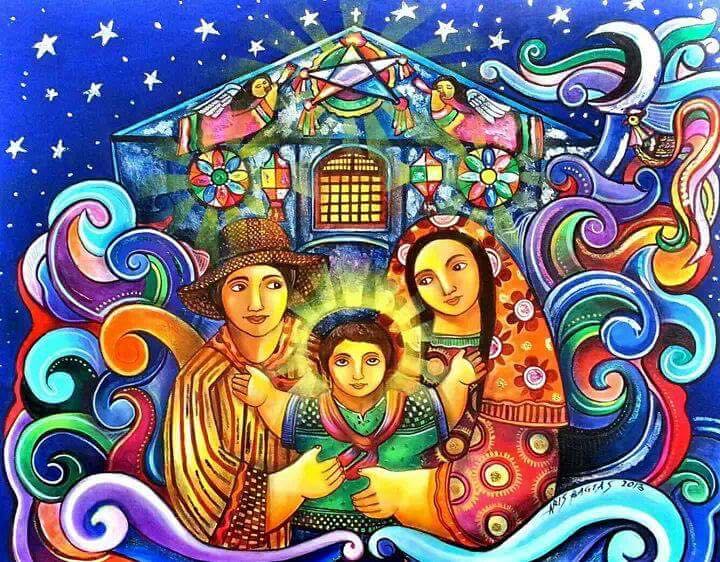
*Photo is a painting on acrylic canvas by Bulakenyo artist Aris Bagtas, “Triangulo ng Liwanag” exhibited in Washington DC in 2013.  Typical of paintings by Aris is the joy of the Filipino family where there is always the presence of love represented by his vibrant colors.  According to Aris, the relationship among the father, mother and child is everyone’s “triangle of love” in this colorful life we have.  Used with permission.

Advent Is Creating A Room for God In My Life

37196152_10156528615579704_3429030339266215936_o (1)
The Lord Is My Chef Sunday Recipe
Advent-2, Year C, 09 December 2018
Baruch 5:1-9//Philippians 1;4-6, 8-11//Luke 3:1-6

            I must confess that I am also guilty of getting into the so-called “Christmas rush” that is totally empty of Jesus Christ.  No, I am not a “shopaholic” but this early I am already so stressed out with my toxic schedules of activities for the coming Christmas.  And that is when God in His amazing ways intervened by totally cutting me off from the “loop” to redirect me to the spirit of Advent that calls us to create a room for Christ’s coming.  It started two weeks ago when our internet connection became erratic which we thought was just normal in our country so notorious for its dismal internet services.  But when I could no longer connect with the internet for my work last Tuesday and Wednesday for my talks, classes and blogs, we called a technician to fix the bugs, only to be told that the problem is my nine year-old Sony Vaio that needs to be upgraded or totally replaced.  My first reaction was to replace the technician but it was the first time I really felt to be out of the web that can be alienating and even debilitating.  That was when I realized to pray more, to fast from social media and modern communications, hoping to find Jesus Christ anew in my additional periods of prayer and silence.  It was also at that time when my Ninong and Ninang came from the US to celebrate their golden wedding anniversary at the church where they got married with me as the priest-presider.  After the reception, they asked me to go with them to their hotel where they surprised me with a Christmas gift, a new laptop computer!  See how God works in amazing ways if we give Him a room in our lives; my plan was to get a new computer next year but here is God sending me one from heaven right on my lap in the most perfect time.

             “In the fifteenth year of the reign of Tiberius Caesar, when pontius Pilate was governor of Judea, and Herod was tetrarch of Galilee, and his brother Philip tetrarch of the region of Ituraea and Trachonitis, and Lysania was tetrarch of Abilene, during the high priesthood of Annas and Caiaphas, the word of God came to John son of Zechariah in the desert.  John went throughout the whole region of the Jordan, proclaiming a baptism of repentance for the forgiveness of sins (Lk.3:1-3).”

                 Every time, every moment is a perfect time for God to come but, do we have a room for Him in our lives?  Luke presents us today the setting of the first coming of Jesus Christ more than 2000 years ago.  Times may have changed but the situation and feelings remain the same to this day when God comes to us right in the midst of our present situation, whether in our personal lives or in our political world or religious set up.  There is always that voice in the wilderness calling us to repent and prepare His way, His coming.  In the first Sunday of Advent last week, we reflected how this season of preparation is the presence of God which we can truly experience when we dare to open ourselves to Him in prayer and silence.  On this Second Sunday of Advent, our readings deepen this reflection of finding the presence of God by having a room or space for Him in our hearts and in our lives.

               According to the late American Neal A. Maxwell who was an Elder of the Church of Jesus Christ of the Latter-Day Saints, “Each of us is an innkeeper who decides if there is room for Jesus.”  What a beautiful insight that is very true!  We need to create a space and room in ourselves – more than just merely opening – to welcome Jesus Christ’s intense presence in our lives these days!  With all hyperrevolution now happening in our midst due to modern means of  communications that have greatly affected our lives, the more we need to experience Christ’s intense presence so that we are not only informed and formed but most of all transformed like during the time of John the Baptizer.  Every year, the second and third Sundays of Advent are always about the preaching of John the Baptist which is essentially about the coming of Jesus Christ.

                  The key here is the intense presence of Jesus Christ not only in us but also in the world.  The detailed reportorial by Luke of the setting of Christ’s coming over 2000 years ago suggests the integration of salvation history with secular history of all peoples.  Christ has come and Christ will come again though Christ had never left us but remains with us in the present.  We have just celebrated the Solemnity of the Immaculate Conception that reminds us of God’s presence amid man’s absence.  We become absent to God when we sin like Adam who hid from God after eating the forbidden fruit.  We fail to meet and experience God in His power and grace when we are absent to Him as we prefer to spend more time with things of the world than of heaven.  We become absent from God when we refuse to abandon our sinful ways or when we have stopped to hope for any change and salvation coming from God with whom nothing is impossible.  This Sunday, let us intensify the presence of God by creating a room, creating a space in our hearts and in our lives where Jesus may dwell and reign to direct our lives like John the Baptizer who went to desert to fast and create a space in himself and in his life for Christ.  It is impossible to meet God when we are so filled with things of the world and of ourselves.  God has many plans for us in Jesus that He sent Him to us but He cannot do anything if we do not let Him into our lives.  St. Paul tells us in the second reading that he is “confident” or sure that God will fulfill his promise that every man and woman shall see “the salvation of God” (Lk. 3:6).  Let us continue to dare on this second Sunday of Advent to open ourselves to God by creating a room for Him in our hearts and in our lives and allow Him to take possession of us like what Baruch prophesied in the first reading when Jerusalem would eventually be liberated from its conquerors.  Look back to your past and see how the Lord has done great things for you; trust Him, hope in Him always for He has come, He shall come and He is come. AMEN.  Fr.Nicanor F. Lalog II, Parokya ng San Juan Apostol at Ebanghelista, .Gov. F. Halili Ave., Bagbaguin, Sta. Maria, Bulacan

*Photo by Jim Marpa, St. James the Greater Parish, Solsona, Ilocos Norte, 17 July 2018.  Used with permission.

LMC

Advent Is the Presence of God

4XmasJohnhay17M
The Lord Is My Chef Sunday Recipe
Advent Week I, Year C, 02 December 2018
Jeremiah 33:14-16//1Thessalonians 3:12-4:2//Luke 21:25-28, 34-36

             Happy New Year everyone!  Today we start our new liturgical calendar in the Church with the first of the four Sundays of Advent symbolized by the Advent wreath that would be blessed and lighted after the homily by the priest.  Flowers are minimized at the altar and violet or deep blue is the motif while the Gloria is not sung except during the Simbang Gabi in joyful anticipation of Christmas.  The word Advent is from the Latin adventus that referred to the coming or arrival of the Roman emperor known as Caesar.  At the height of the Roman Empire (the Pax Romana), the emperor used to visit the different provinces under his rule and there would always be elaborate preparations because he was also considered as god by the Romans.  With the fall of Rome, the Church eventually adopted that practice to prepare for the birth of the King of kings.  And rightly so if we recall what Jesus told Pilate last Sunday at the Solemnity of Christ the King, “You say I am a king.  For this I was born and for this I came into the world, to testify to the truth.  Everyone who belongs to the truth listens to my voice.” (Jn.18:37)

             When we look at our liturgical calendar, we celebrate every day in the whole year the Kingship of Jesus Christ who is the presence of God among us.  Though Advent has two aspects, beginning today until December 16 when our sights are focused on the Second Coming of Christ and from December 17 to 24 when we focus on His first coming more than 2000 years ago, we celebrate every day in our lives the presence of Jesus in us and among us.  St. Bernard of Clairvaux beautifully said that between these two comings of Christ is His third coming in every present time.  And that is what Advent is all about:  the presence of God.  Christmas is more than a date to be remembered but the Person of Jesus Christ.  We can never experience His coming at the end of time nor His first Christmas if we do not dare to open ourselves to God, to His presence in every here and now.

             “But when these signs begin to happen, stand erect and raise your heads because your redemption is at hand.  Beware that your hearts do not become drowsy from carousing and drunkenness and anxieties of daily life, and that they catch you by surprise like a trap.  For that day will assault everyone who lives on the face of the earth.  Be vigilant at all times and pray that you have the strength to escape the tribulations that are imminent and to stand before the Son of Man.” (Lk.21:28, 34-36)

             Like during the Sunday before Christ the King, our gospel for the first Sunday of Advent invites us to focus on the “end time” or eschaton, the days of fulfillment of God’s promise when Christ comes again which nobody knows when except the Father.  Unlike in the movies and the other doomsday scenarios portrayed by some, the end of time should never be taken literally because it is a kind of writing called apocalyptic.  Such portrayals should never be imagined as they merely try to evoke the very difficult trials and tribulations peoples would experience and have experienced in different periods of time that continue to this day.  Are we not all still groaning in pain as St. Paul described from all the sufferings and hardships we go through today?  But here lies the good news of Advent:  it is during our moments of trials and sufferings when Jesus Christ comes!  The more persecutions, the more hardships we go through, the more we need to pray hardest, to be vigilant, to stand erect and raise our heads because it is during those trying times when Jesus Christ comes, and in fact when He is with us.

             The key word here is presence from which came also the word present which is the synonym for the word gift.  We need to always dare to open ourselves to God in the most unexpected moments of our lives because that is when we truly feel Him present in us and among us.  It is in our daring to be open to God’s presence when we can truly experience the giftedness of each day and each moment of life.  Too often, we remember God most when we are too far from Him due to our sinfulness.  That is when we look inside, examine our hearts, and turn back to Him, searching for His presence.  It is a proof that we can only find meaning in our lives in Jesus Christ and that is why He came.  On the other hand, we also feel God’s presence most when we are so blessed.  But these are two extremes that do not happen every day.  That is why we have to be “daring” or adventurous in being open to God especially during ordinary days.  The ordinary days are in fact the trying times for us all to be faithful to God, to feel His presence.  Too often, we get so used with our lives that we become oblivious to the presence of God.  Even in the midst of problems, disappointments and frustrations we just don’t mind them at all, expecting things would get better soon.  And God?   We just presume He is in charge but we do not really feel Him.  God has become a mere given in life that we pray, do our devotions and other spiritual activities just to fulfill them or get them done.  They have become empty because we have closed our hearts and selves to God’s many and amazing ways of coming to our lives, that He is always present in the simplest and most ordinary moments of life.

           This is the challenge of Advent:  that we always dare to open ourselves to God’s presence through prayers and silence.  Jeremiah said it well in the first reading, “The days are coming, says the Lord, when I will fulfill the promise I made to the house of Israel and Judah.  In those days, in that time…” (Jer. 33:14,15)    God is faithful to His promise and always comes to us, always with us.  We need to be daring to open ourselves to His presence to meet Him in our prayers and in silence.  To be daring in opening ourselves to God’s presence means being still with Him, “wasting” time with Him by daring to set aside too much social media and gadgets that waste our time and distract us of the more important things in life.  On this first week of Advent, let us be daring in opening ourselves to God by doing something different, by being good and better Christians as St. Paul asked us in the second reading.  If we fail to experience God during this Advent season, we would never experience Him in Christ coming on Christmas or any time.  Be daring and be filled with God this week!  AMEN.  Fr. NicanorF. Lalog II, Parokya Ng San Juan Apostol At Ebanghelista, Gov. F. Halili Ave., Bagbaguin, Sta. Maria, Bulacan

*Photo by the author, Manor House, Camp John Hay, December 2017.

LMC

Giving Jesus

MaiShowaKinen2
The Lord Is My Chef Sunday Recipe, Week XXXII-B, 11 November 2018
1Kings 17:10-16///Hebrews 9:24-28///Mark 12:38-44

            Maybe you have heard the story of how the chicken and the cow argued who between them gives the most to their master.  The cow said she gives the most because from her supply of milk, the farmer is able to have cheese as well.  But the chicken argued that their master have to go through tedious work in milking the cow unlike with her when she simply has to lay eggs in her nest that can be easily obtained every day.  The pig heard their discussion, praised them both for their daily supply of milk and eggs to their master but reminded them that for her to give ham and bacon, she has to die first by offering her whole life as food.

            Jesus is still in the temple area teaching the people and His disciples some important lessons before His coming Passion, Death, and Resurrection.  Last week He had taught us of asking questions of the above and higher things that is actually a search for God which is the most essential in life.  Today, Jesus deepens this search for God by reminding us of the need to give our total selves to Him in order to find and have Him.  First we ask Jesus, and now we give our total selves to Jesus.

            In the course of his teaching, Jesus said to the crowds, “Beware of the scribes, who like to go around in long robes and accept greetings in the marketplaces, seats of honor in synagogues, and places of honor in banquets.” (Mk.12:38-39)

            The first step in giving our total selves to God and to others is to go back to what I call as our “hallowed hiddenness” in God.  We now live in the midst of social media where everything is “exposed” with nothing hidden from us anymore.  Everyone is either a “bida” or in a “pabida” mode.  Bida is the star or lead character in a movie or a TV show.  It is from the Spanish word vida that means life (contravida is the villain, the opposite of life).  Jesus was attacking here the scribes for being so “pabida”, always seeking popularity and admiration from the people.  They have entirely forgotten God and most likely must have thought of themselves as God Himself.  Sad to say, this continues to our own time.  Check Facebook and you see what I mean.  We have become a clapping generation because everybody is a bida.  Even in church where solemnity of the Mass is sacrificed on the pretext of making it more celebratory and participative that priests encourage so much clapping of hands.  How sad that some Masses have become a variety show with the priest becoming a celebrity that in the process, Jesus is forgotten.  Today’s warning by Jesus is personally directed to us who have become the modern scribes, reminding us how we must present ourselves more before God than before humans.   There is always this danger of hypocrisy and showmanship in every kind of service especially in the Church which is also the reason why laypeople quarrel among themselves on who is the real bida.  When this happens especially in the Church, we all become a kontrabida of the real and only bida, Jesus Christ.

            CNN reported recently that amid South Korea’s being the most wired country in the world with the fastest internet speed, it is now building many public libraries and centers where people can relax minus the ubiquitous smartphones and other gadgets.  The report says how the Koreans have realized the need for silence and stillness to truly progress.  Likewise, many companies and offices in Silicon Valley are reportedly encouraging their people to drop all gadgets once in a while during work to recharge and be refreshed in silence to discover new ideas.  Some tech companies there have even encouraged their workers to go hiking without bringing their gadgets to reconnect with self, others and nature.  Even the latest top of the line model of the iPhone is said to have a built-in monitor that reminds a user for being too focused with the gadget for a certain period of time.  These are all wonderful developments of how people are slowly rediscovering anew the need to be alone, to be still, and be silent.  We need to recapture our “hallowed hiddenness” with God so we can be whole again as a person.  The problem with too much exposure like in FB where even coffee breaks are posted is not only the growth of narcissism and superficiality among us but the grave mistake that one’s meaning in life is measured with the number of likes or followers one gets.  Unknown to us, the more we become visible and popular, the more we also become dependent on others for having meaning in life.  We can only find our true selves and meaning of life in God, the root of our being.  God is always found in emptiness and nothingness, not in abundance of the world.

            In the first reading we find this hallowed hiddenness in God in the beautiful story of the faith of Elijah and of that pagan widow of Zarephath.  Elijah was fleeing from the soldiers sent to kill him after telling King Ahab and his queen Jezebel that there would be drought in Israel due to their worship of baal.  He was first directed to a mountain stream where ravens brought him bread daily.  When the stream ran dry, God told Elijah to hide in Zarephath near Sidon in the home of a pagan widow.  This story of Elijah obeying God in a land of scarcity and danger (Zarephath was under the rule of Jezebel’s father) shows us his complete faith in God, of abandoning himself entirely with God.  The same is true with the pagan widow who gave everything to Elijah, believing in the promise of God told by the prophet.  In their hiddenness in God, relying solely on Him alone than with themselves and with others, Elijah and the pagan widow along with her son never went hungry until the rains came.  When we try to spend some hallowed hiddenness with God daily, taking a break from our busy schedules and social media, that is when we are purified to become better persons filled with the Spirit and substance.

            This is also the point of Jesus in calling His disciples to tell them later while seated opposite the treasury that the poor widow who put in two small coins worth a few cents gave more than the others for she “has contributed all she had, her whole livelihood.” (Mk.12:44)  The issue at hand is not about big money and little coins or amount of contributions but the spirit behind the act of giving.  Jesus was evoking here His coming total gift of self on the Cross that would soon take place which the author of the Letter to the Hebrews underscored in today’s second reading.  According to Pope Francis, “Giving and forgiving means reproducing in our lives some small measure of God’s perfection, which gives and forgives superabundantly” (Gaudete et Exsultate, 81).  Indeed, God has given us with so much but we have given so little.  May we learn to give more of ourselves and more of Jesus in us with others.  AMEN. Fr. Nicanor F. Lalog II, Parokya ni San Juan Apostol at Ebanghelista, Gov. F. Halili Ave., Bagbaguin, Sta. Maria, Bulacan 3022.  Email:  lordmychef@gmail.com   

*Photo by Dra. Mai B. Dela Pena, Showa Kinen Garden in Japan, 2018.  Used with permission.

Jesus Calls Us In Our Blindness

RaffySunset3
The Lord Is My Chef Sunday Recipe, Week XXX-B, 28 October 2018
Jeremiah 31:7-9///Hebrews 5:1-6///Mark 10:46-52

           After my Mass last Sunday evening, a friend sent me a text message about their janitor who had committed suicide at the top floor of their new school building that afternoon.  She had sought my opinion a few weeks ago about that janitor suffering from depression, and later brought him to a professional for evaluation and counselling by personally paying for it.  But his condition deteriorated until he hanged himself that Sunday afternoon.  What is very disturbing with the suicide story is the seeming lack of support for the victim by their school officials.  And, as if to rub salt on his wounds, an HR officer of the school went to see the janitor at their home Friday before the suicide to serve his termination paper after going on AWOL for several weeks.  It seemed to be the final straw that hit the camel’s back, so to speak, that the poor janitor had totally lost all hopes in life that led to his tragic end Sunday afternoon.  My friend was very sad, deeply pained – and rightly so! – as it happened in their Catholic school run by religious priests and brothers.  Suicides do happen especially these days and there is no need to blame or pin on anybody, but to hear stories of neglect and lack of concern is another thing. One life is always too many to lose in senseless deaths like suicide.  As I prayed over today’s gospel, I cannot resist seeing in that school janitor the blind Bartimaeus, begging and shouting for attention, seeking compassion but alas, many in the crowd were so blind that they ignored him, except maybe Jesus, who knows might be passing by that Sunday afternoon and stopped for another lost soul in our modern Jericho.

         As Jesus was leaving Jericho with his disciples and a sizeable crowd, Bartimaeus, a blind man, the son of Timaeus, sat by the roadside begging.  On hearing that it was Jesus of Nazareth, he began to cry out and say, “Jesus, son of David, have pity on me.”  And many rebuked him, telling him to be silent.  But he kept calling out all the more, “Son of David, have pity on me.”  Jesus stopped and said, “Call him.”  So they called the blind man, saying to him, “Take courage; get up, he is calling you.”  He threw aside his cloak, sprang up, and came to Jesus.  Jesus said to him in reply, “What do you want me to do for you?”  The blind man replied to him, “Master, I want to see.”  Jesus told him, “Go your way; your faith has saved you.”  Immediately he received his sight and followed him on the way. (Mk.10:46-52)

          Last Sunday we reflected how Jesus wanted us to be radical in following Him by going back to the roots (radix in Latin) of our discipleship which is His Cross of suffering and death.  To be radical disciples of Jesus, we also reflected of the need to subvert or overturn our secular ideas of leadership based on power and position by imitating Christ’s kind of loving service that is always hidden in humility.  Today’s gospel is more than a story of the healing of Bartimaeus but also of responding to Jesus’ call for us to remove our different kinds of blindness that prevent us from closely following Him on the road to Jerusalem.  And the first step healing our blindness is deepening our faith in Jesus as the Christ.  Recall that the journey of Jesus back to Jerusalem started at Caesarea Philippi last month when He asked the fundamental question every disciple must personally answer, “who do you say that I am?” (Mk.8:29) 

          Bartimaeus was physically blind but it was very clear with him that Jesus of Nazareth is the Christ, the “Son of David” who would save Israel.  Despite his blindness, Bartimaeus “saw” in Jesus through the many stories he must have heard about Him that He is the fulfillment of God’s promise that Jeremiah prophesied in our first reading, “the Lord shall deliver Israel and bring her back from exile, gathering them all especially the blind and the lame, consoling them and guiding them to brooks of water, on a level road, so that none shall stumble.” (Jer.31:7-9)   His physical disability did not hinder Bartimaeus in growing in faith, “seeing” God as a loving Father who looks after His children especially the sick like him, healing and consoling them that he shouted “Jesus, Son of David, have pity on me.”  Observe that despite his being a blind beggar, Bartimaeus neither asked for his sight nor for any money or material thing except for God Himself.  When he told Jesus that he wanted to see, it was actually a plea for deeper faith in God!  Contrast this with the request of the “seeing” Twelve who were all blinded with ambitions, always debating who among them is the greatest, always seeing selves but not God and others.

          In my 20 years of priesthood, I have realized that most people who come for help are more in need of spiritual things like the warmth of friendship, a pair of listening ears for their many burdens with some sprinklings of humor, a lot of affirmation, prayers and compassion.  Faith in God always leads to faith with others who are also looking for someone to encourage and guide them to grow and mature in that faith.  In our modern Jericho of today, may we share Jesus to the many Bartimaeus longing for that warm and loving human face who can recognize and smile at them, pat their shoulders, and soothe their souls by accompanying them in their journey in life that is often filled with many pains and hurts.  Let us not be blinded with life’s many pursuits where there are no real winners that later in life would fill us with many regrets that make us wish to have loved and smiled more, have been more forgiving, kinder or crazier and funnier.

          Being healed of our blindness to mature in deep faith in Christ is a long process.  This is why Jesus is always passing by, calling us in spite of our blindness for He knows so well our weaknesses.  He is willing to stop to heal us so we could regain our sight, asking us with the same question He had asked Bartimaeus and the brothers James and John last week, “What do you want me to do for you?”  Like Bartimaeus, we can only answer that question truthfully if we are willing to leave the roadside to follow Jesus on the middle of the road that is always filled with danger and difficulties.  Like Bartimaeus, we can only answer that question truthfully if we can throw aside our cloaks, to strip ourselves naked of the many false securities we rely on that hamper us in our journey to Jerusalem.  Trust only in Jesus the Christ like Bartimaeus, following Him every Sunday in the Eucharist where He, as our High Priest (second reading) gives us His Body and Blood to restore our sight and strength in this journey.  Amen.  A blessed Sunday to you!Fr. Nicanor F. Lalog II, Parokya ni San Juan Apostol at Ebanghelista, Gov. F. Halili Ave., Bagbaguin, Sta. Maria, Bulacan 3022.  Email:  lordmychef@gmail.com

*Photo by Mr. Raffy Tima of GMA-7 News, sunset in Dubai, October 2018.  Used with permission.