True hospitality leads to salvation

The Lord Is My Chef Sunday Recipe Wk. XVI-C, 21 July 2019
Genesis 18:1-10 >< }}}*> Colossians 1:24-28 >< }}}*> Luke 10:38-42
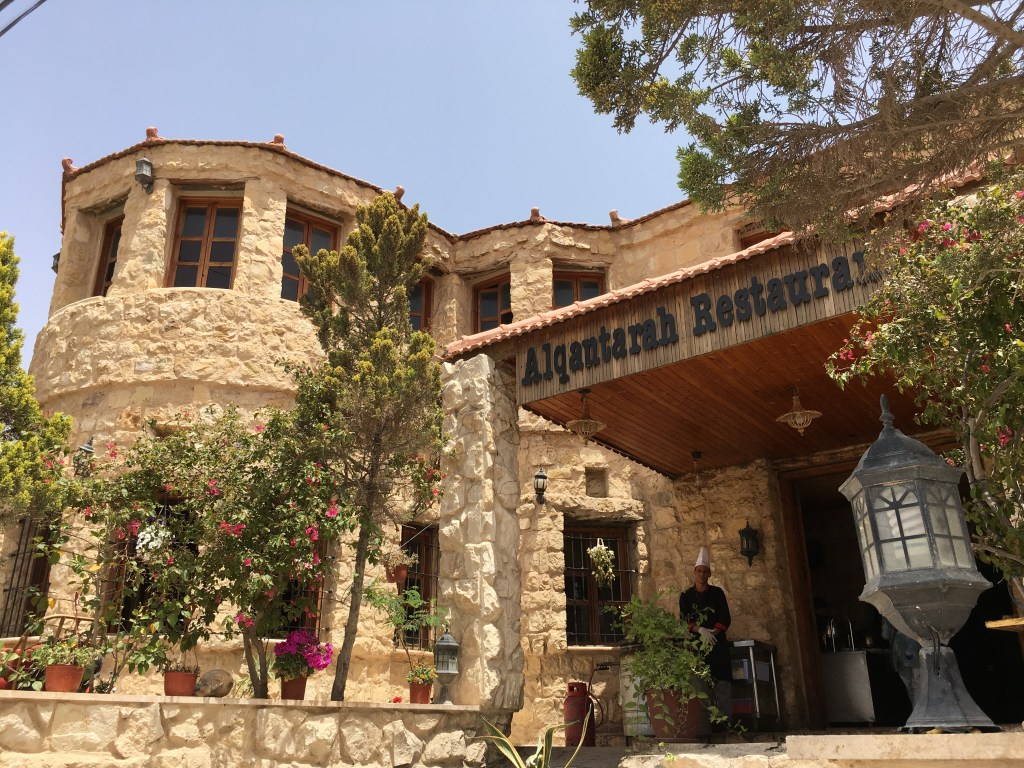
A restaurant in the desert of Meribah on the way to the ancient city of Petra in Jordan. Photo by author, 01 May 2019.

Jesus our Good Samaritan continues his “resolutely determined journey” to Jerusalem. On his way, “Jesus entered a village where a woman whose name was Martha welcomed him. She had a sister named Mary who sat beside the Lord at his feet listening to him speak” (Lk.10:38-39).

It is another story only St. Luke has like the parable of the Good Samaritan last Sunday. And like that parable, we have memorized this story so well that we think there is nothing new we can find regarding the attitudes of Martha and Mary in receiving Jesus. Worst of all is when we look at its simplistic interpretation that Jesus favored Mary’s contemplative spirit than Martha’s active characteristic.

Again, Jesus invites us today to suspend our beliefs about the story of Martha and Mary by going deep inside us to discover its true meaning as it tells us something about that inner question we shared last Sunday with the scholar who asked the Lord, “what must I do to inherit eternal life?” (Lk.10:25).
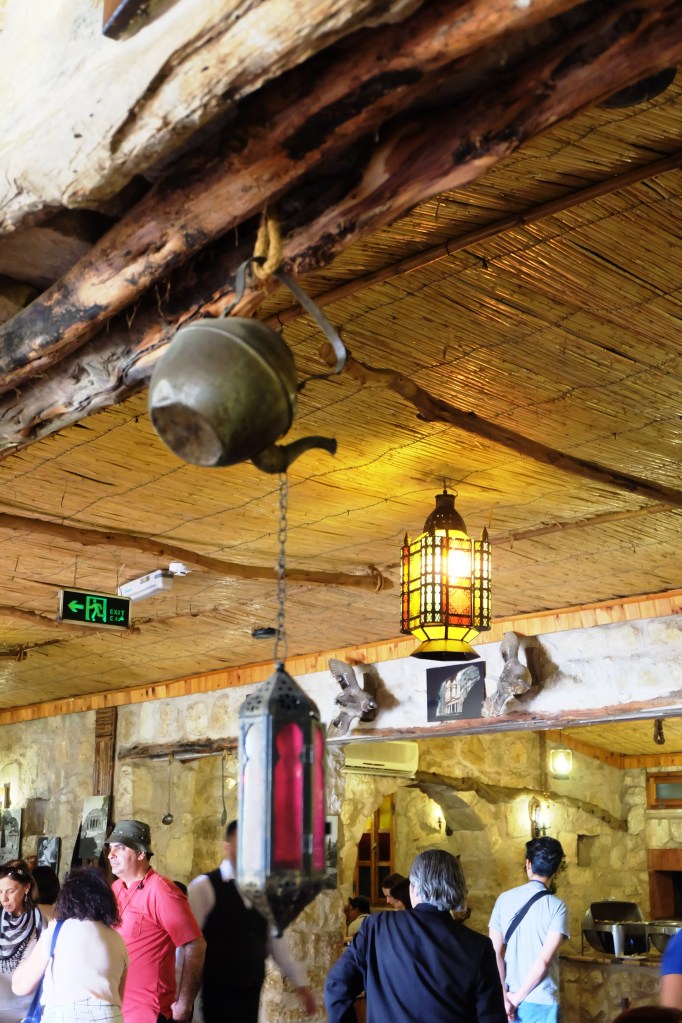
Kettle-lamp inside a restaurant in Meribah, Jordan.

Martha, burdened with much serving, came to him and said, “Lord, do you not care that my sister has left me by myself to do the serving? Tell her to help me.” The Lord said to her in reply, “Martha, Martha, you are anxious and worried about so many things. There is need of only one thing. Mary has chosen the better part and it will not be taken from her.”

Luke 10:40-42

Too often, the simplistic preaching we hear about this story is very unconvincing when some would argue the primacy of the “contemplative spirit” displayed by Mary over Martha’s zeal in hosting or “catering” for Jesus that is both necessary and valuable. Recall the many instances when Jesus also warmly accepted invitations by Pharisees and other sinners like Zacchaeus who also waited on him during meal. Two Sundays ago we heard how Jesus instructed the 72 disciples he had sent to “eat and drink whatever is offered to you” (Lk.10:7) when they are received as guests.

Very clearly, the lesson here is about hospitality that is more than staying at the feet of the Lord like Mary or getting busy at the kitchen like Martha. True hospitality in the Lord is welcoming him right in our hearts whether we are praying or doing something. Hospitality is from the Latin word “hospes” that means to welcome or to receive. In everything we do, whether in our actions and contemplation, it is Jesus who is our only focus and attention. We work in Jesus, through Jesus and with Jesus.

Jesus reproached Martha not for preparing their meal but for being “too anxious and upset” with so many things except him who had come to visit her and Mary. The gospels teem with so many instances where Jesus warned us his followers not to worry so much of the things of the world like food and clothing, money and other forms of security including how we shall defend ourselves against enemies when persecuted. Jesus has us all covered, so to speak.

The problem among so many of us priests and nuns these days is when we have become politicized than evangelized that we are so anxious and upset of so many things that we feel we are the savior of the world. The messianic complex plagues us in the Church where we have been so focused with our call, forgetting our Caller, Jesus Christ. Worst of all, we have stopped praying to Jesus especially in the Blessed Sacrament.

Last Sunday Jesus asked us to look more inside of us so that the more we see ourselves, the more we see him in others. Today, Jesus tells us that the more we become active, the more we must be contemplative looking to him within us. And when we are truly contemplative, we become more active in him with others! At its core is always that deep relationship, personal relationship with the Lord who always comes to visit us.

15th century icon of Abraham’s visitors at Mamre by Russian artist Andrei Rublev.

In the first reading we have heard Abraham welcoming his visitors believed to be the Blessed Trinity at his tent in Mamre. What a lovely story and a scene to behold where Abraham was like Martha busy preparing for the Lord his visitor. But unlike Martha, Abraham was never reproached because the Lord remained his focus in his waiting and hosting! It was during that visit at Mamre when God promised Abraham before leaving that his wife Sarai would bear a son the following year, fulfilling the earlier promise made to him that he would he would be the father of a great nation. If you have time to read further, Abraham’s wife came to be called Sarah from Sarai after the Lord heard her laughed upon hearing him spoke of their having a son the following year. It was Sarah who was reproached by God like Martha for not believing she would bear Abraham a son because she must be anxious and upset with so many other things like her age and being barren. There was no true hospitality in her too like Martha.

Back with Abraham at Mamre, the Lord revealed that true hospitality always leads to salvation, the fulfillment of the Divine promises. There in his tent where Abraham welcomed God wholeheartedly in himself, he received the good news of the birth of Isaac, the fulfillment of being the father of a great nation.

In Nazareth the same thing happened when Mary wholeheartedly welcomed the Angel Gabriel’s good news of the birth of Jesus, the Christ now in us according to St. Paul who is our “hope for glory” (Col.1:27).

In this simple story of Martha and Mary, St. Luke tells us something more than true hospitality, that whenever we receive somebody as a guest, when we reach out to help those in need like the Good Samaritan last Sunday, it is always Jesus whom we meet. Don’t be caught up with so many other things except Jesus because whenever he comes, he always has good news for us! A blessed week to everyone. Amen.

Welcome to our Parish of St. John Evangelist, Bagbaguin, Sta. Maria, Bulacan. Saturday Vigil mass at 5:30 PM and Sunday Masses at 7AM and 5:30PM. Don’t miss Jesus with his blessings and good news for you this Sunday!

“Warrior Is A Child” by Gary Valenciano (2000)

The Lord Is My Chef Sunday Music, 07 July 2019
Jesus Christ the Good Shepherd always taking care of us all his little sheep, especially the lost and wounded. Photo from Google.
Lately I’ve been winning battles left and right
But even winners can get wounded in the fight
People say that I’m amazing
I’m strong beyond my years
But they don’t see inside of me
I’m hiding all the tears

They don’t know that I come running home when I fall down.They don’t know who picks me up when no one is around
I drop my sword and cry for just a while
‘Coz deep inside this armor
The warrior is a child

Some of you must have sang the lyrics above from Gary Valenciano’s 2000 hit “Warrior Is A Child”, our Lord My Chef Music this 14th Sunday in Ordinary Time.

Gary’s song speaks so well of our reflections for today that the only bragging rights we have as disciples of Jesus Christ is to be one with him in his Cross, to be weak and wounded to manifest the power and greatness of God in us.

Almost everybody can identify with this song who seem to be so strong on the outside when in fact inside, we are all hurting in pain – a sick loved one, a broken relationship, a failure in an important exam, a lost family member.

That is discipleship in Christ for only those who truly love are willing to sacrifice and even offer their lives for their beloved. It is from this great love like Jesus Christ we his disciples are gifted with his peace, the only possession we are all allowed to have in order to share with others.

May we persevere in our struggles in life, may we keep on loving and forgiving in the name of Jesus Christ, continue to wage his war against evil and darkness for he is fighting with us, fighting for us.

Discipleship is embracing the Cross of Jesus Christ

The Lord Is My Chef Sunday Recipe for the Soul, Wk. XIV-C, 07 July 2019
Isaiah 66:10-14 >< }}}*> Galatians 6:14-18 >< }}}*> Luke 10:1-12, 17-20
Photo by Lorenzo Atienza, Malolos Cathedral, 12 June 2019.

Please forgive me for my curiosity: lately I have noticed the sudden sprouting of many “breastfeeding stations” and “lactation sections” in many public places that I feel so tempted getting inside them just to see how the mothers would react.

One of the joys of prayer is how God would communicate with us even with the most crazy ideas we have like that thought of entering a breastfeeding station. I recalled this thought as I dwelt deeply into Isaiah’s prophecy in our first reading today presenting God like a mother comforting her children the Israelites who were exiled to Babylon.

It was one of the lowest points in the history of the Jewish people when they lost everything – family and friends, country and nation, and most of all, their Temple in Jerusalem that they felt they were forsaken by God. As exiles, they were slaves without any freedom at all.

Thus says the Lord: “Rejoice with Jerusalem and be glad because of her, all you who love her, exult, exult with her, all you who were mourning over her! Oh, that you may suck fully of the milk of her comfort, that you may nurse with delight at her abundant breasts! As nurslings, you shall be carried in her arms, and fondled in her lap; as a mother comforts her child, so will I comfort you; in Jerusalem you shall find your comfort.”

Isaiah 66:10-11, 12b-13

Sometimes, God allows us to experience several blows and beatings in life not because he punishes us or he takes delight in seeing us suffer; sometimes, we need to be like infants and children again to trust God more, to rely to his goodness. It is the surest way to remind us who we really are. That we are not god.

In our second reading, St. Paul bolstered this imagery of our being children of God by reminding us that the only bragging rights we have as disciples of Jesus is to be one with him in his Cross.

Brothers and sisters: May I never boast except in the cross of our Lord Jesus christ, through which the world has been crucified to me, and I to the world.

Galatians 6:14
Photo by Pixabay on Pexels.com

As children of the Father and disciples of Jesus, our mark of distinction is not found in our greatness, achievements and success but in our being weak, in our being wounded and bruised, always needing the comfort by God like a mother to her children. This is very clear with St. Paul not only in our second reading today but most especially in his second letter to the Corinthians:

“I will rather boast most gladly of my weaknesses, in order that the power of Christ may dwell in me. Therefore, I am content with weaknesses, insults, hardships, persecutions, and constraints, for the sake of Christ; for when I am weak, then I am strong.”

2 Corinthians 12:9-10

It is in our weakness when God is most manifested.

Try listening to anyone bragging about his or her achievements and talents: for a time, we get impressed, we admire them but in the long run, it becomes both convulsing and convoluting. But when we come to learn or hear the sacrifices and sufferings of people even those we do not personally know, we feel uplifted. We remember God and his goodness, his mercy and love.

Crucifix at the side wall of the chapel of St. John Evangelist at Cana, Galilee. Photo by author, 06 May 2019.

Only the disciples of Christ who join him in his Cross can be filled with the gift of peace, the only possession of every disciple. See how how when Jesus sent out the 72 other disciples, he asked them not to bring anything at all. The only thing they must have is the peace of Jesus Christ that they have to share with everyone they visit.

“Go on your way; behold, I am sending you like lambs among wolves. Carry no money bag, no sack, no sandals; and greet no one along the way. Into whatever house you enter, first say, ‘Peace to this household.'”

Luke 10:3-5

Remember that when Jesus visited his Apostles in the locked upper room on the evening of Easter Sunday, he also greeted them with “peace” or “shalom” which is God’s greatest gift to anyone. Shalom in Hebrew means having a good relationship with one’s self, with others, and with God. Peace is always borne out of love and only those willing to sacrifice, suffer and even die for someone are the ones who truly love.

Mt. St. Paul Retreat House, June 2017.

There can be no peace in our hearts when we are filled with pride and ego. We need to be like children again, relying solely in the powers of our parents.

Last Thursday we brought our niece to her doctor at UST Hospital. While waiting for my sister when she left to get the lab results, I saw my niece feeling sleepy. I asked her to sleep on my lap as I gently rubbed her shoulder until she fell asleep soundly and peacefully.

What an attitude of not being bothered by her sickness because she must have great trust in me her uncle, my sister her mom, and also her doctor!

When we embrace our crosses in life and rely solely in Christ, we can also experience peace within. That is when we can rejoice as Jesus assured us, “your names are written in heaven” (Lk. 10:20).

A blessed week ahead to everyone! Jesus loves you, entrust to him all your worries and woes. Amen.

“Follow Your Road” by Pauline Wilson (1979)

The Lord Is My Chef Sunday Music, 30 June 2019
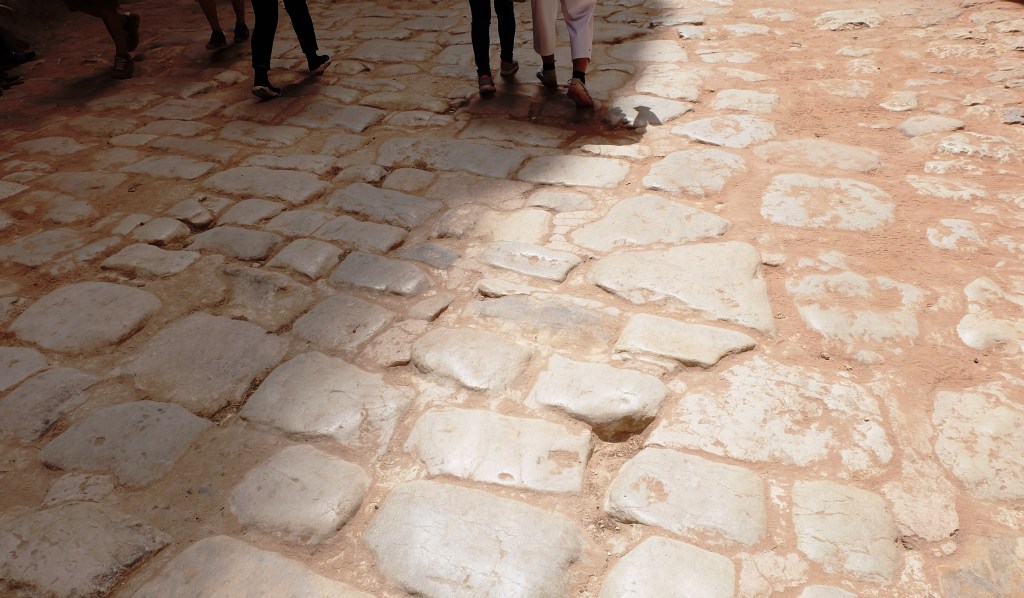
Walking back to 300 BC on the streets leading to ancient city of Petra in Jordan. Photo by author, 30 April 2019.

It’s a lazy, rainy Sunday.

And today’s gospel speaks of Jesus “resolutely determined to journey to Jerusalem” to face his death in fulfillment of his mission from the Father for our salvation.

Jesus is inviting us today to see death in his perspective as something beautiful and even glorious. Coming to terms with death is coming to terms with life. The moment we start accepting the certainty and reality of death like Jesus, the more we lead authentic lives filled with love and celebrations, not with bitterness and resentment.

We are all pilgrims, aliens and sojourners here on earth whose true home is heaven. And the only way to get there is death. It is a journey we all have to take.

Pauline Wilson’s “Follow the Road” captures this so well while her lovely voice assures us of the beauty and joy in taking all the risks in following this road of life. Very interesting is the second stanza where Pauline sings of “this one road that journeys far out of sight” that seems to imply of fullness and fulfillment in God considering her Filipino roots and strong Christian grounding in faith.

Jesus followed the road to Jerusalem over 2000 years ago and conquered death with his glorious Resurrection. Let us follow him more closely each day as we follow the road of life, trusting him, loving him.

A blessed Sunday to everyone!

Discipleship is facing death

The Lord Is My Chef Sunday Recipe, Wk. XIII-C, 30 June 2019
1 Kings 19:16, 19-21 >< )))*> Galatians 5:1, 13-18 >< )))*> Luke 9:51-62
Jerusalem as seen from the Mount of Olives with a Jewish cemetery at the foreground facing its eastern wall where the Messiah is believed would pass through when he comes. It is the very route Jesus had taken more than 2000 years ago on Palm Sunday before his Passion, Death and Resurrection. Photo by author, 04 May 2019.

After all the solemnities we have celebrated since the closing of Easter Season last Pentecost Sunday, we now get into the very heart of the Ordinary Time of our liturgy with St. Luke as our guide. Feel the sobriety and hint of solemnity at the start of the second part of his gospel we have heard today which is about discipleship and facing death like Jesus.

When the days for Jesus’ being taken up were fulfilled, he resolutely determined to journey to Jerusalem.

Luke 9:51

I love the way St. Luke wrote this part about Jesus “resolutely determined to journey to Jerusalem.” In some translations, they have retained its literal equivalent from the original Greek text that says “Jesus set his face to Jerusalem”. For Jesus, Jerusalem is where he fulfills his mission from the Father by dying on the Cross. So, if we are going to be more literal with this opening sentence by St. Luke, it would be “Jesus set his face to death.”

Photo by Pixabay on Pexels.com

A friend who had inspired me about blogging has been writing about death lately. Last June 10, 2019 he wrote:

No one wants to write about death. Or dying.

To many, it’s not only a morbid topic. It is a taboo to talk about it.

Of course we’d rather talk about the joie de vivre in our daily chronicles. It is, after all, what sparks joy.

Death is a stranger to this world. Until it comes knocking at your door.

https://relativejoyforyou.wordpress.com/2019/06/10/dear-death/?fbclid=IwAR2ryu6Kou_CIRYqTz193ZTkpdS5bSabCX9-7NuhDSHM3jYcrhjNY8rta6o

His words are very true.

In fact, I have been very hesitant to write about death as a topic for my homily this Sunday because Sundays are supposed to be joyful! And that is perhaps our problem with death: we always see it as something dark and negative. (Is it not?)

Today Jesus is teaching us to see death in his perspective as something beautiful and even glorious. St. Luke saw it and is now leading us in this new approach to death as he tells us the story when “Jesus resolutely determined to journey to Jerusalem.”

One thing that strikes me during sick visitations in my parish and in Metro Manila is how we see death as an escape or an ending. Patients and relatives alike always tell me to pray for death to end all sufferings and pains.

When “Jesus resolutely determined to journey to Jerusalem,” he was not sick, physically and emotionally. He was very well and able. When he was hanging on the Cross, he did not wish death to end his pains. On the contrary, he actually faced death head on. And this is one of the very important lessons Jesus had taught and shown us: facing death, even embracing death. Recall how during his Last Supper on Holy Thursday Jesus was never caught surprised by death. He was in total control of everything.

This is the reason why Jesus accomplished so much in just three years of his ministry because he was very aware of his coming death. In coming to terms with death, Jesus lived fully even if he died at 33 years old. The same is very true with some of our saints who have died young and have accomplished so much because they have all lived to the fullest that death did not surprise them at all in their works and mission.

The “sleeping Jesus” on a bench at the entrance to Capernaum. See the wounds on his feet, markings from his crucifixion. Photo by author, 02 May 2019.

One of the new attractions at Capernaum today when you come to visit the ruins of the synagogue Jesus used to visit there during his lifetime is a park where one finds his statue sleeping on a bench at the entrance across the Franciscans’ quarters. The statue is executed artistically and realistically that passersby would drop some coins for alms in a pot near the image! The sleeping Christ on a bench depicts exactly the second part of the gospel we have heard today: there is nothing certain in this life except Jesus Christ. The sooner we come to accept and embrace this reality vis-a-vis death, the better for us.

As they were proceeding on their journey someone said to him, “I will follow you wherever you go.” Jesus answered him, “Foxes have dens and birds of the sky have nest, but the Son of Man has nowhere to rest his head.”

Luke 9:57-58

Discipleship is coming to terms with death, accepting its reality so that we stop wasting our lives with bitterness and resentments to start living joyfully and meaningfully in Christ. I have heard countless of times how most patients including relatives and friends would bargain for more time, for more life because they felt they have not lived fully. As they come face to face with death during sickness or an accident, they beg even for a little time to live fully, proving that “in the end, it is not the years in your life that count but the life in your years.”

Facing death like Jesus Christ is having God as our top priority. Unlike the second and third people Jesus had invited to follow him and asked his permission “to first bury his dead father” and “to first say goodbye to his family.” Jesus is not teaching us to turn away from our family and loved ones; he wants us to always have God and eternal life as our top priorities in life. Like Elisha in the first reading who slaughtered his oxen and cooked them using the yoke and plow as firewood to show he was foregoing everything to follow Elijah as a prophet.

Every disciple is a nomad following Christ, a pilgrim and sojourner whose true home is in heaven with the Father; hence, the importance of thinking always of things of the above, of heaven and of eternal life. St. Ignatius of Loyola calls it the “principle and foundation” in life wherein we do the things that would lead us to salvation and avoid things that would bring us to eternal damnation.

Of course, such a vision about life is not only contrary to the values of the world but even a folly. See how the world tells us to “just do it” and to “obey your thirst” so that we can have easy and comfortable lives, enjoying everything to the fullest by ensuring our security with material wealth. On the other hand, discipleship in Christ as St. Paul reminds us in the second reading is allowing the Holy Spirit to direct our lives because it is the spiritual things that truly fulfill us. What a tragedy especially among affluent nations we hear reports of increasing number of people committing suicides, feeling empty and lost despite their material wealth?!

Jesus alone is our joy and security. In him, trials and sufferings become blessings because they make us stronger and better persons. Most of all, death is neither an end nor an escape in Jesus but a passage to life in the fullest. This is not a simplification of the complex reality of death but an assurance that Jesus had conquered it and had made it into a blessing that we can now discuss and reflect about it.

I know that speaking about death is easier said than done. It may even be Quixotic. But, death is a reality of life we have to face and deal with, even befriend little by little as we age. Reflecting about death is a kind of death itself and at the same time a grace from God who enabled us to face it even in our limited abilities. Let us put our complete faith in Christ, following him resolutely to Jerusalem as his disciples so that when death finally comes to us, we find Jesus by our side. A blessed week to you! Amen.

“When The Morning Comes” by the Kalapana (1975)

The Lord Is My Chef Sunday Music, 23 June 2019
Sunrise at Lake Tiberias, the Holy Land, 02 May 2019. Photo by the author.

Our Sunday music on this Solemnity of the Body and Blood of Jesus Christ is an original composition by Daryl Hall of the dynamic duo “Hall and Oates” included in their “Abandoned Luncheonette” album released in 1973. Two years later, the upcoming rock group who called themselves “Kalapana” based in Hawaii did a cover of the Hall composition that became a hit that many thought it to be their original.

What I like with Kalapana is how they can make sad songs sound good like “When the Morning Comes” or their more popular hit “The Hurt”.

There is too much darkness in their songs, of disappointments but, the way they sang them you forget all their sad messages.

Went down town to see my little lady
She stood me up and I stood there waiting
It’ll be alright,
When the morning comes

Well now I’m up in the air with the rain in my hair
Got nowhere to go I can go anywhere
It’ll be alright
When the morning comes

I’m just passin’ and I’m not askin’ that you be anyone but you
When you come home, try to come home alone
It’s so much better with two

Well now I’m out in the cold and I’m growin’ old
Standing here waiting on you
It’ll be alright 
When the morning comes

Ooh ooh ooh ooh
When the morning comes
Ooh ooh ooh ooh
When the morning comes

There will always be darkness in our lives.

And that is why Jesus came, not really to remove darkness but, to accompany us so we can make it through the night until the morning comes.

But most of all, on this Solemnity of His Body and Blood, Jesus invites us to be his presence in the world plunged in darkness by always trying to see him in the face of everyone we meet.

As most people say, darkness ends and morning comes the moment we come to recognize the face of another person as our brother or sister.

Happy listening to everyone and enjoy your Sunday!

From “no body” to “some body”

The Lord Is My Chef Sunday Recipe for the Soul
Solemnity of the Body and Blood of Christ, 23 June 2019
Genesis 14:18-20 >< )))*> 1 Corinthians 11:23-26 >< )))*> Luke 9:11-17
Darkness descending upon the Sinai mountain range at St. Catherine, Egypt, 07 May 2019. Photo by author.

We all fear darkness.

It is difficult to do things in darkness because our sight is always impaired. We cannot see things clearly, giving rise to many imaginations of evil lurking behind darkness.

Even in the bible, darkness means the presence of evil. And this is why the bible teems with many stories of God coming to his people in darkness. Most especially in the gospels where Jesus comes to comfort and console his disciples and the people in darkness.

But there is more sinister in darkness, a kind of darkness that envelops people and not just the world around us. It is a darkness that refuses to see the other person as a brother and a sister. This we see in our gospel on this Sunday Solemnity of the Body and Blood of Jesus Christ.

As the day was drawing to a close, the Twelve approached him and said, “Dismiss the crowd so that they can go to the surrounding villages and farms and find lodging and provisions; for we are in a deserted place here.” He said to them, “Give them some food yourselves.” They replied, “Five loaves and two fish are all we have, unless we ourselves go and buy food for all these people.”

Luke 9:12-13

It is a very classic situation we always find ourselves in when more than the darkness around us is the darkness within when we refuse to see the face of everyone as another person who needs to be cared for, who must be fed and kept warm. Most of all, assured as a brother and a sister, being our kin or one of us.

This is the tragedy that happened recently at the Recto Bank where 22 local fishermen were abandoned at sea when a Chinese fishing vessel rammed their boat while safely anchored in the dead of the night.

After several hours at sea, Vietnamese fishermen rescued the 22 Filipinos, gave them water, and fed them with rice and noodles. Despite their language barrier that was another kind of darkness, the Filipino and Vietnamese fishermen understood each other in hand gestures, repeating only three words they knew so well: “Philippines. Vietnam. Friends.”

But the scariest darkness that the 22 local fishermen went through did not happen at sea but at home under glaring lights of camera when government officials downplayed their harrowing experience, dismissing it as an ordinary maritime accident involving “ordinary folks” (i.e., fishermen) and worst of all, after barraging them with so many questions and insinuations sweetened with offers of cash and materials, they eventually succumbed to darkness that they retracted their earlier statements of the incident.

Photo from Yahoo News.

The Recto Bank incident showed us the blinding darkness we are into as a nation. It shows how as the only Christian nation in this part of the world we have been living in too much darkness within us, how we have long forgotten to see the other person as a brother or a sister, that we have stopped caring for one another despite our too many devotions and religiosity.

Like the Twelve, we always wanted to secure our own comfort when darkness comes that we keep on dismissing others away, unmindful of whatever would happen to them along the way. This we do in all sectors of society when we do not care for those next to us if there would still be enough funds or resources or infrastructures after us. This is most evident in our garbage disposal and lack of care for the environment when we think only of our own selves, regardless of the next generation.

And, so, here we are groping in darkness even in the Church when both the clergy and the laity have been blinded by edifice complex, erecting monuments for their own glory forgetting those in the margin. How can some of us in the Church hide in darkness with all kinds of abuses, sexual and financial exploitation of those entrusted to us?

Today in this Solemnity of the Body and Blood of Jesus Christ, we are invited to dispel the darkness within us by seeing again that everything we have is from God.

In the first reading we heard the mysterious person Melchizedek, king of Salem and priest of the Lord. He had blessed Abraham with bread and wine after he had won over four pagan kings. Unlike most victors in any war, Abraham refused to take all the possessions of the pagan kings he had defeated because it was very clear to him his victory was due to God’s intercession. He claimed nothing to himself and that is he gave a tenth of everything to Melchizedek who then blessed him. It is exactly what we do in every Sunday Mass when we celebrate each week with gratitude to all of God’s blessings we have received. Like Abraham, we share not only our selves but also our treasures to God through our Mass offerings.

This is what St. John Paul II called as the “cosmic character” of the Eucharist.

In his 2003 encyclical “Ecclesia de Eucharistia”, St. John Paul II described this cosmic character of the Eucharist as Christ’s saving presence in the community of the faithful everywhere (cf. Ecclesia de Eucharistia 8-9). This happens when we enter into this mystery of Christ in the Holy Communion of the Mass whereby after receiving his Body and Blood, we become his very presence in the world which St. Paul explained in our second reading today.

With this in mind now, we see the larger context of the instruction of Jesus to the Twelve in the wilderness at that time of darkness to “Give them some food yourselves” (Lk.9:13). During his last supper, Jesus took bread and said “This is my Body…this is my Blood.” You who receive me as your Teacher and Lord, see my Body in every-body. No one is a no-body.

Whenever there is a darkness within every person, there is surely a failure in recognizing this Body and Blood of Jesus. Recall how it was in the darkness of the night when Judas sold Jesus for 30 pieces of silver to the priests. It was also in the darkness of the night when he betrayed Jesus.

There was also Simon during the darkness of the night who denied Jesus thrice when he failed to see him as his Lord for fear of being arrested too.

Then there were the two disciples going back to Emmaus on the evening of Easter: they were both in the darkness of despair and loss after the Crucifixion of Jesus whom they did not recognize walking with them at sunset. And when they recognized him at the breaking of bread, despite the darkness around them, they hurriedly back to Jerusalem to inform the Apostles how they have met the Risen Lord!

The Solemnity of the Body and Blood of Christ today reminds us that despite the many darkness in the world today, even right in our very hearts, Jesus comes to dispel them so we can see more the beauty and wonder of life and every person around us.

Is there any darkness in you that needs to be dispelled by Christ’s Body and Blood? Are you ready to offer him that darkness in your heart to become his light in this dark world?

A blessed week to everyone!

Photo by Pixabay on Pexels.com

“Walking in Rhythm” by The Blackbyrds (1975)

The Lord Is My Chef Sunday Music, 09 June 2019
From Google.

It’s Pentecost Sunday, the coming of the Holy Spirit to the first disciples of Jesus Christ who were filled with fire and zeal in spreading the good news from Jerusalem to the whole world. But more than an event in the past, Pentecost is something the Church needs so badly these days to continue the work of Christ in the world that has become cold and without direction and fulfillment.

What we need in the Church that has become so rigid and lethargic in one end and pompous and glitzy at the other end is a “perennial Pentecost”, the daily coming of the Holy Spirit to enlighten us again in following and sharing Jesus with others in loving service. We need the Holy Spirit to convert us and go back to Christ in the Blessed Sacrament and the Holy Eucharist which is the sacrament of love.

From Google.

The Blackbyrds’ 1975 hit “Walking in Rhythm” captures the image of somebody filled with the Holy Spirit who is so full of love and life, joy and excitement. The smooth rhythm and blues jazzy beat of the song is so moving and uplifting. It is exactly what the Holy Spirit does when its fire burns and purifies us to realize that our true greatness as human is in being small, in our ability to share to become a part of a larger whole.

“Walking in Rhythm” tells of a man so in love and passionately driven to come home to meet his sweetheart after being away for some time. He is walking in rhythm because he knew he would be complete again when he becomes one with his beloved.

That is essentially the meaning of being a Christian, of being a member of the Church: we become whole with others in Christ. Jesus is our head and we are the body. Every body is important. How sad that whenever we gather every Sunday during the Mass, we are on our own! The priest delivers a boring homily he himself does not understand because he had not prayed nor prepared at all. The congregation are on their own, some asleep, others with thoughts wandering, while the young are either texting or plugged to their playlists. We have to dispose ourselves to the coming of the Holy Spirit always. It is Pentecost or nothing if we want to walk in rhythm, to be fill with life and joy.

From Google.

Like the lover in “Walking in Rhythm”, or the apostles at the Upper Room in Jerusalem during that Pentecost, we have to open ourselves to give a space within us for the Holy Spirit to work in us, to fill us with life and joy. Most of all, with love.

Walking in rhythm
Movin' in sound
Hummin' to the music
Trying to move on
I'm walking in rhythm
Singin' my song
Thinkin' about my baby
Tryin to get home....

The Nearness of God

The Lord Is My Chef Sunday Recipe for the Soul
Solemnity of the Ascension of the Lord Jesus Christ, 02 June 2019
Acts 1:1-11 >< }}}*> Hebrews 9:24-28; 10:19-23 >< }}}*> Luke 24:46-53
The Chapel of the Ascension believed to be the site where Jesus stood before ascending into heaven while his disciples looked at. Photo by author, 04 May 2019.

Outside the old city of Jerusalem on the Mount of Olives is the Chapel of the Ascension believed to be the site of Jesus Christ’s Ascension into heaven. Though the octagon-shaped structure is massive and very high, it is quite small inside with just one door for entrance and exit. Immediately upon entering that door on the floor is a framed slab of stone called the “Ascension Rock” venerated by pilgrims because that is where Jesus stood before going up to heaven.

The Ascension Rock. Photo by author, April 2017.

But personally, in the two occasions I have been there in 2017 and last month, my focus have always been more on the four windows of the chapel’s dome.

The rays of light coming through them have always evoked in me the beauty of Christ’s Ascension with a feeling that is so uplifting. The morning rays of the sun gently filling the room with light warms your heart as if angels are keeping you company like what we heard from the first reading during the Ascension of Jesus.

A window at the dome of the Chapel of the Ascension. Photo by author, April 2017.

As I prayed this week on the meaning of the Solemnity of the Ascension by recalling my two pilgrimages to the Holy Land in the light of our readings today, it is only now have I realized that the key to this feast is not found in looking up to the skies or looking down on where Jesus stood before going up to heaven.

It is in looking more into our hearts, looking deep inside us can we truly find the meaning of the Ascension of the Lord.

This feast is an invitation to get inside our hearts, not just into our minds and imagination to appreciate the words of Jesus Christ these past two Sundays about his “going and coming in a little while” (Jn.13:31, 33;14:25;16:16,20).

Remember how Jesus these past two weeks kept on speaking about his leaving and his coming at the same time? Of how we reflected last Sunday that in life, we do not really leave but simply come into new level of existence and new level of relating with God and with others?

Then he led them out as far as Bethany, raised his hands, and blessed them. As he blessed them he parted from them and was taken up to heaven. They did him homage and then returned to Jerusalem with great joy, and they were continually in the temple praising God.

Luke 24:50-53

Normally, it is sadness that we feel most in every leaving and departures: when kids leave home to pursue college somewhere, when a father or a mother leaves abroad to work over a long period of time, or a beloved dies. Though the cliche may be right sometimes that “parting is such a sweet, sweet sorrow”, the fact remains there is always sadness whenever we leave or somebody leaves us.

That is why St. Luke’s account of the Ascension is strange when he tells us that Christ’s disciples “then returned to Jerusalem with great joy” after the Ascension. St. Luke does not give any hint or a tinge of sadness among the disciples when Jesus left them to sit at the right hand of God almighty Father in heaven. And, the Holy Spirit has not come down yet. Where did the disciples get this great joy after Jesus had left?

Detail of a 15th century Greek Orthodox icon of the Ascension of Christ with Mary so calm while the apostles very animated, eager to proclaim the gospel. From Google.

We do not have the details at how this great shift happened that the disciples were filled with great joy after Ascension but, the Scriptures and the stories of the saints as well as those of some true heroes provide us with some answers and reasons.

According to St. Luke as well as the other evangelists, Jesus came to see his disciples for many days (40 according to Luke) after Easter. The Lord taught them with some more lessons preparing them for his coming Ascension. Most of all, Jesus made his disciples experienced his new mode of presence in his glorious body. He showed them his wounds and dined with them so often to convince them that he had really risen.

In all instances of his appearances, there was always joy among the disciples. Slowly, the disciples’ joy in knowing Jesus is risen deepened into great joy at the Ascension when this truth sank deeper into their hearts too that they have finally and truly accepted Jesus is alive!

When a truth or a reality stays only in our minds, that is always open to doubts. But, the moment that truth or reality we know is brought down to our hearts, that is only when we truly accept it as really true. And that is when we are filled with great joy because we are already convinced without any doubts of the truth or reality we have received.

Saints and heroes alike find great joy in their sufferings and death because of their convictions in their hearts that what they knew in their minds are very true. They lead “authentic” lives because what they knew in their minds was what they felt in their hearts that they eventually say and do. It is only in authentic living can we find great joy in living, no matter how painful or difficult it may be.

15th century Greek Orthodox icon of the Ascension. From Google.

And that is the great joy in the Ascension of Jesus Christ: the disciples, like us, start living authentically because we are deeply convinced that the Lord had not left us but had in fact launched a new level of nearness with us. His Ascension is the finality of the redemption he had won for us coming right into our hearts when we realize that Jesus did not simply die and rose again for a nameless mass of people. He did everything personally for each one of us.

This is what social media can never give us. Despite its great popularity, social media have left many of us still sad and even sick with various forms of mental illnesses. Everything that happens in the Net often remains up in our heads, rarely sinking into our hearts that still keep us apart despite our connections.

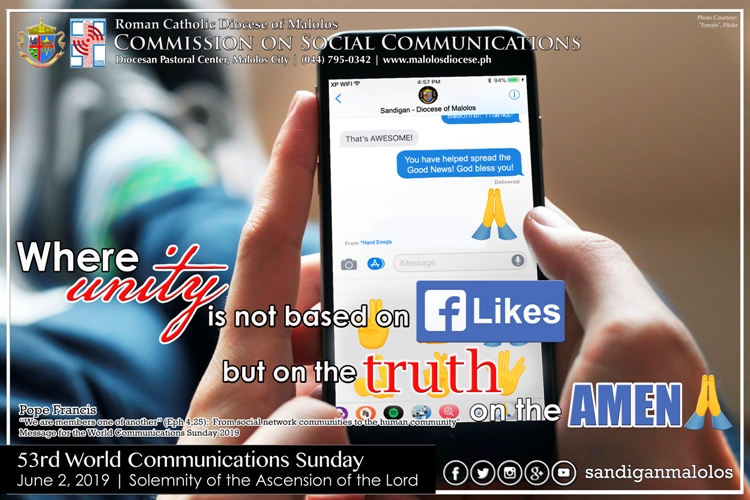
In his message for the 53rd World Communications Sunday we also celebrate today, Pope Francis invites us to connect deeper into the human community and not just in social network communities. The Holy Father stresses that interconnection must go down into personal encounters in the flesh, not just in virtual reality, calling for a shift from “likes” to “amen”.

Poster by Kendrick Ivan Panganiban.

How ironic that all these modern means of communications were invented to bring us all closer together but it seems the opposite is happening. We are growing apart and have become more impersonal than ever! We are all guilty of so often clicking the “like” button without having read the complete post or seen the photos of our relatives and friends. We rarely take time to “process” what we read and see on Facebook by people we call “friends” who often number to thousands. What an inauthentic way of living!

The Ascension of the Lord is a call to authentic living as it launched a new level of nearness of God with us and us with him and with one another. Unlike in the Old Testament as the author of the Letter to the Hebrews explained, Jesus did not enter a sanctuary made of human hands, referring to the old Temple worship that was never complete due to human imperfections. When Jesus came and went through his pasch, he brought God closest to us. We can rise up or ascend to his new level of relationship, new level of existence by rising up also from our infirmities and limitations in him who dwells in our hearts. A joyful month of June to you! Amen.

“To Love Somebody” by the Bee Gees (1967)

The Lord Is My Chef Sunday Music, 19 May 2019
Clouds over the vast desert of Egypt going to Cairo, 07 May 2019.

Thank you for following our LordMyChef Sunday Music.

It is nice to be back again this Sunday with a music from the Bee Gees with their second international hit single called “To Love Somebody” released in 1967.

According to Barry Gibb, the only surviving member of one of the world’s most successful musical group composed of his late brothers Robin and Maurice (and Andy), To Love Somebody is his most loved composition because of its “clear, emotional message” (Piers Morgan’s Life Stories interview in 2017). In another interview earlier in 2001, Barry said the song was meant for their long-time producer Robert Stigwood’s gift and brilliance, as a sort of a tribute. He explained that Stigwood asked him to compose a soul for Otis Redding in 1967; they presented To Love Somebody to Redding in New York who liked it very much. Unfortunately, Redding never had the chance to record the song when he died in a plane crash that year. To Love Somebody was then offered to other artists but despite their good reviews of the song, nobody wanted to record it. Hence, the Bee Gees included it in their first international debut album Bee Gees 1st, releasing it as a single that reached the 17th spot in the US charts and 41 in UK. The brothers reissued it in 1980 and the song has been covered by so many other artists worldwide that included Michael Bolton, Rod Stewart, Janis Joplin and Nina Simone.

To Love Somebody sounds so close to our gospel today when Jesus gave his disciples a new commandment to love one another as he has loved us, which is, “to love somebody the way I love you”!

Of course, the song is romantic in nature but it gives us also a hint of the newness of Christ’s new commandment to love like him that is always unitive, creating a communion and bond of unity with the lover and the beloved. That unity for Jesus is rooted in God our Father who is love himself.

Human love is always imperfect. There will always be people so difficult to love or deal with or simply accept. Even more difficult to forgive. But when we love in Christ Jesus, in him and with him, our love becomes more truer and doable and possible. After all, as the Bee Gees sing in this song, it is Jesus Christ who first loved us too and desired so much that unity in him. We are able to love because of Christ’s gift of love for us. Let us not waste that gift of love. Love somebody, the way Jesus loves you! Amen.

From Youtube.