Advent Is The Joy of Persons

48363133_2022338281220522_1767266466916204544_n
The Lord Is My Chef Simbang Gabi Recipe-1
Advent-3, Year C, 16 December 2018
Zephaniah 3:14-18//Philippians 4:4-7//Luke 3:10-18

          Christmas is undeniably the most joyous season of the whole year.  And we all know the reason because it is the birth and coming of our Savior Jesus Christ.  Unfortunately in practice, we always forget Jesus Christ and we get focused on the gifts and decorations that delight our senses but leave us empty within.  When we forget Jesus Christ as the reason of the season, then we altogether forget the persons around us, forgetting that the greatest gift we can always receive is the gift of our personhood, the gift of another person we journey in life.  One rejoices because of a person.  Only persons can bring joy and only persons can rejoice.

          You must have seen the Christmas short film of Ayala Malls’ “Wishing Tree” where a Lola and her apo celebrate the Simbang Gabi at Greenbelt.  After Mass, the apo would hang his Christmas wish on the “wishing tree” aided by the security guard.  The Lola eventually had Alzheimer’s, had to stay home while her apo went alone to Simbang Gabi.  As usual, the apo who had grown up into a young man went to hang his Christmas wish but this time, instead of asking for toys, he simply wrote “Make Lola happy again.”  The security guard saw his wish and had a brilliant idea of gathering from the mall’s CCTV records the joyful memories of the Lola and her apo at Greenbelt through the years.  On Christmas Eve, the apo went to kiss and greet his sick Lola in her room where he found a Christmas card from Ayala malls.  Inside was a USB with footages of their happy days together at Greenbelt that lit up Lola’s face with joy as if she had suddenly recovered her memories that she rested her head on her apo’s arm.  How amazing that despite her dementia, Lola rejoiced again when she saw the gift of person in her apo, their gift of selves to each other that tells us only persons can bring joy to another person, not money or things or gadgets.

         This third Sunday of Advent which we also call “Gaudete Sunday” or “Rejoice Sunday”, we level up our rejoicing because our joy is not only coming from another person but from the Second Person of the Holy Trinity, the Son of God Jesus Christ!  Such was also the joy of Mary in singing her Magnificat upon experiencing the very person of  God in herself and in Elizabeth, “My soul magnifies the Lord” (Lk.1:46).  Every joy is magnified because of the person of Jesus Christ who revealed to us that our God is not merely an entity but a Person who relates with us and wants that relationship deepened as a true Father to us.  Last week, we reflected how we must create a room or a space within us to let Christ come to us and possess us.  Today, our readings remind us how God shows us Himself and His plans for us through other persons in Christ Jesus.  See how the people were filled with joy upon listening to the preaching by John the Baptizer in the wilderness of Jordan.  Everybody, including sinners like tax collectors and soldiers were asking him “what should we do?” because they felt the joy within of Christ’s coming.  And the good news is that through John, the people of that time including us today found that God is not really asking so much from us:  we simply have to live simple lives of sharing whatever we have, being fair and just with one another.

         To everyone in the crowd, John said, “Whoever has two cloaks should share with the person who has none.  And whoever has food should do likewise.  Tax collectors should stop collecting more than what is prescribed while soldier should stop the practice of extortion, do not falsely accuse anyone, and be satisfied with their wages.” (Lk.3:11, 13, 14)

          Let us rejoice because God is not asking great things from us to experience His coming in Jesus!  We do not have to withdraw to the mountains and wilderness to find Jesus Christ.  All He wants is our complete person with concrete acts of love and charity, mercy and kindness with every person around us who is our brother and sister in Him.  All God wants is our complete person wherein we are faithful and true to Him through others in whatever state of life we are into.  See how all the readings proclaimed during this Season of Advent teach us to realize that God has truly come among us in the person of Jesus Christ so that we can experience Him in our very personhood and among other persons, both in good times and in bad times, in joys and in tears.  Together we all celebrate life’s ups and downs with God Himself in Jesus through the persons who heed His call to love and to serve.  In becoming human like us, God the Son came to proclaim that the Kingdom of God is within us and that the Holy Spirit has been sent to support our relationships with other persons.  It is always a struggle to be a good person most especially among relatives and friends who are supposed to be the first to love and understand us but turn out to do the opposite.  So often, we forget the other person due to many fears within us like being unloved or rejected, going hungry or thirsty, of losing and getting lost.  The prophet Zephaniah tells us in the first reading to cast away all fears and be not discouraged by failures and hurts in life; rejoice because you are so loved by the Lord!  “The Lord, your God, is in your midst, a mighty savior; he will rejoice over you with gladness, and renew you in his love, he will sing joyfully because of you, as one sings at festival” (Zeph. 3:17).  St. Paul reiterates this call for rejoicing, telling us “Your kindness should be known to all.  The Lord is near.  Have no anxiety at all, but in everything, by prayer and petition, with thanksgiving, make your requests known to God.  Then the peace of God that surpasses all understanding will guard your hearts and minds in Christ Jesus” (Phil.4:5-7). 

         How sad, and how can we rejoice this Advent and Christmas in our country where Christmas is said to be the merriest and the longest when the president and his men especially in the police force rejoice in the death of drug dependents and criminals?  We condemn every act of violence especially to innocent victims but executing their perpetrators, eliminating addicts and criminals will never solve the problem.  How can we rejoice when very clearly justice favors the rich and powerful who can all go free or even be exempted from being arrested simply because of age?  How can we rejoice when telling lies and peddling fake news are the norms of the administration, maligning people and institutions?  The most tragic part of this attitudes of killing, telling lies and injustice in courts is the atmosphere they create among people to lose respect for another person, to fail to see the value of every person rooted in God.  Anyone who rejoices in the death of another person, in fake news and lies can never have true joy because deep inside, they are the most insecured and fearful persons of all who are so afraid to love and to forgive, to accept the truth that they have lost their own value of being a person.  They will never experience Christmas like Herod who ordered the murder of innocent children upon hearing the birth of another person truly greater than him, Jesus Christ.

         This joy of Advent and Christmas in the coming of Jesus Christ is found in the humility of our all-powerful, ever-present, and all-knowing God who chose to be another person among us, so weak and so small even begging us to receive Him.  Doubt no more, my dear reader that no matter what your sins are or your past may have been, whatever may be your state and condition in life today, God is here.  Have a room in your heart for Him, welcome Him for He does have plans for you.  He is also among other persons around you at this very moment, meet Him too among them.  Rejoice and give the person you love with a big, warm hug to feel God’s intense presence on this Rejoice Sunday. AMEN. Fr.NicanorF.LalogII,Parokya ng San Juan Apostol at Ebanghelista, .Gov. F. Halili Ave., Bagbaguin, Sta. Maria, Bulacan.

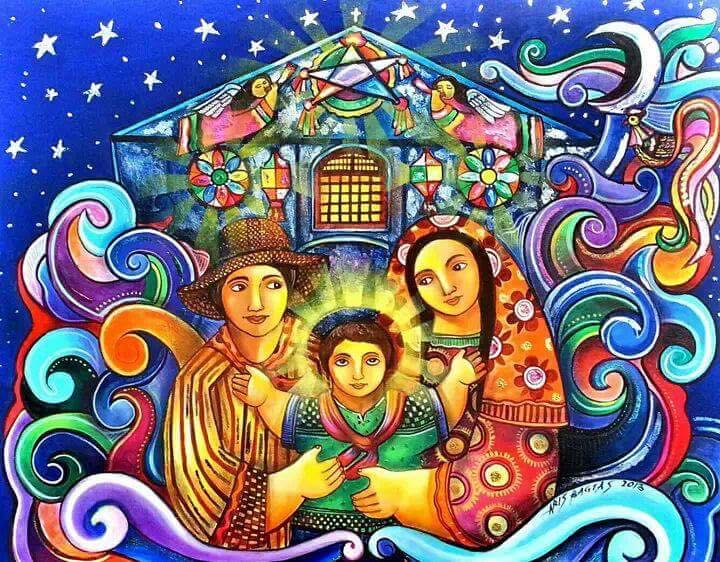
*Photo is a painting on acrylic canvas by Bulakenyo artist Aris Bagtas, “Triangulo ng Liwanag” exhibited in Washington DC in 2013.  Typical of paintings by Aris is the joy of the Filipino family where there is always the presence of love represented by his vibrant colors.  According to Aris, the relationship among the father, mother and child is everyone’s “triangle of love” in this colorful life we have.  Used with permission.

Advent Is Creating A Room for God In My Life

37196152_10156528615579704_3429030339266215936_o (1)
The Lord Is My Chef Sunday Recipe
Advent-2, Year C, 09 December 2018
Baruch 5:1-9//Philippians 1;4-6, 8-11//Luke 3:1-6

            I must confess that I am also guilty of getting into the so-called “Christmas rush” that is totally empty of Jesus Christ.  No, I am not a “shopaholic” but this early I am already so stressed out with my toxic schedules of activities for the coming Christmas.  And that is when God in His amazing ways intervened by totally cutting me off from the “loop” to redirect me to the spirit of Advent that calls us to create a room for Christ’s coming.  It started two weeks ago when our internet connection became erratic which we thought was just normal in our country so notorious for its dismal internet services.  But when I could no longer connect with the internet for my work last Tuesday and Wednesday for my talks, classes and blogs, we called a technician to fix the bugs, only to be told that the problem is my nine year-old Sony Vaio that needs to be upgraded or totally replaced.  My first reaction was to replace the technician but it was the first time I really felt to be out of the web that can be alienating and even debilitating.  That was when I realized to pray more, to fast from social media and modern communications, hoping to find Jesus Christ anew in my additional periods of prayer and silence.  It was also at that time when my Ninong and Ninang came from the US to celebrate their golden wedding anniversary at the church where they got married with me as the priest-presider.  After the reception, they asked me to go with them to their hotel where they surprised me with a Christmas gift, a new laptop computer!  See how God works in amazing ways if we give Him a room in our lives; my plan was to get a new computer next year but here is God sending me one from heaven right on my lap in the most perfect time.

             “In the fifteenth year of the reign of Tiberius Caesar, when pontius Pilate was governor of Judea, and Herod was tetrarch of Galilee, and his brother Philip tetrarch of the region of Ituraea and Trachonitis, and Lysania was tetrarch of Abilene, during the high priesthood of Annas and Caiaphas, the word of God came to John son of Zechariah in the desert.  John went throughout the whole region of the Jordan, proclaiming a baptism of repentance for the forgiveness of sins (Lk.3:1-3).”

                 Every time, every moment is a perfect time for God to come but, do we have a room for Him in our lives?  Luke presents us today the setting of the first coming of Jesus Christ more than 2000 years ago.  Times may have changed but the situation and feelings remain the same to this day when God comes to us right in the midst of our present situation, whether in our personal lives or in our political world or religious set up.  There is always that voice in the wilderness calling us to repent and prepare His way, His coming.  In the first Sunday of Advent last week, we reflected how this season of preparation is the presence of God which we can truly experience when we dare to open ourselves to Him in prayer and silence.  On this Second Sunday of Advent, our readings deepen this reflection of finding the presence of God by having a room or space for Him in our hearts and in our lives.

               According to the late American Neal A. Maxwell who was an Elder of the Church of Jesus Christ of the Latter-Day Saints, “Each of us is an innkeeper who decides if there is room for Jesus.”  What a beautiful insight that is very true!  We need to create a space and room in ourselves – more than just merely opening – to welcome Jesus Christ’s intense presence in our lives these days!  With all hyperrevolution now happening in our midst due to modern means of  communications that have greatly affected our lives, the more we need to experience Christ’s intense presence so that we are not only informed and formed but most of all transformed like during the time of John the Baptizer.  Every year, the second and third Sundays of Advent are always about the preaching of John the Baptist which is essentially about the coming of Jesus Christ.

                  The key here is the intense presence of Jesus Christ not only in us but also in the world.  The detailed reportorial by Luke of the setting of Christ’s coming over 2000 years ago suggests the integration of salvation history with secular history of all peoples.  Christ has come and Christ will come again though Christ had never left us but remains with us in the present.  We have just celebrated the Solemnity of the Immaculate Conception that reminds us of God’s presence amid man’s absence.  We become absent to God when we sin like Adam who hid from God after eating the forbidden fruit.  We fail to meet and experience God in His power and grace when we are absent to Him as we prefer to spend more time with things of the world than of heaven.  We become absent from God when we refuse to abandon our sinful ways or when we have stopped to hope for any change and salvation coming from God with whom nothing is impossible.  This Sunday, let us intensify the presence of God by creating a room, creating a space in our hearts and in our lives where Jesus may dwell and reign to direct our lives like John the Baptizer who went to desert to fast and create a space in himself and in his life for Christ.  It is impossible to meet God when we are so filled with things of the world and of ourselves.  God has many plans for us in Jesus that He sent Him to us but He cannot do anything if we do not let Him into our lives.  St. Paul tells us in the second reading that he is “confident” or sure that God will fulfill his promise that every man and woman shall see “the salvation of God” (Lk. 3:6).  Let us continue to dare on this second Sunday of Advent to open ourselves to God by creating a room for Him in our hearts and in our lives and allow Him to take possession of us like what Baruch prophesied in the first reading when Jerusalem would eventually be liberated from its conquerors.  Look back to your past and see how the Lord has done great things for you; trust Him, hope in Him always for He has come, He shall come and He is come. AMEN.  Fr.Nicanor F. Lalog II, Parokya ng San Juan Apostol at Ebanghelista, .Gov. F. Halili Ave., Bagbaguin, Sta. Maria, Bulacan

*Photo by Jim Marpa, St. James the Greater Parish, Solsona, Ilocos Norte, 17 July 2018.  Used with permission.

LMC

“Good Times” by Edie Brickell (1994)

Advent1M
LordMyChefSundayMusic//AdventWeekI//02december 2018
Advent Is the Presence of God

            Today we begin the new year in our Church calendar with the Season of Advent, the four week preparation for Christmas.  It has two aspects: today until December 16 our focus are set on the Second Coming of Jesus at the end of time, and from December 17 to December 24, we turn our attention to the first Christmas when Christ was born more than 2000 years ago.  According to St. Bernard of Clairvaux, between these two comings of Christ is His Third Coming in the present.  And that is why Advent is the presence of God among us in Christ.  Advent challenges us to be daring in opening ourselves to Christ’s coming in the most ordinary as well as in the most trying and difficult moments of our lives.  It is only when we dare to open our hearts to Christ’s daily coming can we truly experience the giftedness of each moment and day of our lives in God.

             Let Edie Brickell help you to be bold in opening to God with her 1994 hit single “Good Times”. Edie’s music is very refreshing and natural but bold in its message and lyrics where we find her openness to the presence of her loved one whether in “good times or in bad times.”  That is the challenge of Advent to us:  if we cannot dare to open ourselves to God in our good times and bad times, we would never have that space for Him in our hearts where He truly comes every day.  Dare to open your heart to God, give a space for Jesus to come and that is when Christmas happens regardless of the date and time.


You don’t even have to try
It comes easy for you
The way you move is so appealing it could make me cry
Go out drivin’ with my friends
In bobby’s big old beat up car
I’m with a lot of people then, I wounder were you are

Good times, bad times gimme some of that (3x) Ooh woo ooh

I don’t wanna say goodbye
Don’t wanta walk ya to the door
I spent a little time with you, I want a little more

Good times, bad times gimme some of that (3x) Ooh woo ooh

And baby really, I don’t have to
I have to go anywhere right now
You want some more, you want some more of this
Anywhere where, were ever you want baby, just,
Say it…. Ah…. Just say it

Good times, bad times gimme some of that (3x) Ooh woo ooh

Now want those good, good ,good times
And got those bad, bad, bad times
I want those good, good, good ,good times
Gimme some that

*Photo by author, Advent wreath at the Parokya ng San Juan Apostol at Ebanghelista, Gov. F. Halili Ave., Bagbaguin, Sta. Maria, Bulacan, 02 December 2018.

Advent Is the Presence of God

4XmasJohnhay17M
The Lord Is My Chef Sunday Recipe
Advent Week I, Year C, 02 December 2018
Jeremiah 33:14-16//1Thessalonians 3:12-4:2//Luke 21:25-28, 34-36

             Happy New Year everyone!  Today we start our new liturgical calendar in the Church with the first of the four Sundays of Advent symbolized by the Advent wreath that would be blessed and lighted after the homily by the priest.  Flowers are minimized at the altar and violet or deep blue is the motif while the Gloria is not sung except during the Simbang Gabi in joyful anticipation of Christmas.  The word Advent is from the Latin adventus that referred to the coming or arrival of the Roman emperor known as Caesar.  At the height of the Roman Empire (the Pax Romana), the emperor used to visit the different provinces under his rule and there would always be elaborate preparations because he was also considered as god by the Romans.  With the fall of Rome, the Church eventually adopted that practice to prepare for the birth of the King of kings.  And rightly so if we recall what Jesus told Pilate last Sunday at the Solemnity of Christ the King, “You say I am a king.  For this I was born and for this I came into the world, to testify to the truth.  Everyone who belongs to the truth listens to my voice.” (Jn.18:37)

             When we look at our liturgical calendar, we celebrate every day in the whole year the Kingship of Jesus Christ who is the presence of God among us.  Though Advent has two aspects, beginning today until December 16 when our sights are focused on the Second Coming of Christ and from December 17 to 24 when we focus on His first coming more than 2000 years ago, we celebrate every day in our lives the presence of Jesus in us and among us.  St. Bernard of Clairvaux beautifully said that between these two comings of Christ is His third coming in every present time.  And that is what Advent is all about:  the presence of God.  Christmas is more than a date to be remembered but the Person of Jesus Christ.  We can never experience His coming at the end of time nor His first Christmas if we do not dare to open ourselves to God, to His presence in every here and now.

             “But when these signs begin to happen, stand erect and raise your heads because your redemption is at hand.  Beware that your hearts do not become drowsy from carousing and drunkenness and anxieties of daily life, and that they catch you by surprise like a trap.  For that day will assault everyone who lives on the face of the earth.  Be vigilant at all times and pray that you have the strength to escape the tribulations that are imminent and to stand before the Son of Man.” (Lk.21:28, 34-36)

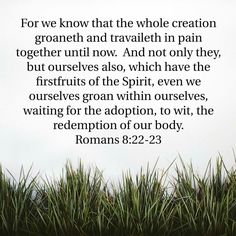
             Like during the Sunday before Christ the King, our gospel for the first Sunday of Advent invites us to focus on the “end time” or eschaton, the days of fulfillment of God’s promise when Christ comes again which nobody knows when except the Father.  Unlike in the movies and the other doomsday scenarios portrayed by some, the end of time should never be taken literally because it is a kind of writing called apocalyptic.  Such portrayals should never be imagined as they merely try to evoke the very difficult trials and tribulations peoples would experience and have experienced in different periods of time that continue to this day.  Are we not all still groaning in pain as St. Paul described from all the sufferings and hardships we go through today?  But here lies the good news of Advent:  it is during our moments of trials and sufferings when Jesus Christ comes!  The more persecutions, the more hardships we go through, the more we need to pray hardest, to be vigilant, to stand erect and raise our heads because it is during those trying times when Jesus Christ comes, and in fact when He is with us.

             The key word here is presence from which came also the word present which is the synonym for the word gift.  We need to always dare to open ourselves to God in the most unexpected moments of our lives because that is when we truly feel Him present in us and among us.  It is in our daring to be open to God’s presence when we can truly experience the giftedness of each day and each moment of life.  Too often, we remember God most when we are too far from Him due to our sinfulness.  That is when we look inside, examine our hearts, and turn back to Him, searching for His presence.  It is a proof that we can only find meaning in our lives in Jesus Christ and that is why He came.  On the other hand, we also feel God’s presence most when we are so blessed.  But these are two extremes that do not happen every day.  That is why we have to be “daring” or adventurous in being open to God especially during ordinary days.  The ordinary days are in fact the trying times for us all to be faithful to God, to feel His presence.  Too often, we get so used with our lives that we become oblivious to the presence of God.  Even in the midst of problems, disappointments and frustrations we just don’t mind them at all, expecting things would get better soon.  And God?   We just presume He is in charge but we do not really feel Him.  God has become a mere given in life that we pray, do our devotions and other spiritual activities just to fulfill them or get them done.  They have become empty because we have closed our hearts and selves to God’s many and amazing ways of coming to our lives, that He is always present in the simplest and most ordinary moments of life.

           This is the challenge of Advent:  that we always dare to open ourselves to God’s presence through prayers and silence.  Jeremiah said it well in the first reading, “The days are coming, says the Lord, when I will fulfill the promise I made to the house of Israel and Judah.  In those days, in that time…” (Jer. 33:14,15)    God is faithful to His promise and always comes to us, always with us.  We need to be daring to open ourselves to His presence to meet Him in our prayers and in silence.  To be daring in opening ourselves to God’s presence means being still with Him, “wasting” time with Him by daring to set aside too much social media and gadgets that waste our time and distract us of the more important things in life.  On this first week of Advent, let us be daring in opening ourselves to God by doing something different, by being good and better Christians as St. Paul asked us in the second reading.  If we fail to experience God during this Advent season, we would never experience Him in Christ coming on Christmas or any time.  Be daring and be filled with God this week!  AMEN.  Fr. NicanorF. Lalog II, Parokya Ng San Juan Apostol At Ebanghelista, Gov. F. Halili Ave., Bagbaguin, Sta. Maria, Bulacan

*Photo by the author, Manor House, Camp John Hay, December 2017.

LMC

What’s on your mind, Who’s in your heart?

PhilipStPaulResize
The Lord Is My Chef Sunday Recipe, 25 November 2018
Solemnity of Our Lord Jesus Christ, King of the Universe
Daniel 7:13-14///Revelation 1:5-8///John 18:33-37
 
            The trial of Jesus before Pontius Pilate occupies a very important role in the fourth gospel.  Unlike the other three evangelists, John mentioned only in passing that Jesus was brought to the high priest Caiaphas (Jn.18:24) after being examined by his father-in-law Annas while Simon Peter was outside denying the Lord thrice (Jn.18:12-23).  In narrating to us this trial of Jesus before Pilate, we see the spirituality and artistry of the beloved disciple who began his gospel account by solemnly declaring the eternal divinity of the Lord, “In the beginning was the Word, and the Word was with God, and the Word was God” (Jn.1:1).  Building up the climax of his gospel, John placed Jesus for the first time – in fact the only time – face to face with the world’s representative of political power.  And this shows us the meaning and essence of what we are celebrating today with Jesus Christ our Lord as King of the Universe, that His kingdom is “in this world but not of this world.”
 
            Pilate said to Jesus, “Are you the king of the Jews?”  Jesus answered, “Do you say this on your own or have others told you about me?”  Pilate answered, “I am not a Jew, am I?  Your own nation and the chief priests handed you over to me.  What have you done?” (Jn.18:33-35)

             Every morning when we open our Facebook, this scene seems to be happening again in a similar manner when Mark Zuckerberg’s creation asks us“What’s on your mind?”  Facebook and social media are gifts from God, a tremendous blessing for mankind where people meet to forge new friendships and renew old ones.  However, its overuse and abuse have led to many occasions of sins and evil.  In asking Pilate “Do you say this on your own or have others told you about me”, Jesus was not merely asking him what was on his mind but more of who was in his heart.  And we all perfectly know what happened next:  despite pleadings even by his own wife when he himself knew deep inside him the truth, Pilate washed his hands and went on with what was on his mind to sentence Jesus to death even if he knew deep in his heart He was totally innocent and in fact a very good man.

                The question “what’s on your mind” is so enticing for us to just open up without really thinking hard with what we say that may hurt others or have long lasting negative effects not only on other persons but especially to us.  It is a question with so many other implications that do not really seek to address anything substantial but only to affirm our own selves that in this world, at this very moment, “I am the king or the queen” and I can do everything!  We say whatever is on our minds to lord it over other people, sometimes literally throwing our weight around on others that in the process, we destroy our relationships.  Worst of all, when we keep on letting out what is on our minds without checking its veracity, we actually reveal our stupidity than sanity.  If we have to ask any question, we have to be ready to know its answer.  That is why, when we ask Jesus a question, we must inquire things of the above than things of this world for we might not like His answer that eventually would forcibly bring out from our hearts the right answer like what happened with Pilate later.  When Pilate asked Jesus “are you the king of the Jews”, he was not really ready to know yet the answer because deep in his heart he felt and knew the people behind the plot to kill Jesus.  Pilate was not ready to confront them because he also knew the Jewish leaders were very much aware of his corrupt practices.  How sad that so often we ask not to know the answers but simply to affirm our convictions especially if we know they are not sound at all.  When we ask more of this world, of things verifiable by facts and things that can be seen and tested, then we are not yet ready for the truth.

                Jesus answered, “My kingdom does not belong to this world.  If my kingdom did belong to this world, my attendants would be fighting to keep me from being handed over to the Jews.  But as it is, my kingdom is not here.”  So Pilate said to him, “Then you are a king.”  Jesus answered, “You say I am a king.  For this I was born and for this I came into the world, to testify to the truth.  Everyone who belongs to the truth listens to my voice.” (Jn. 18:36-37)

            Jesus Christ is king but His kingdom does not belong to this world.  It is in the world but not of the world.  His kingdom transcends beyond this world but right here in us.  Jesus Christ is king when in our hearts He reigns supreme, when we see Him among others as our brothers and sisters in Him.  More than our thoughts and ideas, more than our feelings and assumptions are persons to be loved and respected.  This is the reason why the question is not“what’s on your mind” but “who’s in your heart” which asks the more crucial question, “is Jesus our king?”  
             To recognize Jesus our King is to follow Him by taking up our cross because His kingdom is based not on force or power but on love expressed in humility, kindness, patience, and mercy that are often seen as weakness in the world.  Yes, one may say His kingship is out of this world but that is exactly what the world needs these days!  Remember His lessons to us His disciples these past weeks when He sent us with “no food, no sack, no money in our belts” (Mk.6:8),  that we must be like little children for “whoever does not accept the kingdom of God like a child will not enter it” (Mk.10:15), insisting that whoever wants to be great in His kingdom must be the slave of all like Him who came “not to be served but to serve and to give his life as ransom for many” (Mk.10:44-45).

             The Solemnity of Christ the King reminds us at the closing of our liturgical calendar as we prepare for Advent next week of that main truth that we as a Church must continue to be an image of this kingdom.  And what is the truth?  In the bible, truth is a road or a path one can follow with complete trust to have life found in God’s law.  Truth is something that must be done as in the expression “to walk in truth” (Ps. 119:105) by conforming our lives to the word of God.  See again the spirituality and artistry of the beloved disciple, of how he alone recorded the Lord’s declaration “I am the way, the truth, and the life” (Jn.14:6).  Here we find the totality of Christ the King who is the Truth because He is the way and the life.  Let us recognize today with thanksgiving to God Christ’s coming to us as our Alpha and Omega, our beginning and end.  May His kingdom come as we heed His call every day, especially in the Holy Mass as “the time of fulfillment… Repent, and believe in the gospel” (Mk.1:14-15).  Jesus my King, stay in my heart, reign in my life always!  AMEN. Fr. Nicanor F. Lalog II, Parokya ni San Juan Apostol at Ebanghelista, Gov. F. Halili Ave., Bagbaguin, Sta. Maria, Bulacan 3022.  Email:  lordmychef@gmail.com   

*Photo by my former student Arch. Philip Santiago, Basilica of St. Paul Outside-the-Walls in Rome, October 2018.

LMC

“Seasons of Love” from the musical “Rent” (1996)

yellow watch on tabletop
Photo by Vincenzo Malagoli on Pexels.com
LordMyChefSundayMusic//Week XXXIII-B//18 November 2018
And Life Goes On…with Love

         What matters most in this life is not really what we have achieved but what we have become:  have we been more loving, more understanding, more forgiving?  Today’s gospel reminds us of the end of time.  It is something we must not be afraid of but actually anticipate with joy because eventually, we all die.  But we do not simply die by ourselves.  We die in Jesus Christ.  And to die in Christ is to live in love.  The moment we come to terms with life, then, we come to terms with death because that is when we start living in love.  Love is the only measure of life as expressed in this beautiful music from the rock opera “Rent” of 1996.  Enjoy your Sunday with a lot of love with everyone!  A lovely Sunday and week ahead of everyone!

Five hundred twenty-five thousand six hundred minutes
Five hundred twenty-five thousand moments so dear
Five hundred twenty-five thousand six hundred minutes
How do you measure, measure a year?

In daylights, in sunsets
In midnights, in cups of coffee
In inches, in miles
In laughter, in strife

In five hundred twenty-five thousand six hundred minutes
How do you measure a year in the life

How about love?(3x)
Measure in love
Seasons of love
Seasons of love

Five hundred twenty-five thousand six hundred minutes
Five hundred twenty-five thousand
Journeys to plan

Five hundred twenty-five thousand six hundred minutes
How do you measure the life
Of a woman or a man?

In truths that she learned
Or in times that he cried
In bridges he burned
Or the way that she died

It’s time now to sing out
Tho’ the story never ends
Let’s celebrate
Remember a year in the life of friends

Remember the love (3x)
Measure in love
Measure, measure your life in love

Seasons of love
Seasons of love

And Life Goes On…with Love

howietaal
The Lord Is My Chef Sunday Recipe, Week XXXIII-B, 18 November  2018
Daniel 12:1-3///Hebrews 10:11-14, 18///Mark 13:24-32

            A clockmaker was about to finish a grandfather’s clock when the pendulum spoke and begged him not to be given that task of swinging back and forth to measure time.  “I am afraid I might not be able to do my job well when I have to swing every second or 60 times a minute, about 3600 an hour or 86400 a day,” the pendulum explained to the clockmaker who assured him everything would be fine.  The pendulum believed his maker.  Life goes on with the pendulum, tick-tock, tick-tock, sounding the chime every hour long even after his clockmaker had died.  In a sense, our lives are like the pendulum continually swinging, sometimes late, sometimes advanced.  When 2018 started, we felt so unsure of how this year would be but here we are, about to end the year as we look forward for the coming 2019.

           After celebrating All Saints’ Day and All Souls’ Day, we are now in the penultimate week of our liturgical calendar set to close on Sunday with the Solemnity of Christ the King.  Today we are invited to focus on the “end time” called the eschaton or days of fulfillment of all that God has promised.  In fact, every celebration of the Mass is oriented towards this end, especially when we proclaim the mystery of faith, “Christ has died, Christ is risen, Christ will come again.”  In the Apostle’s Creed we profess every Sunday our belief in Jesus Christ “who shall come again to judge the living and the dead” as well as in the “communion of saints, the forgiveness of sins, the resurrection of body and life everlasting.”

             Jesus said to his disciples:  “In those days after that tribulation the sun will be darkened, and the moon will not give its light, and the stars will be falling from the sky, and the powers in the heavens will be shaken.” (Mk.13:24-25)

             Jesus was still in the Temple and the people were marveling at its beauty when he spoke of these words, predicting its fall that would happen in the year 70 AD when Rome sacked Jerusalem.  But most of all, Jesus was speaking here in the classical language of apocalypse (from the Greek apocalypsis or revelation).  It is the same literary genre used in our first reading from the Book of Daniel.  Apocalyptic writings are not meant to be taken literally or even be imagined and pictured in its cosmic upheavals alluded to.  Jesus is not scaring us of the coming tribulations but is trying to evoke in us the image of a new creation dawning where the sun will be darkened, the moon will lose its light as the stars fall before His splendor as the returning Son of Man (see Rev. 21:23).  Recall how in Genesis God first created light by separating it from darkness when earth was all chaos and formless; then, He created the sun, moon, and stars to light the earth by fixing days and nights and years.  “In those days” life was simple and a bliss until sin came and everything was shattered.  In His infinite goodness, God preserved His creation and promised salvation to renew everything in the coming Savior.  “In those days” though there were disturbances and breaks from all the beauty of creation, life went on.  There was no need to destroy everything to start anew.  God perfects His creation amidst the many imperfections we are into.  Just like in our own experiences with the many tribulations we are going through like sickness, losses and deaths.  These words of the Lord and of the prophet Daniel are actually encouraging us to look at the fulfillment of the good news, the Gospel of Jesus Christ Himself personally coming to us, personally involved with us and in us.

             “And then they will see ‘the Son of Man coming in the clouds’ with great power and glory, and then he will send out the angels and gather his elect from the four winds, from the end of the earth to the end of the sky.” (Mk.13:26-27)

             A cousin in Canada emailed me one early Sunday morning last month of his being diagnosed with advanced stage of liver cancer.  A former soldier who had spent ten years in Mindanao as a Scout Ranger, he simply told me to pray for him in his life’s final battle.  More than the sadness is the pain still in my heart with his condition that it took me the whole day to write him back to assure him of my prayers. His siblings along with some cousins and relatives flew to visit him in Toronto, all praying for some miracle.  I chose to be silent in their prayers for a miracle because that very day he told me of his cancer, I have offered him to God.  Like Jesus Christ, it is not being a “kj” or killjoy to focus more on the coming eschaton and apocalyptic realities of present tribulations we are going through.  Death surely comes.  We are all going through many tribulations at the moment as individuals, as families, as communities and as a nation.  And things could even get worst before things get any better, here or hereafter.  That’s the reality of life we must face with joy and anticipation.  The prophet Daniel mentions in his vision seeing God sending us Archangel Michael to help us in our battle with evil in this life.  God recognizes the severity and gravity of our tribulations that He had sent us St. Michael so that life would go on while we await that eschaton that must be our gaze despite not knowing when it would be.  What the Lord is telling us is to learn from the fig tree, to always see each passing day as a changing of season, a time of rebirth, of living in His presence which the author of the letter to the Hebrews implies as always standing and faithful in our duties as disciples of Christ now“seated at the right hand of the Father in heaven”.
 

           Life goes on with all the tribulations in and around us because God never leaves us alone.  There would always be destructions and endings in life to give way to more recreations and new beginnings.  The key is to be like the pendulum, remaining faithful in our task of lovingly serving God among those around us.  In 1996, the rock musical “Rent” opened in Broadway.  Its theme song is called “Seasons of Love” which says life is measured not in minutes or time but in love.  Very true!  The most important and memorable events of our lives are those moments we have loved or we have been loved.  To live is to love and that is why if you want to be eternal, love for only love shall remain.  And it is love that will see us through in this life that is passing.  You are loved!  AMEN.Fr. Nicanor F. Lalog II, Parokya ni San Juan Apostol at Ebanghelista, Gov. F. Halili Ave., Bagbaguin, Sta. Maria, Bulacan 3022.

*Photo by Mr. Howie Severino of GMA-7 News, Taal Lake, 13 November 2018.  Used with permission.  Photo below from Google.

romans823

Giving Jesus

MaiShowaKinen2
The Lord Is My Chef Sunday Recipe, Week XXXII-B, 11 November 2018
1Kings 17:10-16///Hebrews 9:24-28///Mark 12:38-44

            Maybe you have heard the story of how the chicken and the cow argued who between them gives the most to their master.  The cow said she gives the most because from her supply of milk, the farmer is able to have cheese as well.  But the chicken argued that their master have to go through tedious work in milking the cow unlike with her when she simply has to lay eggs in her nest that can be easily obtained every day.  The pig heard their discussion, praised them both for their daily supply of milk and eggs to their master but reminded them that for her to give ham and bacon, she has to die first by offering her whole life as food.

            Jesus is still in the temple area teaching the people and His disciples some important lessons before His coming Passion, Death, and Resurrection.  Last week He had taught us of asking questions of the above and higher things that is actually a search for God which is the most essential in life.  Today, Jesus deepens this search for God by reminding us of the need to give our total selves to Him in order to find and have Him.  First we ask Jesus, and now we give our total selves to Jesus.

            In the course of his teaching, Jesus said to the crowds, “Beware of the scribes, who like to go around in long robes and accept greetings in the marketplaces, seats of honor in synagogues, and places of honor in banquets.” (Mk.12:38-39)

            The first step in giving our total selves to God and to others is to go back to what I call as our “hallowed hiddenness” in God.  We now live in the midst of social media where everything is “exposed” with nothing hidden from us anymore.  Everyone is either a “bida” or in a “pabida” mode.  Bida is the star or lead character in a movie or a TV show.  It is from the Spanish word vida that means life (contravida is the villain, the opposite of life).  Jesus was attacking here the scribes for being so “pabida”, always seeking popularity and admiration from the people.  They have entirely forgotten God and most likely must have thought of themselves as God Himself.  Sad to say, this continues to our own time.  Check Facebook and you see what I mean.  We have become a clapping generation because everybody is a bida.  Even in church where solemnity of the Mass is sacrificed on the pretext of making it more celebratory and participative that priests encourage so much clapping of hands.  How sad that some Masses have become a variety show with the priest becoming a celebrity that in the process, Jesus is forgotten.  Today’s warning by Jesus is personally directed to us who have become the modern scribes, reminding us how we must present ourselves more before God than before humans.   There is always this danger of hypocrisy and showmanship in every kind of service especially in the Church which is also the reason why laypeople quarrel among themselves on who is the real bida.  When this happens especially in the Church, we all become a kontrabida of the real and only bida, Jesus Christ.

            CNN reported recently that amid South Korea’s being the most wired country in the world with the fastest internet speed, it is now building many public libraries and centers where people can relax minus the ubiquitous smartphones and other gadgets.  The report says how the Koreans have realized the need for silence and stillness to truly progress.  Likewise, many companies and offices in Silicon Valley are reportedly encouraging their people to drop all gadgets once in a while during work to recharge and be refreshed in silence to discover new ideas.  Some tech companies there have even encouraged their workers to go hiking without bringing their gadgets to reconnect with self, others and nature.  Even the latest top of the line model of the iPhone is said to have a built-in monitor that reminds a user for being too focused with the gadget for a certain period of time.  These are all wonderful developments of how people are slowly rediscovering anew the need to be alone, to be still, and be silent.  We need to recapture our “hallowed hiddenness” with God so we can be whole again as a person.  The problem with too much exposure like in FB where even coffee breaks are posted is not only the growth of narcissism and superficiality among us but the grave mistake that one’s meaning in life is measured with the number of likes or followers one gets.  Unknown to us, the more we become visible and popular, the more we also become dependent on others for having meaning in life.  We can only find our true selves and meaning of life in God, the root of our being.  God is always found in emptiness and nothingness, not in abundance of the world.

            In the first reading we find this hallowed hiddenness in God in the beautiful story of the faith of Elijah and of that pagan widow of Zarephath.  Elijah was fleeing from the soldiers sent to kill him after telling King Ahab and his queen Jezebel that there would be drought in Israel due to their worship of baal.  He was first directed to a mountain stream where ravens brought him bread daily.  When the stream ran dry, God told Elijah to hide in Zarephath near Sidon in the home of a pagan widow.  This story of Elijah obeying God in a land of scarcity and danger (Zarephath was under the rule of Jezebel’s father) shows us his complete faith in God, of abandoning himself entirely with God.  The same is true with the pagan widow who gave everything to Elijah, believing in the promise of God told by the prophet.  In their hiddenness in God, relying solely on Him alone than with themselves and with others, Elijah and the pagan widow along with her son never went hungry until the rains came.  When we try to spend some hallowed hiddenness with God daily, taking a break from our busy schedules and social media, that is when we are purified to become better persons filled with the Spirit and substance.

            This is also the point of Jesus in calling His disciples to tell them later while seated opposite the treasury that the poor widow who put in two small coins worth a few cents gave more than the others for she “has contributed all she had, her whole livelihood.” (Mk.12:44)  The issue at hand is not about big money and little coins or amount of contributions but the spirit behind the act of giving.  Jesus was evoking here His coming total gift of self on the Cross that would soon take place which the author of the Letter to the Hebrews underscored in today’s second reading.  According to Pope Francis, “Giving and forgiving means reproducing in our lives some small measure of God’s perfection, which gives and forgives superabundantly” (Gaudete et Exsultate, 81).  Indeed, God has given us with so much but we have given so little.  May we learn to give more of ourselves and more of Jesus in us with others.  AMEN. Fr. Nicanor F. Lalog II, Parokya ni San Juan Apostol at Ebanghelista, Gov. F. Halili Ave., Bagbaguin, Sta. Maria, Bulacan 3022.  Email:  lordmychef@gmail.com   

*Photo by Dra. Mai B. Dela Pena, Showa Kinen Garden in Japan, 2018.  Used with permission.

Asking Jesus

45333784_1945748215727504_3541947692357779456_nThe Lord Is My Chef Sunday Recipe, Week XXXI-B, 04 November 2018

Deuteronomy 6:2-6///Hebrews 7:23-28///Mark 12:28-34 
                          

            We have seen these past two weeks Jesus in His journey back to Jerusalem asking us – through James and John, and the blind Bartimaeus – the quintessential question, “What do you want me to do for you?”  But this Sunday, we find a reversal of roles when, One of the scribes came to Jesus and asked him, “Which is the first of all the commandments?” (Mk.12:28)

             What question would you ask Jesus if given that chance?

             Jesus had finally reached Jerusalem, frequenting the Temple area which He had cleansed upon His arrival on Palm Sunday.  Mark tells us the building up of antagonism against Him by His enemies asking Him with many questions.  First were the chief priests, scribes and elders who asked about His authority in cleansing the Temple and then the Pharisees who teamed up with the Herodians to ensnare Him with the question about the paying of taxes to the emperor.  Last to test Jesus were the Sadducees who asked about the resurrection by presenting to Him the case of a woman who had married seven brothers after dying one after the other.  Mark tells us how Jesus satisfactorily answered all their questions that people were so amazed with Him.  It was at this time when a scribe who had heard them disputing and saw how well Jesus had answered them came forward with the question we also ask up to this time, “Which is the first of all the commandments?”

             Like that man who asked Jesus what must he do to inherit eternal life (Mk.10:17), we can also identify with this scribe whose question is without guile.  Like him, we find ourselves in many occasions asking the same question due to confusions from the so many things to be followed and fulfilled to be a good person and enter heaven.  We know deep in our hearts like him how humans have stretched God’s commandments that have now exceeded more than ten that many could not even recite in order.  Like this scribe, we have seen how faith and religion have ceased to be a way of life but more of casuistry, of obeying and keeping rules that made God look like a cop watching over us, ready to apprehend us for any violations instead of being a loving Father living with us.  Like that scribe, deep in us is a longing for something higher, of something really akin with God than with our present situation when everything seems to be relative and on ground level.

             We are known by the questions we ask, not by the answers we give that are often wrong or far from truth and reality.  Asking the right question leads us to the right answer and solution to our problems.  Even if we cannot find any ready answer to our questions but for as long as we are asking the right ones, we find clues for their answers as we move on with our lives.  Here in our gospel today we find how our questions reveal who we really are, indicating our focus and distractions in life.  In preparation for His coming pasch in Jerusalem, Jesus would reveal to us today and next Sunday the more essential things with God regarding our obedience to His laws and our attitude on giving.  So, let us reflect on the reply of Jesus to the question of the scribe which is based on the “Shema Israel” prayer that every pious Jew must know by heart:  “The first is this:  ‘Hear O Israel!  The Lord our God is Lord alone!  You shall love the Lord your God with all your heart, with all your soul, with all your soul, and with all your strength.’  The second is this:  ‘You shall love your neighbor as yourself.’  There is no other commandment greater than these.” (Mk.12:29-31) 

           Shema Israel is a verbatim quote from Deuteronomy 6:4-5.  It is a prayer that evolved from the Jews’ experience and reflection of the Ten Commandments as a love involving their relationship with God and with others.  More than a list of laws to be followed, the Decalogue became the sign of God’s covenant with Israel, a relationship to be kept with God at its center whose face is found among everyone as brothers and sisters.  Hence, when the scribe asked Jesus which is the first of all the commandments, it was a desire to find God Himself.  And when Jesus saw how the scribe had understood His answer, He told him “You are not far from the kingdom of God.” (Mk.12:34) 

           Observe that child-like attitude of the scribe with his question.  He was looking up to Jesus, looking for God in Him.  When we ask Jesus any question, that is the only attitude required of us.  Recall the different questions asked to Jesus in the daily readings last month like those concerning inheritance or how many would be saved (Lk.12:13, 23), or if His teachings are meant for us or for everyone (Lk.12:41).  See how Jesus ignored the questions because they were the least of His concerns.  Instead, He proceeded with His teachings to emphasize the importance of storing riches in heaven, passing through the narrow gate and being a wise and faithful steward.  When a teacher of the law asked Jesus who is my neighbor, the Lord replied with the parable of the Good Samaritan so that he would realize in himself that we are all neighbors who must show love and concern for one another.  When Pilate asked Jesus during His trial, the Lord clarified his questions so as to remind him that He is more than of this world.  And speaking of the fourth gospel, it is only John who had recorded Jesus repeatedly saying His being lifted up in glory, that is, His crucifixion when He would draw everyone to Himself (Jn.12: 32).  Here we find my dear readers how that every time we ask Jesus a question, the answer would always be found on His Cross because we can only look upward to Christ crucified.  It is only on the Cross can we be led to higher things like God Himself!  Ask Jesus any question like:

        Do you love me, Lord?
        Why all the sufferings in the world?
        Where are we going?

          Try asking Jesus like a child, like that scribe and most likely, when we see His pains and sufferings on His outstretched arms and folded legs, head crowned with thorns with expressive eyes and lips filled with love, we find His answers on the Cross.  This is why Jesus is “able to save e to save those who approach God through Him (Heb.7:24-26)” because He is our High Priest who literally hanged high up on the Cross for us.  May you be blessed to find God in your questions to Jesus!  AMEN. Fr. Nicanor F. Lalog II, Parokya ni San Juan Apostol at Ebanghelista, Gov. F. Halili Ave., Bagbaguin, Sta. Maria, Bulacan 3022.  Email: lordmychef@gmail.com

*Photo by Richard Val Candelaria.  Used with permission.

Jesus Calls Us In Our Blindness

RaffySunset3
The Lord Is My Chef Sunday Recipe, Week XXX-B, 28 October 2018
Jeremiah 31:7-9///Hebrews 5:1-6///Mark 10:46-52

           After my Mass last Sunday evening, a friend sent me a text message about their janitor who had committed suicide at the top floor of their new school building that afternoon.  She had sought my opinion a few weeks ago about that janitor suffering from depression, and later brought him to a professional for evaluation and counselling by personally paying for it.  But his condition deteriorated until he hanged himself that Sunday afternoon.  What is very disturbing with the suicide story is the seeming lack of support for the victim by their school officials.  And, as if to rub salt on his wounds, an HR officer of the school went to see the janitor at their home Friday before the suicide to serve his termination paper after going on AWOL for several weeks.  It seemed to be the final straw that hit the camel’s back, so to speak, that the poor janitor had totally lost all hopes in life that led to his tragic end Sunday afternoon.  My friend was very sad, deeply pained – and rightly so! – as it happened in their Catholic school run by religious priests and brothers.  Suicides do happen especially these days and there is no need to blame or pin on anybody, but to hear stories of neglect and lack of concern is another thing. One life is always too many to lose in senseless deaths like suicide.  As I prayed over today’s gospel, I cannot resist seeing in that school janitor the blind Bartimaeus, begging and shouting for attention, seeking compassion but alas, many in the crowd were so blind that they ignored him, except maybe Jesus, who knows might be passing by that Sunday afternoon and stopped for another lost soul in our modern Jericho.

         As Jesus was leaving Jericho with his disciples and a sizeable crowd, Bartimaeus, a blind man, the son of Timaeus, sat by the roadside begging.  On hearing that it was Jesus of Nazareth, he began to cry out and say, “Jesus, son of David, have pity on me.”  And many rebuked him, telling him to be silent.  But he kept calling out all the more, “Son of David, have pity on me.”  Jesus stopped and said, “Call him.”  So they called the blind man, saying to him, “Take courage; get up, he is calling you.”  He threw aside his cloak, sprang up, and came to Jesus.  Jesus said to him in reply, “What do you want me to do for you?”  The blind man replied to him, “Master, I want to see.”  Jesus told him, “Go your way; your faith has saved you.”  Immediately he received his sight and followed him on the way. (Mk.10:46-52)

          Last Sunday we reflected how Jesus wanted us to be radical in following Him by going back to the roots (radix in Latin) of our discipleship which is His Cross of suffering and death.  To be radical disciples of Jesus, we also reflected of the need to subvert or overturn our secular ideas of leadership based on power and position by imitating Christ’s kind of loving service that is always hidden in humility.  Today’s gospel is more than a story of the healing of Bartimaeus but also of responding to Jesus’ call for us to remove our different kinds of blindness that prevent us from closely following Him on the road to Jerusalem.  And the first step healing our blindness is deepening our faith in Jesus as the Christ.  Recall that the journey of Jesus back to Jerusalem started at Caesarea Philippi last month when He asked the fundamental question every disciple must personally answer, “who do you say that I am?” (Mk.8:29) 

          Bartimaeus was physically blind but it was very clear with him that Jesus of Nazareth is the Christ, the “Son of David” who would save Israel.  Despite his blindness, Bartimaeus “saw” in Jesus through the many stories he must have heard about Him that He is the fulfillment of God’s promise that Jeremiah prophesied in our first reading, “the Lord shall deliver Israel and bring her back from exile, gathering them all especially the blind and the lame, consoling them and guiding them to brooks of water, on a level road, so that none shall stumble.” (Jer.31:7-9)   His physical disability did not hinder Bartimaeus in growing in faith, “seeing” God as a loving Father who looks after His children especially the sick like him, healing and consoling them that he shouted “Jesus, Son of David, have pity on me.”  Observe that despite his being a blind beggar, Bartimaeus neither asked for his sight nor for any money or material thing except for God Himself.  When he told Jesus that he wanted to see, it was actually a plea for deeper faith in God!  Contrast this with the request of the “seeing” Twelve who were all blinded with ambitions, always debating who among them is the greatest, always seeing selves but not God and others.

          In my 20 years of priesthood, I have realized that most people who come for help are more in need of spiritual things like the warmth of friendship, a pair of listening ears for their many burdens with some sprinklings of humor, a lot of affirmation, prayers and compassion.  Faith in God always leads to faith with others who are also looking for someone to encourage and guide them to grow and mature in that faith.  In our modern Jericho of today, may we share Jesus to the many Bartimaeus longing for that warm and loving human face who can recognize and smile at them, pat their shoulders, and soothe their souls by accompanying them in their journey in life that is often filled with many pains and hurts.  Let us not be blinded with life’s many pursuits where there are no real winners that later in life would fill us with many regrets that make us wish to have loved and smiled more, have been more forgiving, kinder or crazier and funnier.

          Being healed of our blindness to mature in deep faith in Christ is a long process.  This is why Jesus is always passing by, calling us in spite of our blindness for He knows so well our weaknesses.  He is willing to stop to heal us so we could regain our sight, asking us with the same question He had asked Bartimaeus and the brothers James and John last week, “What do you want me to do for you?”  Like Bartimaeus, we can only answer that question truthfully if we are willing to leave the roadside to follow Jesus on the middle of the road that is always filled with danger and difficulties.  Like Bartimaeus, we can only answer that question truthfully if we can throw aside our cloaks, to strip ourselves naked of the many false securities we rely on that hamper us in our journey to Jerusalem.  Trust only in Jesus the Christ like Bartimaeus, following Him every Sunday in the Eucharist where He, as our High Priest (second reading) gives us His Body and Blood to restore our sight and strength in this journey.  Amen.  A blessed Sunday to you!Fr. Nicanor F. Lalog II, Parokya ni San Juan Apostol at Ebanghelista, Gov. F. Halili Ave., Bagbaguin, Sta. Maria, Bulacan 3022.  Email:  lordmychef@gmail.com

*Photo by Mr. Raffy Tima of GMA-7 News, sunset in Dubai, October 2018.  Used with permission.