Resting In Jesus

SacredRest
Resting in Jesus Christ
The Lord Is My Chef Sunday Recipe, Week XVI-B, 22 July 2018
Jeremiah 23:1-6///Ephesians 2:13-18///Mark 6:30-34

            As I was telling you last Sunday, discipleship is directional than about destination.  And though we have different missions in life, every mission always has Jesus Christ as direction.  Today we deepen this direction in Christ with the return of the Twelve after being sent by Jesus to their first mission last week when He invited them to rest with Him to a deserted place.

            The apostles gathered together with Jesus and reported all they had done and taught.  He said to them, “Come away by yourselves to a deserted place and rest a while.”  People were coming and going in great numbers, and they had no opportunity even to eat… When he disembarked and saw the vast crowd, his heart was moved with pity for them, for they were like sheep without a shepherd; and he began to preach them many things. (Mk.6:30-31)

            Friends always wonder what kind of “rest” I take when I go on a little solitude every Thursday on my weekly day-off or during my annual personal retreat.  They ask, “anong klaseng pahinga po iyon Father kung nagdarasal pa rin kayo?”   Of course, I sometimes go on out-of-town vacation but when we try to reflect on our gospel today, we discover some beautiful dimensions about rest.  To rest means to stop because tasks have been completed.  This we find in Genesis 2:2 when God rested on the seventh day after creating everything good.  In John 19:30, we find Jesus Christ saying “it is finished” when He died to complete His work of salvation that after His Resurrection, He ascended into heaven to seat at the right hand of His Father in heaven.  To rest primarily means to stop because work has been completed like God when He completed His works of creation and salvation.  But in the gospel today we find how Jesus and the Twelve could not rest nor eat because of the people coming!

            Here we find the essential reality about rest which is always to rest in the Lord.  We do not only rest with Jesus Christ but also rest in Him.  Unlike God, we complete our works by episodes, not in its entirety.  Jesus invited the Twelve to rest after completing their first mission given them.  There would still be other missions to be given to them until Jesus ascended into heaven.  Those missions continue to this day and would never be fully completed until His Second Coming.  For us to fulfill any mission in life, we need to rest always in Christ because as we have seen last week, He Himself is our direction in the ministry.  That is the direction of intimacy with Jesus, of being close with Jesus because it is Jesus Himself whom we share with the people we serve.

            People would always be coming to us but never forget that before they all came, Jesus came first to call us and send us.  Therefore, when we rest, we rest in Him too which is a call to a personal and intimate relationship with Him.  Note how Mark referred to the “Twelve” last week and now being called as “apostles” upon their return from their first mission.  This is an important shift in calling them as apostles for later we shall see they are distinct from followers or disciples.  An apostle is someone who is sent forth ahead of Jesus.  It is from the Greek verb “apostolein”, to send forth while disciple is from “discipulous”, to follow like discipline.  Most of all, an apostle is someone who had seen Jesus Christ like the Twelve so that Paul had to insist on this title too because he met the Lord on the way to Damascus.  In a deeper sense, an apostle is also someone very intimate with Jesus Christ, always interacting with Him, doing His works.  We are all apostles of the Lord sent into the world to continue His saving works which demands a close relationship with Him in fulfilling that mission that is very demanding, even impossible.  Most of all, what the people are really hungry and thirsty of are not things of this world but Jesus Christ Himself – His love and presence, His mercy and forgiveness, His joy and consolation.  It is for this reason that when a priest asked St. Mother Teresa for any message to priests, she simply asked them “to give them Jesus, only Jesus, and always Jesus.”  This will also be the focus of the gospel in the next five weeks when we shift to John’s gospel account of the bread of life discourse in chapter six.

            In the recent Philippine Conference on New Evangelization, speakers kept on reminding us priests, religious and consecrated persons on this essence of our ministry:  we can never be moved with compassion to feed the multitude like Jesus Christ when we are apart from Him.  Of the many speakers there, I was moved most on the first day by the Bulakenyo Jesuit Fr. Albert Alejo who asked us, “who/what gives you joy in the ministry?”  He reminded us to always go back to Jesus Christ in everything we do because without Him, we could never lead people to Him.  He capped his talk with a beautiful metaphor of the rooster by demonstrating and mimicking how the rooster would crow at the break of dawn.  According to Fr. Alejo, once the rooster had seen the first rays of light of the day, he stands erect first, flaps his wings to make sure he is already awake, then beats his chest to muster enough courage and strength to announce morning has broken with a powerful crow.  And when other roosters follow with the same methodology of crowing, the whole farm is awakened as the new day begins filled with life and hope.

            Without Jesus in our hearts, without resting in Jesus in every mission we have labored along with its triumphs and failures, pains and joys, it would always be difficult to feed the multitude.  Worst like the shepherds of Israel, we could “mislead and scatter the flock of the Lord’s pasture”(Jer. 23:1) that has sorely marred our own history of the Church with the many scandals that have rocked us.  Jesus Christ is the promised Good Shepherd God had spoken through Jeremiah (Jer.23: 5-6), the one sent to reconcile us all in God and with others (Eph.2: 16) whom Paul proclaimed in the second reading.  This Sunday, let us not just stop from our work to rest with our gadgets and other things.  Let us rest in God – magpahinga – let Him breathe on us His life-giving spirit so we may be recreated for the challenges of this new week.  Amen. Fr. Nicanor F. Lalog II, Parokya ng San Juan Apostol at Ebanghelista, Gov. F. Halili Ave., Bagbaguin, Sta. Maria, Bulacan.  <lordmychef@gmail.com>

Discipleship Is About Direction, Not Destination

37051002_10216065813494448_8731131289668681728_n
The Lord Is My Chef Sunday Recipe, Week XV-B, 15 July 2018
Amos 7:12-15///Ephesians 1:3-14///Mark 6:7-13

             I have always thought that since life is a journey, then life must be about arriving at a certain destination.  This is very evident in early childhood when we keep on asking “are we there yet?”  Later in life, this question evolved into the expression of “having arrived” to mark the different milestones in our lives.  It has always been about destination that sometimes we wonder deep inside if we are in the “right place” at this particular time of our lives especially if you are near or past age 50.  The problem is not about our chosen vocation or profession or path in life; the issue is, as we fulfill our mission, we continue to discover many other aspects and facets of our life’s calling that sometimes nudge us with the existential question if we have really arrived or are we at the right place already?

             Our readings this Sunday offer us with consolation that life, after all, even if it is a journey, is not about destination but more of directions.  Or, preferably we shall say “directional” to indicate a deeper meaning of what God wants us to be.  This direction we can discover in whatever mission God sends us in this life:   Jesus summoned the Twelve and began to send them out two by two and gave them authority over unclean spirits.  He instructed them to take nothing for the journey but a walking stick – no food, no sack, no money in their belts.  They were, however, to wear sandals but not a second tunic.  So they went off and preached repentance.  The Twelve drove out many demons, and they anointed with oil many who were sick and cured them. (Mk.6:7-9,12-13)

             Our first point of reflection that life is more of a directional nature than a destination is the sending of Apostles “two by two.”  It is actually an old practice among Jews to send missionaries two by two so that there is always a companion to testify to the preaching of the other.  Notice how the evangelists enumerate the names of the Twelve also two by two.  This practice continues to this day but in a deeper sense of always having Jesus as our companion.  It is always best to have Jesus in this journey of life.  This is why we receive Holy Communion on Sundays so that Jesus may accompany us throughout the week.  The last sacrament that a dying person receives is not really Anointing of the Sick but Holy Communion for the Sick called  “Viaticum” that means “with Jesus along the way” of death to eternal life.

             In the second reading we find Paul speaking this companionship with the Lord when he mentioned three times the expression “In him” to emphasize that we do everything in Christ and never on our own.  Discipleship and life itself are directional, always in Christ.  No one can lay claim for himself or herself being a self-appointed missionary or prophet of God.  It is always the initiative of God like in the experience of Amos in our first reading.  If last week we heard how difficult it was for Jesus to be accepted in His own town as a prophet, today the story of Amos tells us the more difficult situation when a prophet like Amos from Judea was sent to their rival Northern Kingdom or Israel:  Amos answered Amaziah, “I was no prophet, nor have I belonged to a company of prophets.  I was a shepherd and a dresser of sycamore.  The Lord took me from following the flock, and said to me, ‘Go, prophesy to my people Israel.’”(Amos 7:14-15)

             Like us priests, or any volunteer in the Church, we were doing something else in life when the Lord called and sent us.  We cannot lay claim to this mission of shepherding for we never wanted this on our own considering its enormous difficulties.  It is not only an impossible job but even foolish if you say so!  But we do it because of Jesus who initiated the call to follow Him while we were busy doing something else like building a career, preparing for marriage or just enjoying life in whatever form.  We have no regrets in answering His call because we have found in Christ Jesus the person more worthy of our love and life.  Life and discipleship are directional because both are a call to a relationship with Jesus which the song “Day by Day” says so well, “Day by day Lord, three things I pray:  that I may know you more clearly, so that I may love you more dearly, and follow you more closely, day by day.”  We do not really know where the Lord would lead us for there is no precise destination to speak of but only a direction which is to be like Jesus, to stay with Jesus.

             Closely linked with this being with Jesus Christ is our task of being holy like Him.  Following Jesus Christ is the direction of fighting evil, the very first mission He entrusted the 12 according to Mark in our gospel today.  Authority over unclean spirits is the power to cast away the devil, the root of every illness in us and society.  That authority can only be claimed in holiness, when we are filled with God.  With the present situation we are into, we need to claim that authority more than ever as evil continues to destroy us, causing so much misery with deaths, divisions, and sickness it sows among us.  The CBCP have recognized this sad fact in our society with the recent diabolic and blasphemous statements and events going on.  The bishops have rightly reminded us that we do not fight evil with evil like vengeance but instead with prayer and fasting that purify us and give us strength to strive for holiness – the direction we all have to follow in whatever mission Jesus sends us to.  Even Pope Francis reminds us in his third encyclical “Gaudete et Exultate” that holiness remains as our sacred call in life today.

             Discipleship, like life in general is essentially directional.  It is not about destination.  It is useless to ask like children if “are we there yet?” because in this journey of life, we really do not know the place where we should be.  Or we would be.  But as we follow Jesus, we realize that what matters most is the inner direction within us He is leading us into to be able to fulfill His mission.  And that is being holy like Him, always avoiding and fighting evil and sins.  When we are holy like Jesus, then the more we realize that indeed, heaven is more than a place or destination.  It is a “Now here”, a presence within us because we abide in God, we are inclined in His direction.  A blessed week to you!Fr. Nicanor F. Lalog II, Parokya ni San Juan Apostol at Ebanghelista, Gov. F. Halili Ave., Bagbaguin, Sta. Maria, Bulacan 3022

Photo by the author, Sacred Heart Novitiate in Novaliches, 06 July 2018.

Recognizing Jesus

recognizingjesus
Photo from Google.
The Lord Is My Chef Sunday Recipe, Week XIV-B, 08 July 2018
Ezekiel 2:2-5///2Corinthians 12:7-10///Mark 6:1-6

            These past weeks we have seen the growing success and popularity of Jesus Christ.  People were amazed with Him that great crowds kept on following Him wherever He would go to hear Him preach and most especially to touch Him or be touched by Him to be healed of all kinds of sickness.  Jesus was “viral” and “trending” in every town He visited around the Lake of Galilee except in His hometown of Nazareth which is His next stop today.

            Jesus departed from there and came to his native place, accompanied by his disciples.  When the Sabbath came he began to teach in the synagogue, and many who heard him were astonished.  They said, “Where did this man get all this? What kind of wisdom has been given him? What mighty deeds are wrought by his hands?  Is he not the carpenter, the son of Mary, and the brother of James and Joses and Judas and Simon?  And are not his sisters here with us?”  And they took offense at him.(Mk.6:2-3)

             In spite of the popular enthusiasm He had aroused during His ministry, Jesus was no stranger to bitter disappointments and failures.  All four evangelists tell us of the many times Jesus was rejected by people, reaching its highest point in His crucifixion.  See how Mark noted in our gospel today how the people refused to recognize Jesus Christ, “And they took offense at him.”  It was an attack on the very person of Jesus, not on His works!  See how the people’s queries about Him were tinted with malice and suspicion.  This is the ugly side of that adage “familiarity breeds contempt” when those closest to you, when those who are supposed to know you more and better are the ones who refuse to believe you.  This is the reason Jesus said to them, “A prophet is not without honor except in his native place and among his own kin and in his own house.”(Mk.6:4)

             But it is also here where we find the good news for us this Sunday:  when we feel rejected or unaccepted or doubted by those closest to us, do not despair.  Not all days are bright and sunny for us that in everything we do we are accepted and appreciated.  Sometimes, there are dark clouds of doubts and suspicions cast over us, on our very person by those closest to us like family and relatives, friends and neighbors.  And in those moments of rejection, try to feel in your heart Jesus Christ who always believes in you because He Himself sent you as His prophets, His spokesperson.  Like Ezekiel in the first reading, we are all prophets sent to speak of God’s love and mercy in this world where everything and everyone is doubted, questioned and examined like microorganisms under a microscope.  It does not matter “whether they heed or resist – for they are a rebellious house – they shall know that a prophet has been among them.”(Ez.2:5)    Like all the prophets, keep doing what you believe is good.  Keep pursuing your dreams and keep striving to be better not to prove yourself and disprove those around you but because it is a mission from God Himself to express His love and concern for everyone.  Even if others refuse to believe in us, even if they refuse to accept us, we continue to speak to them, we continue to serve them, we continue to love them, we continue to be among them just like Jesus because we believe.  Most of all, because we love.

            This was the moving spirit behind St. Paul’s enthusiasm amidst many sufferings and rejections:  “I will rather boast most gladly of my weaknesses, in order that the power of Christ may dwell with me.  Therefore, I am content with weaknesses, insults, hardships, persecutions, and constraints for the sake of Christ; for when I am weak then I am strong.” (2Cor.12:9-10)   In imitating Jesus Christ, St. Paul realized power is made perfect in weakness on the Cross.  When we let go of our power and strength, God fills us with life and resurrection.  Recall the days you relied more on God, when you refused to fight back or resort to violence so as not to go down to “lowlife” level – those are the same moments of your sweetest victories and maturity because those were the moments we have truly loved.  When we love, it means we believe.  We have faith!  Note how Mark ended his story today with a note that Jesus “was not able to do any mighty deed there, apart from curing a few sick people by laying his hand on them.  He was amazed at their lack of faith.”(Mk.6:6) 

             The people took offense at Jesus for they lacked faith because they do not love Him.  The problem is not with God if nothing good is happening in our lives like when we cannot experience healing and forgiveness.  We have to believe in Jesus first for us to see Him present.  To believe in Him, like with any person demands love.  When we truly love a person including Jesus, our eyes are always opened, recognizing them even in their shadows or footsteps.  When we truly love anyone, there is no need to see because in our hearts, that person is already present in us.  And so we believe.  Then miracles happen, joy overflows.  A blessed week ahead of you! Fr. Nicanor F. Lalog II, Parokya Ng San Juan Apostol at Ebanghelista, Gov. F. Halili Ave., Bagbaguin, Sta. Maria, Bulacan

Touching Jesus, Being Touched by Jesus

touchingjesus
The Lord Is My Chef Sunday Recipe, Week XIII-B, 01 July 2018
Wisdom 1:13-15;2:23-24///2Corinthians 8:7,9,13-15///Mark 5:21-43

            Experts claim that touching another person for at least five seconds is worth more than 300 words of encouragement.  At the same time, they say that the sense of touch can hasten the healing process among people recuperating from illnesses and surgery.  That is the power of touch that even the word “touch” itself is so powerful that it may be used in literal and figurative sense.  We tell others to “keep in touch” to mean to stay connected, to make our relationships and bonds grow stronger.  The same thing is true when we say we are “touched” by words or gestures of kindness as they strike deeper realities that connect us within.  This explains why we always try to touch things literally because figuratively, every touch leads to bigger, inner realities that link us with persons and whatever they represent.  That woman in today’s gospel suffering in hemorrhages believed that by touching even the clothes of Jesus could heal her.  In fact, it was more than enough for her as it was the closest thing she could do to relate with Jesus who was always being followed by a vast crowd.

            There was a woman afflicted with hemorrhages for twelve years.  She had heard about Jesus and came up behind him in the crowd and touched his cloak.  She said, “If I but touch his clothes, I shall be cured.”  Immediately her flow of blood dried up.  She felt in her body that she was healed of her affliction (Mk.5:25,27-29)

            What is so beautiful with this story that St. Mark had sandwiched with the healing of the daughter of Jairus is the sensitivity of Jesus with our touch:  He felt power had left Him that He stopped to ask among the crowd “Who touched me?”  Jesus is not contented with just being touched as He wants a more intimate relationship with us.  Jesus wants more than touching us but even hugging us, embracing us to feel the warmth of His love and mercy for us.  More than a touch, Jesus wants a personal connection – a relationship – with everyone.  That is why when He went into the room of the dying daughter of Jairus, He tenderly addressed her with the words “Talitha koum,” which means, “Little girl, I say to you, arise!”  It is a connection of far more significance as it leads to more fulfillment and freedom, a relationship filled with life.

            Touching Jesus and being touched by Jesus is always a step into an intimate relationship with the Lord calling for faith in us.  How sad that most often we stop at touching Him, like with what we always see inside churches where people touch all statues and images of Jesus, His Mother Mary and the saints.  Yes it is an expression of faith but that faith needs to grow more into a relationship.  How many would really stop to stay for an hour or half an hour or mere 15 minutes to be in touch with the Lord and be touched by the Lord?  Can we lay bare ourselves openly to Jesus, allowing Him to touch those sensitive nerves inside us that make us seethe with anger or jealousy?  Can we allow Jesus to touch our closely guarded secrets and hurts so we could finally confront the ghosts within us and remove blocks in our relationships with God and with others?

            The author of the Book Wisdom had reflected how God had wanted since the beginning to keep in touch with us that He made us in His likeness, “the image of his own nature to be imperishable.  But by the envy of the devil, death entered the world, and they who are in his possession experience it.”(Wis.2:23-24)  Recently the whole nation was disturbed and rose in indignation when the man in Malacanang called “God stupid” after he had wrongly interpreted the story of the Fall in the Book of Genesis.  There is no doubt his words were blasphemous but after all the noise, we must also start reflecting about our own faith and personal relationship with God whom we also blame for all the sufferings and miseries in the world.  There are times during funeral Masses I felt tearing apart my clothes when I hear priests claiming the death of a beloved as “God’s will.”  Three years ago, I wished having a laser sword so I could chop off the brainless head of a priest declaring it was “kalooban ng Diyos, tanggapin natin” the deaths of the two brothers of a priest who were peppered with Armalite bullets by a neighbor.  Both their bodies were mangled by the Armalite bullets, the other cut into half and then the priest saying the crime was the will of God?  My God…  And that is how stupid some of us Christians are including some priests who believe that sufferings like cancer and dying in a freak accident are willed by God.  Our first reading is very clear today, “God did not make death, nor does he rejoice in the destruction of the living.” (Wis.1:13)

            Let us be like St. Paul in the second reading who was definitely in touch with God and reality when he tried addressing the question of suffering with the Corinthians by encouraging them to share their wealth with those in need.  St. Paul did not glorify suffering for its own sake nor did he encourage the Corinthians to seek suffering in this part of his second letter to the Corinthians.  Instead, he tried explaining to them that suffering is part of the process of our inner transformation that leads to glory:  “Not that others should have relief while you were burdened, but that as a matter of equality your abundance at the present time should supply their needs so that their abundance may also supply your needs, that there may be equality.” (2Cor.8:13-14)  If we truly touch God, He would touch us too, experiencing His love and mercy that in turn becomes natural for us to personally touch others with the loving service of Christ. In this age when our communications and interactions are mediated by gadgets and other things, may we bring back that personal touch of love and kindness with others.  May God bless and touch you today and the whole week through! Fr. Nicanor F. Lalog II, Parokya ni San Juan Apostol at Ebanghelista, Gov. F. Halili Ave., Bagbaguin, Sta. Maria, Bulacan 3022

Photo from Google.

We Are All A John the Baptist: A gift of God, herald of Jesus Christ

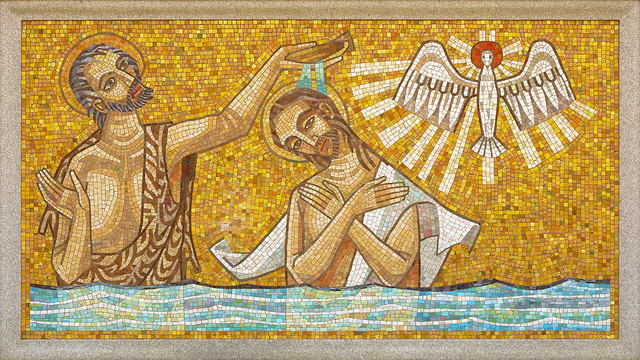
Baptism of Christ by John the Baptist in the Jordan River (mosaic) - Ravenna, Italy
The Lord Is My Chef Sunday Recipe, Birth of John the Baptist, 24 June 2018
Isaiah 49:1-6///Acts 13:22-26///Luke 1:57-66,80

            Today we take a break from our series of readings in Ordinary Time to give way for the Solemnity of the Birth of St. John the Baptist.  Solemnity is our highest liturgical celebration as it shows a direct link with the salvific work of Jesus Christ like the birth of St. John the Baptist who prepared the way of the Lord.  This is the reason he is the greatest of all prophets according to our Lord Jesus Christ Himself who declared “Amen, I say to you, among those born of women there has been none greater than John the Baptist; yet the least in the kingdom of heaven is greater than he.”(Mt.11: 11)  But, here we also discover our own greatness though we are the least in the kingdom of heaven because as disciples of Jesus Christ, we are tasked like John the Baptist to make way for Him whom we proclaim by preparing His path, showing Him to those who seek Him.  We are all a precursor, a forerunner of the Lord like John whose name means “God is gracious” who is so good to call us for such a mission despite our sins and weaknesses. Three things I wish to share with on being another John the Baptist, a forerunner of the Lord: rejoicing, being amazed, and becoming strong in spirit.

            “When the time arrived for Elizabeth to have her child she gave birth to a son.  Her neighbors and relatives heard that the Lord had shown his great mercy toward her and they rejoiced with her.”(Lk.1:57-58)

            They rejoiced with her.  How sad that in our world today characterized by affluence and convenience, there is that growing trend of dissatisfaction and gloom among us, giving rise to depression that leads to suicide.  For the past couple of years, we have been shocked by news of celebrities here and abroad ending their lives.  They are the people we looked up to for making our lives better with their thoughts and creations, people who have made us laugh and cry in the movies and arts, and people who have simply inspired us with their success. Joy is more than being happy; it is having that firm conviction within that no matter what happens in our life, there is always God who loves us despite our sins and shortcomings.  Joy is always a gift of the Holy Spirit, a result of our faith in God.  The neighbors of Elizabeth rejoiced because they have felt the spirit of God in the birth of John.  Unless we are able to go back to our grounding in God, we can never experience joy.  Wealth and fame, gadgets and other things can make us happy for a moment but never joyful which comes only from within.  Pope Francis explained “Whenever our interior life becomes caught up in its own interests and concerns, there is no longer room for others, no place for the poor. God’s voice is no longer heard, the quiet joy of his love is no longer felt, and the desire to do good fades. This is a very real danger for believers too. Many fall prey to it, and end up resentful, angry and listless.”(Evangelii Gaudium, 2)

            He asked for a tablet and wrote, “John is his name,” and all were amazed.(Lk.1:63)

            All were amazed.  Joy always leads to amazement or surprise and sense of awe.  The neighbors were amazed not only with the miraculous birth of John by his mother who was not only old but also barren.  Likewise, they were more amazed because when they asked his father what name to be given him, he wrote “John”.  Immediately, Zechariah spoke anew after being deaf and mute as punishment in doubting the angel’s announcement of Elizabeth’s giving birth to their child. Being surprised or amazed is an expression of a sense of wonder that indicates our recognition of God and His presence.  Remember how Isaac’s son, Jacob fled to Bethel where he slept and upon waking up from a dream, “he exclaimed, ‘Truly, the Lord is in this spot, although I did not know it.’  In solemn wonder he cried out:  ‘How awesome is this shrine!  This is nothing else but an abode of God, and that is the stairway to heaven!’”(Gen.28:16-17)

            See how in our world today we are losing that sense of awe due to “demystification” when everything has to be empirical to be true.  No more surprises, no more patient waiting, no more spiritual because when something cannot be dissected or explained, it is dismissed as untrue.  What amazes us these days are often the extraordinary, the ones at the extremes of the scale like longest or shortest, bestest or worst.  We have forgotten to appreciate and be surprised by the usual and ordinary things that actually make up real life!  The most significant things in life are not the “pinaka” and “bonggacious” (spectacular) but the most ordinary and average things we experience and encounter like the usual people we meet day in and day out, the sunrise and sunset, the plants and trees we see around us, the gentle breeze on our face or simple sights of kids playing on the streets, licking an ice cream cone.  Without that sense of awe in us, then we stop “taking things into our hearts” and everything becomes fleeting and temporary that we no longer pause to reflect on the meaning of life.  It is that taking things into our hearts that truly enrich us, always surprising us to go on with life amidst all the pains and difficulties and uncertainties.  Every time we are surprised in life, that is when God is beside us.

            The child grew and became strong in spirit, and he was in the desert until the day of his manifestation to Israel. (Lk.1:80)

            The child grew and became strong in spirit.  Becoming strong in spirit is being holy.  Again, Pope Francis reminds in his latest letter “Gaudete et Exultate” (Rejoice and Be Glad) that holiness remains our call as Christians.  He writes, “We are frequently tempted to think that holiness is only for those who can withdraw from ordinary affairs to spend much time in prayer. That is not the case. We are all called to be holy by living our lives with love and by bearing witness in everything we do, wherever we find ourselves.”(14)  The Holy Father stressed that holiness is “oneness in Christ” (20) which is the meaning of our celebration today in the birth of  St. John the Baptist:  we have to see our life as a mission in Christ.  Sometimes like Isaiah, we feel discouraged because we “thought we have toiled in vain, and for nothing, uselessly spent our strength”; but, that is our task, to lead others to God, to be a light on their path to God (cf. Is.49: 4-6) that when they find Him, we vanish from the scene like John who said “He must increase; I must decrease.”(Jn.3:30)  Continue to rejoice in the Lord always, be amazed of His love and mercy, grow and be strong in the spirit for God remembers His promise to His people like Elizabeth which means “God promised” and Zechariah that means “God remembered.”  God be with you! Fr. Nicanor F. Lalog II, Parokya ni San Juan Apostol at Ebanghelista, Gov. F. Halili Ave., Bagbaguin, Sta. Maria, Bulacan 3022

*Photo from Google, mosaic detail of the Baptism of Christ found in Ravenna, Italy (c. 451 AD).

Sowing the Seeds of Love, the Gift of Fatherhood

fathers-day-1465559565
The Lord Is My Chef Sunday Recipe, Week XI-B, 17 June 2018
Ezekiel 17:22-24///2Corinthians 5:6-10///Mark 4:26-34

            Thank you very much for your “happy father’s day” greetings.  Thank you for considering me your “spiritual father” in the parish.  However, I hope you don’t mind me telling you that I do not really feel the celebration of “father’s day” every third Sunday of June because 18 years ago on the Saturday before this civil celebration, my dad passed away shortly before dawn due to a heart attack.  It was also the birthday of my mother, June 17, 2000.

            Last Friday, I again realized another sad note of this “happy father’s day” for me as a priest when Fr. Richmond V. Nilo was laid to rest in San Antonio, Nueva Ecija.  As you all know, Fr. Nilo is the third priest to be shot and killed in the country in six months.  Another priest was also ambushed last month but survived the attack.

            Am I bothered?  Not really for myself but for others, for the nation.  Suffering and death is our life as priests.  Too often you only see so little of who we are as priests but for those who truly take a deeper look into why we chose to become priests, why we do all these sacrifices, why we refuse to follow the current of the world today, then you start to wonder why we have chosen to be a priest of Jesus Christ.

            And there is no easy answer except the Lord.  Dominus est!

            It is the same for every dad out there:  why work so hard, sacrifice so much, love so much, suffer so much for the children and for the mother?  Why not must leave everything and everyone behind like others have done?  Every time a dad would claim that he bears everything because of love, that he strives hard to keep his family alive and secured, it is simply because of the Lord!  It is not being simplistic but simply because it is the truth.  That is why when Jesus taught us to pray, He told us to call God, Abba or Daddy.  That is who God is, Somebody always around us, ensuring our safety and security, enabling us to fulfill our dreams and aspirations.

            Our first reading today beautifully captures this enigma of fatherhood, of priesthood, of our life of love and suffering as a follower of Jesus Christ.  “Thus says the Lord God:  I, too, will take from the crest of the cedar, from its top most branches tear off a tender shoot, plant it on high and lofty mountain… and become a majestic cedar.  And all the trees of the filed shall know that I, the Lord, bring low the high tree, lift high the lowly tree, wither up the green tree, and make the withered tree bloom.  As I, the Lord, have spoken, so will I do.” (Ez.17: 22, 23b,24)

            Recall, fathers, that day when you got married, pledging to love your wife “for richer and for poorer, in sickness and in health, till death do us part”?  I also felt like you when I was ordained, saying yes to every question of our bishop particularly to proclaim the Gospel, to be obedient to him and his successor, and to remain celibate and not get married.  We were all young and perhaps blinded of the whole reality but we all said yes, we vowed before God to be faithful and true without realizing fully what it totally meant.  We were like St. Paul and continues to be like him, “walking by faith, not by sight.”(2Cor.5:7)  We were nobody.  We had nothing to boast in life during that time we were ordained or when you got married.  Or when you stepped into college or senior high school, or when you moved out of town or out of the country to work and pursue your dreams in life.  Look back to those days and we all realize we were nothing but fresh green shoots of the crest of the cedar tree plucked by the Lord and planted where we are now, fulfilled in our lives amid all the pains and sufferings.  God has always been present in our lives though many times we never noticed Him or refused to recognize Him.  He makes everything possible and most especially so beautiful.  And that is why we forge on despite the many hardships and difficulties our chosen path in life entail.  Deep inside us we are convinced “God is greater than our hearts.”(1Jn.3:20)

            This Sunday, we continue our journey in Jesus Christ with Mark as our guide.  Last week, we have seen ourselves among the relatives and family of Jesus who also misunderstood Him, yet still believed Him as the Christ.  Today Jesus begins to teach us in parables, inviting us to be open in receiving Him like a seed sown in the land wherein we would “sleep and rise night and day and the seed would sprout and grow, with us not knowing how.”(Mk.4:27)   This is the time of being patient in listening more to Jesus especially in prayer as we discern His mystery for only He knows the secrets of the kingdom of God.  Indeed, Jesus is asking us like St. Paul to “walk by faith, not in sight” because the most important things in life are not always visible with the eyes, always hidden in the heart of every person whom we must always love and respect as a brother or a sister.

            In 1989, the British pop duo Tears for Fears released their third hit single called “Sowing the Seeds of Love.”  Like their previous hit “Everybody Wants to Rule the World”, it had political undertones that remain so relevant up to this day.  Its opening line right away leads us to the urgency of their call to sow seeds of love, “High time, we made a stand, And shook up the views of the common man.”  Today’s gospel is a call for us to sow seeds of love, to make a stand for Christ, to shake up our views on real love for God, real love for others, and real love for country.  There are times we priests like married fathers fail to live up to our vows, even causing others to sin.  But, there is no amount of any wrong doing or sin, or whatever differences we may have with others can give anyone the power to destroy that seed sown in each of us because it is only God who makes that sprout into life, germinate and grow until it bears fruit for harvesting.  Cheer up your father, thank your dad, and start sowing seeds of love in everyone!  A blessed week to everyone! Fr. Nicanor F. Lalog II, Parokya ni San Juan Apostol at Ebanghelista, Gov. F. Halili Ave., Bagbaguin, Sta. Maria, Bulacan 3022

Are you an admirer or a follower?

41990903_330608297768322_4349419363825090560_n

The Lord Is My Chef Sunday Recipe, Week X-B, 10 June 2018

Genesis 3:9-15///2Corinthians 4:13-5:1///Mark 3:20-35

             Just like you, I am also a big fan of the late Anthony Bourdain.  In fact, I got the idea for my email address from him, lordmychef.   When I heard the news of his death, something at the back of my mind was saying they should not write or report his alleged suicide because I was hoping he was still alive.  And now that he is really gone, I just felt it is not right to tell of negative things of him or of anyone still alive especially if he/she is a rock star, like an icon or an idol.  Or, like the Son of God, our Lord Jesus Christ.

Much like the news on the alleged suicide of Bourdain, probably we also ask why did Mark write this event in his gospel?  Was it necessary to tell us that even His relatives took shot at Him?  Never mind about the allegations by His enemies that He was possessed by the devil but, His relatives and family not understanding Him so well?

Jesus came home with his disciples.  Again the crowd gathered, making it impossible for them to even eat.  When his relatives heard of this they set out to seize him, for they said, “He is out of his mind.”  His mother and his brothers arrived.  Standing outside they sent word to him and called him.  A crowd seated around him told him, “Your mother and your brothers and your sisters are outside asking for you.”  But he said to them in reply, “Who are my m other and my brothers?”  And looking around at those seated in the circle he said, “Here are my mother and my brothers.  For whoever does the will of God is my brother and sister and mother.”(Mk. 3:20-21,31-35)

Mark wrote the first gospel account of Jesus Christ.  Matthew and Luke patterned their versions from Mark’s work that collectively they are called “synoptic gospels” from the Greek word synoptikos that means “able to be seen together” due to their similar stories.  Of the three evangelists, Mark used a literary style of “sandwiching” one story within another like the other week when Jesus cursed a fig tree with no fruits with the cleansing of the temple.  Today, Mark sandwiched the accusation by scribes that Jesus was possessed by evil spirits with the two stories of His relatives calling Him “out of his mind” and later His mother and brothers calling for him.  In doing this, Mark wanted to highlight the growing mystery of the person of Jesus.   Recall last February before Lent interrupted our Ordinary Time, Jesus was already preaching around Galilee, choosing 12 Apostles to accompany Him in His ministry.  Many people followed Him as they wondered at His preaching and powers to exorcise demons (Mk.1:21), to cure the sick like Peter’s mother-in-law (Mk.1:29), cleanse lepers (Mk.1: 40), and heal by forgiving the sins of a paralytic who was lowered from the roof of the house where He was teaching (Mk.2:1).  Everybody was wondering, asking who is this Jesus Christ?

In telling us the story of Jesus’ relatives saying “He is out of his mind” by sandwiching the episode of scribes accusing Him of being possessed with the arrival of His mother and brothers who then “sent word to call him”, Mark shows us that it is not really that easy to understand who Jesus really is.  His behavior defies human reason to the max.  You cannot just take Him for granted like any rock star or icon still living or already dead.  By making us see how the relatives and family with their reactions to Jesus, Mark is asking us too, “what do you think of Him really?”  Do you sincerely believe He is the Christ?

Along with his literary style of sandwiching, Mark is also fond of portraying negatively those closest to Jesus like His disciples and in this story, His relatives and family.  In the original short ending of his gospel, Mark said that on Easter after Magdalene and the other women were instructed by the angel in the empty tomb to inform the 11 about the resurrection, they “fled… seized with trembling and bewilderment.  They said nothing to anyone, for they were afraid.”(Mk.16:8)   Mark always presented negatively the disciples and family of Jesus like in our story today to show the early Christians as well as today that these people who were closest to the Lord had many weaknesses too except for the Blessed Virgin Mary.  But, eventually they were able to overcome these negative traits to boldly spread the Good News of salvation everywhere.  By showing us the negative side of the family of Jesus, Mark challenges us whether we are admirers of Jesus or His followers?  It is always easier to be an admirer of the Lord or of anyone.  We admire celebrities for their talents and convictions but we rarely follow and imitate them except perhaps for their fashion.  But with Jesus Christ, it is not enough to simply admire Him.  Maybe His relatives and family admired Him that they wanted Him to come home to be shielded from further nasty talks and accusations.  But Jesus could not be swayed because He is so sure of Himself, of His person and of His mission.  And so therefore, at the end of his story, Mark obliges us too to be there inside that crowded house to join the true family of Jesus, to be His mother and brother and sister by “doing the will of His Father.”

In this age of troubled and dysfunctional families with separated parents or solo parents so anxious with children hooked on drugs, or into depression and suicidal tendencies, the family of Jesus offers us with some solace.  They were troubled too.  But everything can be overcome in Christ Jesus who is our only fulfillment and salvation promised by God on the very day Adam and Eve sinned (first reading).  For us to be followers of Christ, St. Paul is telling us in the second reading to always search Jesus in every suffering we are going through especially in our family.  When are able to see Jesus even in our troubled family and personal sufferings, we are not “discouraged because although our outer self is wasting away, our inner self is being renewed day by day.”(2Cor.4:16)   Despite our troubled backgrounds, family or personal, we can be followers of Jesus, listening and acting on His words to lovingly serve others, to be forgiving and kind with everyone especially those silently suffering in our family circles.  Jesus values each one of us no matter what we think of Him because He is sure of Himself as the Christ, our Savior.  Amen.Fr. Nicanor F. Lalog II, Parokya ni San Juan Apostol at Ebanghelista, Gov. F. Halili Ave., Bagbaguin, Sta. Maria, Bulacan 3022

 Photo by the author at Mt. St. Paul Retreat House, Baguio City, July 2017.

The Tenderness of God

RCMSacred-Heart-770x439_c
The Lord Is My Chef Breakfast Recipe, Sacred Heart-B, 08 June 2018
Hosea 11:1,3-4,8-9///Ephesians 3:8-12,14-9///John 19:31-37 

One of my all-time favorite love songs is Billy Joel’s “Leave a Tender Moment Alone.” (https://youtu.be/JHpIC4Kk0MU)  The poetry of its lyrics and its lovely melody introduced by a stirring harmonica always bring the “kilig moments” of every man’s love experience:

Even though I’m in love
Sometimes I get so afraid
I’ll say something so wrong
Just to have something to say

I know the moment isn’t right
To tell the girl a comical line
To keep the conversation light
I guess I’m just frightened out of my mind

But if that’s how I feel
Then it’s the best feeling I’ve even known
It’s undeniably real
Leave a tender moment alone

While praying over the Solemnity of the Sacred Heart of Jesus, I kept on hearing this song playing in my mind because our celebration today is actually about the tenderness of God.  See how He had spoken through the prophet Hosea in the first reading like a Father to us.  Let us personalize His words and be immersed in His tenderness: “As a child I loved you, I called you my son.  The more I called you, the farther you went away from me.”(Hos.11:1-2)

             Is it not this is how our love relationship is with our parents and family including God? When we were kids, we loved running to our dad, taking pride for being his son or daughter, always clinging to his big hands?  During the early years of marriage, couples seem to be so inseparable.  But as we mature and find new friends and new relationships, we drift apart from our parents or spouse, including God.  And worst, we drive them away, even feeling ashamed of them especially when they come near us with their gestures of love and concern.  But, when problems arise in our new relationships like betrayal and infidelity, we go back to them, most especially to God, rediscovering their genuine love that is so tender and very comforting:  “I took you in my arms, drew you with human cords with bands of love. I fostered you like one who raises an infant to his cheeks; yet, though I stooped to feed you my child, you did not know I am your healer.”(Hos.11:3-7)

             Unlike Billy Joel in his song “Leave A Tender Moment Alone,” God makes no mistakes in loving us.  He remains faithful to us with His love, even “allowing” us often to sin and commit mistakes so that eventually, when we hit rock bottom, we rediscover Him and His love that is so real and so personal.  This “stooping down” by God that He had spoken to Hosea hundreds of years earlier took its deepest plunge when He sent us Jesus Christ His Son as our Savior by dying on the Cross.  St. John tells us how on that Good Friday soldiers broke the legs of the other two thieves crucified with Jesus to hasten their death; but, when they saw Jesus “already dead, they did not break his legs, but one soldier thrust his lance into his side, and immediately blood and water flowed out.” (Jn.19:33-34)

According to St. John, this fulfilled the Old Testament that “Not a bone of it will be broken” and that “They will look upon him whom they have pierced”(Jn.19:36), thus identifying Jesus Christ as the new lamb offered once and for all to God for the forgiveness of our sins.  It verified the words of John the Baptist also found in the fourth gospel describing Jesus as “the lamb of God who takes away the sins of the world”, the perfect offering on the Cross and expression of God’s immense love for each of us.  His death on the Cross is the most tender moment of love in history when our God who personally loves us by becoming like us in everything except sin loved us until the last drop of His blood because we are His beloved brothers and sisters in His loving and faithful Father in heaven we have always deserted in our many sins.  Indeed, when blood and water flowed out from His pierced side on the Cross, the ocean of Divine Mercy flowed out for us, forgiving our most grievous sins, regardless of our many weaknesses.  In His Most Sacred heart, Jesus is inviting us to always leave some tender moments alone with Him so that “He may dwell also in our hearts through faith so that once we are rooted and grounded in His love, we may have the strength to comprehend the breadth and length and height and depth of His love that surpasses knowledge and be filled with the fullness of God.”(cf. Eph.3:17-19)

It is an imperative for us all to be “rooted and grounded in His love” because human love is always imperfect.  Only God can love us perfectly in Christ Jesus who offered Himself on the Cross to fulfill what we have failed since the beginning – that is, to love God and others. Oh what a loving God we have in Him as we pray, Jesus meek and humble heart make my heart like thine!  Amen. Fr. Nicanor F. Lalog II, Parokya ng San Juan Apostol at Ebanghelista, Gov. F. Halili Ave., Bagbaguin, Sta. Maria, Bulacan.
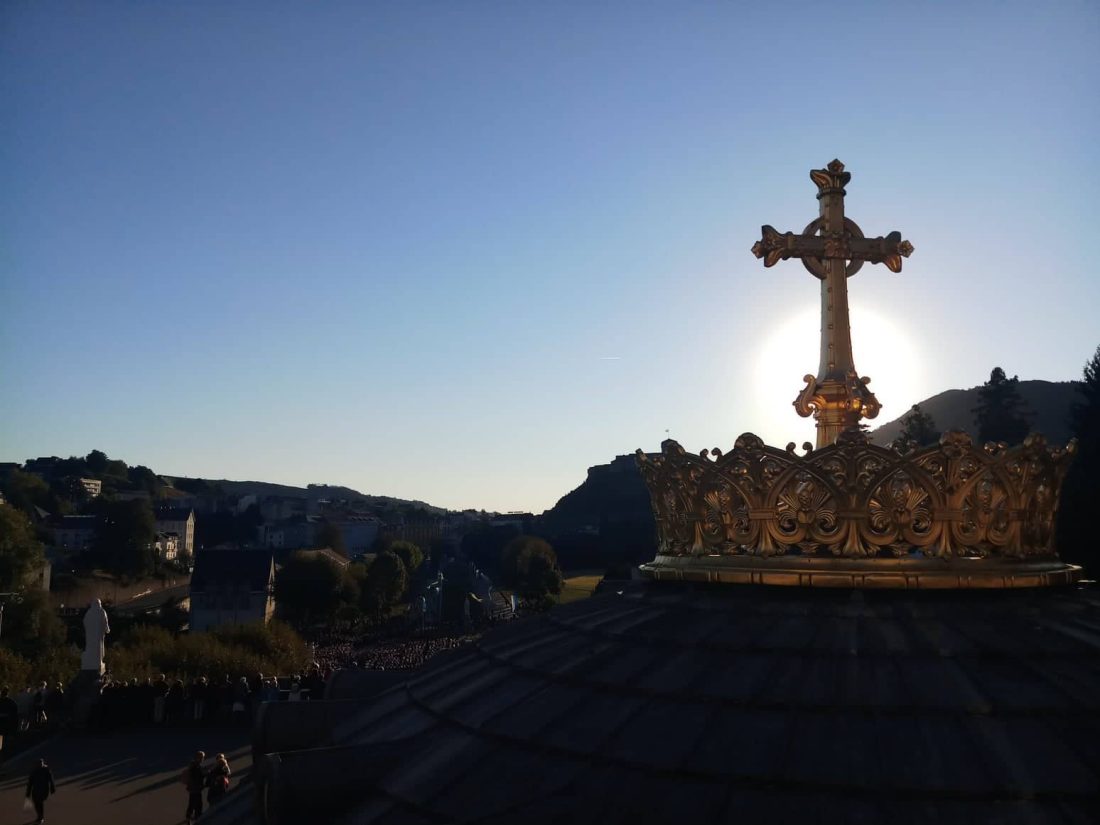
Photo from Google.

The Eucharist, An Experience of Trinitarian Love and Unity

holy-trinity-rublev-icon-8x10-2052404

The Lord Is My Chef Sunday Recipe, Corpus Christi-B, 03 June 2018
Exodus 24:3-8///Hebrews 9:11-15///Mark 14:12-16, 22-26

When I was still assigned as teacher-administrator of the Immaculate Conception School for Boys (ICSB) of Malolos, I always reminded my students that in every first date they would have, always bring their girlfriend to a restaurant— the more expensive, the better! Because in every date, what matters most is not the food and drinks but the moment they share together to know each other. The same thing happens when we invite family and friends for a party or meal together at home when do much more than offer them food and drinks but friendship, fellowship, and intimacy or closeness. When we ask our guests to have more food and desserts as well as drinks of every kind plus “take-home” or “bitbit”, we actually offer them our very selves as food and drinks in the same manner they nourish us with their coming. This explains why we take time preparing everything, from the food down to the table-setting. It is not really the eating that matters but the togetherness, the growth of a spiritual bond as family and friends nourishing each other, becoming food and drinks for one another.

The same thing happens in a more complete and perfect manner whenever we celebrate the Holy Eucharist. By giving us His very self as Body and Blood, Jesus Christ our host in this sacred meal not only nourishes our spiritual and deepest longings but most of all offers us the most intimate communion possible with others and with God. He is the one who makes everything possible for us to be together, calling us to “come to Him with our burdens to find rest for He is humble and gentle of heart.”

On the first day of the Feast of Unleavened Bread, when they sacrifice the Passover lamb, Jesus’ disciples said to him, “Where do you want us to go and prepare for you to eat the Passover?” He sent two of his disciples and said to them, “Go into the city and a man will meet you, carrying a jar of water. Follow him. Wherever he enters, say to the master of the house, “The Teacher says, ‘Where is my guest room where I may eat the Passover with my disciples?’ Then he will show you a large upper room furnished and ready. Make the preparations for us there.” The disciples then went off, entered the city, and found it just as he had told them; and they prepared the Passover.(Mk.14:12-16)

See how Jesus prepared everything for their Passover meal: He had prepared everything most likely in secret to surprise His disciples for that important meal together. In His last supper, Jesus was like Jack Ryan or Jason Bourne when He arranged everything with coded messages like following “a man carrying a jar of water” because in ancient Israel, the woman is the one who fetches water. You cannot find a man carrying a jar of water unless there is something extraordinary like in our gospel today. And that is how much God loves us, always taking the initiative to meet us, to encounter us, to be closest with us. It is always Jesus Christ who takes the initiative to meet us and bless us like in the Holy Eucharist. Imagine at the start of the Mass, right away He welcomes us even if we are sinners, granting us pardon even before we have asked forgiveness. In the Eucharist, we are even far more better than the apostles who have lived and seen the Lord because we are more closer to Him than them when we receive His Body and Blood in Holy Communion. That is what really happens in the sacred meal of the Holy Eucharist, a divine communion! It is the most perfect moment to pray when Jesus is Body and Blood, truly Himself inside our body: tell Jesus whatever you want, complaint if you want to and after speaking to Him, listen. He always have something to tell us every day but we are so busy with so many things that we fail to even recognize His presence.

In celebrating the Solemnity of the Body and Blood of Jesus Christ today, we experience the love and unity of God expressed in last week’s celebration of the Blessed Trinity, of how the three Persons in their mutual giving of self to each other outpoured upon us life and abundant blessings. Like the three Persons bonded in love, we too can achieve that unity with God and with others through the Holy Eucharist. As we get into the rhythm of Ordinary Time since after Pentecost Sunday, we have been celebrating in the past two consecutive Sundays the Solemnities of Trinity and Body and Blood to remind us of the great lessons of love and mercy we have realized and experienced in Easter must grow in us throughout this year. There is a beautiful descent of God’s mysteries into our very selves that culminates on Friday when we celebrate the Solemnity of the Sacred Heart. From the highest truth of our faith last Trinity Sunday, we now have this feast of Body and Blood of Christ as an experience in the Holy Eucharist of that Trinitarian love and unity that deepens into our very hearts on Friday’s Solemnity of the Most Sacred Heart of Jesus. See how in every movement, in every step, there is always God taking the initiative to meet us, to be with us. A blessed week to you!

Fr.Nicanor F. Lalog II
Parokya Ng SanJuan Apostol At Ebanghelista
Gov.F.HaliliAve., Bagbaguin, Sta.Maria,
Bulacan3022

*Photo from Google, the famous icon of Trinity by Andrei Rublev (c. 1411) based on Gen. 18 when Abraham was visited by three angels at Mamre.  The icon now hangs at the Tretyakov Gallery in Moscow.  It is one of the best portrayal of the Holy Trinity that is also very Eucharistic at the same time.