
Lord My Chef Daily Recipe for Soul by Fr. Nicanor F. Lalog II
Monday, Twenty-Fifth Week in Ordinary Time, Year II
Feast of St. Matthew the Apostle
Ephesians 4:1-7, 11-13     <*{{{{><  +  ><}}}}}*>     Matthew 9:9-13
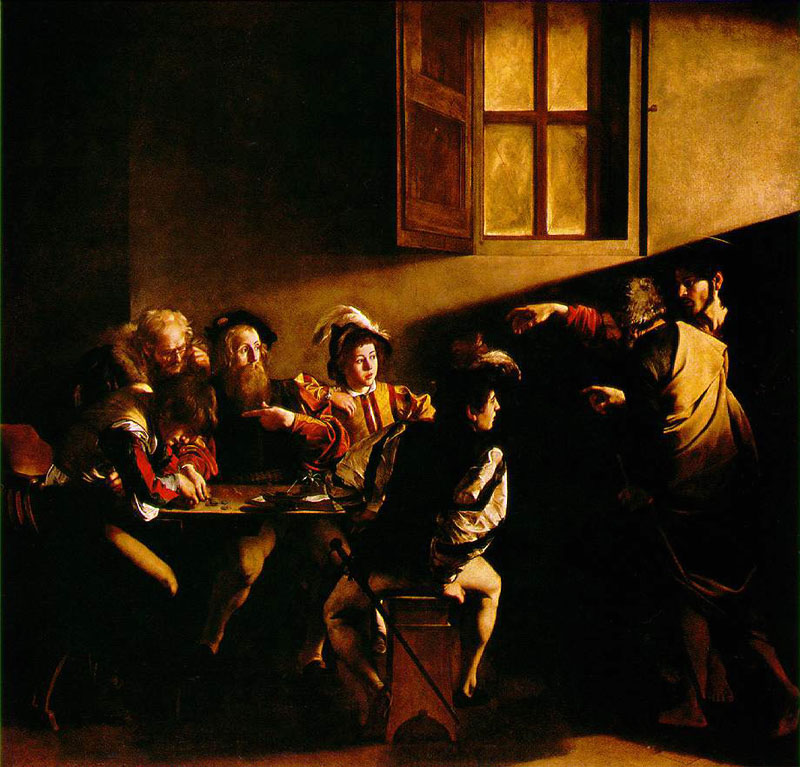
That beautiful painting by Caravaggio, “The Calling of St. Matthew” completed in 1600 for the French congregation of San Luigi Francesi in Rome is said to be the favorite of the late Pope Francis among the many other masterpieces found in the eternal city.
If given another chance to go on a pilgrimage to Rome, I have vowed to personally see that painting by Caravaggio along with his two other masterpieces, that of the meeting of Thomas Didymus with the Risen Lord and his breaking of bread at Emmaus that all evoke body movements and inner motions among the characters that lead us to continue the beautiful story of the painter’s subjects.
But I can’t wait to go there in Rome to view those paintings; through the wonder of internet, let us reflect on this Feast of St. Matthew using this painting characterized by lights and darkness, from his sitting to his rising and standing to follow Jesus while working as a tax collector.
As Jesus passed by, he saw a man named Matthew sitting at the customs post. He said to him, “Follow me.” And he got up and followed him (Matthew 9:9).

Sitting. Many centuries from now, anthropologists and other experts will study our generation on how humans have evolved – or retrogressed – with our spending too much time sitting. Doctors warn of the many health risks that result in prolonged sitting like obesity and heart disease.
Sitting is an important human movement especially in studying and learning lessons through reading and writing, meeting and discussions.
Imagine St. Matthew when he was called by Jesus, while sitting at the customs post: here we find sitting at its worst imagery of being stuck on our seats of comfort and complacency, sins and other vices. Worst is see how in our modern time we have given so much premium on where we sit to insist on our ego trips and sense of territory as well as claims to fame and prominence not realizing that what really matters in life is not where we sit but where we stand (https://lordmychef.com/2019/02/22/it-is-where-we-stand-that-matters-most-not-where-we-sit/).
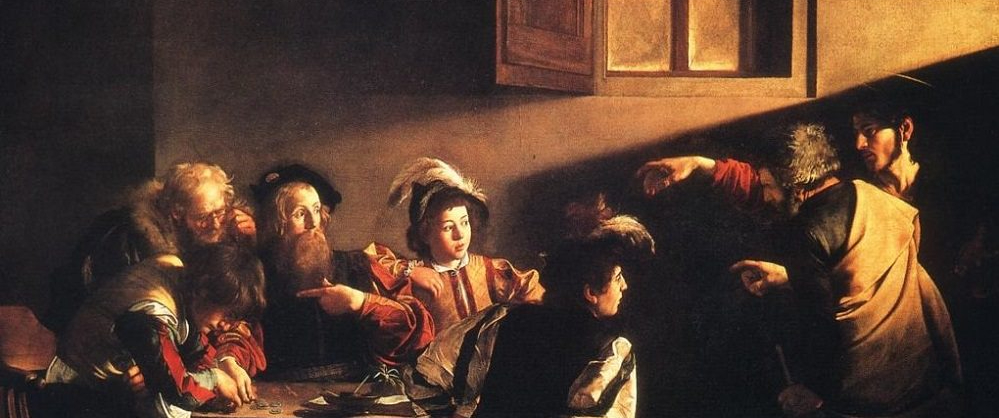
See in Caravaggio’s painting how everybody is seated at the table with St. Matthew dressed in the artist’s period of the 1600’s to show that Jesus continues to come in our own particular time in history.
Most of all, the gospel tells us that St. Matthew was seated at his customs post when called by Jesus but Caravaggio’s painting portrays them to be inside a tavern to tell us that we are also St. Matthew whom Jesus visits and calls daily while we are busy or drunk sitting at our comfort zones, in our vices and sins, in our complacency and mediocrity.
And like St. Matthew, we, too, are invited to rise and follow Jesus right away!
This brings us to the second movement of man so important, that of standing.
Following Jesus demands that we must first rise from our seats to make a stand for Jesus and his teachings of love and kindness, mercy and forgiveness, service and self-sacrifice. Notice how St. Matthew, the fat man at the middle with a black hat like a beret pointing to the man bowed down to the table.
See and feel the hesitancy of St. Matthew – like us – always wondering, asking God, “is it I, Lord?” So many times we cannot believe Jesus really looking for us, wanting us, calling us, believing in us!
And in all that beautiful interplay of light and darkness by Caravaggio in his painting, we feel the eyes of Jesus looking at our beloved apostle as if telling him, “yes, you, Matthew; Follow me”.
Cast all your doubts if Jesus were really calling you, believing in you, trusting you – he does! Jesus always comes to each of us in the most personal manner like with all his apostles, telling us, “It was not you who chose me, but I who chose you and appointed you to go and bear fruit” (Jn.15:16).
Don’t you hear how Jesus is calling you daily, asking you, “will the real you please rise up and stand for who you really are”?
See yourself the way Jesus sees you – forgiven and beloved, precious and loved. No need for us to look good before Jesus. Just rise and stand with him!
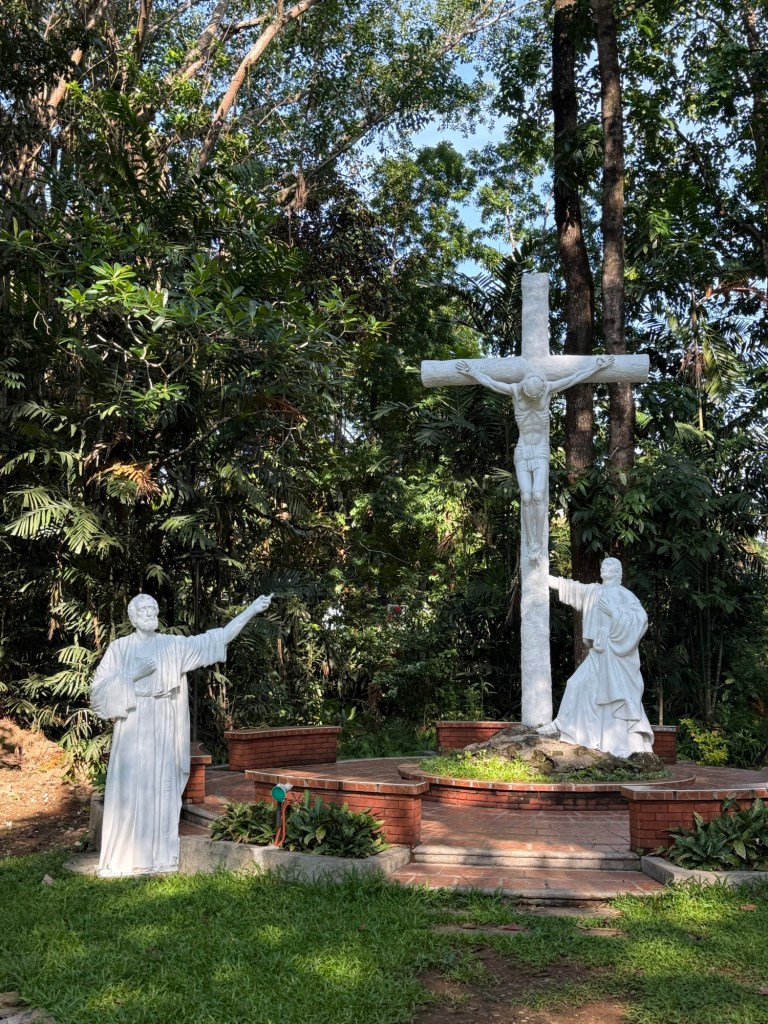
Walking. It is not enough for us to remain standing. Making a stand for Jesus means to follow him in his path of justice and love, mercy and forgiveness, being small and the least serving the weak and the poorest of the poor.
To walk in Christ is to be like Christ because Jesus himself is “the way the truth and the life” (Jn.14:6).
Walking in Christ is following the “road less travelled” that leads to the Cross of self-offering and sacrifice, of love and acceptance.
Notice in Caravaggio’s painting how he portrayed Jesus in his own traditional clothes along with Simon Peter – and they are both barefooted!
There seems to be a slight commotion wherein Simon is like warning the man with a sword close to him to be still, to not make any move for they are walking away soon once St. Matthew rises and stands from his seat. Look at the feet of Jesus and Simon; they are all set to walk, as if telling St. Matthew, “come on, let us go!”
But where to?
While he was at table in his house, many tax collectors and sinners came and sat with Jesus and his disciples. The Pharisees saw this and said to his disciples, “Why does your teacher eat with tax collectors and sinners?” He heard this and said, “Those who are well do not need a physician, but the sick do. Go and learn the meaning of the words, I desire mercy, not sacrifice. I did not come to call the righteous but sinners” (Matthew 9:10-13).

Following Jesus, walking on his path of the cross means going to those forgotten by us and the society, walking to meet those who are not like us – in beliefs and way of thinking, in clothing and appearances, in disposition and backgrounds.
It can be a lonely walk filled with pains and sufferings, and yes, disappointments like the two disciples who walked back to Emmaus on Easter without realizing Jesus was the stranger who had joined them along the way. That is the beauty of walking with Jesus, in Jesus, and to Jesus: you never see him nor recognize him right away but he is always with us, walking with us by our side even if we are going the opposite direction in life!
Walking the way of Jesus is tough and rough. It is not easy but it is the only way we must follow. That is why we need to rest in Jesus, with Jesus who asks us to be seated again as he washes our feet to comfort and console us, and prepare us for longer walks in the journey.

Kneeling. Of all the body movements modern man has forgotten is kneeling. Again, look at Caravaggio’s painting, take a peek below the table and notice the robust knees of St. Matthew, look at the soft throw of light on his right leg and the softer tone on his left.
Caravaggio must be telling us something about the healthy lower body of St. Matthew despite his sitting position. See Caravaggio’s genius in throwing that soft light on St. Matthew’s legs and knees that were made strong not only by long hours of standing and walking with Jesus but with longer time of kneeling and praying after the Lord’s Ascension.
Kneeling is one very important gesture and body movement we must regain to truly follow Jesus and regain order in ourselves and in our nation. It is the best praying position for it signifies surrender and humility before God. In fact, for the Hebrews, the knee is the symbol of strength that to bend one’s knees – to kneel – means to submit one’s self to God the all-powerful.
How sad when people refuse to kneel because their knees or expensive pants and clothes might get dirty. Worst of all is when we have refused to kneel and bend our knees because we feel so strong and able to accomplish a lot that we would rather be pursuing our own interests than following Jesus.
Like Caravaggio’s painting of “The Calling of St. Matthew”, our lives and nation are into a great darkness due to the pandemic and the worsening decadence in every aspect of our society.
It is not a time to be a fence-sitter or a bystander; Jesus calls us to arise and make a stand against the pervading evils, asking us whom are we really following in this journey in history and life.
Amid the gloom are streaks of light bringing hope and reason, truth and goodness, inviting us to learn from the call of St. Matthew to…
Sit and learn more of Jesus
Rise and stand with Jesus
Walk and follow Jesus
Kneeling always at the foot of his Cross
to truly follow him our Lord and Master.
Amen.


