
Lord My Chef Sunday Recipe for Soul by Fr. Nicanor F. Lalog II
Twenty-Ninth Sunday in Ordinary Time, Cycle A, 18 October 2026
Isaiah 45:1, 4-6  ><}}}}*>  1 Thessalonians 1:1-5  ><}}}}*>  Matthew 22:15-21

Ever since, I have never been fascinated with court scenes except with those television series like LA Law, the Lincoln Lawyer and Law & Order that was actually more of police stories. Hence, I have never followed up the Impeachment trial of the Vice President except read reports or watch reels of what transpired in each day because I simply don’t have the patience. Imagine the comedies happening daily courtesy of the defense team.
However, while praying over our gospel this Sunday, it looked like a sort of trial scene in court for me where Jesus seems to be on trial by his enemies. Beginning this Sunday until next, Christ’s enemies would take turns in entrapping Jesus with questions hoping to find grounds for his arrest.
The Pharisees went off and plotted how they might entrap Jesus in speech. They sent their disciples to him, with the Herodians, saying, “Teacher, we know that you are a truthful man and that you teach the way of God in accordance with the truth. And you are not concerned with anyone’s opinion, for you do not regard a person’s status. Tell us, then, what is your opinion: Is it lawful to pay the census tax to Caesar or not?” Knowing their malice, Jesus said, “Why are you testing me, you hypocrites? Show me the coin that pays the census tax.” Then they handed him the Roman coin. He said to them, “Whose image is this and whose inscription?” They replied, “Caesar’s .” At that he said to them, “Then repay to Caesar what belongs to Caesar and to God what belongs to God” (Matthew 22:15-21).
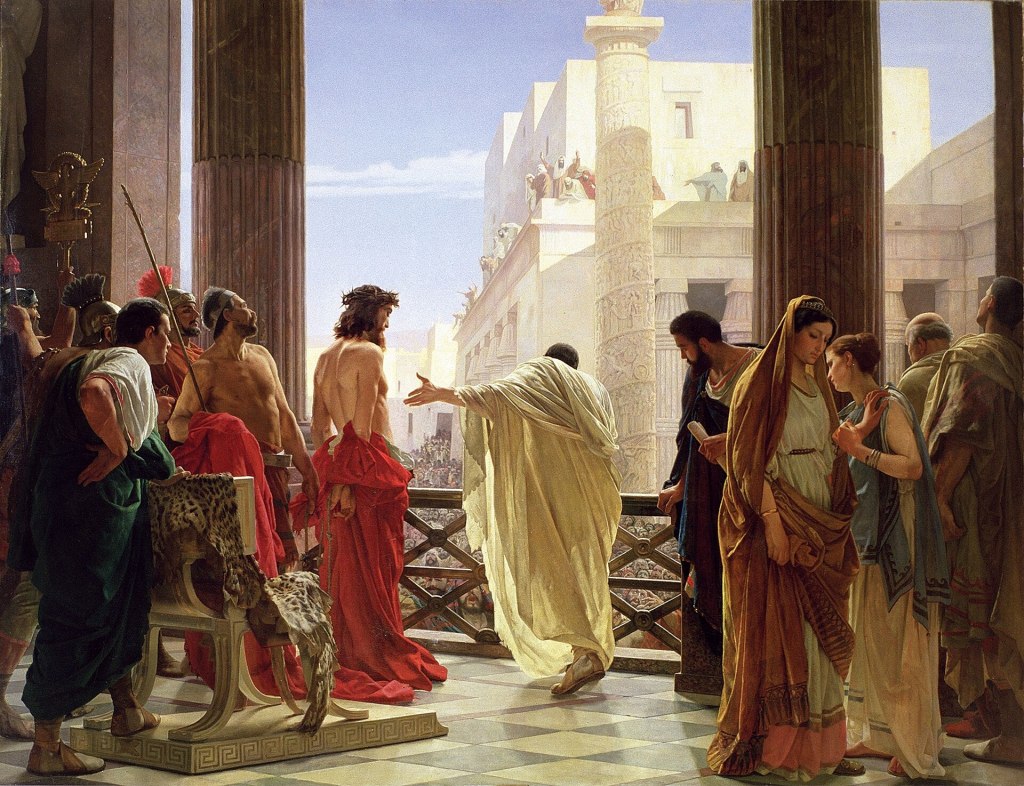
The scene is actually a prelude to Jesus Christ’s trial before Pontius Pilate after his enemies eventually made up charges against him.
Reflecting on the trial of Jesus by Pontius Pilate, St. John Paul II wrote that until now we put God on trial, accusing him of so many crimes and negligence in the world. And the most ironic part of it is that the more we accuse God of “crimes”, the more we incriminate ourselves actually into the very crimes we accuse him. Every trial, every testing of God is a self-indictment of our very selves.
Self-incrimination is the act of making a statement, providing testimony, or sharing information that exposes one’s self to criminal liability or possible criminal prosecution. Self-indictment is a slight variation of self-incrimination or to describe an action, statement, or work that acts as a severe, self-generated criticism or condemnation of oneself (from wikipedia).
See how the bitter enemies, Pharisees and Herodians joined forces against Jesus: the Pharisees were against the Roman occupiers while the Herodians were pro-Romans. They are a perfect example of “the enemy of my enemy is my friend.” Though they hated each other, they hated Jesus even more, foolishly deciding to set aside their differences momentarily to settle a score against Jesus.
But Jesus smelled their rancid odor right away, asking them of their motive, calling them hypocrites!
But their hypocrisy lies not only in their joining forces against Jesus but most of all in knowing how Jesus is so fair and just, “teaching the way of God in accordance with the truth”, then, why did they not finally accept him as the Christ and followed him? After all their praises, they have the gall to test him?
It was a hypocrisy to the highest degree actually. That is why we always have to beware of people who lavish us with praises with their lips smooth as butter but sharp as dagger.
The Pharisees and all enemies of Jesus have seen how he loved the poor and the sick, the marginalized, the women especially the widows, the children, the sinners and even them despite their being self-righteous. Jesus never drove them away nor rejected their invitations to dinner. Yet, they still refused to believe in Jesus and they wanted to test him.
It is the same tactic we have against one another, against Jesus. We go into secret alliances with our “enemies” against a common enemy without realizing it is in itself a self-indictment of our own sinfulness. It is one reason why I have strongly opposed priests and church organizations aligning with some groups like the so-called progressives, leftists or left-leaning who are mostly wokes: many times we may share a common stand against certain issues like capital punishment but what about their hard-core stance on divorce, contraceptives and abortion, gender-redefinition and same-sex marriage?
How much do we really believe in God? Then why do we have to “sleep with the enemies” like the rich and powerful politicians for donations and favors?

Inasmuch as we view this as a sort of a court trial scene with the Pharisees and Herodians on the offensive, Jesus is not on the defensive mode here because he has nothing to defend in the first place. In fact, his enemies have conceded earlier on the good character of Jesus which we have just mentioned earlier.
Reminiscent of the tempting by the devil in the wilderness and later his trials with the Sanhedrin then with Pilate, here we find Jesus always with the “upper hand”, never swayed for he is sure and certain of himself. Plaudits and flatteries can never deviate Jesus from the truth that he is the Christ, the Son of God. And this is what he is telling us here: believe in yourself. Stand with your conviction in Christ always. Do not be bothered or affected by what others say.
This we shall see at how Jesus addressed his enemies with their entrapment by asking for a Roman coin. It was the strongest case of his enemies’ self-incrimination, of hypocrisy: they really have no plans of knowing whether it was lawful to pay the census tax to Caesar or not because in giving Jesus the Roman coin, they have betrayed themselves as in fact paying the tax to Rome after all, even the Pharisees who were anti-Rome.
Most of all, they were not supposed to bring into the temple area idolatrous objects, images of other gods, exactly what a Roman coin was with the image and inscription of the Roman emperor who believed in himself as a god. It was the height of their stupidity to bring out that Roman coin, their clear self-indictment. Though they professed faith in God as Jews, they still followed the false gods of Rome like its emperor.
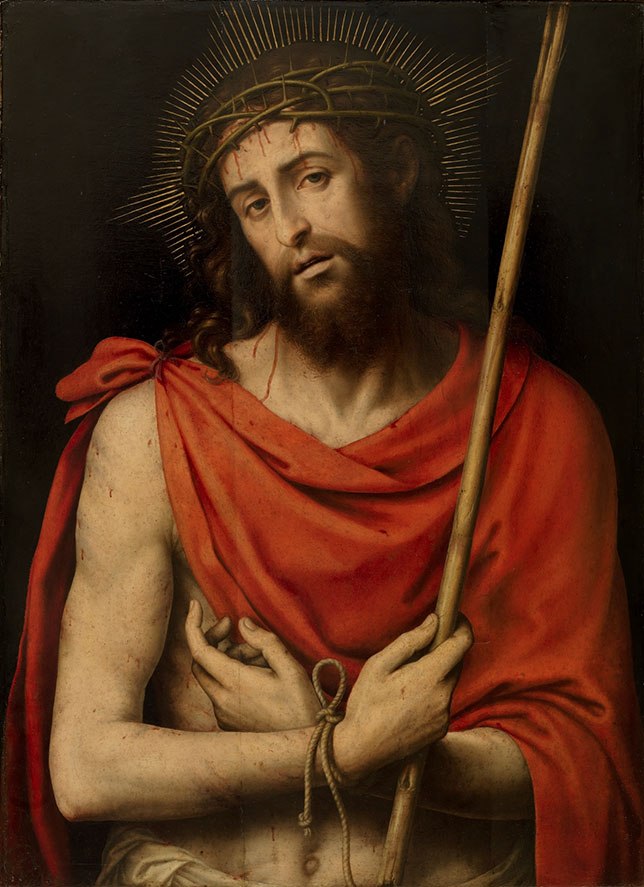
Every day, this happens among us, always complaining, always ranting to God, even sometimes testing him like the Pharisees and the Herodians; but, if we search our hearts, if check on what we have, who we follow, we too are guilty like the enemies of Jesus having aligned with the new gods of today like cellphone and other gadgets, wealth and fame.
How unfortunate many these days live in social media where what is most accepted even glorified and followed is whatever that is shallow and superficial, rude and obscene, stupid and idiotic.
Jesus tells us this Sunday to look beyond what we see on things to find God who is the source of our very life, of every blessings we enjoy. Let us hold on to that assurance by St. Paul in the second reading that we were chosen by God in Christ Jesus to receive all his abundant blessings in life. Hold on to Jesus. Look beyond and find the face of Jesus in everything and everyone like the Persian emperor Cyrus in the first reading used by God as instrument in setting free the Jewish exiles in Babylon. Amen. Have a blessed week ahead!