Joy to the world

Lord My Chef Sunday Recipe for the Soul by Fr. Nicanor F. Lalog II
Feast of the Sto. Niño, Cycle A, 18 January 2026
Isaiah 9:1-6 ><]]]]'> Ephesians 1:3-6, 15-18 ><]]]]'> Matthew 18:1-5, 10
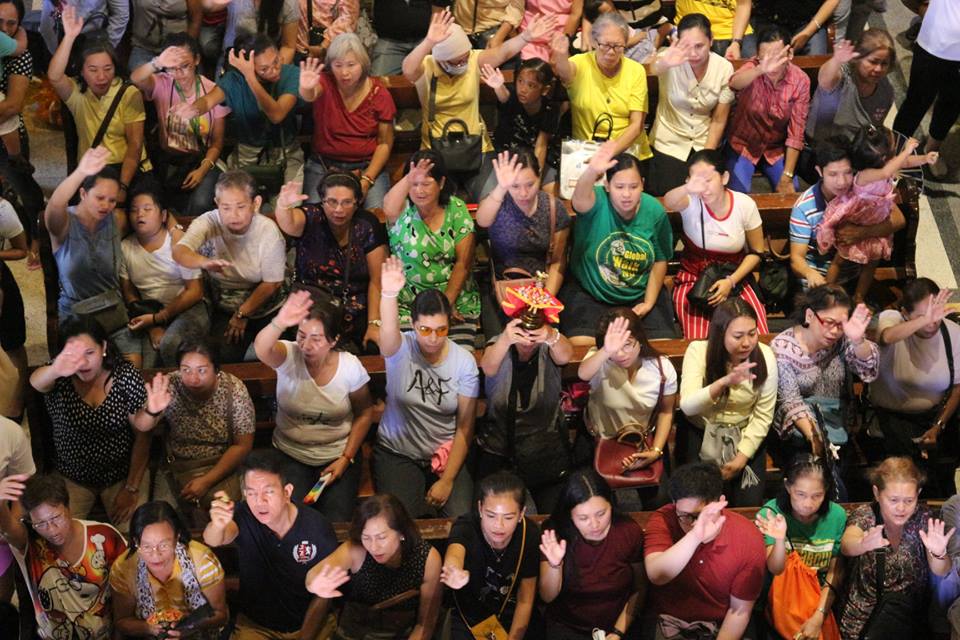
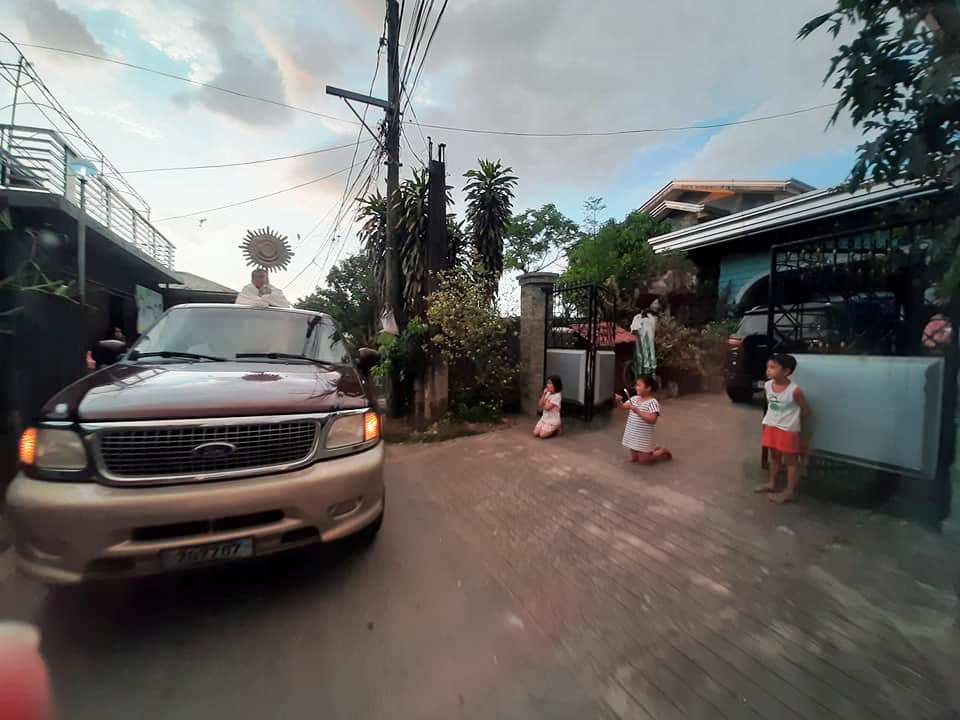
Photo from https://santoninodecebubasilica.org/chronicles/viva-pit-senor-viva-senor-santo-nino/

On this Second Sunday in Ordinary Time, we extend for a day our Christmas celebration with the Feast of Sto. Niño (Child Jesus), a special feast granted to us by Rome in honor of the crucial role in our evangelization by that image gifted by Magellan to Queen Juana of Cebu over 500 years ago.

As Nick Joaquin claimed in many of his writings, it was the Sto. Niño who actually conquered our country to become the only Christian nation in this part of the world which shows indeed as Christ had declared in today’s gospel that whoever humbles himself like a child is the greatest in the kingdom of heaven.

At that time the disciples approached Jesus and said, “Who is the greatest in the kingdom of heaven?” He called a child over, placed it in their midst and said, “Amen, I say to you, unless you turn and become like children, you will not enter the kingdom of heaven. Whoever humbles himself like this child is the greatest in the kingdom of heaven. And whoever receives one child such as this in my name receives me” (Matthew 18:1-5).
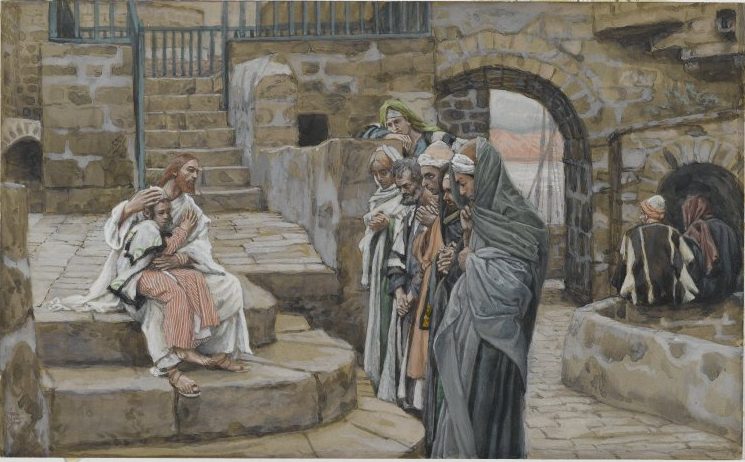
“Jesus and the Little Child” painting by James Tissot between 1886-1894 now at Broolyn Museum; from wikimedia.org.

One of the things I cherish in my hospital ministry since 2021 is visiting new born babies: now I know why there are called a “bundle of joy” and always a sight to behold for me whenever I see them yawning and stretching then curling their little hands and arms when I sprinkle them with Holy Water.

Babies and children have something so uniquely in them that elicit joy in everyone even the most hardened criminals. They are so lovely because they speak to us of the beauty of life, of the joy of living, of the bright future still coming for us all. That is why experts are worried anywhere there is a falling or zero birth rate because that paints a bleak future of all kinds of problems and disaster to any nation or society so evident these days among developed countries that lack younger generation to care for their elderly and workforce to run their economy.

The sight of every child and baby is always a celebration of life, most specially in the arrival of Jesus Christ, the eternal Word in time and space over 2000 years ago. This Sunday, Jesus is inviting us to remember that scene at the first Christmas when he was born, to see him in every child like that one he had called in the midst of his apostles with flesh, bones, and blood pitched among us.
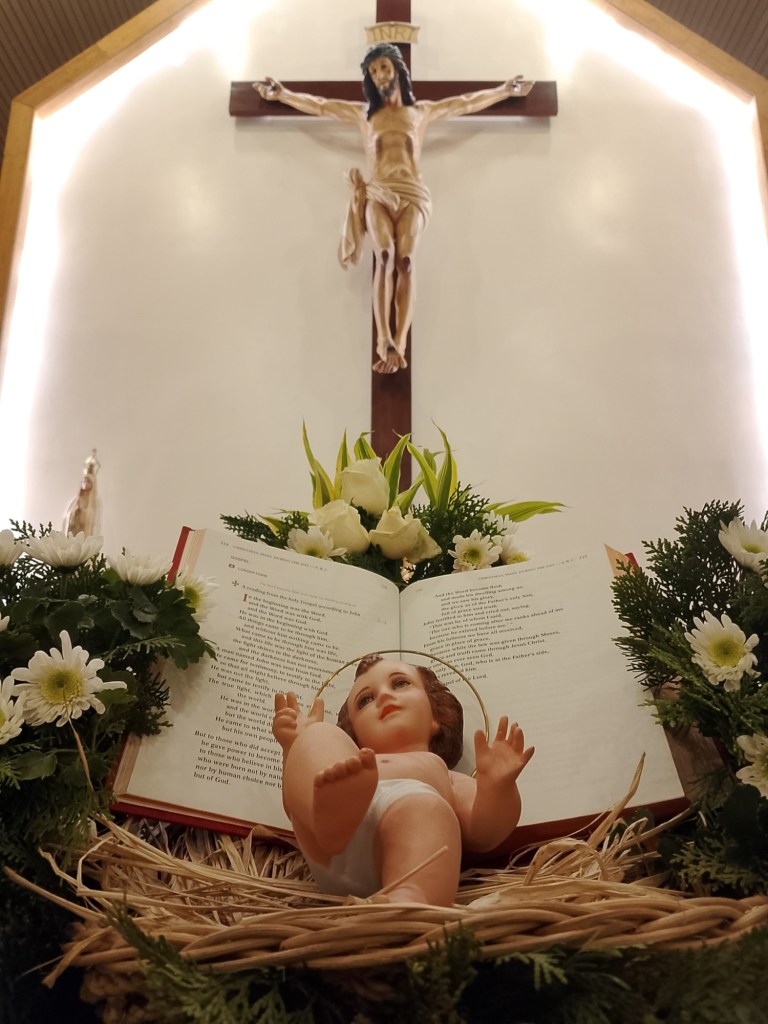
Photo by Mr. Darwin Arcilla, Chapel of the Angel of Peace, RISE Tower, OLFU-Valenzuela, Christmas 2025.

Here is the Son of God so intimate with our own lives including all its mess especially sickness and death itself.

Here is the Child Jesus we fondly call Sto. Niño who came to be born among us because he loves us so much.

Here are the children of the world, the greatest among us because they assure us of continuity in the future.

Looking at the Child Jesus and the child he had called in the midst of the apostles, we are challenged today to feel and realize what is to be with a baby or a child as another person with breath, body and a purpose yet to unfold throughout his/her life. Being like a child is the greatest of all because that is when we are fully human, entrusting everything to God. Que sera, sera!

It is said that in ancient Egypt, people cried aloud whenever a baby was born because of the sufferings every newborn is due to undergo in life. So true! In fact, my earliest lesson about life came through an illustration in a Reader’s Digest magazine of a newly delivered baby crying while being held by a doctor in the OR. I asked my mother why the baby was crying and she told me that when a child is born and cries, then it is alive; if a baby does not cry at birth, it could be dead that is why the doctor has to spank to make him/her cry. That lesson had remained until now with me as a priest – that life is difficult and growing up is always painful.

And how ironic as in the gospel today that Jesus directs us to becoming like children to fully grasp these realities. It is not only Jesus but also the little children who enlighten our unclear minds with such great light that “shone in darkness” (first reading) because of their simplicity. We adults tend to complicate things by overthinking while children remind us of all the beautiful possibilities in life despite the mess and chaos we are into.

Photo by author, 2022.

It is this simplicity of children that also disarm us of our false securities and pretensions when they playfully smile and laugh at us as they simply live in the present moment enjoying our company. In their fragility and vulnerability is their strength making us so concerned with them that we can’t stand leaving a baby or a child alone especially when he/she is crying, when in need.

There lies the good news of the Sto. Niño and of being like a child: he calls us to stay because Jesus too like children remain with us. There is no turning back for Jesus and for every child here today.

Jesus is here along with every child that is why we too are here gathered today to receive them and to ensure every life is safely protected and lovingly cared. It is in our staying, in our remaining we become child-like as we realize the tremendous blessings God has bestowed on us as his children (second reading) called to grow and mature in Christ by making him felt and known in this world that has slowly become so unwelcoming of babies and of God.

Notice how with the growth of what St. John Paul II called as “culture of death” promoting artificial contraceptives and abortion to control population growth, there is the corresponding turning away of people from God and eventually from one another. In this age of “Do-It-Yourself” Christianity, deciding on the number of kids to raise depend more on the couple’s financial capabilities than faith in God’s grace and power so that couples and people in general have unconsciously considered babies more as things to have than persons to love.

We end our reflection on this Feast of Sto. Niño with this Christmas song we have always taken for granted, “Joy to the World”. Written in 1719 by the English minister Isaac Watts, “Joy to the World” expresses the very joy not only of Christ’s coming but also of the birth of every child who reminds us of God among us in Jesus and of the need for us adults to be one with God always.

Photo by author, Sto. Niño Exhibit at the Malolos Cathedral, January 2022.
Joy to the world,
the Lord is come
Let Earth receive her King
Let very heart prepare him room
And heaven and nature sing
And heaven and nature sing.

Joy to the world,
the Savior reigns
Let men their songs employ
While fields and floods,
rocks, hills and plains
Repeat the sounding joy

He rules the world
with truth and grace
And makes the nations prove
The glories of his righteousness
And wonders of his love

For heaven and nature to sing anew of this joy, we have to be like the children welcoming Jesus in our hearts without any ifs and buts.

For us to repeat the sounding joy in life, we have to be like children in trustingly following Jesus in his Cross; notice how the gospels are silent about children calling for the crucifixion of Jesus. Only the adults demanded his death!

Finally, for us to experience the wonders of God’s love, we have to become like children who let truth and grace be the rules in life, not lies and powers. That is the greatness of being like a child – of trusting more in God than in man and his sciences and technologies, ideologies and philosophies that all fall short in bringing true joy and fulfillment in life. Amen. A blessed week ahead of everyone!

True freedom is being like children

The Lord Is My Chef Sunday Recipe for the Soul by Fr. Nicanor F. Lalog II
Feast of the Sto. Niño, Cycle C, 19 January 2025
Isaiah 9:1-6 ><}}}}*> Ephesians 1:3-6, 15-18 ><}}}}*> Luke 2:41-52
Photo by Daniel Reche on Pexels.com

I have never liked children especially infants not until these last twenty years of my life. Before, I could not understand when parents especially mothers giggled with joy in seeing babies, describing how handsome or pretty they are when they all look the same to me.

Everything changed when I became a priest especially when I turned 40 and had my own nieces and nephew. Suddenly, I realized how children could be so nice with their energy and laughter and wits too. As I now approach my 60th birthday serving as a chaplain in a University with a hospital since 2021, I have come to love children that I have been telling my sister to push her two daughters to get married so we could have babies again in the family!

As my attitudes with children changed, the more I understand why our Lord Jesus Christ had insisted in His teachings the need for us to become like them. Until His death, Jesus showed us the importance of being like a child not only in trusting and having faith in the Father but most of all on the true meaning of freedom.

Photo by author, Tagaytay City, 17 January 2025.

Contrary to common beliefs of many, freedom is not the ability to do whatever one likes; freedom is choosing to do what is good. That is why freedom is never absolute. In the Book of Genesis we find God telling Adam and Eve to eat every fruit of trees in Eden except the fruit of the tree in the middle of the garden (cf. Gen. 3:2-3). And we have seen how in the abuse of their freedom, they including us today have become “unfree”.

In Christ’s coming, He made us recover our freedom, giving us the grace to always choose and do what is good, to be free from sin and free to love, free to forgive, free to be kind. This essence of freedom He taught even at His early age as the true Son of God.

Each year his parents went to Jerusalem for the feast of Passover, and when he was twelve years old, they went up according to festival custom. After they had completed its days, as they were returning, the boy Jesus remained behind in Jerusalem but his parents did not know it… After three days they found in the temple, sitting in the midst of the teachers, listening to them and asking them question, and all who heard him were astounded at his understanding and his answers. When his parents saw him, they were astonished, and his mother said to him, “Son, why have you done this to us? Your father and I have been looking for you with great anxiety.” And he said to them, “Why were you looking for me? Did you not know that I must be in my Father’s house?” (Luke 2:41-43, 46-49)

“The Finding of the Savior at the Temple” painting by William Holman Hunt (1860) from en.wikipedia.org.

First thing we notice in our gospel regarding freedom as the ability to choose what is good is Luke’s portrayal of Joseph and Mary as devout Jews who regularly went on pilgrimage to Jerusalem.

Each year his parents went to Jerusalem for the feast of Passover, and when he was twelve years old, they went up according to festival custom. 

What a simple expression of the essence of freedom of choosing what is good, choosing God: the parents of Jesus devoutly practiced their faith that Jesus fully imbibed. The gospels teem with many stories of Jesus regularly going to the synagogues on sabbath to proclaim the word and to preach to the people.

This is something many parents today are missing, the Sunday devotion. No wonder that many children today do not understand the meaning and importance of the Sunday Mass, even the preeminence of God in our lives. How sad that many families even on holy days of obligation choose malls and vacation than choose God to worship Him in the church.

And many have the gall to defend this as part of their freedom, an expression of unity as family. But, where is God among them? Most of all, have we really become free by not going to the Sunday Mass?

Definitely not. Even at the surface some people would not seem to have any qualms at all in skipping Sunday Masses, deep inside many are bothered. Many of them feel an emptiness within, a kind of darkness that Isaiah described in the first reading. See how despite the affluence of many people today than three decades ago yet more and more are feeling lost and depressed because they have lost their roots in God who leads us to our rootedness in ourselves and with others.

Photo by author, January 2022.

Speaking of roots, its Latin origin is radix from which the word radical came from.

When we hear the word radical, we associate it always with someone who is a revolutionary, someone who literally or figuratively “destabilizes” our status and ways of thinking like Jesus Christ.

Very often, we find Jesus presented to us as one who was radical in His teachings who was thought to have been a revolutionary member of the Zealot party that worked to overthrow the Roman occupiers in ancient Israel. It was one of the accusations hurled against Him at His trial, citing His declaration to destroy the temple that He would rebuild in three days after its cleansing. Of course, these are not true; Jesus was not a radical revolutionary like the communists or power grabbers of modern century.

However, if we examine His teachings and mission, Jesus was a radical revolutionary because He preached and worked to bring humanity back to our very “root” – radix – who is God Himself. Listen to His words to His Mother after being found in the temple…

And he said to them, "Why were you looking for me? Did you not know that I must be in my Father's house?" 
Photo by author, Parish of St. Joseph, Pacdal, Baguio City, 28 December 2024.

Here Jesus showed His Mother and us today that true freedom is being one always with the Father. Jesus was a truly free person because even at His early age, He was totally united with the Father’s will.

All throughout His life and mission, Jesus helped us all attain that freedom of inner communion with God our Father to be truly free from sin and evil to be free to love, free to understand, free to serve and whatever is good.

See how Jesus spoke so plainly to Mary and Joseph, as if reminding them and us today that our roots is in God alone and that is what we must always be concerned with, of how we must remain rooted in God as His children.

In the fourth gospel, we find this imagery of remaining rooted in God in Jesus Christ so beautifully explained during the Lord’s Last Supper discourses specifically in that of the vine and the branches (Jn. 15:15:1-17).

That’s the paradox of true freedom in Christ: being one in God does not limit but rather expands one’s freedom as a person. Any freedom outside of God is a fake and most likely, leads only to bondage because it is only in doing what is good when we truly grow and mature as persons.

Photo by author, Malolos Cathedral January 2022.

This Sunday we celebrate an extra day of Christmas for the Feast of the Sto. Niño in recognition of its great role in the spread of Christianity to our country since its coming in 1521 when Magellan gifted Queen Juana of Cebu with a Sto. Niño image.

The late Nick Joaquin rightly claimed in his many writings that the Philippines was actually conquered by the Sto. Niño than by the guns and cannons of the invading Spaniards more than 500 years ago. That’s probably because of this lesson on true freedom by the Child Jesus.

Let us learn and grow in true freedom by first choosing God especially on Sundays by celebrating the Lord’s Supper, the Holy Mass. Like the Child Jesus, let us remain in the Father, be free to ask most of all to listen and learn about life.

Like Mary and Joseph, it takes time before we can truly understand the words of Jesus Christ; what matters is like them, we keep on choosing always Jesus, only Jesus because Jesus is the truth. May the Lord “enlighten the eyes of our hearts so we may know what is the hope that belongs to his call, what are the riches of glory in his inheritance” (Eph.1:18). Amen. Have a blessed and free week ahead!

Photo by Mr. Jim Marpa, 2018.

God’s Kingdom is for children

The Lord Is My Chef Sunday Recipe for the Soul by Fr. Nicanor F. Lalog II
Feast of the Sto. Niño, Cycle B, 21 January 2024
Isaiah 9:1-6 ><}}}*> Ephesians 1:3-6, 15-18 ><}}}*> Mark 10:13-16
Photo by Ms. Anne Ramos, 22 March 2020 in Bagbaguin, Sta. Maria,Bulacan during our “libot” of the Blessed Sacrament at the start of the COVID-19 lockdown.

Our Lord Jesus Christ’s attitude to children is perfectly clear in our gospel this Sunday, “Let the children come to me; do not prevent them, for the kingdom of God belongs to such as these. Amen, I say to you, whoever does not accept the kingdom of God like a child will not enter it” (Mk 10:15).

Being like a child is actually the main teaching of Jesus Christ who came to us precisely as one. Right at his infancy like most babies these days, Jesus faced a lot of great risks of being harmed or even getting killed.

See how Jesus insisted in all his teachings on this need to become like a child, to go back to one’s beginnings in order to get into God’s kingdom which is actually him, his very person. Keep in mind that the kingdom of God is not a territorial domain but the very person of Jesus Christ himself. It is from this fact we realize that being a child as taught by Jesus is a mystery that can never be explained nor solved in our minds and mental faculties. This we find in that occasion when Nicodemus, a Pharisee, came to Jesus hiding in the darkness of the night to discuss the kingdom of God. When Jesus told him of the need to be born from above (or, be born again in earlier translations) which is to become like a child, he thought it to be in the literal manner.

Jesus chided Nicodemus by saying, “You are the teacher of Israel and you do not understand this?” (Jn. 3:9-10). It was not sarcasm nor an insult by Jesus but a clarification to everyone including us today that being a child to enter the kingdom of God is a mystery we have to embrace and experience and feel in the heart not deduced in the mind.

And this is exactly what the Feast of the Sto. Niño is all about that we celebrate every third Sunday in January.

The Vatican has given us this special celebration as an extension of the Christmas season in recognition of the great role played by the image of Sto. Niño Magellan gifted Queen Juana of Cebu in 1521.

After leaving our shores after Magellan was killed in Mactan, the Spaniards returned in 1565 under Miguel Lopez de Legazpi to claim our islands for the King of Spain. Upon their arrival in Cebu, they found the Sto. Niño enshrined in a house of worship prominently displayed as the main God of the natives along with their other idols and gods. Historians say the people of Cebu during those years between 1521 to 1565 have found the Sto. Niño as the most powerful and effective in granting their prayers for children (fertility), rains and bountiful harvests that rightly it was the Sto. Niño who actually conquered the Philippines that we have become the only Christian nation in this part of the world. In those 44 years after Magellan and his men left the Philippines, the Sto. Niño had remained and stayed with the natives keeping them safe and secured all those years until the Spaniards returned to be colonized through Legazpi.

What a beautiful imagery of the Sto. Niño staying behind with our forefathers conquering them not with swords nor force but with love and mercy, and youthfulness of the Child Jesus! 

Photo from https://santoninodecebubasilica.org/chronicles/viva-pit-senor-viva-senor-santo-nino/

Recall how last Sunday we have reflected the words stay and remain when Andrew asked Jesus where he was staying: to stay, to dwell mean more than its spatial nature as a place or location but also in a deeper sense, a communion. It is in dwelling in Jesus who is the kingdom of God that we belong, we become a part of that kingdom.

When Jesus spoke of “being born from above” to Nicodemus, he was not only referring to the Sacrament of Baptism but to the very fact how he as the Christ from the very start has always dwelled and remained in the Father. 

Three days after being found in the temple in Jerusalem when Jesus was 12 years old, he told Mary his Mother, “Why were you looking for me? Did you not know that I must be in my Father’s house?”(Lk.2:49). What a beautiful expression of that union in “being in my Father’s house” to show us this mystery of Jesus being like a child, the Son of God who has remained the Father’s beloved One into his adulthood because he had always been in union with the Father. Jesus is inseparable from the Father because he himself takes abode and dwelling in God.

“The Finding of the Savior at the Temple” painting by William Holman Hunt (1860) from en.wikipedia.org.

When Jesus was approaching his Passion and Death, he repeatedly told everyone how everything he had said and done were not his but his Father’s to indicate his communion and union in him. Ultimately there on the Cross, his final words expressed the same truth that he is the Son of God obedient unto death especially when he called out, “Father, into your hands I commend my spirit” (Lk.23:46).

Therefore, to accept and welcome a child in Jesus’ name is not just an act of charity nor of a simple finding of Jesus among children. It is ultimately being one, of remaining in the Father because Jesus also said “whoever welcomes such a child in my name, welcomes me” (Mt 18:5).

Photo by author, 2022.

That is why the kingdom of God is for those who are like children always one with God like Jesus.

To be a child is to remain in God, to always love expressed in kindness and care for others especially the weak, being forgiving and merciful and compassionate with those lost like the Father.

To be like a child is being a light who brightens the life of others just like a babies whose very sight and smiles can ease our pains and sorrows, giving us the much needed boost to forge on in life. We are filled with hope whenever we encounter or see infants because they remind us too of God dwelling in them, of a God who assures and ensures us with s bright future.

This the reason we have in our first reading that part of the Book of Isaiah we heard proclaimed on Christmas day to remind us that Jesus is the light born on the darkest night of the year to illumine our lives and the world darkened by sins and evil like wars, poverty, and diseases. We see light in being like a child because that is when we are one in the Father too in being like a child.

Let me cite again that beautiful movie Firefly where the main character, the child named Tonton loved his mother so much that he totally believed her stories that sent him into a journey to search for the magical island filled with fireflies. Tonton dwelled in his mother’s love that he eventually found the magical island with the many fireflies that in the process also brought light into the darkness within the three adults he befriended in the bus going to Bicol.

Many times in my ministry as chaplain in our hospital, I have seen the great powers within every child – of how a sick baby, a sick child could send his/her parents to summon all their faith in God to heal them, to save them. 

Listen to the stories of those who join the Traslacion every year in Quiapo: most of them had their panata borne out of answered prayers for their sick children. Every parent knows it so well how they have moved mountains and did the most extraordinary for the sake of their infants and children.

That is the mystery of the kingdom of God belonging to children when God gives us every spiritual blessing we need to achieve the impossible (second reading) to become like children by remaining in God as the only power and salvation in this life.

Be with a child, stay with a child and you shall find God’s kingdom.

Be like a child and you shall experience the kingdom of God! Amen. Have a blessed week ahead!

Photo by Mr. Jim Marpa, 2018.