
The Lord Is My Chef Recipe for the Solemnity of Palm Sunday of the Lord’s Passion, 05 April 2020
Isaiah 50:4-7 >>+<< Philippians 2:6-11 >>+<< Matthew 26:14-27:66
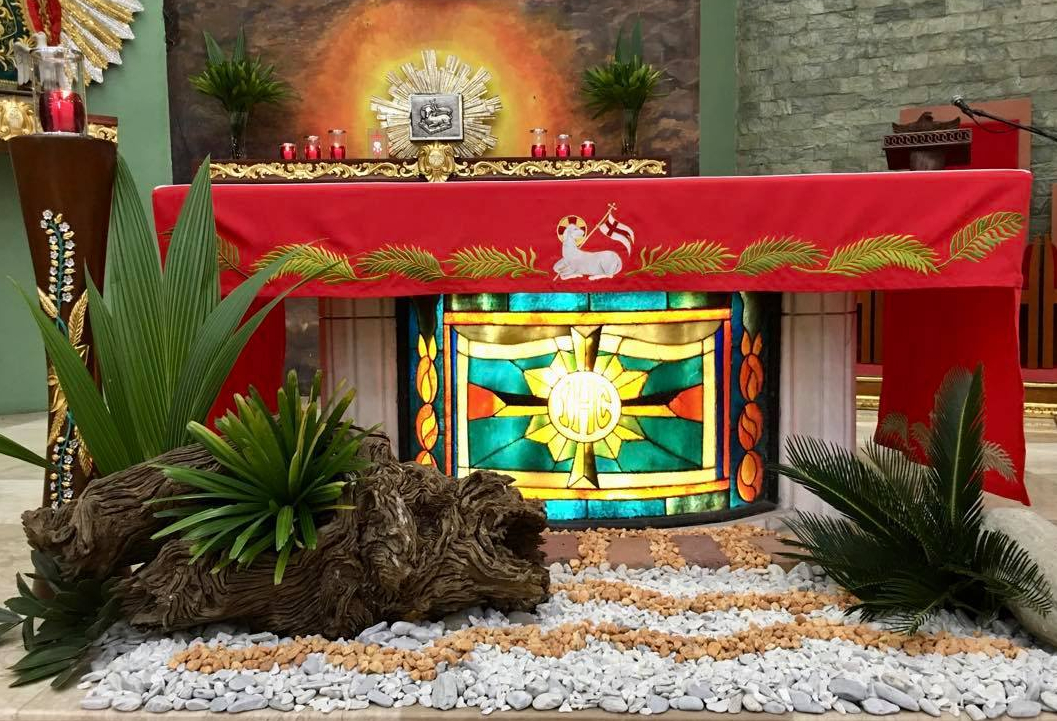
“Hosanna!” is the song of the day and despite the ongoing lockdown now entering its penultimate week, we have every reason to praise God this Solemnity of Palm Sunday in the Lord’s Passion.
Let us continue to sing “hosanna” even if our churches are closed due to threats of COVID-19 because even with all the difficulties arising from this enhanced community quarantine, it also gives us much needed time and space to reflect on the meaning of our Holy Week celebrations.
Let us make this Holy Week holy indeed so we may discover God anew in our sacred celebrations and right in our very hearts in this time of the corona pandemic.
The “ascent” to Jerusalem

Geographically speaking, to go to Jerusalem is to go up, to ascend to higher level as it rises to 754 meters above sea level (2,474 feet) compared with Galilee from where Jesus spent his three years of ministry which is just 209 meters (686 feet) above sea level.
Jesus Christ’s “trip to Jerusalem” was both literally and figuratively speaking an “ascent” in all aspects: he went up to Jerusalem to offer himself on the Cross to replace temple worship so people can finally worship in “truth and spirit” as he had told the Samaritan woman at Jacob’s well three Sundays ago.
More than the outward sign of ascending Jerusalem is the inner sign of Christ’s ascent in his outpouring of love for the Father and us.
That is the beautiful imagery of his triumphant entrance to Jerusalem which will reach its climax on Good Friday capped by the glorious Easter.
Every day, Jesus invites us to welcome him and most of all to join him in his ascent to Jerusalem, to the Father by forgetting one’s self, taking our crosses, and following the Lord in giving of self in love.
Now is the perfect time to sing “hosanna” – to welcome and follow Jesus in our inner ascent when everything and everyone is “down” due to COVID-19. The only way to rise again from this misery of the corona pandemic is to ascent in Jesus, with Jesus, and through Jesus.
For so long, we have been following the upward path of “social mobility” measured in income and material things without considering the emotional and spiritual imbalances that result in these worldly pursuits. In our rat race for higher productivity, more money and less costs, we have become distant from persons especially family. Now, we have to practice social distance not only to stop spread of virus but most of all, to realize anew that above all is always the human person.
And the best route to encounter each person is in Jesus Christ who leads us from Jerusalem to the Cross and into Easter; hence, the liturgies this Holy Week are the oldest and simplest we have in the Church so that we can truly sing “hosanna” and focus only to Jesus ever present to us.
Death and Love

Now playing at Netflix is the fourth part of its hit series “Money Heist”. I had the chance to watch its first episode that opened with a scene of the professor escaping police in the forest with a narration by “Tokyo” trying to control the situation in the bank they have taken over. She said, “His (the professor) heart held two words that should not be together: love and death.”
Perfect sound bite for Palm Sunday of the Lord’s Passion – “two words that should not be together: love and death” when in fact, its opposite is the exact reality! For love to be very true, it must be willing to suffer and die as the Lord Jesus Christ had shown us more than 2000 years ago.
Love and death are always together! That is why we have a Holy Week leading to Easter!
It is a basic reality we have always tried to negate and escape that have only left us more empty and lost within. The undeniable sign of love is when we are able to love somebody more than our very self – and that includes willing to die for the beloved!
We can never ascend, never arise for as long as we have too much of self, like the characters opposite our Lord Jesus Christ this Holy Week.
One of the Twelve, who was called Judas Iscariot, went to the chief priests, and said, “What are you willing to give me if I hand him over to you?” They paid him thirty pieces of silver, and from that time on he looked for an opportunity to hand him over.
Matthew 26:14-16
Selflessness and silence of Jesus, Selfishness of man

One distinct characteristic of Jesus throughout his life that is most especially clear from Palm Sunday to Good Friday is his selflessness and silence in the face of too much pressure and suffering.
Rather than being a sign of weakness, it is Jesus Christ’s shining moment of mastery and control as we have noted last Sunday when he cried in meeting Martha and Mary at the tomb of Lazarus who had been dead for four days.
This becomes more evident starting this Sunday reaching its highest point on Good Friday to be capped by his glorious Resurrection on Easter.
See how during his entrance and ascent into Jerusalem, Jesus was silent. Because he knew what was going to happen! He was even looking forward into it.
His entrance into Jerusalem to assert his being the Christ by offering himself on the Cross is the culmination of what St. Luke had noted in his account early on at Caesarea Philippi that “when the days of his going up to heaven was nearing completion, Jesus resolutely journeyed to Jerusalem.”
Despite the dangers and the certainty of death, Jesus did not balk nor even thought of backing out. He resolutely went into his death because of his immense love for us and the Father. He never cracked under pressure!
Even during his trials first before the Sanhedrin and before Pontius Pilate, there was the mastery and surety of Jesus very evident in his silence. He was totally composed, wholly entrusting himself in total obedience to the Father in heaven.
How about us these days of lockdown in the face of the growing threats of COVID-19?
What a shame that our officials and their families finally revealed their true colors as the modern Judas Iscariots seeking VIP treatment for COVID-19 testing! So afraid of dying because love they have none whatsoever for the country and the people but for themselves alone.

Like Judas, they think only of themselves, keeping their loot of more than 30 pieces of silver, looking for the opportune time to betray us again, totally quiet in the comfort of their homes when thousands are facing hunger and uncertainties.
They are the modern Pontius Pilates who mumble in public, who could not make a definitive stand on anything at all, more at home in accusing and blaming others for the confusions and lack of order, always washing their hands, without guts to humbly accept lack of foresight despite the grave dangers that did not happen overnight.
Most of all, look inside ourselves too for those moments we think more of “what we can have” than “what we can give or do” in these trying times? Do we hoard and panic buy? Do we cower in fear by hiding it with our anger and demands for assistance and relief goods?
Above is a nice guide I found on my friend’s Facebook, indicating three zones to show where are in the midst of COVID-19 pandemic. It can be very useful too in indicating where we can meet Jesus in ascending and entering Jerusalem to fulfill his mission and our mission too.
Entering Jerusalem, entering Jesus

When the Luzon lockdown started last March 18, I cried on my first Mass: it was simply unbelievable – until now – for me celebrating Mass without people because a Mass always presupposes people and community to celebrate Christ’s presence!
But now, everybody is gone.
Except me. And the birds who keep constant company for me.
Every morning after pealing our bell as I celebrate Mass alone, I bow before the giant crucifix looming above our altar and look on the metal engraving of the Lamb of God on the cover of our Tabernacle where the Blessed Sacrament of Jesus is kept.
This week as I looked more often onto the lamb during prayer periods, I felt it to be looking at me too. That’s when I realized how the lamb perfectly signifies Jesus Christ entering Jerusalem, the “Suffering Servant” of God prophesied by Isaiah in the first reading today. But what struck me most is the song’s latter part not included in our first reading, referring to Jesus Christ:
Though he was harshly treated, he submitted and opened not his mouth; Like a lamb led to the slaughter or a sheep before the shearers, he was silent and opened not his mouth.
Isaiah 53:7
That lamb is indeed Jesus Christ, coming to us day in, day out in the Holy Eucharist we priests continue to celebrate even if our churches are closed. Every day especially in the Mass, Jesus invites us to ascend with him to the Father, little by little with our selfless acts of charity and kindness to others.
Looking into that lamb of our Tabernacle, I see the eyes of Jesu telling me how much he loves me, how much he has forgiven me from my sins despite his knowing me through and through.
And that is Jesus Christ: always silent, gazing with his eyes full of love, full of knowledge about us and what’s going to happen next, inviting us to join him, to come with him to ascend to our higher selves especially in this time of crisis. All despite his knowing our sins because he sees us too with eyes full of mercy!
These my dear readers are more enough reasons to sing “hosanna” today despite the many difficulties and uncertainties around us because Jesus is with us and will never leave us especially when we reach the cross. Amen.
A blessed holy week to you!





 lordmychef.com