“Cross” My Heart

Lake Tiberias
The Lord Is My Chef Sunday Recipe, Week XXII-B, 02 September 2018
Deuteronomy 4:1-2, 6-8///James 1:17-18, 21-22, 27///Mark 7:1-8, 14-15, 21-23

            When we were growing up, one of the common expressions among us was “cross my heart” to indicate the sincerity and truthfulness of what one is saying.  It is often reinforced with the making of a sign of the cross on one’s chest or heart.  It is a beautiful expression that shows us the centrality of the human heart in our very being and person.  Today’s gospel speaks also of the heart and the many “crossings” we have to make to ensure it remains true.

            After an interruption of five Sundays, we now go back to Mark’s Gospel which we continue to read until the Solemnity of Christ the King in November that closes this liturgical year to usher in Advent, those four Sundays before Christmas.  It is very funny, even ridiculous, that as early as last week, people have been raring to start the Christmas countdown in social media as they hurried to cross into September to get rid of the last few days of ghost month August which actually ends in September 9.  Observe my dear reader that concept of “crossing” into the “ber” months while in the gospel, we find Jesus repeatedly crossing the lake to proclaim the kingdom of God.  After miraculously feeding the more than 5000 people, Jesus sent the Twelve ahead of Him in crossing Lake Tiberias as He sent the crowd home.  He then prayed on top of a hill and at 3AM, He followed His apostles by walking on water in the midst of a storm at the lake.  After calming the sea, they came to Gennesaret, the setting of our gospel today.  Mark reports the growing tensions among Jewish officials and Jesus who have become so popular among the people for His teachings and healings.  Now, some Pharisees and scribes from Jerusalem have found a case against Jesus after observing His disciples non-compliance with their rituals of washing and purification.  But Jesus would mince no words explaining the meaning of the rituals, citing the Prophet Isaiah to highlight their hypocrisy in showing off their “holiness” in complying with their ancient traditions of washing and cleansing.

            See that after His initial explanation, Jesus “summoned the crowd again and said to them that nothing enters one from outside can defile that person; but the things that come out from within are what defile.”(Mk.7:14-15)  After this second explanation to the crowd, Mark tells us that “when Jesus got home away from the crowd … He said to His disciples that from within people, from their hearts, come evil thoughts, unchastity, theft, murder, adultery, greed, malice, deceit, licentiousness, envy, blasphemy, arrogance, folly.  All these evils come from within and they defile.”(Mk.7:17,21-22)  Jesus had to separate – a sort of “crossing” the crowd from the Pharisees and scribes, and later separate too the Twelve from the rest to insist that holiness is about having a clean heart through conversion from sins, not from cleaning and washing of hands and utensils.  That is what all these “crossings” imply in the gospel today, the need for our continuous conversion of the heart within, not in some outward appearances and practices.  Discipleship is a life of crossing the lake with Jesus every night in darkness, even in the midst of storms.  Discipleship is a daily crossing of the Red Sea, an Exodus, from slavery to freedom – a crossing from death into life, from sin into grace.  Discipleship is a daily conversion of our hearts so that Jesus truly reigns in our lives.

               Since the start of His ministry in Galilee, Jesus had been crossing the lake to pray and to rest with His disciples, to preach and to heal the people.  He always crossed that great lake so as to reach out everyone, especially the marginalized ones like the poor, the sick, the orphans, and the widows.  In becoming human like us, Jesus “crossed” heaven to earth, from eternity to temporal to be among us.  His Passion, Death, and Resurrection was in fact a “crossing” that led Him to the glory of Easter.  Through Him, we too are able to cross into a life of fulfillment in Him when we are able to bear our crosses with Him.  In preaching about the purity of one’s heart while in Gennesaret, Jesus dared the Pharisees and scribes to “cross” to His side by discarding their truncated views and practice of the rituals.  In summoning the crowd closer to Him away from the Pharisees and scribes, Jesus invited the people to “cross” to Him to realize true purity based on a clean heart and not from external rituals.  Most of all, He repeated this important teaching to His disciples again after they have gone home, away from the Pharisees and scribes and from the crowd, implying the need to always cross from everyone and everything so that we can solely be focused in God.
                 When we cross our hearts in words and in gestures, let us remember that it was God who first crossed His heart to reach out to us to experience His Fatherly love through His commandments as explained by Moses in the first reading today.  God’s laws are not mere letters to be obeyed but words meant to take root in our hearts for it is also a call to a relationship with Him and with others.  When we cross our hearts in words and in gestures, let us remember how Jesus Christ crossed from heaven to reach us and die on the Cross because of His love for us.  Like Him, when we cross our hearts with words and gestures, we express our desire to follow Him by leaving our comfort zones into the fringes to meet and serve our wounded brothers and sisters as expressed by Pope Francis in his latest encyclical (Gaudete et Exultate, 135).  He calls this as “boldness and passion” or“parrhesia” that are signs of holiness in our modern time.  It is exactly what St. James referred to in the second reading, “Religion that is pure and undefiled before God and the Father when we care for orphans and widows in their afflictions and when we keep ourselves unstained by the world.”(James 1:27)  When we celebrate the Sunday Eucharist, we also cross from the past week into the new week filled with many opportunities to grow and mature in holiness by nurturing in our hearts Jesus we have receive in the Holy Communion, His daily crossing from heaven.  A blessed week to everyone!Fr. Nicanor F. Lalog II, Parokya ni San Juan Apostol at Ebanghelista, Gov. F. Halili Ave., Bagbaguin, Sta. Maria, Bulacan 3022
*Photo by the author.  Lake Tiberias at sunrise, 22 April 2017.

The Body and Blood of Christ, Our Communion with God

TabghaAltar
The Lord Is My Chef Sunday Recipe, Week XX-B, 19 August 2018
Proverbs 9:1-6///Ephesians 5:15-20///John 6:51-58

            Our gospel is now getting more interesting as the drama among the Jews and Jesus Christ unfold into new dimensions on this penultimate Sunday of the “bread of life” discourse.  Last week, the Jews murmured among themselves when Jesus declared “I am the bread that came down from heaven” (Jn.6:41); today, the Jews quarreled among themselves, saying, “How can this man give us his flesh to eat?”(Jn.6:52)

            Notice the beautiful interplay of “antes” noted by John in this part of the bread of life discourse:  from murmuring, the Jews have turned into quarrelling among themselves in their renewed refusal to believe in Jesus.  They have deteriorated from being skeptical into being insidious, reaching its lowest point next week when in their refusal to take the words of Jesus, they would eventually leave Him behind along with other disciples who have followed Him after that episode of feeding of more than 5000 people.  Only the 12 would remain with Jesus.  On the other hand, we find Jesus speaking more boldly to the unfriendly audience by increasing the force of His declaration as “the bread of life” by repeating it eight times in eight verses!  And this time, He would even add that not only His flesh is food but also His blood is drink for eternal life.  Jesus did not budge in the arguments of the crowd and instead slowly spiraled up His discourse as food and drink for eternal life.  Jesus is trying to establish here a new direction in knowing Him, in following Him.  In presenting Himself as our food and drink for eternal life, Jesus is also showing us the direction we have to follow in Him.  Remember our reflection last July 15 that discipleship is not destination but directional?  And the direction Jesus is taking us in His bread of life discourse is about our Holy Communion in God.

            If you have observed in these past four weeks, sometimes the discourse by Jesus seems to be going nowhere, could be vague or ambiguous that it does not seem to progress at all.  See how since last Sunday Jesus was repeating over and over His being the bread of life who came down from heaven and that whoever eats His flesh and drinks His blood will have eternal life.  Jesus is not trying to get our attention with some fancy thoughts or brilliant expositions; Jesus is inviting us to a more personal experience of Himself in His bread of life discourse.  He is asking us to take our time in listening and digesting His words because in the end, His goal is not to fill our minds but to rest in our hearts.  Jesus is seeking communion with us, a oneness that can be achieved in the mystery of faith with a certitude deep in our hearts.  It is something like our daily prayers and weekly celebration of the Sunday Mass when we sometimes feel nothing is happening; even in our minds, we know we have known everything.  Yet, as we try to be open, holding on to our faith in God, we continue to pray and celebrate the Sunday  Mass that deep within us we are convinced something had changed, that we have experienced Someone so real and profound.  That is communion.  When we receive Jesus Body and Blood, we realize and know for a fact we are not one.  We have a communion not only with others with similar pains and hurts like ours but most of all with God who became human like us because He loves us so much.  Now in Holy Communion, He is one with us, truly inside our body, flesh and blood under the signs of bread and wine.  There is now an existing relationship on common experiences inexhaustible in its richness.  That is how personal God is with us.

             Since the fall of Adam and Eve, God had always longed to restore our union with Him.  In the first reading, we have heard how the author of the Book of Proverbs had personified God as Wisdom (a feminine) inviting us to come to her.  “Let whoever is simple turn in here; to the one who lacks understanding, I say, Come, eat of my food, and drink of the wine I have mixed!  Forsake foolishness that you may live; advance in the way of understanding.”(Prov.9:4-6)  Wisdom is God Himself who is at once transcendent and close at hand, very lofty but also in the daily realities of life because He is always seeking a communion with us humans.  Note in this passage, God is food and wine – the essentials of life!  In the Eucharist, we have the most ordinary food, bread and wine, becoming the most divine presence of God with us in Christ Jesus.  It is our common union with God in Christ who became human like us in everything except sin so that we can become like Him who is divine.  Observe when the priest prepares the wine during the Mass, he would pause before pouring water to recite the silent prayer, “By the mystery of this water and wine may we come to share in the divinity of Christ who humbled himself to share in our humanity.”  I love praying that, especially when I could see that amid the great amount of wine, our human contribution is just a droplet of water because Jesus did everything for us, we just have to believe!  Then again while the “Agnus Dei” is sung in preparation of the Holy Communion, the priest pauses in silence as he breaks the bread, takes a little piece of it and puts it into the wine, silently praying “May this mingling of the body and blood of our Lord Jesus Christ bring eternal life to us who receive Him.”
 
          Here again is Jesus Christ before us, like the scene at Capernaum after the feeding of more than 5000 people, inviting us to enter into a communion with Him and in Him without murmuring and quarrelling to calmly reflect on this mystery of the Lord as our food and drink to eternal life.  Let us heed St. Paul’s reminder to the Ephesians today “to watch carefully how we live, not as foolish persons but as wise” (Eph.5:15) more concerned with God and not of the worldly things.  Most of all, let us not rush God like the crowd at Capernaum by demanding spectacular and verifiable things to remind us of His presence.  Jesus is with us in the most ordinary things like bread and wine, in the most common experience like the Mass.  He speaks to us in the most consistent manner, always repeating the same words of assurances of His love and mercy, kindness and presence.  Never doubt for we are making progress every Sunday, from Eucharist to Eucharist.  Sooner or later, we shall come to that promised day of eternal life in the Father through Jesus Christ. Amen.  A blessed week to you!Fr. Nicanor F. Lalog II, Parokya ng San Juan Apostol at Ebanghelista, Gov. F. Halili Ave., Bagbaguin, Sta. Maria, Bulacan 3022
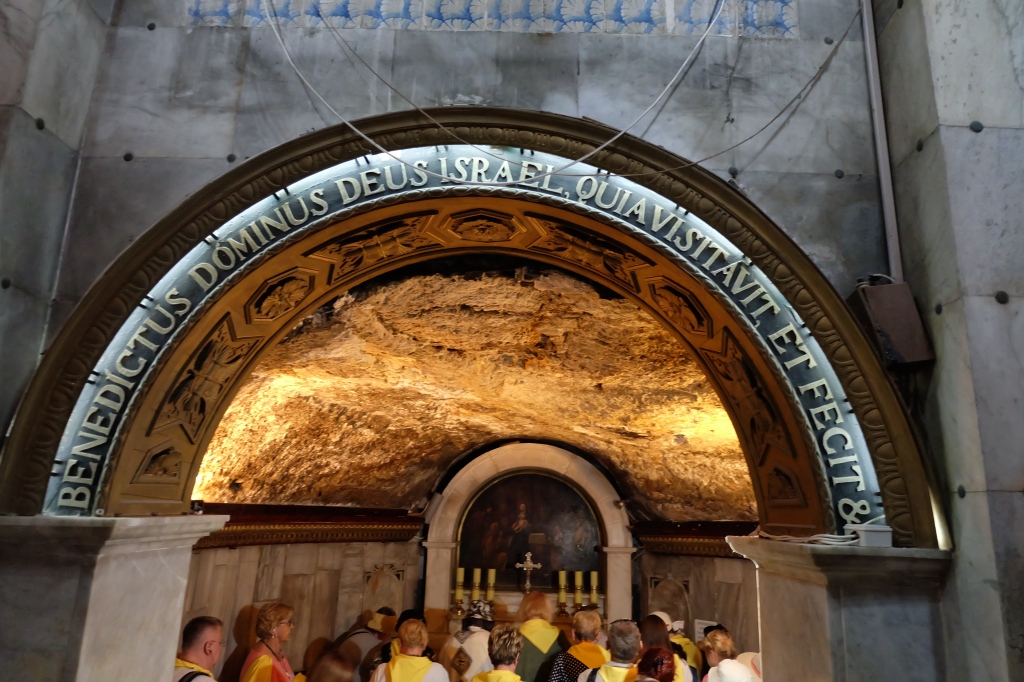
*Photo by Fr. Nick F. Lalog II, Church at Tabgha where Jesus is believed to have fed more than 5000 people; at the altar floor is a mosaic of the loaves of bread and two pieces of fish.  Taken during our Holy Land pilgrimage April 2017. 

Jesus Transforms First Our Questions to Transform Us

DSCF0622

The Lord Is My Chef Breakfast Recipe-Prayer
Thursday, 16 August 2018, Week XIX, Year II
Ezekiel 12:1-12///Matthew 18:21-19:1

            Dearest Lord Jesus:

            Every day we come to you with so many questions, an endless series of who, why and why not, and how.  As I prayed today’s gospel, I realized you seldom give straight answers to questions given to you in many instances like when Peter asked you about how many times should we forgive a brother who sins against us.  In many occasions in the gospel like today, you answer questions with a parable.  It is as if you first transform our questions in order to transform us eventually with the answers we can glean from your parables.

            As I dwelled on your parable of the unforgiving servant, I have realized one important aspect with our questions to you, Lord Jesus.  And that is our being so fearful of many things in life, especially of being loving and merciful like you.

           We try to be specific like Peter, asking in a numerical form “how many times should I forgive… seven times?”  The other day, we asked “who is the greatest in the Kingdom of heaven?”  Once we have asked you “who is my neighbor?” or “Lord, are you going to establish your kingdom now?”  In these instances, you never gave in to our questions because you knew very well we asked these while bounded by fears.  We lacked freedom.  Or, we refused to be free to be who we really are as beloved children of a very loving Father in heaven.  Because we doubt your love and mercy.
             And so, you give us parables like today’s unforgiving servant to assure us that we are loved and forgiven by the Father.  Give us the grace to fully embrace this truth, that we would always listen to your gentle voice within to forgive and to love with all our hearts.  Amen.Fr. Nicanor F. Lalog II,Parokya ng San Juan Apostol at Ebanghelista, Gov. F. Halili Ave., Bagbaguin, Sta. Maria,Bulacan 3022 .
*Photo by Fr. Nick F. Lalog II, still life experiment, September 2016.

Meaningful Existence In Christ, the Bread of Life

grayscale photography of crucifix
Photo by Pete Johnson on Pexels.com
Meaningful Existence in Christ, the Bread of Life
The Lord Is My Chef Sunday Recipe, Week XVIII-B, 05 August 2018
Exodus 16:2-4,12-15///4:17,20-24///John 6:24-35

            Existence.  From “ex estare”, “to stand out.”

            The word “existence” is a very obvious concept in our lives but also the most overlooked if not seen or understood at all.  A very peculiar greeting among us Filipinos when we meet someone is “Hi!  Nandito ka pala?”  When translated into English, the more it is illogical and dumb as “Hi!  You are here?” or worst, “Hi!  Are you here?”  Now, what kind of a question is it especially if the person you meet is like me standing at 5”5’, weighing 265 pounds?  Do you ask “are you here?” when the presence is very obvious?  It is a case of what teenagers call “MEMA” for “may masabi” or “just to have something to say”, indicating a very shallow perception and a lack of depth in friendship or acquaintanceship.  The normal and most sane things to say when you meet anyone anywhere after the usual greeting of “Hi” and “Hello” are “how are you”, “what’s up”, and “what are you buying or looking for?”  It was exactly the situation with the people who asked Jesus a silly question upon finding him on the other side of the lake in our gospel today.

            And when they found him across the sea they said to him, “Rabbi, when did you get here?”  Jesus answered them and said, “Amen, amen, I say to you, you are looking for me not because you saw signs but because you ate the loaves and were filled.  Do not work for food that perishes but for the food that endures for eternal life, which the Son of Man will give you.  For on him the Father, God, has set his seal.”(Jn.6:25-27)

            At least the people did not ask Jesus “Rabbi, are you here?”  But still, their query of “Rabbi, when did you get here?” showed their lack of deep appreciation for the person of Jesus.  They were really looking for bread and for things.  Not for Jesus and His person which is exactly what our relationship with God and with others too!  We always look for something else except for the very persons we relate with like family and friends and God.  This is what I refer to as “objectifying” the subject or taking persons as things.  Sometimes, we feel we truly love God and those around us but when we examine our priorities in life, we do not really love that much because we fail and even refuse to care, recognize and look for the person.  What we easily and often look for is the object, the things we can have to fill us, even bloat us.

            It is very amazing that John recorded this seemingly trivial anecdote but loaded with meanings.  After all, he is often referred to as the “beloved disciple” that, for his love for Jesus he must have seen something very special in this episode.  It was not merely a simple question on the part of the people but the sad reality of their lack of love for God and others, something we too must admit as very true with us today.  Like in the first reading, the people were so tired and seem to have lost all zeal in following God in the wilderness that they have become very shallow in their perception of everything and of themselves.  They were disillusioned and tired with the wandering in the desert, the circuitous route they were taking that suddenly, they have forgotten their deepest desires and aspirations when still in Egypt as slaves.  They have forgotten God.  Like us in this life of so many concerns when we forget the most essential ones like persons and the values they represent – love, kindness, and loyalty.

             See how Jesus did not answer the people’s question and instead declared to them in very clear manner something that echoes even within us today:  “Do not work for food that perishes but for the food that endures for eternal life, which the Son of Man will give you.  For on him the Father, God, has set his seal… This is the work of God, that you believe in the one he sent – the Christ.”   Have we become like those people who approached Jesus at the other side of the lake with the silly question to mask their desire for things, for material bread than for the person of Jesus Christ?  Have we forgotten all the lofty ideals of life and being a person created in God’s image and likeness?  Is this the reason why these days we could easily dispense prayer and celebration of the Mass because we have been so focused with material things than with deeper realities?  How ironic that when life has become more convenient and easier today, the more we experience of being lost and anxious, sad and unfulfilled.  What a tragedy that amidst the material affluence of life these days, lives and people have become more empty and unfulfilled.

             Last Sunday we reflected on the need to see things with the eyes of Christ to fully understand and appreciate the feeding of more than five thousand people by Jesus from five loaves of bread and two fish.  Today, Jesus is telling us to search for Him, for His very person and not for the bread and other material things it represents.  Jesus Himself is the bread of life, the bread from heaven – the Christ or the Anointed One of God.  When we believe in Him, then we see Him too in the many signs He comes in our lives daily.  Then we eventually realize we are also like Him – bread offered, blessed, broken and shared with others to sustain earthly life into eternity.  That is when we find meaning in our lives!  This is the direction of life we must all take as we reflected three weeks ago.  It is a direction demanding a continuous laboring in love, of always finding and giving meaning in our lives in God.  And that is the wondrous reality in every Eucharistic celebration we have when we are constantly renewed in Christ as St. Paul told the Ephesians in our second reading today.  The great St. John Paul II described the Eucharist as a “cosmic reality” or the brief experience of eternity while still here on earth!

             When Jesus declared Himself as the bread of life, He made Himself existent among us, very present in us and among us.  In the Eucharist, Jesus exists, standing out to us, reaching out to us to fulfill our very person so we could also stand out and reach out unto others in loving service and presence.  For a meaningful existence, may we desire more of the person of Jesus, the only essential in life readily available to us in the Holy Eucharist.  A blessed week to you! Fr. Nicanor F. Lalog II, Parokya ni San Juan Apostol at Ebanghelista, Gov. F. Halili Ave., Bagbaguin, Sta. Maria, Bulacan 3022

Seeing With The Eyes of Christ

Feeding5k2
The Lord Is My Chef Sunday Recipe, Week XVII-B, 29 July 2018
2Kings 4:42-44///Ephesians 4:1-6///John 6:1-15

             Beginning today for five weeks of Sunday we shall hear from the sixth chapter of John to discover and experience the mystery of the person of Jesus Christ.  Taking off from where Mark left us last week when Jesus and His apostles crossed the lake to rest at a deserted place, John now introduces us to the long but beautiful bread of life discourse of Jesus Christ:  Jesus went across the Sea of Galilee.  A large crowd followed him, because they saw the signs he was performing on the sick.(Jn.6:1-2)

             John’s gospel is also known as “the book of signs” wherein he arranged the major miracles of Jesus as revelations of His being the awaited Messiah or Christ.  But unlike the other evangelists, John preferred to call these miracles as “signs”, from the Greek “semeion”that denotes the existence and character of unseen, deeper reality.  The word miracle is from Latin “mirum oculis” or something that causes wonder when seen or beheld.  But a sign is deeper in meaning that John preferred to use it to show that the healings and other acts performed by Jesus are proofs and evidence that indeed He is the Christ.  In doing so, John is inviting us to see more beyond the healings and other acts by Jesus the deeper realities He wishes to reveal and share with us to be experienced too.  He wants us to shift our perceptions of persons and things to higher levels.  Like Jesus Christ, John wants us to see beyond material things for every detail can be a bearer of meaning, a sign of deeper reality and of Christ Himself.  Let us try:

             Jesus went up on the mountain, and there he sat down with his disciples.  The Jewish Passover was near.  When Jesus raised his eyes and saw that a large crowd was coming to him, he said to Philip, “Where can we buy enough food for them to eat?”  He said this to test him, because he himself knew what he was going to do.  Philip answered him, “Two hundred days’ wages worth of food would not be enough for each of them to have a little.”  One of his disciples, Andrew, the brother of Simon Peter, said to him, “There is a boy here who has five barley loaves and two fish; but what good are these for so many?”(Jn.6:3-9) 

             Imagine standing there with Jesus, looking at the great crowd of people coming.  It was getting dark, the feast of Passover was approaching and you were at a deserted place.  Then suddenly Jesus asks you like Philip where can we buy enough food for them to eat?

             Notice that if we examine the Lord at how He looked at the situation, it could lead to a shift in our perception from scarcity to plenty by first seeing the people coming as persons who need to be fed and cared for.  Jesus felt their hunger and thirst, seeing them as brothers and sisters.  It was an opportunity for Him to teach them some lessons about God.  Unfortunately, the disciples saw the opposite – it was a big problem.  Philip even viewed it as a nightmare when he told Jesus that even “Two hundred days’ wages worth of food would not be enough for each of them to have a little.”  The same thing with Andrew who found a boy with five loaves of bread and two fish not good enough for everyone.  They saw it as a hopeless situation.

             This is perhaps one of the main tragedies of our time when we begin to see and look at people as problems and mere statistics.  We have failed and even refused to see each one as a person to be loved and cherished!  Andrew did not even bother to ask the name of the boy and just brought him to Jesus with his bread and fish.  Exactly how in media these days people are objectified and made into things, referring to persons with demonstrative pronouns this and that or ito at iyan in Filipino.  On the other hand, objects are subjectified like food as “he/she’s delicious” or “masarap siya”.  Sometimes I fear that one day PAGASA might even ask us priests to baptize typhoons as forecasters keep on referring to them like a human being:  ang bagyon si Josie ay kumikilos pakanluran at may lakas siya ng hanging na…  The most glaring sign of how low we have come to regard persons came from Congress during the SONA when Duterte reiterated the relentless continuation of his anti-drug campaign based on his erroneous view that human rights and human lives are two distinct realities.  The list of instances continues when we take people for granted especially women and children when we give more emphases on things like money and clothes than persons.  There is always more than enough bread for everyone when we learn to stop looking at everyone as a commodity to be bought and used.  In the first reading, the prophet Elisha highly regarded those around him as persons who need to be fed with food that he had to remind his servant there was enough for everyone.  With God, there are always plenty of bread for everyone but to the devil, there is never enough that is why its first temptation to Jesus was to turn stones into bread, the temptation to always take people for granted.

             There is no doubt in the powers of Jesus Christ and most of all of His knowing what to do when in such difficult situations.  Inasmuch as we trust in His powers, we also need to see others as brothers and sisters who are beloved by the Father.  John mentioned in our gospel today the setting of this feeding of 5000 when the Jewish feast of Passover was near to show us the Eucharistic nature of the sign.  How wonderful to remember that during His supper, Jesus took the same gestures at the wilderness and gave the bread to His disciples, saying “This is my body which will be given up for you.”  Notice how there in the wilderness that the Son of God who had become man like us took on a body to remind everybody is a somebody and no one is a nobody.  We are all bread meant to be shared and broken with one another for we are all one Body in Christ as Paul reminds us today in his letter to the Ephesians.  Amen.Fr. Nicanor F. Lalog II, Parokya ni San Juan Apostol at Ebanghelista, Gov. F. Halili Ave., Bagbaguin, Sta. Maria, Bulacan 3022

*Photo from Google.

Resting In Jesus

SacredRest
Resting in Jesus Christ
The Lord Is My Chef Sunday Recipe, Week XVI-B, 22 July 2018
Jeremiah 23:1-6///Ephesians 2:13-18///Mark 6:30-34

            As I was telling you last Sunday, discipleship is directional than about destination.  And though we have different missions in life, every mission always has Jesus Christ as direction.  Today we deepen this direction in Christ with the return of the Twelve after being sent by Jesus to their first mission last week when He invited them to rest with Him to a deserted place.

            The apostles gathered together with Jesus and reported all they had done and taught.  He said to them, “Come away by yourselves to a deserted place and rest a while.”  People were coming and going in great numbers, and they had no opportunity even to eat… When he disembarked and saw the vast crowd, his heart was moved with pity for them, for they were like sheep without a shepherd; and he began to preach them many things. (Mk.6:30-31)

            Friends always wonder what kind of “rest” I take when I go on a little solitude every Thursday on my weekly day-off or during my annual personal retreat.  They ask, “anong klaseng pahinga po iyon Father kung nagdarasal pa rin kayo?”   Of course, I sometimes go on out-of-town vacation but when we try to reflect on our gospel today, we discover some beautiful dimensions about rest.  To rest means to stop because tasks have been completed.  This we find in Genesis 2:2 when God rested on the seventh day after creating everything good.  In John 19:30, we find Jesus Christ saying “it is finished” when He died to complete His work of salvation that after His Resurrection, He ascended into heaven to seat at the right hand of His Father in heaven.  To rest primarily means to stop because work has been completed like God when He completed His works of creation and salvation.  But in the gospel today we find how Jesus and the Twelve could not rest nor eat because of the people coming!

            Here we find the essential reality about rest which is always to rest in the Lord.  We do not only rest with Jesus Christ but also rest in Him.  Unlike God, we complete our works by episodes, not in its entirety.  Jesus invited the Twelve to rest after completing their first mission given them.  There would still be other missions to be given to them until Jesus ascended into heaven.  Those missions continue to this day and would never be fully completed until His Second Coming.  For us to fulfill any mission in life, we need to rest always in Christ because as we have seen last week, He Himself is our direction in the ministry.  That is the direction of intimacy with Jesus, of being close with Jesus because it is Jesus Himself whom we share with the people we serve.

            People would always be coming to us but never forget that before they all came, Jesus came first to call us and send us.  Therefore, when we rest, we rest in Him too which is a call to a personal and intimate relationship with Him.  Note how Mark referred to the “Twelve” last week and now being called as “apostles” upon their return from their first mission.  This is an important shift in calling them as apostles for later we shall see they are distinct from followers or disciples.  An apostle is someone who is sent forth ahead of Jesus.  It is from the Greek verb “apostolein”, to send forth while disciple is from “discipulous”, to follow like discipline.  Most of all, an apostle is someone who had seen Jesus Christ like the Twelve so that Paul had to insist on this title too because he met the Lord on the way to Damascus.  In a deeper sense, an apostle is also someone very intimate with Jesus Christ, always interacting with Him, doing His works.  We are all apostles of the Lord sent into the world to continue His saving works which demands a close relationship with Him in fulfilling that mission that is very demanding, even impossible.  Most of all, what the people are really hungry and thirsty of are not things of this world but Jesus Christ Himself – His love and presence, His mercy and forgiveness, His joy and consolation.  It is for this reason that when a priest asked St. Mother Teresa for any message to priests, she simply asked them “to give them Jesus, only Jesus, and always Jesus.”  This will also be the focus of the gospel in the next five weeks when we shift to John’s gospel account of the bread of life discourse in chapter six.

            In the recent Philippine Conference on New Evangelization, speakers kept on reminding us priests, religious and consecrated persons on this essence of our ministry:  we can never be moved with compassion to feed the multitude like Jesus Christ when we are apart from Him.  Of the many speakers there, I was moved most on the first day by the Bulakenyo Jesuit Fr. Albert Alejo who asked us, “who/what gives you joy in the ministry?”  He reminded us to always go back to Jesus Christ in everything we do because without Him, we could never lead people to Him.  He capped his talk with a beautiful metaphor of the rooster by demonstrating and mimicking how the rooster would crow at the break of dawn.  According to Fr. Alejo, once the rooster had seen the first rays of light of the day, he stands erect first, flaps his wings to make sure he is already awake, then beats his chest to muster enough courage and strength to announce morning has broken with a powerful crow.  And when other roosters follow with the same methodology of crowing, the whole farm is awakened as the new day begins filled with life and hope.

            Without Jesus in our hearts, without resting in Jesus in every mission we have labored along with its triumphs and failures, pains and joys, it would always be difficult to feed the multitude.  Worst like the shepherds of Israel, we could “mislead and scatter the flock of the Lord’s pasture”(Jer. 23:1) that has sorely marred our own history of the Church with the many scandals that have rocked us.  Jesus Christ is the promised Good Shepherd God had spoken through Jeremiah (Jer.23: 5-6), the one sent to reconcile us all in God and with others (Eph.2: 16) whom Paul proclaimed in the second reading.  This Sunday, let us not just stop from our work to rest with our gadgets and other things.  Let us rest in God – magpahinga – let Him breathe on us His life-giving spirit so we may be recreated for the challenges of this new week.  Amen. Fr. Nicanor F. Lalog II, Parokya ng San Juan Apostol at Ebanghelista, Gov. F. Halili Ave., Bagbaguin, Sta. Maria, Bulacan.  <lordmychef@gmail.com>

Recognizing Jesus

recognizingjesus
Photo from Google.
The Lord Is My Chef Sunday Recipe, Week XIV-B, 08 July 2018
Ezekiel 2:2-5///2Corinthians 12:7-10///Mark 6:1-6

            These past weeks we have seen the growing success and popularity of Jesus Christ.  People were amazed with Him that great crowds kept on following Him wherever He would go to hear Him preach and most especially to touch Him or be touched by Him to be healed of all kinds of sickness.  Jesus was “viral” and “trending” in every town He visited around the Lake of Galilee except in His hometown of Nazareth which is His next stop today.

            Jesus departed from there and came to his native place, accompanied by his disciples.  When the Sabbath came he began to teach in the synagogue, and many who heard him were astonished.  They said, “Where did this man get all this? What kind of wisdom has been given him? What mighty deeds are wrought by his hands?  Is he not the carpenter, the son of Mary, and the brother of James and Joses and Judas and Simon?  And are not his sisters here with us?”  And they took offense at him.(Mk.6:2-3)

             In spite of the popular enthusiasm He had aroused during His ministry, Jesus was no stranger to bitter disappointments and failures.  All four evangelists tell us of the many times Jesus was rejected by people, reaching its highest point in His crucifixion.  See how Mark noted in our gospel today how the people refused to recognize Jesus Christ, “And they took offense at him.”  It was an attack on the very person of Jesus, not on His works!  See how the people’s queries about Him were tinted with malice and suspicion.  This is the ugly side of that adage “familiarity breeds contempt” when those closest to you, when those who are supposed to know you more and better are the ones who refuse to believe you.  This is the reason Jesus said to them, “A prophet is not without honor except in his native place and among his own kin and in his own house.”(Mk.6:4)

             But it is also here where we find the good news for us this Sunday:  when we feel rejected or unaccepted or doubted by those closest to us, do not despair.  Not all days are bright and sunny for us that in everything we do we are accepted and appreciated.  Sometimes, there are dark clouds of doubts and suspicions cast over us, on our very person by those closest to us like family and relatives, friends and neighbors.  And in those moments of rejection, try to feel in your heart Jesus Christ who always believes in you because He Himself sent you as His prophets, His spokesperson.  Like Ezekiel in the first reading, we are all prophets sent to speak of God’s love and mercy in this world where everything and everyone is doubted, questioned and examined like microorganisms under a microscope.  It does not matter “whether they heed or resist – for they are a rebellious house – they shall know that a prophet has been among them.”(Ez.2:5)    Like all the prophets, keep doing what you believe is good.  Keep pursuing your dreams and keep striving to be better not to prove yourself and disprove those around you but because it is a mission from God Himself to express His love and concern for everyone.  Even if others refuse to believe in us, even if they refuse to accept us, we continue to speak to them, we continue to serve them, we continue to love them, we continue to be among them just like Jesus because we believe.  Most of all, because we love.

            This was the moving spirit behind St. Paul’s enthusiasm amidst many sufferings and rejections:  “I will rather boast most gladly of my weaknesses, in order that the power of Christ may dwell with me.  Therefore, I am content with weaknesses, insults, hardships, persecutions, and constraints for the sake of Christ; for when I am weak then I am strong.” (2Cor.12:9-10)   In imitating Jesus Christ, St. Paul realized power is made perfect in weakness on the Cross.  When we let go of our power and strength, God fills us with life and resurrection.  Recall the days you relied more on God, when you refused to fight back or resort to violence so as not to go down to “lowlife” level – those are the same moments of your sweetest victories and maturity because those were the moments we have truly loved.  When we love, it means we believe.  We have faith!  Note how Mark ended his story today with a note that Jesus “was not able to do any mighty deed there, apart from curing a few sick people by laying his hand on them.  He was amazed at their lack of faith.”(Mk.6:6) 

             The people took offense at Jesus for they lacked faith because they do not love Him.  The problem is not with God if nothing good is happening in our lives like when we cannot experience healing and forgiveness.  We have to believe in Jesus first for us to see Him present.  To believe in Him, like with any person demands love.  When we truly love a person including Jesus, our eyes are always opened, recognizing them even in their shadows or footsteps.  When we truly love anyone, there is no need to see because in our hearts, that person is already present in us.  And so we believe.  Then miracles happen, joy overflows.  A blessed week ahead of you! Fr. Nicanor F. Lalog II, Parokya Ng San Juan Apostol at Ebanghelista, Gov. F. Halili Ave., Bagbaguin, Sta. Maria, Bulacan

Touching Jesus, Being Touched by Jesus

touchingjesus
The Lord Is My Chef Sunday Recipe, Week XIII-B, 01 July 2018
Wisdom 1:13-15;2:23-24///2Corinthians 8:7,9,13-15///Mark 5:21-43

            Experts claim that touching another person for at least five seconds is worth more than 300 words of encouragement.  At the same time, they say that the sense of touch can hasten the healing process among people recuperating from illnesses and surgery.  That is the power of touch that even the word “touch” itself is so powerful that it may be used in literal and figurative sense.  We tell others to “keep in touch” to mean to stay connected, to make our relationships and bonds grow stronger.  The same thing is true when we say we are “touched” by words or gestures of kindness as they strike deeper realities that connect us within.  This explains why we always try to touch things literally because figuratively, every touch leads to bigger, inner realities that link us with persons and whatever they represent.  That woman in today’s gospel suffering in hemorrhages believed that by touching even the clothes of Jesus could heal her.  In fact, it was more than enough for her as it was the closest thing she could do to relate with Jesus who was always being followed by a vast crowd.

            There was a woman afflicted with hemorrhages for twelve years.  She had heard about Jesus and came up behind him in the crowd and touched his cloak.  She said, “If I but touch his clothes, I shall be cured.”  Immediately her flow of blood dried up.  She felt in her body that she was healed of her affliction (Mk.5:25,27-29)

            What is so beautiful with this story that St. Mark had sandwiched with the healing of the daughter of Jairus is the sensitivity of Jesus with our touch:  He felt power had left Him that He stopped to ask among the crowd “Who touched me?”  Jesus is not contented with just being touched as He wants a more intimate relationship with us.  Jesus wants more than touching us but even hugging us, embracing us to feel the warmth of His love and mercy for us.  More than a touch, Jesus wants a personal connection – a relationship – with everyone.  That is why when He went into the room of the dying daughter of Jairus, He tenderly addressed her with the words “Talitha koum,” which means, “Little girl, I say to you, arise!”  It is a connection of far more significance as it leads to more fulfillment and freedom, a relationship filled with life.

            Touching Jesus and being touched by Jesus is always a step into an intimate relationship with the Lord calling for faith in us.  How sad that most often we stop at touching Him, like with what we always see inside churches where people touch all statues and images of Jesus, His Mother Mary and the saints.  Yes it is an expression of faith but that faith needs to grow more into a relationship.  How many would really stop to stay for an hour or half an hour or mere 15 minutes to be in touch with the Lord and be touched by the Lord?  Can we lay bare ourselves openly to Jesus, allowing Him to touch those sensitive nerves inside us that make us seethe with anger or jealousy?  Can we allow Jesus to touch our closely guarded secrets and hurts so we could finally confront the ghosts within us and remove blocks in our relationships with God and with others?

            The author of the Book Wisdom had reflected how God had wanted since the beginning to keep in touch with us that He made us in His likeness, “the image of his own nature to be imperishable.  But by the envy of the devil, death entered the world, and they who are in his possession experience it.”(Wis.2:23-24)  Recently the whole nation was disturbed and rose in indignation when the man in Malacanang called “God stupid” after he had wrongly interpreted the story of the Fall in the Book of Genesis.  There is no doubt his words were blasphemous but after all the noise, we must also start reflecting about our own faith and personal relationship with God whom we also blame for all the sufferings and miseries in the world.  There are times during funeral Masses I felt tearing apart my clothes when I hear priests claiming the death of a beloved as “God’s will.”  Three years ago, I wished having a laser sword so I could chop off the brainless head of a priest declaring it was “kalooban ng Diyos, tanggapin natin” the deaths of the two brothers of a priest who were peppered with Armalite bullets by a neighbor.  Both their bodies were mangled by the Armalite bullets, the other cut into half and then the priest saying the crime was the will of God?  My God…  And that is how stupid some of us Christians are including some priests who believe that sufferings like cancer and dying in a freak accident are willed by God.  Our first reading is very clear today, “God did not make death, nor does he rejoice in the destruction of the living.” (Wis.1:13)

            Let us be like St. Paul in the second reading who was definitely in touch with God and reality when he tried addressing the question of suffering with the Corinthians by encouraging them to share their wealth with those in need.  St. Paul did not glorify suffering for its own sake nor did he encourage the Corinthians to seek suffering in this part of his second letter to the Corinthians.  Instead, he tried explaining to them that suffering is part of the process of our inner transformation that leads to glory:  “Not that others should have relief while you were burdened, but that as a matter of equality your abundance at the present time should supply their needs so that their abundance may also supply your needs, that there may be equality.” (2Cor.8:13-14)  If we truly touch God, He would touch us too, experiencing His love and mercy that in turn becomes natural for us to personally touch others with the loving service of Christ. In this age when our communications and interactions are mediated by gadgets and other things, may we bring back that personal touch of love and kindness with others.  May God bless and touch you today and the whole week through! Fr. Nicanor F. Lalog II, Parokya ni San Juan Apostol at Ebanghelista, Gov. F. Halili Ave., Bagbaguin, Sta. Maria, Bulacan 3022

Photo from Google.