Lord My Chef Daily Recipe for the Soul, 29 September 2025
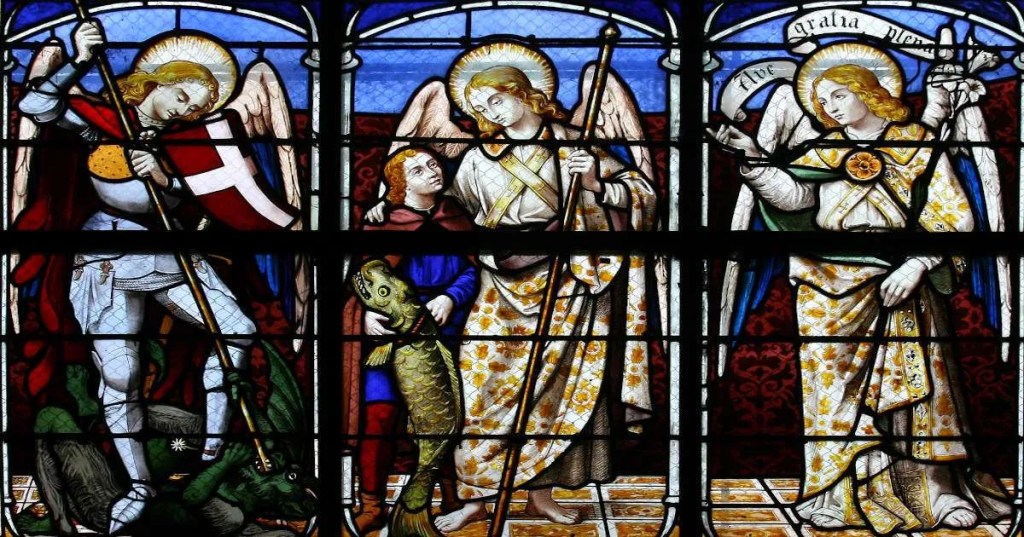
Monday, Memorial of Saints Michael, Gabriel & Raphael, Archangels
Revelation 12:7-12     <*{{{{><  +  ><}}}}*>     John 1:47-51
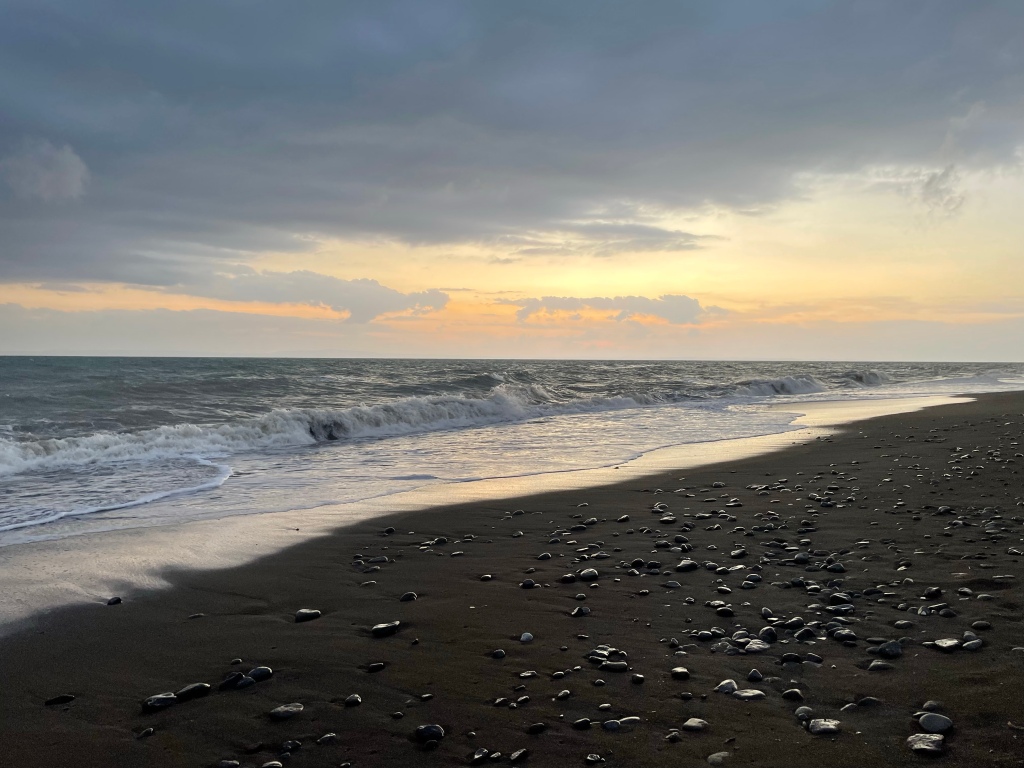
Photo by author, Carmel of the Holy Family Monastery, Guiguinto, Bulacan 25 September 2025.
Thank you dearest
God our loving Father
for your gift of Archangels
helping us fight our many
spiritual battles in life;
the wholesale corruption
and looting in government
in connivance with some
contractors has unmasked
the realities of the demons
led by Satan working hard
here in on earth
right in our country;
more than the billions of pesos
they have looted from government,
they have put so many lives in
danger and misery.
Then I heard a loud voice in heaven say: “Now have salvation and power come, and the kingdom of our God and the Authority of his Anointed… They conquered him by the blood of the Lamb and by the word of their testimony; love for life did not deter them from death. Therefore, rejoice, you heavens, and you who dwell in them. But woe to you, earth and sea, for the Devil has come down to you in great fury, for he knows he has but a sort time” (Revelation 12:10, 11-12).
But the greatest spiritual battle
against evil and sin, Lord
happens not in government offices
nor halls of Congress nor of the
streets; they happen right here
in our hearts.

All the evil happening now started
in our selfish hearts,
in our malicious minds,
in our uncontrolled appetites for
comfort and luxuries.

Help us fight the demons
within us, Lord Jesus;
pray for us, St. Michael
that we may have the strength
and courage to stand firm
in what is true and just;
pray for us St. Gabriel
that we may speak the
gospel and life of God in this
world so misled by the words
and images of evil masquerading
as good and beautiful;
pray for us St. Raphael
that we may heal from our
many afflictions in body,
mind, heart and soul.
Amen.

Fr. Nicanor F. Lalog II
Our Lady of Fatima University
Valenzuela City
(lordmychef@gmail.com)
Photo by author, somewhere in Rizal en route to Infanta, Quezon, March 2023.
It is widely held that our physical well-being has a direct relationship with our spiritual condition and vice versa. That is why aside from the treatment of physical sickness, there is also a need to address the spiritual well-being of patients for their “healing” which is more wholistic in nature and meaning.
Jesus Christ himself showed this relationship of the physical and the spiritual. The gospels are filled with accounts of Jesus not only treating the sick but also of healing them by first touching them (physical) then telling them how their sins were forgiven or how great was their faith (spiritual).
Photo by author, somewhere in Rizal en route to Infanta, Quezon, March 2023.
Here we find that healing involves the total person in body, mind, heart and soul. Healing is not just the restoration of health but transformation of the person. This is the spirit behind hospital ministry. Patients eventually die but may have still experienced healing when properly prepared for death by a priest or pastor or a nun through counseling and administering of the Sacraments of Confession, Viaticum, and Anointing of the Sick.
As I immersed myself in this ministry since 2021 as chaplain of a university with a medical center, I have realized too that it is actually more of what Jesus is doing to me than of what I am doing to our patients and our medical professionals. Indeed, priesthood is a ministry seeking new directions in Jesus Christ that is most true in the hospital ministry when the tables – or beds – are turned on me as patient needing medical and spiritual attention!
Twice I have been rushed to the ER for minor accidents: first in 2023 and second only this Sunday when I slipped in our garage and hurt my left knee. While recovering in my room from this recent injury, I decided to put into writing to share with you some lessons from my two experiences that may hopefully help in the healing process of those who are wounded physically and emotionally.
Photo by author, Hidden Spring & Resort, Calauan, Laguna, February 2025.
First thing to do when we are wounded physically and spiritually or emotionally is to have the wounds “cleansed”.
We were having a tug-o-war during our 2023 team-building when the rope snapped and sent me rolling down the ground. I quickly stood up and brushed the dirt and blood on my left arm, declining offers of others to wash and clean my wounds as I insisted to them sanay po ako sa ganito.
But when our university physician approached me on my way to the wash area to check my wounds and asked if I had had anti-tetanus shots before because I would be needing one that afternoon, everything changed. Fear crept in me with all the scary imaginations running through my mind as I asked him why the tetanus shots? The doctor explained that the ground is dirty with harmful bacteria including animal shit that may infect my wounds; hence, the need to first wash my wounds with clean water and soap and get anti-tetanus shots for sure. Oh my God…
Looking back to that experience after this recent fall (when I got another pair of tetanus shots), I realized the same thing is true when our heart and soul are wounded: we need to wash them clean with sincerity and honesty of one’s self. Cleansing our spiritual and emotional wounds require self-confrontation, no ifs nor buts why it happened. It is recalling the incident no matter how painful it may be like in washing our physical wounds with water and soap to clean ourselves of harmful microbes of anger and hatred that might infect us later.
Cleansing our emotional and spiritual wounds is being true to ourselves to face, accept, then embrace the realities why and how it happened. Crying may be good as a catharsis which is literally a cleansing process. Cleansing our spiritual and emotional wounds is suspending any conclusions that may lead to unnecessary self-pity and self-blame of the incident by facing the mirror like when after we have washed our wounds on any part of the body to check and see its extent of damage. It is normal to be sad and even angry because it is painful as it is something hurting from deep inside us. The more we face our wounds, the more we become at home with them.
Photo by author, Katmon Nature Sanctuary & Beach Resort, Infanta, Quezon, March 2023.
Next is disinfect the wounds and apply medications to prevent infection. After washing my wounds with soap and water that Sunday, I disinfected these with Cutasept that resulted in more pain as if the antiseptic solution was fiercely battling the germs and microbes trying to infect my left knee.
When our soul is wounded, we do the same procedure after cleansing by facing the realities of pains and hurts with prayer, our spiritual antiseptic. Even doctors prescribe prayers to their patients in critical situation. And here is the interesting part in this process: prayer does not change the situation, it will not remove the wounds even the scars in our memory and soul; but, prayers make us stronger and better after the spiritual and emotional woundings we have had. Most of all, prayer facilitates our healing process because it opens us to Jesus, the only doctor who will heal us completely from both physical and spiritual and emotional wounds.
Photo by author, Katmon Nature Sanctuary & Beach Resort, Infanta, Quezon, March 2023.
Part of disinfecting and applying medications to our spiritual and emotional wounds is seeking help from others, finding Jesus our healer from priests and nuns, pastors and counsellors, and persons you look up to for their wisdom and maturity in Christ. Like when we are physically wounded that we go consult doctors, the same thing is needed when we are emotionally and spiritually wounded. Prayers like disinfectants and medicines are not everything; persons give the personal touch of the spiritual disinfection and healing of our brokenness inside. There is no need to let everyone know our spiritual and emotional wounds; simply share your hurts with someone who could help you “treat” your wounds and willing to journey with you in its long process of healing.
Do not broadcast these in social media which would only worsen the situation. That’s rubbing salt on your wounds because not everyone out there cares for you! It will just feed the frenzy of the many “low life” hungry for anything negative to feast upon. Every time I come across selfies of people while at the ER or confined in the hospital, I wonder how sick they really are that they could still hold their cellphone while being treated for an injury. Getting sick physically and emotionally is always an occasion for more prayers and conversion in Christ.
Finally, dress your wounds for protection. I am from Generation X and most of us were never hospitalized nor brought to the ER for any treatment while still a child despite our many mischiefs and misadventures while growing up.
We only had our mother as doctor who treated our wounds with agua oxinada and gamot na pula that was so painful that we need to blow dry our wounds once dabbed with it. Then, mom would leave our wounds open like that, no kuritas and gauze because makukulob ang sugat, magtutubig at magnanana (infection).That is why after that 2023 injury, I did not follow the doctor’s instruction to cover my wounds on my left arm with gauze; I would later learn its value in a painful and embarrassing way a week after when I was called to anoint a patient in our ICU.
On my way there, the elevator door suddenly closed that instinctively I used my left wounded arm to stop it. Anyway, I thought the wounds were already healing and felt no pain at all when hit by the elevator door. When I entered the ICU, the nurses and doctors stared at me and asked what had happened because blood was dripping from my left arm. It was only then I realized the elevator door had scratched my wounds!
What a shame that doctors and nurses attended first to my wounds before letting me anoint the patient; I felt so embarrassed especially when the attending physician explained the need to cover wounds for protection from dirt and other elements as well as accidents like what had happened to me at the elevator.
Photo by author, Sacred Heart Novitiate, Novaliches, QC, 20 March 2025.
From that experience, I realized that one reason our spiritual and emotional wounds never get healed is because we “expose” them. When a person is wounded in heart or soul, it is not enough we clean and disinfect and treat them. We need to protect them from further pains and hurts from those who have inflicted their emotional wounds. Protecting them is to stop blaming them in causing their inner pains and hurts. Nasaktan na nga, nasisi pa. Ibinaon pa!
Friends and loved ones are the spiritual gauze who cover and protect spiritual wounds from more hurts and pains. They are the Band-aid strips protecting those spiritually and emotionally wounded by being at their side, assuring them with love and support, of still believing them despite their painful experiences. There is no need to engage the guilty offenders into a skirmish. If their wounds were of their own doing, soften the impact by motivating them to be better, to hope for the best, that it is not the end of their lives. And most of all, assure them their life is not defined by their emotional and spiritual wounds.
Protecting those wounded emotionally and spiritually means helping them find anew their true selves and worth as persons who are beloved children of God. Protecting them like gauze is helping them bear the long process of healing.
Photo by author, 2019.
There is a saying that “time heals” but time can only heal when there is human intervention in the treatment of our emotional wounds aided by prayers and faith in God. Time alone, no matter how long the years are, cannot heal us in itself if we remain exposed to dirt and elements that contribute to “infecting” us further. Or worst, if we remain with the very causes of our wounds.
For those hurting spiritually or emotionally, may Jesus Christ heal you and give you the courage to confront and deal with your inner wounds and pains. Seek God and seek persons too to help you. Amen. May God bless you on your road to recovery and healing! Fr. Nicanor F. Lalog II, Our Lady of Fatima University, Valenzuela City (lordmychef@gmail.com).
The Lord Is My Chef Sunday Recipe for the Soul by Fr. Nicanor F. Lalog II
Twentieth Sunday in Ordinary Time, Cycle B, 18 August 2024
Proverbs 9:1-6 ><}}}}*> Ephesians 5:15-20 ><}}}}*> John 6:51-58
Photo by author, James Alberione Center, QC, 15 August 2024.
It is our fourth consecutive Sunday listening to the sixth chapter of John’s gospel that opened with the miraculous feeding by Jesus of more than five thousand people in a deserted place; Jesus fled from there, went back in Capernaum where people caught with Him and disciples as He began three Sundays ago His “Bread of Life” discourse now getting deeper while the drama among the crowd is heating up.
From murmuring last Sunday about Jesus who said “I am the bread that came down from heaven” (Jn.6:41), the people today quarreled among themselves after Jesus said “I am the living bread that came down from heaven; whoever eats this bread will live forever; and the bread that I will give is my flesh for the life of the world” (Jn. 6:51).
Photo by author, James Alberione Center, QC, 15 August 2024.
Notice the beautiful contrast of reactions by people to Jesus: from murmuring last Sunday, they sank deep into quarreling while Jesus leveled up to “the living bread from heaven” from merely “the bread from heaven” last week. For us to live well, we have to eat well by having Jesus Himself as our food and drink.
The Jews quarreled among themselves, saying, “How can this man give us his flesh to eat?” Jesus said to them, “Amen, amen, I say to you, unless you eat the flesh of the Son of Man and drink his blood, you do not have life within you. Whoever eats my flesh and drinks my blood has eternal life, and I will raise him on the last day. For my flesh is true food, and my blood is true drink. Whoever eats my flesh and drinks my blood remains in me and I in him. Just as the living Father sent me and I have life because of the Father, so also the one who feeds on me will have life because of me” (John 6:52-57).
Photo by Ms. Ria De Vera in Banff, Alberta, Canada, 07 August 2024.
Eating is the most common human activity anywhere, any time. Human life basically revolves around eating as we have seen since time immemorial how we have progressed following our search for food. We work to feed ourselves and loved ones. Without food, we die. Food is so essential that there is always food to share in our gatherings.
That is why Jesus chose the bread and wine as the signs of His living presence among us in the Holy Eucharist He established during the Last Supper on Holy Thursday. In the Eucharist, Jesus elevated the most ordinary human activity of eating as most sublime and Divine. In the Holy Mass, we share in Christ’s Body and Blood so we too may share our very selves with one another.
When Jesus said in Capernaum that the bread He is giving is His own flesh with His blood as drink, He was already preparing the people for the Eucharist while at the same time teaching them that eating is not everything. We have to eat well to live well. When tempted by the devil in the wilderness, Jesus right away taught us to remember that man does not live by bread alone but with every word from God. At the start of this discourse last August 04, Jesus challenged the people, “Do not work for the food that perishes but for the food that endures for eternal life, which the Son of Man will give you” (Jn.6:27).
Photo by Ms. Ria De Vera in Banff, Alberta, Canada, 07 August 2024.
Many times, we get so used in our many activities that unconsciously, we miss life itself as we punish ourselves with exhaustion and sickness as well as emptiness.
Food is not just something that fills our stomach but must also lead into our heart and soul. Observe any cuisine and you get a taste of the culture and people it represents, even with strong hints of its geographical origin. In the first reading we find how the Book of Proverbs personified Wisdom as God to remind us that though He is transcendent and so above us, God is easily accessed even in the most ordinary instances like eating.
Wisdom has built her house, she has set up her seven columns; she has dressed her meat, mixed her wine, yes, she has spread her table. She has sent out her maidens; she calls from the heights out over the city: “Let whoever is simple turn in here; to him who lacks understanding, I say, Come, eat of my food, drink of the wine I have mixed! Forsake foolishness that you may live; advance in the way of understanding” (Proverbs 9:1-6).
How lovely is that part of God calling us to come like Jesus in the gospel when He said “come to me all who are burdened” or when He ordered to “let the children come to me”. Is it not the same thing we say when we are about to eat, to come and get it?
Sadly these days, we seem to have retrogressed in our manner of eating. Social media rightly labeled it as “food porn” when we are flooded with everything about food and drinks minus its deeper meanings. Food is sadly seen in its material aspect that eating is more on filling the stomach, forgetting the soul because we have totally forgotten God and the people around us. No wonder that despite the growing food production and plethora of food we have these days, many still starve while the rest of us remain lost in life, more sick.
Photo by Ms. Ria De Vera in Banff, Alberta, Canada, 07 August 2024.
See, my dear friends, the great coincidence on the very Sunday Jesus began his bread of life discourse, it was also the opening of the Paris Olympics with a mockery of the Last Supper that led us into a kind of “quarrel” as organizers and their supporters insisted it wasn’t the Last Supper at all despite the clear indications and proofs.
“How can this man give us his flesh to eat?” Suddenly, we heard anew that same question by the people in Capernaum to Jesus reechoed in the Olympics at the capital city of the Church’s so-called “eldest daughter”, France. Of course, we know this bread of life discourse by Jesus refers to the Holy Eucharist and surely, the many defenders of the Paris Olympics are aware for many of them are Catholics. But, Jesus must have willed this gospel be proclaimed at this time coinciding with the Olympics for us to evaluate anew our faith in Him because at the very core of this bread of life discourse is the mystery of faith.
“How can this man give us his flesh to eat?” In the gospel of Luke, we find a similar question by Mary at the Annunciation that is filled with faith, “How can this be?” (Lk.1:34); but today, like in Capernaum as exemplified by the Paris Olympics, that question is a renewed refusal to believe in the words of Jesus Christ. Worst of all as we noted earlier in our perceptions of food and eating these days, that question shows modern man’s insistence on everything material, totally disregarding our spiritual nature.
Photo by Ms. Ria De Vera in Banff, Alberta, Canada, 07 August 2024.
Like in Capernaum, many people today who refuse to believe Christ’s words resort to malicious and insidious arguments that it becomes useless to really converse with them as they would rather insist on their grossly material understanding and perception of life these days. Many prefer to quarrel these days than accept life’s many mysteries not merely seen nor tasted by the senses but experienced and realized through faith in God.
Life for them has become merely material which in Greek is bios as in biology. There is another Greek word for life which is zoe that refers to the eternal, divine life of God that Jesus repeatedly used in our gospel today.
Like last Sunday, Jesus did not engage Himself into debating with the crowd in Capernaum by simply repeating the words living and life to emphasize the total acceptance of Him – Body and Blood – in faith: “I am the living bread… my flesh for the life of the world. Just as the living Father sent me and I have life because of the Father, so also the one who feeds on me will have life because of me.” These are the very same words too, life and living that Jesus would mention before His Passion and Death as well as after His Resurrection because eating His flesh and drinking His blood is to share in His life that is also the fullness of life. It is only in Christ Jesus can we find fulfillment in life. Let us pray:
Lord Jesus Christ,
help me watch carefully
how I live, not as a fool
but as wise as St. Paul taught
us today in his letter to the Ephesians;
let us not be intoxicated
with life's pleasures and worldly pursuits
but let us be filled with the Holy Spirit.
Amen.
Quiet Storm by Fr. Nicanor F. Lalog II, 09 August 2024
Photo by author, Parish of the National Shrine of Our Lady of Fatima, Valenzuela City, 24 July 2024.
I was recently asked to bless a little store the other day, the seventh day of August. My schedule was toxic with another appointment in another city but the owner begged because she believed it is the most auspicious date for blessing.
How I wanted to ask her why have a blessing at all if you believe in luck than in God? Para wala nang gulo, I blessed her store but explained the meaning of blessing and of superstitions during the rites. It is one of those occasions when all we can do is sigh, saying haynaku and Juice colored!
What a sad reality in our Catholic Christian country where the kind of religiosity that binds most of us is more on rites and rituals but lacking in roots and spirituality, centered on ourselves to be assured of every kind of material blessings, forgetting all about the very object of faith who is God expressed in our concern for one another.
And in the light of all these things going on especially the never ending topics in social media, we ask, pera pera na lang ba talaga ang lahat sa buhay natin?
From catholicapostolatecenter.org.
Consider the name of this month August which was borrowed from the Roman Caesar Augustus that signifies reverence or to hold someone in high regard. As an adjective, august means “respected and impressive” like when we say “in this august hall of men and women of science”.
August is not a ghost month nor any other month of the year.
Like the days of the week, every month is a blessed one. No day nor date nor time is malas because these were all created by God who is all good. Nothing bad can come from God. Period.
Moreover, when God became human like us in the coming of Jesus Christ, life has become holy, filled with God, debunking those ancient beliefs of the Divine being seen in various cosmic forces. Pope Benedict explained this so well in his second encyclical:
Photo by author, St.Scholastica Retreat House, Baguio City, 2023.
In this regard a text by Saint Gregory Nazianzen is enlightening. He says that at the very moment when the Magi, guided by the star, adored Christ the new king, astrology came to an end, because the stars were now moving in the orbit determined by Christ[2]. This scene, in fact, overturns the world-view of that time, which in a different way has become fashionable once again today. It is not the elemental spirits of the universe, the laws of matter, which ultimately govern the world and mankind, but a personal God governs the stars, that is, the universe; it is not the laws of matter and of evolution that have the final say, but reason, will, love—a Person. And if we know this Person and he knows us, then truly the inexorable power of material elements no longer has the last word; we are not slaves of the universe and of its laws, we are free. In ancient times, honest enquiring minds were aware of this. Heaven is not empty. Life is not a simple product of laws and the randomness of matter, but within everything and at the same time above everything, there is a personal will, there is a Spirit who in Jesus has revealed himself as Love[3]. (#5, Spe Salvi (Saved in Hope) by Pope Benedict XVI, 30 November 2007)
Photo by author, Sacred Heart Novitiate, Novaliches, QC, 20 March 2024.
I love this part of his encyclical, “It is not the elemental spirits of the universe, the laws of matter, which ultimately govern the world and mankind, but a personal God governs the stars, that is, the universe; it is not the laws of matter and of evolution that have the final say, but reason, will, love—a Person.”
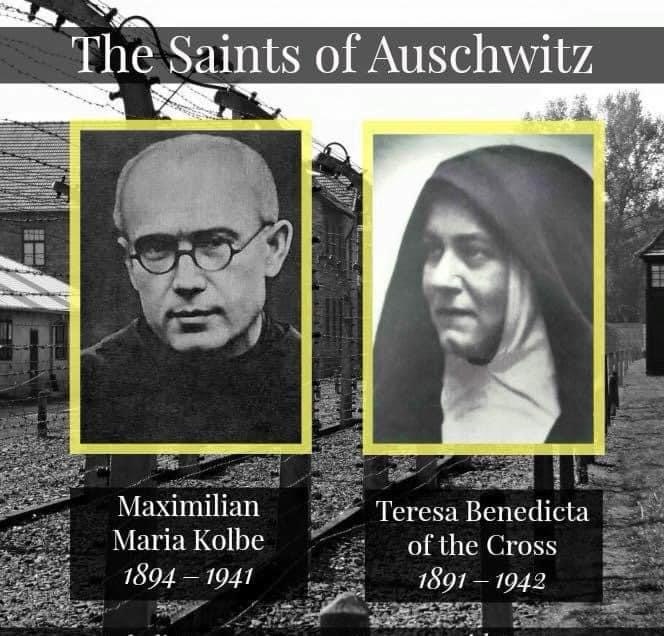
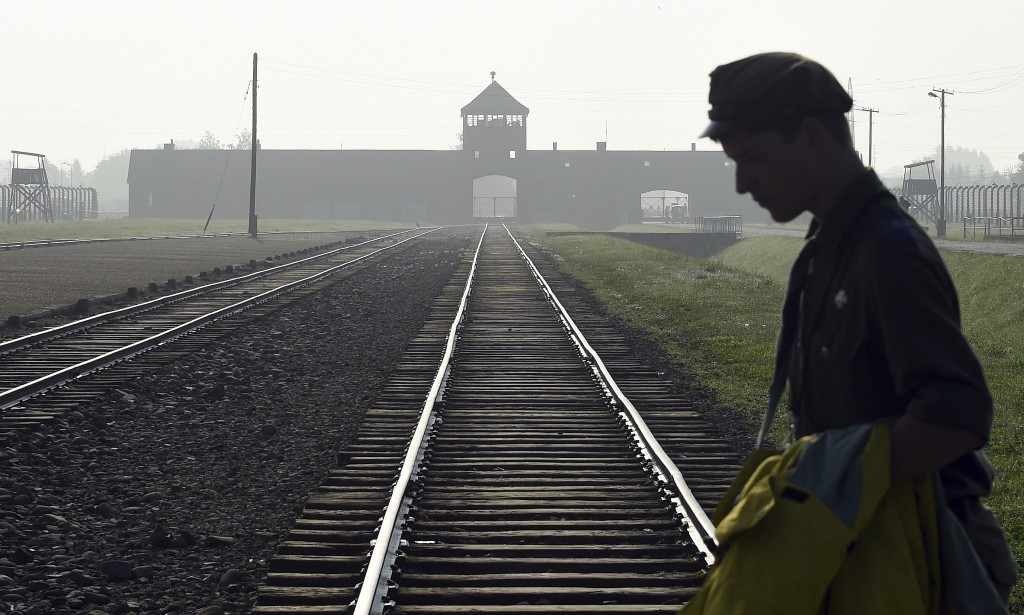
It was this Person of Jesus Christ why so many great men and women then and now have abandoned their previous ways of life to lead holy lives even in the face of death. Very interesting in this modern time are two great saints we celebrate on this month of August, St. Teresa Benedicta of the Cross (August 09) and St. Maximilian Kolbe (August 14) who died at the gas chambers of Auschwitz during the Second World War. Let’s reflect first on St. Teresa Benedicta whose memorial we celebrate today.
Photo from FB page of Scott Hahn, 09 August 2024.
St. Teresa Benedicta is the German philosopher Edith Stein. She came from a prosperous Jewish family gifted with great mind becoming one of the first female university student and later professor in Germany.
An associate of the famed Edmund Husserl of the philosophical method of phenomenology, St. Teresa Benedicta became an atheist during her teenage years; but, upon further studies and prayer, converted into Catholicism, becoming a Carmelite nun where she adopted her new name. She wrote that “Those who seek truth seek God, whether they realize it or not“.
She actually had all the chances to leave for South America and then to Switzerland to escape the Nazis but opted to stay in their monastery in the Netherlands with her younger sister Rosa who had also converted as Catholic and joined the Third Order Carmelite. When they were arrested on August 2, 1942, she told her, “Come, Rosa… we go for our people.”
St. Teresa Benedicta honored her Jewish roots by dying among them as a martyr of Christ, one who had “learned to live in God’s hands” according to Sr. Josephine Koeppel, OCD, a translator of much of her works. According to various accounts, St. Teresa Benedicta showed great inner strength by encouraging her fellow prisoners to have faith in God while helping in looking after the small children when their mothers were so distressed to do so. One woman who survived the war wrote: “Every time I think of her sitting in the barracks, the same picture comes to mind: a Pieta without the Christ.”
Dying ahead of her in Auschwitz on August 14, 1941 was St. Maximilian Kolbe, a Franciscan priest who was arrested for his writings against the evil Nazis. It was actually his second time to be arrested.
When a prisoner had escaped from the camp, authorities rounded up ten men to die in exchange of the lone escapee. Fr. Kolbe volunteered to take the place of a married man with children. They were all tortured and starved in order to die slowly in pain. A devotee of the Blessed Virgin Mary, St. Maximilian was injected with carbolic acid on the eve of the Assumption after guards found him along with three other prisoners still alive, without any signs of fear like screaming but silently praying.
Photo of Auschwitz from Google.
We no longer have gas chambers but atrocities against human life continue in our time, hiding in the pretext of science and laws. Until now, men and women, young and old alike including those not yet born in their mother’s womb are hunted and killed to correct what many perceived as excesses and wrongs in the society. Just like what Hitler and his men have thought of the Jews at that time.
The Nazi officers and soldiers of Auschwitz remind us the true “ghosts” and evil spirits of our time sowing hatred and deaths are people who may be well-dressed, even educated in the best schools, and come from devout or “normal” families. They sow evil every day without choosing any particular month, blindly following orders without much thinking and reflections or introspection.
Photo by author, James Alberione Center, QC, 08 August 2024.
Many times, they insist on following or speaking the truth – a truth so empty of the person of Jesus Christ. As we have been saying amid this growing trend of wokism and inclusivity that have badly infected the Olympics, people tend to exaggerate the truth they believe or follow when actually, they are just exaggerating themselves.
By the lives of the many great saints of August, or of any other month for that matter, we are reminded that holiness is not being sinless but simply being filled with God, being converted daily to the truth of Jesus Christ by allowing that holiness to spill over and flow onto others with our lives of authenticity expressed in charity and mercy, kindness and justice, humility and openness with one another.
Let us make every month holy and blessed with our good deeds to make everyone aware of Christ’s presence among us. Have a blessed weekend!
The Lord Is My Chef Daily Recipe for the Soul by Fr. Nicanor F. Lalog II
Tuesday in the Sixth Week of Ordinary Time, Year II, 13 February 2024
James 1:12-18 <*((((>< + ><))))*> + <*((((>< + ><))))*>  Mark 8:14-21
Photo by Dra. Mylene A. Santos, MD, at Bgy. Tagalag, Valenzuela City, 2023.
On this eve of Ash Wednesday,
help us, dear God,
to prepare for a
meaningful start tomorrow
of our Lenten journey of
40 days to Easter;
banish from our minds
and hearts all thoughts
and apprehensions
about the coming days
of fasting and abstinence,
prayers and penance,
and alms-giving;
forgive us, Father,
when our attention goes
to the details and technicalities
of Lent that we set aside
the most essential
which is to return to you -
our very first love.

Enlighten our minds
and our hearts, Father in your
Son Jesus Christ,
to understand fully the
meaning of Lent which is
having less of ourselves
and of the world
to have more of you
and of the Spirit;
until now, we have not
yet understood Christ's coming
and teachings as we are still bothered
by our scarcity and poverty,
never comprehending at all
how despite the affluence and
abundance of material things
these days, the more we have
become empty and lost in life.
When he became aware of this he said to them, “Why do you conclude that it is because you have no bread? Do you not yet understand or comprehend? Are your hearts hardened? Do you have eyes and not see, ears and not hear? And do you not remember, when I broke the five loaves for the five thousand, how many wicker baskets full of fragments you picked up?” They answered him, “Twelve.” When I broke the seven loaves for the four thousand, how many full baskets of fragments did younpick up?” They answered him, “Seven.” He said to them, “Do you not still understand?”
Mark 8:17-21
Worst,
we got it all wrong that
our sinful temptations are
from God, not realizing these
come from our own worldly
desires.
Rather, each person is tempted when he is lured and enticed by his desire. Then desire conceives and brings forth sin, and when sin reaches maturity it gives birth to death. do not be deceived, my beloved brothers and sisters: all good giving and every perfect gift is from above, coming down from the Father of lights, with whom there is no alteration or shadow caused by change.
James 1:14-17
On this Tuesday
before Ash Wednesday,
we pray, O God,
for us to understand
the sources of temptations
and sins within us;
give us the courage
and strength to confront our
true selves,
to be sincere before you
so that we may be
transformed into your
image and likeness
that Christ had restored
in us.
Amen.
Last Friday was the Feast of the Presentation of Jesus to the Temple (February 2) also known as the Feast of the Candlemass wherein candles were blessed outside the church after which the people led by the priest enters to begin the Mass in a procession with lighted candles.
Candlemass is a beautiful celebration, especially when done properly by priests. Its origin dates back to more than 1500 years ago in France where it started when people incorporated the blessing of candles into the Feast of the Presentation then known with its Eastern title as “the Encounter” to refer to how Simeon with the Prophetess Anna met the child Jesus being offered by his parents Joseph and Mary to the temple 40 days after Christmas. According to St. Luke, Simeon sang the following upon meeting the child Jesus Christ.
Presentation in the Temple painting by Fra Angelico from fineartamerica.com.
“Now, Master, you may let your servant go in peace, according to your word, for my eyes have seen your salvation, which you have prepared in sight of all the peoples, a light for revelation to the Gentiles, and glory for your people Israel.”
Luke 2:29-32
In proclaiming Jesus Christ as the “light” of salvation for the nations, the early French Christians thought of having the blessing of candles and procession of lighted candles to signify Jesus as the only and true light of the world. Thanks be to God for those pious early French Christians!
Though candles are no longer used as a major source of lighting in homes and other places, it is still used in almost all churches, monasteries and other houses of worship around the world, gaining a renewed popularity among the younger generation. It is a most welcomed development in our modern time as more and more people are rediscovering the need for spiritual growth of whatever label. And right in the midst of this is the candle as a tool for better prayer periods.
Unfortunately, this beautiful tradition of the candles is dying in our country. How ironic that we who belong to the Third World have switched to electric vigil lamps and candles while those in the First World still use the traditional candles in their homes and churches.
Go abroad like in North America and Europe, one finds a plethora of all kinds of beautiful candles used and sold even in the simplest churches and stores! During a Holy Land pilgrimage in the 2017 Easter Season, one of the things I appreciated and admired next to the pilgrim sites were the lovely and regal designs of paschal candles in the churches we visited that made me wonder why nobody makes them here in our predominantly Catholic country.
Candles have always have a special place in the life of our faith and the Church since its early beginnings. From the Latin words candere and candela that mean “to shine”, it evolved into the Middle and Old English words candele and candel.
Aside from lighting the gatherings of the early Christians especially in the catacombs to evade arrests during the persecution, candles have always been used to signify Christ as the light of the world guiding our paths as Christians in every celebration, from Baptism to Weddings and Funerals.
Candles do not only make rooms shine but most especially the souls and the hearts of those who cultivate a prayer life. It has that unique warmth that can soothe and calm those who are agitated or worried with life’s many trials and challenges.
Every time we light a candle during prayer periods, our inner selves are made brighter as they evoke in us so much feelings of the Divine presence. Their little lights that flicker remind us of our feeble selves whose life could be easily snuffed out with a single blow.
The scent of burning candle permeates our senses, calming us within, inviting us to leave all our worries in life as we lay our cards out in the open to God. A candles warmth can dissolve every hardness within us, purifying us within and becoming empty and open for God’s grace to work in us.
In a sense, candles may be considered as a sacrament too which is defined as a visible sign with invisible power.
The very act of lighting a candle is already the start of prayer, something like the making of the sign of the Cross. I strongly recommend for those who wish to aid their prayer periods with candles to use matches not lighters that are artificial.
Lighting up a candle for prayer especially in the morning can rouse our senses. The striking of the match with its sudden burst of light to kindle the candle is like an angel had suddenly come down to assure us that our prayer is heard by God, that God is with us at the very moment or at least reminds us we have turned into the mode of praying.
The strong scent of the burning matchstick also adds flavor and aroma to the prayer period especially in the early morning when the whole world is still dark and everyone still asleep with you as the only one awake with God. Lighting a candle first thing first upon waking up can help us avoid from getting our cellphones or turning on the radio or the TV. A lighted candle can prevent us from being distracted by these modern gadgets that keep us away from God and from one another.
My altar with lighted candle at night; see the candle snuffer at the foreground.
Lighting a candle during a prayer period in our room or home works like the candlelight dinner that sets us to a lovely communion with God our beloved. The slow burning of a candle reminds us even in our busiest morning that we are at prayer in the presence of God, that we need to slow down too in our lives, to be conscious of our selves, surroundings and time so we can set our sights to God alone like a beloved in a candlelight dinner date.
At night time, the sight of the candle burning in one’s room is most dramatic as we close the day. Actually, it is during night time that the Church prays the Canticle of Simeon.
Imagine that scene at the temple when Simeon sang as he held the Child Jesus in his arms – of his readiness to die, to go in peace, after seeing Christ the light of salvation. In the darkness of the night punctuated only by a burning candle, we are able to examine our hearts of the many things we have done and failed to do the whole day. These become clearer in the light of the candle that penetrates our hearts and conscience, piercing and rending our souls to remove the darkness within us, exposing the festering anger or bitterness and sadness hiding inside, melting them away with its warmth so we may go to sleep clean and ready to continue with life – here or hereafter like Simeon.
By Kay Bratt in Facebook, 13 December 2023.
One last note about candles as we end this reflection. Monks use a candle snuffer in extinguishing candles in their chapels and monasteries. These are long metal instruments with tips like a bell that monks hover above a candle, slowly covering it until its light is snuffed out, hence, the name candle snuffer.
If you want to be serious in praying better with lighted candles, you may buy those small candle snuffers for home use available at some candle shops in the malls. If there is no candle snuffer, one may use the cover of the candle to snuff out the light. What is important is that as we close our prayers with the lighted candle as companion, we don’t simply blow its light to abruptly end its glow.
When blowing the candle used in prayer, do it slowly as if you are whispering. Do it with solemnity. Every candle used at prayer becomes blessed, demanding some sort of reverence as companions in our prayer life and journey. Of course, it would be good if you can have your candles blessed by the priest for use at home to ward off negative vibes but more important than that is we grow in our prayer life, we become like lighted candles who give light to others in Christ. Like our candles, we also become a prayer to God in our very selves. Amen.Have a blessed Thursday.









 lordmychef.com