The Lord Is My Chef Sunday Music by Fr. Nicanor F. Lalog II, 25 February 2024
Photo from petalrepublic.com.
It is the last Sunday in February, the second in the Season of Lent and most likely, everybody is feeling like “suddenly” the month is over with everything happening so fast just like in the song Yesterday by the Beatles.
Released in 1965 from their album Help!, Yesterday was actually written by Paul McCartney after a dream while staying with his former girlfriend, Jane Asher. It is a sad love song that speaks, as usual, of break-up.
The lyrics and music are simple that McCartney had to research for sometime if he had copied its melody from an existing music at that time. But, its simplicity and eloquence caught so many generations then and now as the song speaks so well of everyone’s experience. Yesterday one of the most covered songs of all time, being interpreted by almost every artist in all continents over 2000 times since its release!
What I wish to share with you this lovely Sunday is my realization that aside from old music getting better with age as it takes on a life of its own, there is also a simultaneous change and maturity among us listeners and fans of our favorite artists and bands of their music.
I practically grew up listening to the music of the Beatles, being born in 1965, the same year Yesterday was released. I have never understood all their songs but growing up at that time surrounded by their music, I have also fallen in love with the sound of Beatles like most of my generation.
And now, I just felt everything so “suddenly” too, of how fast time flies that indeed, “I’m not half the man I used to be”!
Yesterday all my trouble seemed so far away
Now it looks as though they're here to stay
Oh I believe in yesterday

Suddenly I'm not half the man I used to be
There's a shadow hanging over me
Oh yesterday came suddenly
It was that line that actually moved me to link Yesterday with the transfiguration of Jesus, “Suddenly I’m not half the man I used to be.”
The lesson is very simple but many times, it could take us a lifetime learning or realizing. Most of all, accepting and owning.
Like the road to Easter, our lives are always marked with so many light and darkness, failures and triumphs, tears and laughter, even little deaths. Jesus tells us in his transfiguration that the scandal of the Cross cannot be removed from the glory of his Resurrection. There can be no Easter Sunday without Good Friday.
The good news is that in every passages in life we go through, every difficulty we hurdle, every pain and sufferings we endure, we always emerge a different person after – not half the man I used to be.
Of course, it still depends on us if we become better or bitter with every pain we go through. But, like the song Yesterday that went through a long process of ups and downs even before being recorded and released, it had emerged a very great music, a classic in our own time.
How consoling to think that great men and women, like McCartney and all the other artists we look up to went through a lot of troubles in life and have emerged better and wiser as persons.
And that’s because Jesus Christ was there first to suffer and die for us so that when he rose again from the dead, we too shall rise with him. Have a blessed week ahead, folks!
40 Shades of Lent by Fr. Nicanor F. Lalog II
Sunday Recipe for the Soul, Lent II-B, 25 February 2024
Genesis 22:1-2, 9, 10-13, 15-18 ><}}}}*> Romans 8:31-34 ><}}}}*> Mark 9:2-10
Photo by Ms. Analyn Dela Torre, 12 February 2024 in Bgy. Caypombo, Santa Maria, Bulacan.
While praying our gospel this Second Sunday in Lent, the song Yesterday by the Beatles kept playing at the back of my mind, especially the first two stanzas that say:
Yesterday all my troubles seemed so far away.
Now it looks as though they're here to stay.
Oh, I believe in yesterday.

Suddenly, I'm not half the man I used to be.
There's a shadow hanging over me.
Oh, yesterday came suddenly.
Written by Paul McCartney and recorded by the Beatles in 1965, Yesterday is a sad love song about break up that greatly changed the lost lover who was “Suddenly, I’m not half the man I used to be.”
Beautiful music, beautiful lyrics on this beautiful Sunday with another beautiful gospel as Mark leads us from the wilderness last week to Mount Tabor with Jesus Christ and his three disciples whose experiences were like the Beatles in Yesterday.
Jesus took Peter, James, and John and led them up a high mountain apart by themselves. And he was transfigured before them, and his clothes became dazzling white, such as no fuller on earth could bleach them.
Mark 9:2-3
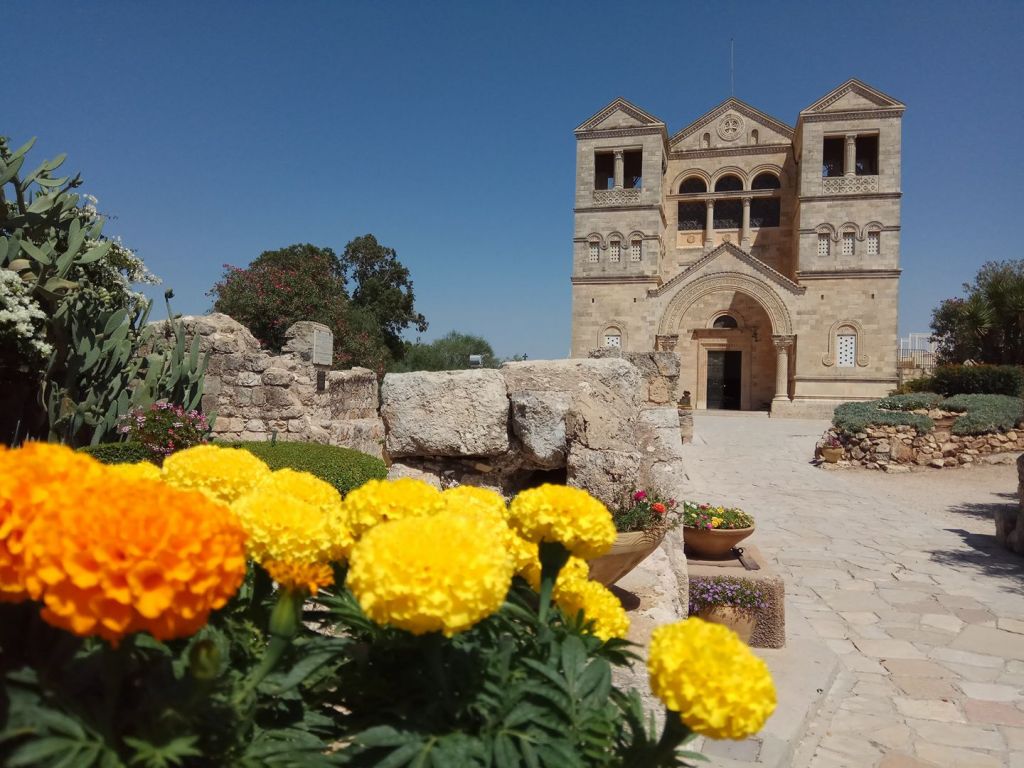
Basilica of the Transfiguration on Mt. Tabor, Israel from custodia.org.
See how the three apostles were overjoyed with the sight of Jesus transfigured, conversing with Moses and Elijah with Peter feeling so “high” that he offered to make three tents for them to remain there. It was the same experience of joy in the Beatles’ Yesterday when McCartney had that great feeling of being loved he thought would last forever.
But,both moments of joy were so brief with the transfiguration cut off immediately after Peter had spoken while McCartney felt his troubles came “suddenly”.
Like his account of Christ’s temptation last Sunday, Mark’s version of the transfiguration is so short unlike those by Matthew and Luke; however, Mark never lost attention to important details that showed the solemnity of the scene from start to finish despite a sudden shift in the mood as they went down the mountain.
As they were coming down from the mountain, he charged them not to relate what they had seen to anyone, except when the Son of Man had risen from the dead. So they kept the matter to themselves, questioning what rising from the dead meant.
Mark 9:9-10
For Mark, the transfiguration of Jesus led the disciples to deepen their faith in Jesus amid his growing mystery especially in the light of his oft-repeated Passion, Death and Resurrection, as if telling us of the many troubles ahead on the road to Easter.
Hence, it is no coincidence that like the transfiguration, Mark ended abruptly his gospel account when Mary Magdalene, Mary the mother of James and Salome saw an angel who spoke to them inside the empty tomb of Jesus very early on Easter: Then they went out and fled from the tomb, seized with trembling and bewilderment. They said nothing to anyone, for they were afraid (Mk. 16:8). Both in the transfiguration and in the Resurrection, the disciples were dared to reflect deeply on those events that later enabled them to make a firm response in their faith in Christ.
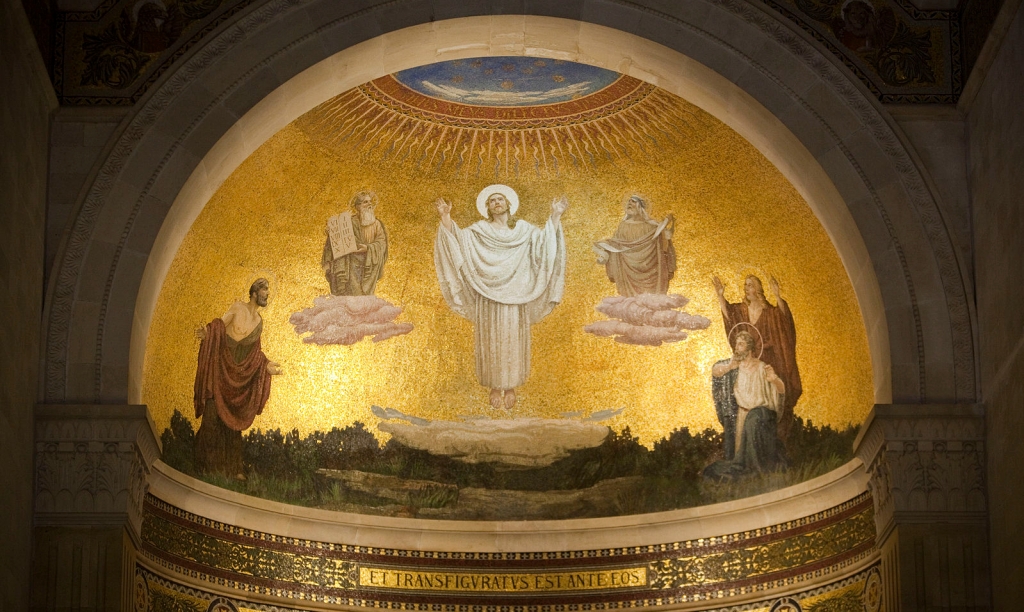
Mosaic inside the Basilica of the Transfiguration on Mt. Tabor, Israel from commons.wikimedia.org..
The same thing applies to us today. Many troubles lie ahead our lives, inviting us to follow Jesus more closely in prayers and reflections to find the meanings and lessons of life’s light and darkness, joy and sadness, triumph and defeat, even of death that keep on hovering above us, even enveloping us at times. We need to deepen our faith in God who had sent us his Son Jesus never stops doing to be our companion in this journey of life especially when we are passing through mountains and valleys, rivers and seas. In the song Yesterday, McCartney sang of our most common experience of having loved and lost yet taught us so much lessons in life. And music.
One thing was clear with the Apostles – and McCartney too – that even though troubles and problems were always with them along the way, they just lived through it and made the most out of them like the Church, including a classic love song!
How about us today, what is our faith response to the many darkness and light we have gone through in life’s journey?
Photo by Roger Buendia/Presidential Museum and Library via esquiremag.ph.
It is always easy to blame others for our many woes in life as we fail to see our own moments of transfiguration. Jesus gifts us with a personal transfiguration event to make us better to be like him but, do we welcome or, run away from them?
Today is the 38th anniversary of the EDSA People Power Revolution when we must ask ourselves how we have personally responded to that great moment of grace from God, a transfiguration in itself, a pasch like the Lord’s. Have we truly valued EDSA 1986, until now?
How unfortunate that EDSA now stands for everything that is wrong with us, especially our wrong choices and wrong decisions in the past 38 years. EDSA invites us to examine our very selves as a Filipino and as a Christian, a disciple of Christ.
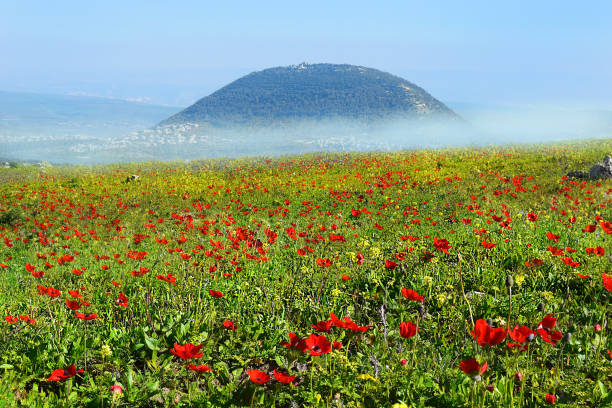
Photo from iStockphoto.com of Mount Tabor in Israel where Jesus is believed to have transfigured.
At his transfiguration, Jesus showed the inseparability of the mystery of the Cross and of his glory on Easter, the closeness of Mount Tabor with Golgotha. The mountain in the bible is always a coming to God, a communion in him.
Every nature lover knows very well the mountain is life itself, difficult to climb, easy to descend. Here now is the beautiful part of the gospel. And song Yesterday. Mountains surely change us but the choice is ours if we want to become better or bitter.
Set on what is believed to be Mount Tabor, the transfiguration was a passage, a foretaste of Christ’s pasch that not only brought him to his glory but transformed too the whole human race and the world itself. In the same manner, McCartney expressed poetically in Yesterday his transformation when “Suddenly, I’m not half the man I used to be.”
From en.wikipedia.org.
This is the good news of this Sunday: every mountain in life is a grace of transfiguration, of being better persons than before. We never come out – or down – the same persons every time we enter through whatever passages or climb any mountain in life. We are always changed, we always emerge different than who we were before after each passages we came through in life.
God gives us the grace and power to choose to be better and stronger, wiser and holier than bitter or resentful with every trials we hurdle in life. This was the experience of Abraham in the first reading when he completely trusted God who asked him to offer his son Isaac on a mountain. It was a very tough test for Abraham who waited in his old age to have a son only to be sacrificed later? But Abraham never doubted God that he still went up the mountain, and as he was about to sacrifice Isaac, an angel stopped him, telling him how God was so delighted with his faith and obedience that he was eventually blessed abundantly after.
Each of us is passing through different trials at this very moment. Many times we feel we suffer more than others, that our tests are tougher than the rest. It is useless and a waste of time to compare ourselves with others. One thing is clear: God does not stop doing something good for us in Jesus, ensuring we get better each day than yesterday. Let the words of St. Paul today assure us that “If God is for us, who can be against us? He who did not spare his own Son but handed him over for us all, how will he not give us everything else along with him? (Rom. 8:31-32)” Have a blessed week ahead, fellow traveler in Christ! Let us pray:
God our loving Father,
thank you for the gift of
this Season of Lent so we may
experience more your Son
Jesus Christ's coming to us
in this journey of life,
our companion amid the
darkness and light
and many troubles
including the little deaths
we experience in life;
give us the faith and trust
of Abraham to offer you those
 dearest to us because
if ever you ask something from us,
it is to make more room in ourselves
for your abounding grace
and gifts of transformation
in Christ Jesus with Mary,
our Lady of Fatima.
Amen.
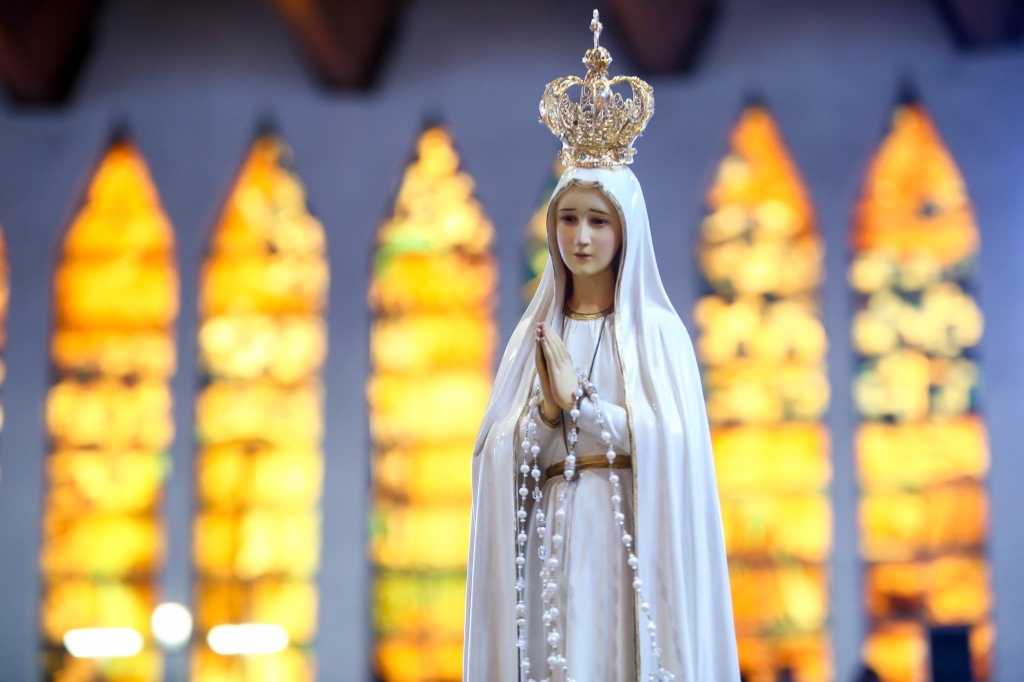
This Sunday, 25 February 2024, is also the Canonical Coronation of the National Pilgrim Image of Fatima here in Valenzuela City, the very image raised at EDSA in 1986. Photo from cbcp.net.
The Lord Is My Chef Sunday Music by Fr. Nicanor F. Lalog II, 18 February 2024
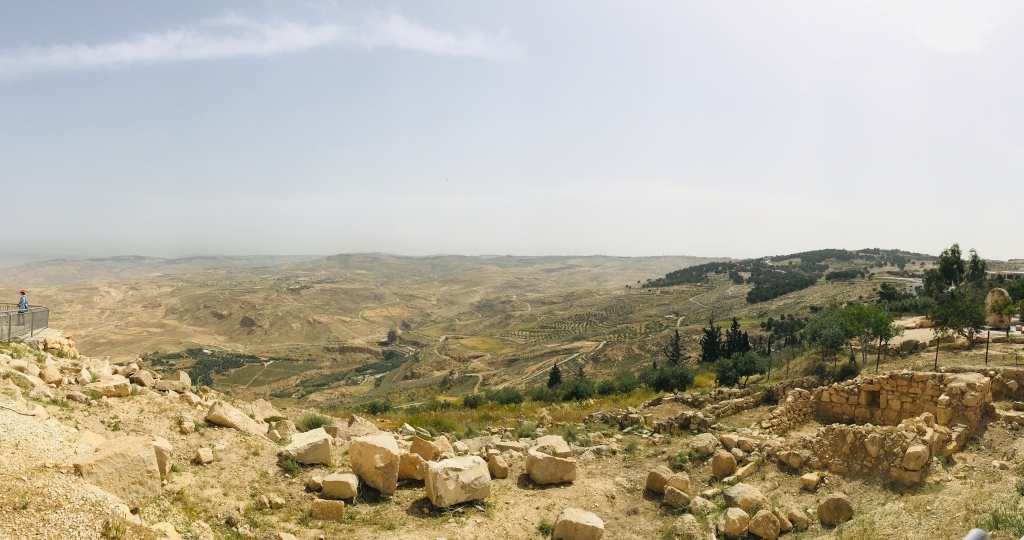
Photo by author, view of Israel from side of Jordan, May 2019.
It is the first week of Lent where the gospel is always about the temptation of Jesus by the devil in the desert. Naturally, the other thing that came to our mind while praying was the song A Horse With No Name by three young Americans who called themselves “America”.
It was still the great heydays of rock n’ roll and even though we were still too young at the time when this was playing on the airwaves, we just knew it was a great music especially when every grown up man was listening to it, humming it and even plucking its chords in their guitars. At that time, we just loved the melody and poetry of the lyrics, beginning with the unusual title A Horse With No Name with its very propitious guitars that kicked our imaginations of a far away journey in the desert.
On the first part of the journey I was looking at all the life There were plants and birds and rocks and things There was sand and hills and rings
The first thing I met was a fly with a buzz And the sky with no clouds The heat was hot and the ground was dry But the air was full of sound
I’ve been through the desert on a horse with no name It felt good to be out of the rain In the desert you can’t remember your name ‘Cause there ain’t no one for to give you no pain La la la la la la…
The desert is more than a place in the Bible. It was more of a setting for meeting and experiencing God amid its dryness and wilderness. Every great prophet in the Old Testament went to the desert to pray and meet God; hence, in the New Testament, Jesus was shown as going first to the desert before launching his mission.
How ironic yet amazing that it is in the desert of our life’s poverty and limitations, sickness and weakness, dryness and weariness when we actually meet God, when we experience fulfillment and meaning in life (https://lordmychef.com/2024/02/17/lent-a-pilgrimage-to-god/). This biblical meaning of the desert was not far from the views of the song’s composer, Dewel Bunnell who explained later that A Horse With No Name was “a metaphor for a vehicle to get away from life’s confusion into a quiet, peaceful place” (from Wikipedia).
However, we remember too how when we were in high school (early 80’s) while listening to “American Top 40” on 99.5RT-FM when Casey Kasem claimed Bunnell saying that they were simply playing with words and chords when they came up with A Horse With No Name!
Whatever… but the music has become a classic because of its sincere message about life as a mystery not meant to be solved at all (because it is unsolvable!). For five decades since releasing A Horse With No Name, the trio of America had taught us how to deal with life’s mysteries by simply allowing ourselves to be wrapped by these mysteries, keeping our hearts and minds open in awaiting new revelations unfolding before us daily. Don’t forget too to have that sense of awe while being wrapped by life’s mysteries which is actually what Lent is asking us during this season as we return to God, our very root and grounding in order to find ourselves anew who are so lost in this world of so many disguises.
After nine days I let the horse run free ‘Cause the desert had turned to sea There were plants and birds and rocks and things There was sand and hills and rings
The ocean is a desert with its life underground And a perfect disguise above Under the cities lies a heart made of ground But the humans will give no love
Here’s America with their first hit A Horse With No Name. Sing along, reflect and, pray. Have a blessed week ahead in this desert of life!
40 Shades of Lent by Fr. Nicanor F. Lalog II
Sunday Recipe for the Soul, Lent I-B, 18 February 2024
Genesis 9:8-15 + + 1 Peter 3:18-22 + + Mark 1:12-15
Pope Benedict XVI eloquently described Lent in his first papal Lenten message in 2006 when he wrote, “Lent is a privileged time of interior pilgrimage towards Him Who is the fount of mercy. It is a pilgrimage in which He Himself accompanies us through the desert of our poverty, sustaining us on our way towards the intense joy of Easter.”
What a beautiful picture too of the short gospel from Mark we heard this first Sunday in Lent that briefly describes the temptation of Jesus so unlike the detailed versions by Matthew and Luke. Nonetheless, Mark’s terse account is loaded heavily in rich symbols and meanings.
The Spirit drove Jesus out into the desert, and he remained in the desert for forty days, tempted by Satan. He was among the wild beasts, and the angels ministered to him. After John had been arrested, Jesus came to Galilee proclaiming the gospel of God: “This is the time of fulfillment. The kingdom of god is at hand. Repent, and believe in the gospel.”
Mark 1:12-15
This scene comes right after the baptism of Jesus by John at the Jordan. It is sad that our liturgical texts have not yet adopted the new revised editions of major Catholic bibles wherein Mark noted how “immediately” or “at once” after his baptism, Jesus was tempted in the desert.
(At once) The Spirit drove Jesus out into the desert tempted by Satan.
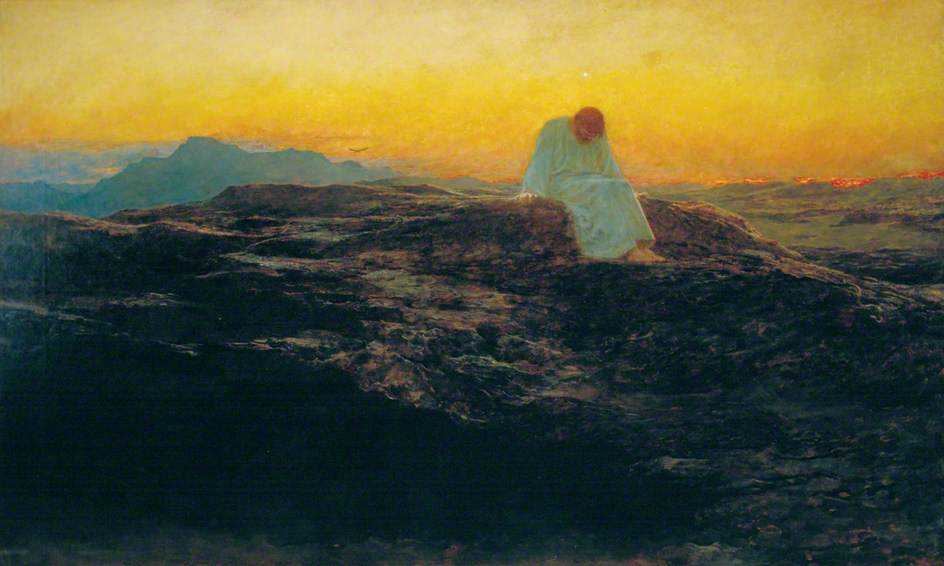
“Temptation in the Wilderness” painting by Briton Riviere (1840-1920) from commons.wikimedia.org.
Do we not experience the same thing daily in life when even right in the moment we are trying to pray, trying to become better when temptations come our way like when we decided to pray or go celebrate the Mass, something else would distract or prevent us from fulfilling it?
See how difficult it is to go on diet when suddenly mother cooks your favorite meal or somebody comes for a visit with burgers and sodas and cakes! Just when you have decided to quit a vice, at once the temptation comes to pick it up again, as we plea to make it our “last” cigarette or joint, last shot of alcohol, last look at pornography, last gamble and so many other lasts that never really ended! Recall those times we decided to finally embark on any religious or spiritual endeavor when at once we are intensely challenged by carnal and material desires.
It is a reality of life that Jesus faced too like us, being tempted immediately by Satan after his baptism when God identified him as his beloved Son with whom he is well pleased. Mark warns us today how Satan is bent on tempting us to abandon God, be lost and just be ordinary without meaning and fulfillment in life and existence. The five Sundays in Lent depict to us our internal pilgrimage and journey into God’s inner room to be with him in Christ Jesus. It is a pilgrimage as we return to our very root and grounding who is God. Let us not waste the grace of this blessed season to become like God again, truly his image and likeness marred by sin and evil.
Oh what a joy to be one with God again, to regain our true selves – contented and fulfilled in our very selves minus all the trappings of this world’s artificialities of fake selves with fake faces and skin, of fake lives glamorized in social media. It is a pilgrimage in the desert where we are invited to leave everything behind, to be bare and nothing for we solely need only God to truly see again our selves as true, good, and beautiful. Not with cosmetics nor food nor even modern thoughts and ideas pretending to be just and fair that deceive us and leave us more empty and lost.
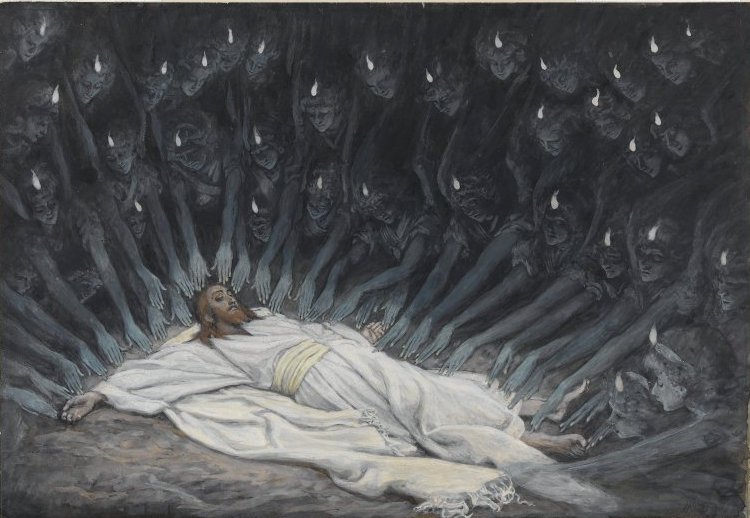
He was among the wild beasts, and the angels ministered to him.
“Jesus Ministered to by Angels” painting by James Tissot (1836-1902) from commons.wikipedia.org.
Lent is an interior pilgrimage to God lived in the wilderness too, an invitation for us to go back to Paradise even in the midst of the chaos around us. This we do every Sunday in the Mass when we go back to God, to his Church and the sacraments.
This is why Lent is the time for more prayers, fasting and alms-giving as they all strengthen our spiritual resolve to become better persons, to become who we really are – beloved children of God with dignity, meaning and purpose found in him.
Despite the fall of Adam and Eve, God never abandoned us because he loves us so much that he sent us Jesus Christ his Son to accompany and show us how among the wild beasts around us, there are angels attending to our needs at all times. Everyone has a struggle, a problem dealing with. Nobody is without any crisis nor lives perfectly. That’s the imagery of the desert, a wilderness with the wildest beasts that are most ferocious and most poisonous.
Yet, God has assured us even right after the Fall that we are his most precious creation that he takes the initiative always to save us from every danger of sickness and death. Most of all, of sin like when Cain was so jealous of his brother Abel, the Lord said to him, “Why are you angry? Why are you dejected? If you act rightly, you will be accepted; but if not, sin lies in wait at the door; its urge is for you, yet you can rule over it” (Gen. 4:6-7).
In the first reading we heard how God acted like human, so fed up with our sinfulness that he sent a great flood to wipe the earth clean again. However, do not forget that before sending the great flood, God sent first Noah and his family. Again, that is exactly how our life is!
Unknown to us, long before any problem and sufferings come to us, there is always God preparing already a remedy, a solution, an exit plan for us in the first place like when he sent Noah and his family to ensure there would still be good people left after the flood. This reached its highest point in Jesus whom the Father sent to become the new rainbow of the sky when Christ stretched out his arms on the Cross to save us. Peter beautifully explained this truth in our second reading today, reminding us how the great flood at Noah’s time was a prefiguring of our baptism in Jesus Christ when we become the Father’s beloved and forgiven children.
Never lose hope when things seem to be so bad and miserable in life. Remember how the silver linings appear always after the heavy rains or how the leaves are greenest after the storm. Yes, life is like a desert, a wilderness with so many wild beasts that may times we could not escape temptations and fall into sins. But God is greater than our hearts, sending us more than enough angels even his only begotten Son so we may overcome temptations and sins, downfalls and defeats in life. Go back to God, go back to paradise in prayers and the Mass. Handle life with prayer, always PUSH, that is, Pray Until Something Happens.
After John had been arrested,
Jesus came to Galilee proclaiming the gospel of God:
"This is the time of fulfillment.
The kingdom of God is at hand.
Repent, and believe in the gospel."
This is the most unique feature in Mark’s brief account of the temptation of Jesus by Satan. Mark began his gospel just like the three other evangelists linking the life and mission of Jesus with John the Baptist; however, he abruptly removed John from this scene by simply saying “after John had been arrested, Jesus came to Galilee proclaiming the gospel of God.”
“Ganun lang yon?” we might ask in Filipino. It would take five more chapters before Mark explains to us the fate of John the Baptist.
And yes, that’s the way it is with us too! We never stop with our mission like Jesus amid all the storms and darkness hovering above us. There will always be sufferings and trials coming and these in itself are the reasons for us to continue with our mission like Jesus.
Inasmuch as the lives and fate of Jesus and John are intertwined, so are our lives and fate as disciples of Christ with him! It is during trials and difficulties when our proclamation of God’s kingdom are loudest and most credible. Most of all, it is in our sufferings when we go back to our internal desert when we truly experience the time of fulfillment if we remain faithful to God like Jesus Christ.
Let us pray:
Dearest Jesus:
accompany us
on this first week of Lent
into the Father's house;
make us stop all whining
and complaining on the many
desert experiences we are going
through for that is how life is -
like a wilderness with many wild beasts!
Let us never lose sight of your
loving presence among us, Lord,
of your angels ministering to us,
assuring us of the colorful rainbow
of life in the horizon if we remain
faithful and true.
Amen.
Photo by Ms. Annalyn Dela Torre, Bgy. Caypombo, Santa Maria, Bulacan, 14 February 2024.
The Lord Is My Chef Sunday Music by Fr. Nicanor F. Lalog II, 11 February 2024
Photo by Mr. Vigie Ongleo in Virginia, 02 February 2024.
It’s the final Sunday in Ordinary Time before we begin our 40-day journey of Lent this Ash Wednesday which falls on February 14th, Valentine’s Day. That is why we have chosen a music that is light and easy and romantic, though poignant about those big what ifs in life, What Might Have Been by Grammy-nominated Lou Pardini.
Co-written with jazz vocalist Ms. Kevyn Lettau, What Might Have Been is Pardini’s most popular song especially here in the Philippines and Asia that was included in his first solo album Live and Let Live released in 1996. Unknown to many, Pardini’s first composition ever recorded was also Smokey Robinson’s most popular song, Just To See Her released in 1987. It earned Robinson a Grammy while Pardini was nominated to a Grammy too for the composition. From 2009-2022, Pardini was the lead vocalist and keyboardist of Rock and Roll Hall of Fame band Chicago. He had collaborated too with almost major bands and vocalists in his career with some stints in Hollywood providing music in some movies and TV shows.
What Might Have Been tells us the story of a love lost and the resulting regrets by the singer. Most of all, it touches one of everyone’s favorite subject and theme or question in life: ”what might have been” our lives be had we made the right choices or have been better or wiser, perhaps more faithful or understanding?
Somewhere lost in the wind I’m watching you Sunlight touching your hair And I remember
Somehow We said that we would never stray But somehow we lost our way Promises to often spoken
Are easily broken apart I’m ready this time I know that I’m No longer undecided
Don’t want to be a fool wondering… … What might have been Trace of forever lingering Drawing me closer to you
A new beginning Now I know There is no doubt I understand
Just how fragile love can be I can’t forget Your memory found me Now I know where I belong…
I’m ready this time I know that I’m No longer undecided Don’t want to be a fool wondering…
… What might have been
I love that last stanza saying, “I’m ready this time/I know that I’m/No longer undecided/Don’t want to be a fool wondering…/What might have been/.” We find this stanza so appropriate and close with the lessons of this Sunday’s gospel when a leper approached Jesus, knelt before him and begged, “If you wish, you can make me clean.” Moved with pity, Jesus stretched out his hand, touched him, and said to him, “I do will it. Be made clean” (Mk. 1:40-41).
Many times in life, we are afraid of approaching the love of our life, even God, for so many reasons but later we find them not important at all. Worst, there were times the other person was just waiting for us to make the move or to approach her/him or them.
Jesus is passing by everyday in our lives, welcoming us even in our worst selves or situations like that leper (https://lordmychef.com/2024/02/10/approaching-jesus-approachable-like-jesus/). Let us approach him, go to him and express what’s deepest in our hearts no matter what these may be. Jesus loves us so much. He wants us to come to him and join him in his journey. Let us leave our comfort zones like our past with all of its mistakes and failures, pains and hurts to start anew in him again. It is Christ’s will too that we be better.
Like in that beautiful lines by Pardini, let us be ready this time, decide once and for all to come to Jesus and follow him instead of wondering what might have been. Don’t let this chance to pass again. Jesus is waiting for us. Have a lovely Sunday, friends!
The Lord Is My Chef Sunday Recipe for the Soul by Fr. Nicanor F. Lalog II
Sixth Sunday in Ordinary Time, Cycle B, 11 February 2024
Leviticus 13:1-2, 44-46 ><}}}}*> 1 Corinthian 10:31-11:1 ><}}}}*> Mark 1:40-45
Photo by Ms. Analyn Dela Torre in Caypombo, Santa Maria, Bulacan, 04 February 2024.
We have seen these past two Sundays Jesus Christ’s personal manner of relating with everyone. It had always been Jesus coming, touching, and speaking directly to the man possessed with unclean spirit at the synagogue in Capernaum on a sabbath and later the sick mother-in-law of Simon Peter at home.
Jesus has always been coming to everyone – to us – in the most personal manner. And he would always ensure all “barriers are down” around him so that we too can approach him like in our gospel this Sunday when a leper came to him for healing.
A leper came to Jesus and kneeling down begged him and said, “If you wish, you can make me clean.” Moved with pity, he stretched out his hand, touched him, and said to him, “I do will it. Be made clean.” The leprosy left him immediately, and he was made clean.
Mark 1:40-42
From vaticannews.va
For the third consecutive Sunday, Mark tells us another healing by Jesus at the start of his ministry in Galilee. This is the last in the series but this is so unique because it was the sick who approached Jesus.
Most of all, that sick was afflicted with leprosy, the worst disease considered at that time when people believed (until now) that any sickness and handicap was a punishment from God for sins committed. Leprosy was the worst because it reminded them of the boils God inflicted on the Egyptians when the pharaoh refused to let them go home to their Promised Land with Moses as leader.
More than the ugly sight of the disease, leprosy became the perfect metaphor for sin and punishment. That is why God himself in the first reading personally issued the health guidelines for anyone with leprosy and similar diseases of the skin. Though God’s prescriptions were more of hygienic purposes, these took on a deeper spiritual meaning for the Israelites especially when lepers have to be separated from the community that it seemed for them, it was indeed a punishment for a grave sin.
Jesus radically changed that perception in this healing of the leper who had approached him.
A leper came to Jesus...
From wikipedia.commons.
Inasmuch as Jesus comes to us everyday as we have seen these past two Sundays, Jesus assures us today that we can always come to him like that leper.
See how this scene was unimaginable because lepers were given strict orders at that time to never approach anyone while people were supposed to drive them away. Where were the four disciples supposed to be following Jesus? And, wasn’t anyone there to restrain that leper from getting close to Jesus?
It seemed Jesus was by himself when the leper approached him as Mark never bothered to tell us of any witnesses at all nor the exact time and location of this incident because this scene happens everyday in our lives. The fact that the leper was able to get near Jesus who welcomed him warmly that day is actually the good news today - Jesus wants us to leave our comfort zones to join him in the middle of the street of his journeys!
Jesus comes to us in the most personal way everyday. And the good news is, nothing can keep us away from Jesus, even our sins which leprosy signified in this story. All barriers are down when Jesus comes and calls us to approach him. No restrictions nor appointments needed to see Jesus who simply wants us to get closest with him like when he “indignantly” told the disciples to let the children come to him (Feast of Sto. Niño, Jan. 21, 2024, Mk. 10:14).
What prevents you or keeps you away from approaching Jesus who passes by everyday?
"I do will it. Be made clean."
Painting by James Tissot (1836-1902) of “Healing of Lepers of Capernaum” from catholic-resources.org.
In his healings these past two Sundays, recall how Mark presented them to us who seemed detached or far from Jesus like spectators watching, astonished and amazed with his authority as the Son of God, all-powerful and beyond us.
This Sunday, Mark shatters all those feelings within us, telling us to dismiss all those thoughts of Jesus being hard to reach when a leper came to Jesus and kneeling down begged him and said, “If you wish, you can make me clean.” Moved with pity, he stretched out his hand, touched him, and said to him, “I do will it. Be made clean.”
Imagine Jesus and you as the leper in this beautiful scene, experiencing the power of his words and hands together!
The words, “I do will it. Be made clean” shows us again the authority of Jesus in his words being sufficient to effect healing like when the Roman centurion declared to him, “only say the word and my servant will be healed” (Mt. 8:8/Lk. 7:7) or when he told the unclean spirit in the man in a synagogue, “Quiet! Come out of him!” (Mk. 1:25).
What is most unique in this Sunday healing is how Jesus felt deep inside that strong love for the leper -for each of us today – that he was filled with compassion to be “Moved with pity”. It was more than an emotion or a feeling within. To be moved with pity is to have one’s heart stirred or disturbed – the literal meaning of the Latin misericordia or mercy. See now the progression from the heart of Jesus, in his compassion and mercy, he stretched out his hand, touched him, and said to him, “I do will it. Be made clean.”
So beautiful! And that happens everyday if we approach Jesus no matter how dark our sins are, no matter how sad we may be or even devastated. Come to your worst like that leper and Jesus will gladly welcome you, heal you, forgive you because he loves you so much!
Photo by Ms. Analyn Dela Torre in Caypombo, Santa Maria, Bulacan, 04 February 2024.
"Be imitators of me, as I am of Christ."
(1 Corinthians 11:1)
Oh, how easy it is to approach Jesus for sinners and weak people like us but is there anyone like Jesus who puts all barriers down to be approachable through our parents and siblings, teachers and friends, and priests to express what’s deepest in our hearts?
Is there still a St. Paul among us who can humbly declare, “Be imitators of me, as I am an imitator of Christ” who welcomes modern lepers getting near for love and affection, even company?
St. Paul may seem to be boasting to us modern people these days but if we try to understand the context of our second reading, we realize the great apostle was simply being humbly honest and true. The Christians at Corinth never saw Jesus like St. Paul. They needed a model to imitate Christ which St. Paul ably provided them with. After all, St. Paul had truly conformed himself to the crucified Christ (Gal. 2:19) as attested by the early Christians.
And while it is true we are all called to imitate Jesus, we priests are expected to be more like the Crucified Christ – approachable especially by the sick and the poor. How sad when we priests are more seen with the rich and powerful, in all their lavish parties but never or rarely with the poor. The same is true with church workers and volunteers when those at the margins find them difficult to approach. Something is gravely wrong with us if people find us priests and lay Christians difficult to approach because, clearly, we are not imitators of Christ. Have a blessed week ahead as we approach Jesus this Ash Wednesday for the 40-day journey towards Easter. Amen.
The Lord Is My Chef Sunday Recipe for the Soul by Fr. Nicanor F. Lalog II
Fifth Sunday in Ordinary Time, Cycle B, 04 February 2024
Job 7:1-4, 6-7 ><}}}}*> 1 Corinthians 9:16-19, 22-23 ><}}}}*> Mark 1:29-39
Photo by The Good Brigade/Digital Vision/Getty Images via cnn.com.
There’s another “war” happening that had actually started a long time ago but only now recognized by the powerful US Senate in Washington DC when they summoned last week the owners of big tech companies to a hearing on the harmful effects of social media.
It is a war that at first seemed to have been neglected or even unrecognized when parents and experts have long been complaining about the ill effects of social media. Finally, authorities are doing something about it.
“Great power comes with great responsibilities.”- Spiderman. Photo from peakpx.com.
Though the issues at hand are very contentious because of the many benefits too of social media, the US Senate hearings are a big step in demanding more social responsibilities from tech owners who have become so powerful with their products’ wide reach and influence.
Of course, much responsibilities are also in the hands of parents and users of social media but one thing has always been clear these past 20 years when experts and ordinary folks have been raising the red flag on social media being so impersonal in nature where persons are often considered as objects than subjects to be loved and respected.
Our ability to communicate is a sharing in the power of God, a sharing in his authority meant to foster union among peoples as persons. Despite the efficiency of social media, it cannot and must not replace the human person in every communication. This we have seen last Sunday when people were “astonished” and “amazed” one sabbath as Jesus spoke with authority in their synagogue in Capernaum. From there, Jesus moved into the home of Simon Peter, staying for a while in Capernaum before moving on to other locations to continue his ministry of teaching and healing.
On leaving the synagogue Jesus entered the house of Simon and Andrew with James and John. Simon’s mother-in-law lay sick with a fever. They immediately told him about her. He approached, grasped her hand, and helped her up. Then the fever left her and she waited on them.
Mark 1:29-31
Photo by author, ruins of the neighborhood around the synagogue of Capernaum where Jesus used to preach; underneath the Church are believed to be the ruins of the home of Simon Peter where Jesus healed his mother-in-law.
It was still the day of sabbath and we could feel the great joy and pride of the four disciples with Jesus that they “immediately told him” about Simon’s mother-in-law who “lay sick with a fever.”
Notice Mark’s detailed report on the healing of Simon’s mother-in-law by Jesus: He approached, grasped her hand, and helped her up. Then the fever left her and she waited on them. In this continuation of a slice in the life of Jesus last Sunday, Mark is presenting us again another important aspect of Christ’s authority and power that is personal which empowers others.
To empower means to raise up a person from one’s lowliness in order to restore his/her well-being. To empower means to make a person whole again as he/she discovers and experiences anew his/her giftedness in God and as a person.
Photo from kimaldrich.com
Now, imagine this in the light of the powers of social media made possible by the internet through various devices: Jesus could have healed anybody who was sick within a 100 or 200 meter radius from the synagogue of Capernaum with his great powers being the Son of God. He could have just sent off signals like a router to heal more sick people instead of making them flock to the home of Simon Peter. Even today, perhaps, we could just come to the church, stay in a specific spot like the confessional to get connected to Jesus and voila – get healed!
But, Jesus never did that kind of healing and would never do it. Recall how Jesus would always approach and touch, speak and meet the sick before healing them. When a woman was healed of her hemorrhages after touching his clothes while they were in a crowd, Jesus stopped and searched for her to have a personal relationship. Unlike the internet, Jesus came in order to personally connect with us and connect us with the Father in the most personal manner.
In every healing by Jesus, there is always something deeper than restoration of one’s health which is salvation, a personal encounter with the Christ who leads us to fulfillment as persons. In every healing of body, there is the forgiveness of sins in one’s soul and being. Healing is more wholistic in nature than being being relieved of headache or any discomfort. Many times, our sickness can leave us deformed, disabled and even invalid without any cure at all yet deep inside us we still experience freedom and joy. That is healing because we are assured of being loved and cared for by another person and most of all by Jesus, personally.
So unlike the powers of any human or professional nor even by the social media so much around us that may be indeed so strong and efficient with its great speed but could never uplift us or restore our well-being. For sometime, they can offer us with relief but the deep longings and emptiness within us lingers on. Why? St. Augustine expressed it perfectly when he wrote in his Confessions, “You have made us for yourself, O Lord, and our hearts are restless until they rest in you.”
From Pinterest.com
This Sunday, Mark is telling us that Jesus comes to us daily right in our hearts where our home is, always “approaching us, grasping our hands, helping us up” from all our burdens and pains, sufferings and miseries. Are we present to meet Jesus? Do we “immediately” tell him our problems like Simon Peter when his mother-in-law had fever?
The only essential and vital connection we must keep and maintain in this life is our personal connection with God in Jesus Christ who exemplified this well at the end of this Sunday’s gospel when “Rising very early before dawn, he left and went off to a deserted place, where he prayed” (Mk. 1:35).
Last Friday we celebrated the Feast of the Presentation where Simeon and Anna showed us too how they remained personally connected with God in their daily prayers and fasting at the temple so that when Joseph and Mary came with the Child Jesus, both were led by the Holy Spirit to meet them. Imagine the crowd at the temple at that time plus Simeon and Anna being both old with the usual woes but were both never distracted in their focus on God and his promise of salvation in Christ before dying.
Photo by Vigie Ongleo in Virginia, USA, 02 February 2024.
There will always be suffering in life as the first reading reminds us. Like Job, we go through many setbacks in life, making us wonder all the more at the mystery – and scandal – of human sufferings, of how it could befall us if we have a powerful and loving God. St. Paul meanwhile tells us in the second reading how imperfect our world is when we sometimes have to make sacrifices to keep the unity of our family and community.
Both Job and St. Paul in their sufferings and sacrifices remained connected with God, bore everything in silence to become “all things to all men” (omnia omnibus) by sharing God’s power and authority in their weaknesses even in death that have empowered countless men and women through the ages including us in our own time.
Let us pray:
Lord Jesus Christ,
our true healer of all sickness
in body, heart, mind and soul:
keep us connected in you
especially in moments of trials
and difficulties so that we may
be filled with your personal powers
as we too empower others
when they are weakest.
Amen.
The Lord Is My Chef Sunday Recipe for the Soul by Fr. Nicanor F. Lalog II
Fourth Sunday in Ordinary Time, Cycle B, 28 January 2024
Deuteronomy 18:15-20 ><}}}}*> 1 Corinthians 7:32-35 ><}}}}*> Mark 1:21-28
Photo by Dra. Mylene A. Santos, MD, an orange-bellied flowerpecker (Dicaeum trigonostigma) somewhere in the Visayas, December 2023.
The gospel makes us wonder anew this Sunday on the mystery of Jesus, on what was with his person and speech. Remember how we wondered the other Sunday on what he had told Andrew and his companion who “went and see” Jesus at his dwelling at “four in the afternoon” (Jn. 1:39) that they realized he was indeed the Messiah, the Christ.
Reading further in that portion of the fourth gospel, we find how Andrew and companion brought two others to Jesus, Simon Peter and Nathanael to become disciples too. This Sunday as we return to Mark’s gospel, the evangelist tells us the start of Jesus Christ’s public ministry on a sabbath in the synagogue of Capernaum with his first four “fishers of men”:
Then they came to Capernaum, and on the sabbath Jesus entered the synagogue and taught. The people were astonished at his teaching, for he taught them as one having authority and not as the scribes.
Mark 1:21-22
Photo by author of ruins of parts of the synagogue at Capernaum where Jesus taught, May 2017.
Every time we hear the word “authority” especially among us Filipinos, it often evokes the sense of power, of superiority over persons and things. In Tagalog, we translate it as “power” or kapangyarihan, kakayanan mapangyari ano mang bagay.
But, Jesus is now telling us something deeper about true authority. People compared his kind of authority with their scribes, men of power and authority in their time along with the priests and Pharisees who were considered experts in scriptures being learned men, highly regarded and feared. Their authority flowed only from their position and name, from the outside and not from within.
Jesus shows us today that real authority flows from within, from a person’s inner self, from one’s heart, not from designations nor positions. True authority is felt even without the titles nor any forms of externalities. True authority comes from people who “walk their talk” so to speak.
Photo by author, tourists and pilgrims at the ruins of the synagogue at Capernaum where Jesus taught, May 2017.
People of true authority “actualize” their words and their thoughts, making them a “reality” that everyone not just notices but even feels their authority. True authority creates a certain sense of aura, of positive vibes (arrive or “dating”) and a lot of mysteries that even in just reading Mark’s account of Jesus in the synagogue, we too could feel it and be astonished with the people there 2000 years ago!
What is most amazing here is that Mark did not tell us what Jesus spoke of nor what he taught nor even described how he spoke. What was so unheard of from Jesus that people and even us today are astonished with his words?
Keep in mind how Mark narrated this scene in the context of the synagogue on a sabbath – a beautiful reminder to us of Jesus continuing the Jewish tradition that had come into fulfillment in him. Recall also that at the start of Mark’s gospel After John had been arrested, Jesus came to Galilee proclaiming the gospel of God: ”This is the time of fulfillment. The kingdom of God is at hand. Repent, and believe in the gospel” (Mk.1:14-15).
Photo by author in May 2019 of a signage at the entrance of the ruins of the synagogue in Capernaum where Jesus taught more than 2000 years ago.
In the synagogue, Jesus continued this preaching. He claimed what he proclaimed for he is in fact – his very person – is the kingdom of God who had come as we reflected last Sunday.
People felt God in him as he spoke, very similar with the experience of the chosen people in the wilderness with Moses in the first reading. There in the synagogue on that sabbath day, Mark presents to us how Jesus is indeed the “Word who became flesh” that people felt God in him because he claimed what he proclaimed. As the first reading from Deuteronomy reminds today, the surest criterion for recognizing a prophet is being a spokesperson of God like Moses now fulfilled in Jesus Christ.
We all share in this prophetic ministry of Christ when we were baptized but, are we rooted in God’s words that we speak only God’s words like Jesus?
Can we claim what we proclaim that after celebrating the Sunday Mass, people experience Christ’s authority within us when we go home and go back to work and school because we actualize, we make God real in ourselves in our words and deeds?
How sad that we – especially us your priests – speak more of our selves and of the world, making the Mass a videoke and a variety show rolled into one that God is hardly felt by the people except be entertained.
The second time Mark mentioned the people being amazed with Jesus in his speaking with authority in the synagogue on that sabbath day was when he exorcised a man with an unclean spirit.
In their synagogue was a man with an unclean spirit… Jesus rebuked him and… And the unclean spirit convulsed him and with a loud voice came out of him. All were amazed and asked one another, “What is this? A new teaching with authority. He commands even the unclean spirits and they obey him.” His fame spread everywhere throughout the whole region of Galilee.
Mark 1:23, 25, 26-28
The surest sign of God speaking through us or anyone is when healing and repentance happen just like in the synagogue on that sabbath day. Notice how Mark recorded the words of the people about Jesus, “A new teaching with authority.”
In John’s gospel during the Last Supper we heard Jesus telling his disciples about his new command or teaching too which is to “love one another as I have loved you” (13:34).
True authority is about love and healing, kindness and compassion, mercy and forgiveness. Definitely not about subjugation nor manipulation nor use of force as we always experience from those with authority who display their powers and literally throw their weight around even amid heavy traffic with their security escorts blaring with sirens.
People were amazed at Jesus in healing the man with unclean spirit and called it a new teaching with authority because they felt God present among them because there was healing and exorcism which only God can do.
Most of all, the people in the synagogue felt God with them because Jesus was one of them unlike the scribes and other people of authority who were above them, detached from them.
The same thing is most true with us these days. Whatever authority we have is to help and comfort people, not to scare them nor burden them. We are most moved by people in authority – whether at home or in school, at work or in the community and in the church – when they are kind and approachable, caring and understanding.
Photo by author at the shore of the Lake of Galilee in Capernaum, Israel, May 2017.
Jesus teaches us today that true authority is making God present in us by offering comfort and consolation to those suffering like the poor and the weak who merely survive as they try to make ends meet daily.
True authority is being prophetic, making God and his words our very own, becoming ourselves his presence and his healing hands with our loving service to everyone, offering hope and inspiration to those down in sins and miseries.
True authority leads to salvation and liberation from sins. This begins with our communion in God through Jesus Christ in our personal and communal prayers, especially the Sunday Mass.
We are all blessed with the same kind of authority of Jesus Christ. Let us claim it by being free from all anxieties in this life (second reading) by joining Jesus in his journeys like the four disciples with him in the synagogue in Capernaum. Amen. Have a blessed week ahead.
The Lord Is My Chef Sunday Recipe for the Soul by Fr. Nicanor F. Lalog II
Feast of the Sto. Niño, Cycle B, 21 January 2024
Isaiah 9:1-6 ><}}}*> Ephesians 1:3-6, 15-18 ><}}}*> Mark 10:13-16
Photo by Ms. Anne Ramos, 22 March 2020 in Bagbaguin, Sta. Maria,Bulacan during our “libot” of the Blessed Sacrament at the start of the COVID-19 lockdown.
Our Lord Jesus Christ’s attitude to children is perfectly clear in our gospel this Sunday, “Let the children come to me; do not prevent them, for the kingdom of God belongs to such as these. Amen, I say to you, whoever does not accept the kingdom of God like a child will not enter it” (Mk 10:15).
Being like a child is actually the main teaching of Jesus Christ who came to us precisely as one. Right at his infancy like most babies these days, Jesus faced a lot of great risks of being harmed or even getting killed.
See how Jesus insisted in all his teachings on this need to become like a child, to go back to one’s beginnings in order to get into God’s kingdom which is actually him, his very person. Keep in mind that the kingdom of God is not a territorial domain but the very person of Jesus Christ himself. It is from this fact we realize that being a child as taught by Jesus is a mystery that can never be explained nor solved in our minds and mental faculties. This we find in that occasion when Nicodemus, a Pharisee, came to Jesus hiding in the darkness of the night to discuss the kingdom of God. When Jesus told him of the need to be born from above (or, be born again in earlier translations) which is to become like a child, he thought it to be in the literal manner.
Jesus chided Nicodemus by saying, “You are the teacher of Israel and you do not understand this?” (Jn. 3:9-10). It was not sarcasm nor an insult by Jesus but a clarification to everyone including us today that being a child to enter the kingdom of God is a mystery we have to embrace and experience and feel in the heart not deduced in the mind.
And this is exactly what the Feast of the Sto. Niño is all about that we celebrate every third Sunday in January.
The Vatican has given us this special celebration as an extension of the Christmas season in recognition of the great role played by the image of Sto. Niño Magellan gifted Queen Juana of Cebu in 1521.
After leaving our shores after Magellan was killed in Mactan, the Spaniards returned in 1565 under Miguel Lopez de Legazpi to claim our islands for the King of Spain. Upon their arrival in Cebu, they found the Sto. Niño enshrined in a house of worship prominently displayed as the main God of the natives along with their other idols and gods. Historians say the people of Cebu during those years between 1521 to 1565 have found the Sto. Niño as the most powerful and effective in granting their prayers for children (fertility), rains and bountiful harvests that rightly it was the Sto. Niño who actually conquered the Philippines that we have become the only Christian nation in this part of the world. In those 44 years after Magellan and his men left the Philippines, the Sto. Niño had remained and stayed with the natives keeping them safe and secured all those years until the Spaniards returned to be colonized through Legazpi.
What a beautiful imagery of the Sto. Niño staying behind with our forefathers conquering them not with swords nor force but with love and mercy, and youthfulness of the Child Jesus!
Recall how last Sunday we have reflected the words stay and remain when Andrew asked Jesus where he was staying: to stay, to dwell mean more than its spatial nature as a place or location but also in a deeper sense, a communion. It is in dwelling in Jesus who is the kingdom of God that we belong, we become a part of that kingdom.
When Jesus spoke of “being born from above” to Nicodemus, he was not only referring to the Sacrament of Baptism but to the very fact how he as the Christ from the very start has always dwelled and remained in the Father.
Three days after being found in the temple in Jerusalem when Jesus was 12 years old, he told Mary his Mother, “Why were you looking for me? Did you not know that I must be in my Father’s house?”(Lk.2:49). What a beautiful expression of that union in “being in my Father’s house” to show us this mystery of Jesus being like a child, the Son of God who has remained the Father’s beloved One into his adulthood because he had always been in union with the Father. Jesus is inseparable from the Father because he himself takes abode and dwelling in God.
“The Finding of the Savior at the Temple” painting by William Holman Hunt (1860) from en.wikipedia.org.
When Jesus was approaching his Passion and Death, he repeatedly told everyone how everything he had said and done were not his but his Father’s to indicate his communion and union in him. Ultimately there on the Cross, his final words expressed the same truth that he is the Son of God obedient unto death especially when he called out, “Father, into your hands I commend my spirit” (Lk.23:46).
Therefore, to accept and welcome a child in Jesus’ name is not just an act of charity nor of a simple finding of Jesus among children. It is ultimately being one, of remaining in the Father because Jesus also said “whoever welcomes such a child in my name, welcomes me” (Mt 18:5).
Photo by author, 2022.
That is why the kingdom of God is for those who are like children always one with God like Jesus.
To be a child is to remain in God, to always love expressed in kindness and care for others especially the weak, being forgiving and merciful and compassionate with those lost like the Father.
To be like a child is being a light who brightens the life of others just like a babies whose very sight and smiles can ease our pains and sorrows, giving us the much needed boost to forge on in life. We are filled with hope whenever we encounter or see infants because they remind us too of God dwelling in them, of a God who assures and ensures us with s bright future.
This the reason we have in our first reading that part of the Book of Isaiah we heard proclaimed on Christmas day to remind us that Jesus is the light born on the darkest night of the year to illumine our lives and the world darkened by sins and evil like wars, poverty, and diseases. We see light in being like a child because that is when we are one in the Father too in being like a child.
Let me cite again that beautiful movie Firefly where the main character, the child named Tonton loved his mother so much that he totally believed her stories that sent him into a journey to search for the magical island filled with fireflies. Tonton dwelled in his mother’s love that he eventually found the magical island with the many fireflies that in the process also brought light into the darkness within the three adults he befriended in the bus going to Bicol.
Many times in my ministry as chaplain in our hospital, I have seen the great powers within every child – of how a sick baby, a sick child could send his/her parents to summon all their faith in God to heal them, to save them.
Listen to the stories of those who join the Traslacion every year in Quiapo: most of them had their panata borne out of answered prayers for their sick children. Every parent knows it so well how they have moved mountains and did the most extraordinary for the sake of their infants and children.
That is the mystery of the kingdom of God belonging to children when God gives us every spiritual blessing we need to achieve the impossible (second reading) to become like children by remaining in God as the only power and salvation in this life.
Be with a child, stay with a child and you shall find God’s kingdom.
Be like a child and you shall experience the kingdom of God! Amen. Have a blessed week ahead!
The Lord My Chef Sunday Music by Fr. Nicanor F. Lalog II, 07 January 2024
Photo by Dra. Mylene A. Santos, MD, in Tagalag, Valenzuela City, 13 September 2023.
It’s the first Sunday of 2024 and we are celebrating in the Church today the Solemnity of the Epiphany of the Lord used to be known as Feast of the Three Kings. Today is the final Sunday of the Christmas season which closes tomorrow with the Feast of the Baptism of Jesus before we go into the Ordinary Time the following Tuesday.
From the Greek word epiphanes that means appearance or manifestation, today’s celebration reminds us that Jesus came for everyone especially those forgotten and unloved, the poor and marginalized, the sinner and those lost.
Most of all, Christ became human like us except in sin so that it would be easier for us to find God who loves us so much without any reservations. In fact, it is actually God who searches for us and always finds us. Whenever we think we are looking for God and have found Him, it was actually God who first sought us and found us.
It was God who moved the magi from the East to search for Jesus Christ born in Bethlehem and they found him. Ironically, it was the people of Jerusalem, especially King Herod along with the scribes and priests who knew where the Christ would be born were the ones who did not find him because they were not really interested in finding Jesus.
Christmas is being “out” with Christ when we think less of ourselves within like the magi from the East who went out of their ways, of their comfort zones and even ivory towers to find Jesus in Bethlehem… Yes, Jesus is out there, manifesting himself daily in so many ways but we could not recognize him because we are locked inside our own beliefs of the Christ, held captive by our many fears like King Herod and the people of Jerusalem.
This is the second time we are featuring on Epiphany Sunday Sergio Mendes and Brasil ’77’s classic “Waiting for Love” composed by Randy McNeill from their 1974 album Vintage 74. One good thing with social media today is how we are able to unearth or discover so many wonderful things about our music in the past like the impressive talents behind this lovely song with vocals from the lovely Bonnie Bowden who collaborated with many other albums later with Mr. Mendes as well as Jazz artist George Duke. Jazz legend Dave Grusin was the conductor and arranger for the orchestra music of the album with some acoustic guitar renditions by another legend Antonio Carlos Jobim.
What we like most with Waiting for Love that rings true to everyone of us is the fact how very often we are so locked inside – with our past pains and hurts, even sins and failures as well as presumptions on everyone and everything that we could not find Jesus and love itself outside in other people.
Was it something in the rain
Or a chance of love again
That made me explain
The secrets of my soul
I guess I only needed
Someone to hold

But I was gone without a trace
And the rain blew away

And it seems I've spent my whole life
Waiting for love
And when it comes
I always run away

Was it something on a dream
That touched my memory
Or a picture I didn't know I'd seen
That made me stop and stare
And then I lost him,
If he was ever there
Waiting for Love challenges us like the Epiphany to be wise like the magi to recognize and follow Jesus appearing daily in our lives in many occasions and circumstances. Surely, there were other people who have seen the bright star of Bethlehem when Christ was born but why only the three magi from the East came to follow it and search for Jesus?
This 2024, stop being “afraid of being close where I need to be the most”to start following and believing in the bright star of Jesus Christ found in people who come to us daily. Cheers to more love this 2024!






















 lordmychef.com